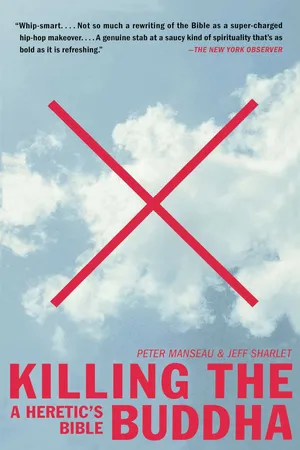
Killing the Buddha
eBook - ePub

Killing the Buddha

A Heretic's Bible

  1. 304 pages
  2. English
  3. ePUB (mobile friendly)
  4. Available on iOS & Android
eBook - ePub

Killing the Buddha

A Heretic's Bible

About this book

"If you meet the Buddha on the road, kill him."
The ninth-century sage Lin Chi gave this advice to one of his monks, admonishing him that this Buddha would only be a reflection of his unexamined beliefs and desires. Peter Manseau and Jeff Sharlet took Lin Chi's advice to heart and set out on a car trip around America, looking for Buddhas along the road and the people who meet them: prophets in G-strings dancing to pay the rent, storm chasers hunting for meaning in devastating tornados, gangbangers inking God on their bodies as protection from bullets, cross-dressing terrorist angels looking for a place to sing.
Along the way Manseau and Sharlet began to wonder what the traditional scripture they encountered everywhere -- in motels, on billboards, up and down the radio dial -- would look like remade for today's world. To find out, they called upon some of today's most intriguing writers to recast books of the Bible by taking them apart, blowing them up with ink and paper.
Rick Moody recasts Jonah as a modern-day gay Jewish man living in Queens. A.L. Kennedy meditates on the absurdity of Genesis. In Samuel, April Reynolds visits a man of tremendous vision in Harlem. Peter Trachtenberg unravels the Gordian logic of Job by way of the Borscht Belt. Haven Kimmel dives into Revelation and comes out in a swoon. Woven through these divine books are Manseau and Sharlet's dispatches from the road, their Psalms of the people.
What emerges from this work of calling is not an attack on any religion, but a many-colored, positively riveting look at the facets of true belief. Together these curious minds tell the strange, funny, sad, and true story of religion in America for the spiritual seeker in all of us: A Heretic's Bible.
Frequently asked questions

Yes, you can cancel anytime from the Subscription tab in your account settings on the Perlego website. Your subscription will stay active until the end of your current billing period. Learn how to cancel your subscription.
No, books cannot be downloaded as external files, such as PDFs, for use outside of Perlego. However, you can download books within the Perlego app for offline reading on mobile or tablet. Learn more here.
Perlego offers two plans: Essential and Complete
  • Essential is ideal for learners and professionals who enjoy exploring a wide range of subjects. Access the Essential Library with 800,000+ trusted titles and best-sellers across business, personal growth, and the humanities. Includes unlimited reading time and Standard Read Aloud voice.
  • Complete: Perfect for advanced learners and researchers needing full, unrestricted access. Unlock 1.4M+ books across hundreds of subjects, including academic and specialized titles. The Complete Plan also includes advanced features like Premium Read Aloud and Research Assistant.
Both plans are available with monthly, semester, or annual billing cycles.
We are an online textbook subscription service, where you can get access to an entire online library for less than the price of a single book per month. With over 1 million books across 1000+ topics, we’ve got you covered! Learn more here.
Look out for the read-aloud symbol on your next book to see if you can listen to it. The read-aloud tool reads text aloud for you, highlighting the text as it is being read. You can pause it, speed it up and slow it down. Learn more here.
Yes! You can use the Perlego app on both iOS or Android devices to read anytime, anywhere — even offline. Perfect for commutes or when you’re on the go.
Please note we cannot support devices running on iOS 13 and Android 7 or earlier. Learn more about using the app.
Yes, you can access Killing the Buddha by Peter Manseau,Jeff Sharlet in PDF and/or ePUB format, as well as other popular books in Theology & Religion & Biblical Commentary. We have over one million books available in our catalogue for you to explore.

Information

Here is the king walking before you.
1 SAMUEL 12:2

Samuel

BY APRIL REYNOLDS
RHETORICALLY pregnant, yet without predicate noun or adjective, I AM…rang out, but no one acknowledged the sound. I AM…. The beginnings of an emaciated, ancient hope battled cranky refrigerators and petite wives afflicted with adenoiditis, and lost. I AM…. Twelve men woke coughing away morning phlegm, unclear in which direction lay the path to glory. For a moment the voice subsided, only to reappear within their dreams, in their place of worship, ruthlessly turning to terror. HE knew no other way. Nightly, these men were pursued by flaming cherubs, a machete-wielding Christ—wooden statues from their church come to life with deadly aim. I AM…I AM…I AM…
None of the twelve deacons rose from bed in a cold sweat, but like women, they woke covered in perspicuous moisture, embarrassed as they reached for Kleenexes to pat themselves dry. There was no need to tell each other about the nightmares. For the deacons, each man’s experience was felt collectively. Each donned his Sunday gloves in the same fashion, all shared an identical aversion to peanuts. Each fucked his wife in the missionary position, each politely demanded that his wife demurely cross her ankles behind his back, as if waiting in a dentist’s office. Each knew the culprit behind his nightmares. No, not themselves—the decisions to put on a production of West Side Story and to hold a canned prune drive were good ones. Who could have foreseen that no one would come to either function? The fault did not lie with them, not these God-fearing men. No, it was the church. The wooden structure in which they worshiped was to blame. There was no mistaking their collective shudder when they stepped through its doors, the revulsion they felt when they walked past the wooden artichoke cornices perched at the edges of each pew. The walls, the partitions, the floors, the sloping double hammer-beamed roof, all made of oak, birch, and pine, were thwarting grander ambitions. Something had to be done.
The Ethiopian United Federated Church of Christ had been founded and built by a group of black lumber foremen, who had not only been woodcarvers by trade but idolized English woodwork. They had dreamed of Devonshire paneling in walnut, but their reverence had been tempered by constant financial constraints, forcing them to use compressed pine shavings for decorative wainscoting. Sprinkled throughout the church were ornament pieces carved from birch, when the thirty foremen would have preferred oak. The Ethiopian was a potpourri of wood, cleverly disguised with shellac. They had used lacquer, penciling the Ascension in high relief along the side paneling to hide the cheapness of some of the wood. The congregation never knew which was which.
Since 1916, the EUFCC had had a constant population of the not-yet-bourgeois. Most parishioners were accountants and secretaries, though none of them could afford to travel during vacation. By the time the last founder died in 1968, the deacons were left with a mahogany pulpit worn glass-smooth at the edges, and eighty-three congregants. Under their tenure the Ethiopian United Federated Church of Christ’s congregation had dwindled to thirty. So it wasn’t just the nightmares filled with statues made of varnished pine, elm, and alder. Visions were something these men could endure. Between the twelve of them, they had served in three American wars, witnessed a score of urban riots, and walked with King—all braved with nary a cry of discomfort. A greater fear loomed. Young mothers now decided to have their children baptized elsewhere; no one darkened their offices for counseling; there hadn’t been a wedding at the Ethiopian in almost six years. Moreover, their small congregation was aging. Most of the collection money was spent on WD-40 for wheelchairs. Two parishioners had died in the past year, and three others were on their last legs. In a few years, there would be no one to attend Sunday services.
So they started looking for a new pastor, a man who might lead new souls to their church. Traveling by train, they tore a wide swath into the South: Washington, D.C., Richmond, Raleigh, and it took until Charleston, South Carolina, for the twelve men to figure out that they should sidestep the larger southern cities altogether. Most of them had as many denominations as New York. Even the towns caused problems. Macon, Georgia, alone had more than three hundred places of worship. Churches like the African Methodist Episcopal Zion, Associated Gospel Churches of Macon, and the Baptist Bible Fellowship had more than five services on Sunday, and each turned away would-be congregants because of lack of space. But the deacons persevered—Sweet Briar, Southern Pines, Bishopville—until they found not quite what they were looking for in a small town inside Lafayette County, Arkansas.
The deacons encountered, preaching to a congregation of 150, one black-as-tar Charlemagne Zephaniah Harpon, known to his parishioners and neighbors as Reverend Carl, conducting church like an emcee at an R & B concert. Slim as a ballet dancer, he mocked gravity, jumping and twirling in front of the pulpit, hovering in the air for what seemed an impossible amount of time. When his feet finally made contact with the ground beneath him, Reverend Carl took off, racing back and forth along the stage, pausing every now and again to deliver percussive footwork—brush, flap, shuffle, cramp, roll. Without a microphone, those not in the front pews could hear only one call, ā€œJeeeeeeeeeeeā€¦ā€
And then the almost desperate response, ā€œCome on, baby. Give me the rest!ā€
ā€œSuuuuuuuuus….ā€
ā€œSock it to me!!!ā€ The twelve stood at the back of the church unable to make out the particulars of the pastor’s sermon because of the cacophonous roar. A seven-year-old boy, shaking a tambourine, leapt into the aisle. Young women and children huddled around the stage, gasping at the pastor’s verticality. It wasn’t just his antics that disturbed the deacons. In their own suppressed fashion, they could appreciate the pastor’s toe dancing. There was something quite beautiful in the way he moved into a ballerina’s first and fourth positions. No, what they found most troublesome was that, without the benefit of language (no one beyond the front three pews could hear a thing), the entire congregation seemed involved in a bacchanalia. Where was the reverence? Why didn’t one soul have a Bible open to read the Scriptures along with the pastor? Not one sleeping child lay hunched over his mother’s lap.
Women who had obviously spent the entire previous night in curlers and under hair dryers needlessly ruined their hairdos, sweating their straightened coiffures back into nappiness. Men they assumed to be as old as themselves were also infected, laughing and crying openly as they slapped their knees. Joy and sorrow, the deacons believed, should not be on such wanton display. From the back of the church the twelve men took it all in, becoming less and less impressed with the soot-colored preacher. But concessions had to be made. They just couldn’t face another night battling a knife-wielding Mary, and time was not on their side.
Up close, they were tempted to call off the entire thing. To begin with, he was short. Really short. As tall as a child just before puberty. With his processed hair, plated gold rings on the thumbs and pinkie fingers, he perched on the edge of his desk, swabbing himself dry with a powder blue towel, dressed in a purple-and-green-plaid polyester suit that not only was a size too small but looked as if someone had lightly dusted the lapels with silver glitter. Twelve men bottled a collective sigh when the Reverend’s tentative smile revealed a gold lateral incisor.
ā€œHello, Reverend,ā€ said one of the twelve. ā€œMy name is Deacon Dan Shannon, and these are my colleagues: Deacon Rueben, Deacon Simon, Deacon Levi, Deacon Judah, Deacon Zebulon, Deacon Issachar, Deacon Gad, Deacon Asher, Deacon Naphtali, Deacon Joseph, and Deacon Benjamin. We are all deacons for the Ethiopian United Federated Church of Christ in New York City.ā€
ā€œWhat can I do you for?ā€ Carl couldn’t help but be impressed as the deacons filed into his office and stood against the wall.
ā€œThat was quite a service, Reverend.ā€
ā€œYou should see me at Easter.ā€
ā€œYes, well, I’m sure that would be quite a sight.ā€ Deacon Dan lapsed into lengthy silence, suddenly unsure where to begin with their proposal. Because of the glitter, the conked hair, the jewelry, they had all failed to recognize the most important aspect of the pastor before them. Carl Harpon was a true believer. His thought and purpose clear: There is none as holy as the Lord: For there is none beside thee: Neither is there any rock like our Lord. All donations were used for the church. He was as poor as most of his congregation and was proud of it. There was a reason why most of his parishioners behaved like zealots. He helped them file their taxes, filled out forms for Section Eight housing and food stamps. Every Sunday, 150 people gathered to pay homage to a man who not only sat down with them for dinner but helped them paint their houses and could unclog a toilet.
ā€œOkay, fellas. I don’t mean to rush you, but I got to pop my head in the Sunday school class. The kids get a real kick out of me coming in with my towel.ā€ But that was said because of his rising unease with the silence, the indistinguishable suits and bow ties. Sons of guns sizing me up, he thought.
ā€œOh, yes, and we wouldn’t want to keep you,ā€ Deacon Dan said, clearing his throat. ā€œAre you married, Reverend?ā€
ā€œNo. No, the Lordā€”ā€
ā€œYes, well, that could be taken care of in short order, couldn’t it?ā€ And before Carl had a chance to answer, Deacon Dan delivered the pitch. The other deacons, on cue, belched out small bouts of laughter around the performance. ā€œWe don’t have frescoes, you understand, but we do have a relief or two that we are quite fond, dare I say, proud of.ā€ But it was the presence of twelve mocha brothers in the same suit that swayed him in a way no other argument they gave could. Twelve. His congregation of 150 had only three deacons and two ushers. Twelve? Their idea of modest was something else in Harlem, he thought as he heard their offer. Least three hundred, I bet. He pressed and pressed, but the deacons wouldn’t give him an exact number, saying only, ā€œWe have a modest congregation in Harlem. But we do have great expectations. With your help, of course.ā€ And Carl leapt at the chance. The deacons were running out of time, but Carl had his own private desires, too.
And yet he should have known something was amiss when he could never tell the deacons apart and thus never got their names right. Every conversation he initiated had to be stopped and corrected before it had a chance to leave the ground. Their eighteenth-century smiles, able to quell even the most suspicious, convinced him to get on the train and settle into the small one-bedroom apartment next to their church. The living room window had been knocked in, the sink ran brown water, but he loved it. A delight he had never experienced overcame him when he realized he could buy lightbulbs, a stick of gum, and a mousetrap all from the same corner store. And more than anything he loved that the Ethiopian United Federated Church of Christ was an all-wooden church in the middle of concrete Harlem. The effort and skill, all in brown hues, inspired him. Some etchings weren’t deep enough to withstand time, a wooden carving of the Last Supper had worn away into an unrecognizable lump, but the engraved, double hammer-beamed roof, along with the mahogany pulpit, hinted at greatness. He sat in the pews at sunset and noticed that from the lone window in the church, sunlight refracted in such a way that in the large wooden relief of the Virgin and Child, Mary’s praying hands shaded baby Jesus’ face. None of the deacons had observed this carpenter’s feat.
ā€œBunch of black guys got together and did this?ā€
Their contemptuous smiles weren’t directed at Carl. ā€œYes, Reverend.ā€
ā€œI can’t wait to see the folks who praise the Lord here. Can’t wait.ā€
During his first Sunday service Carl realized they had lied. A congregation of sixty was modest, not twenty-seven (three congregants had died while they searched for the new pastor), fifteen of whom who would be dead in less than three years from old age. Twenty-seven people, including the twelve deacons, and a six-hundred-dollar church endowment. From the vantage point of the pulpit, there didn’t seem to be a cousin, out-of-town guest, or even a wayward teenager who needed to be punished for being caught with a joint among them. Just a recent widow and octogenarian couples who shared oxygen tanks. Afterward, when Carl asked if any of the flock had grandchildren, the deacons shrugged with embarrassment and admitted they didn’t know.
Carl set to work, bringing southern savvy to the Ethiopian and performing the Herculean task of leading the sheep back into the EUFCC fold. ā€œPut your pride in your pocket,ā€ he told the deacons. ā€œI want each and every one of us to go and sign up for food stamps.ā€ They were scandalized when Carl used the vouchers to buy breakfast muffins and coffee for the morning commuters who walked by the church. ā€œLet me fill your stomach now, and come by on Sunday so I can fill your soul.ā€ For four months while pouring coffee, Carl learned who had a hard time keeping up with their rent, how many women had children out of wedlock, and who was able to keep a steady job. And they liked him, not simply because he showed an interest in their lives and remembered their squabbles but also because he seemed to be as poor as they were. Every day he stood behind his long cardboard table in some outlandish suit, in dire need of a shave, without shame.
Still the community resisted. Each Sunday, Reverend Carl preached to the same twenty-seven members. The mild pleasure the neighborhood experienced when morning after morning this new pastor remembered how each of them took their coffee didn’t scour away what they felt about the deacons. Cold men, cold, uppity men whose sole purpose seemed ...

Table of contents

  1. Cover
  2. Colophon
  3. Title Page
  4. Copyright
  5. Epigraph
  6. Contents
  7. Mortal, Eat This Scroll!
  8. Genesis
  9. Exodus
  10. Leviticus
  11. Ruth
  12. Samuel
  13. Job
  14. Song of Songs
  15. Isaiah
  16. Ezekiel
  17. Daniel
  18. Jonah
  19. Gospel
  20. Revelation
  21. New York, New York
  22. Poolesville, Maryland
  23. Henderson, North Carolina
  24. Myrtle Beach, South Carolina
  25. Broward Country, Florida
  26. An Orange Grove, Somewhere in Florida
  27. Nashville, Tennessee
  28. Mount Vernon, Texas
  29. Crestone, Colorado
  30. Ease L.A., California
  31. Unincorporated Territory, Oklahoma
  32. Heartland, Kansas
  33. Geneva, Illinois
  34. Acknowledgements
  35. Contributors
  36. About the Authors