- 304 pages
- English
- ePUB (mobile friendly)
- Available on iOS & Android
eBook - ePub
About this book
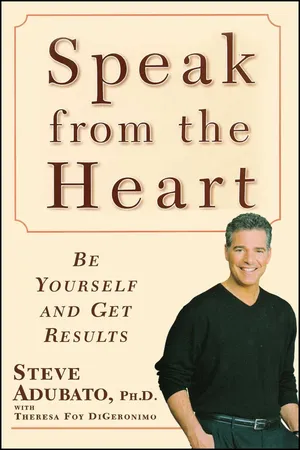
In Speak from the Heart, Emmy Award-winning broadcaster, newspaper columnist, and motivational speaker Steve Adubato reveals the secrets to being a great communicator -- with a program that will dramatically change the way you talk, listen, and connect with others.
Steve Adubato's life experiences, both professional and as a husband, son, brother, and father, have taught him invaluable lessons about the power of personal, sincere communication. In Speak from the Heart, he demonstrates that being a truly great communicator is not simply about being articulate or being a "good talker." It is not about fancy visuals and PowerPoint presentations, or hard-core sales pitches, or even who has the most facts, figures, and technical wizardry. What really counts is making an authentic connection with other people that comes not merely from the intellect but from the heart.
If you want to make a lasting impact, Dr. Adubato shows you how to engage people through empathy and understanding, how to be a great listener, and how to make an audience -- whether one, one hundred, or one thousand people -- care about you and your message. He helps you to rely less on written speeches, teleprompters, and index cards full of too much forgettable information, and learn, instead, how to tell a compelling story and create excitement and enthusiasm. You will learn, for example, how to:
Speak from the Heart will not only make it easier for you to communicate your message without being ignored or misunderstood; it will also improve your relationships with other people and help you to become more productive at work -- with more satisfaction and less stress.
Written by a man who has trained thousands of professionals in all walks of life, including corporate managers, lawyers, educators, health professionals, salespeople, and customer service reps, Speak from the Heart is for anyone who interacts with others at work, at home, in the community, or at social functions.
Steve Adubato's life experiences, both professional and as a husband, son, brother, and father, have taught him invaluable lessons about the power of personal, sincere communication. In Speak from the Heart, he demonstrates that being a truly great communicator is not simply about being articulate or being a "good talker." It is not about fancy visuals and PowerPoint presentations, or hard-core sales pitches, or even who has the most facts, figures, and technical wizardry. What really counts is making an authentic connection with other people that comes not merely from the intellect but from the heart.
If you want to make a lasting impact, Dr. Adubato shows you how to engage people through empathy and understanding, how to be a great listener, and how to make an audience -- whether one, one hundred, or one thousand people -- care about you and your message. He helps you to rely less on written speeches, teleprompters, and index cards full of too much forgettable information, and learn, instead, how to tell a compelling story and create excitement and enthusiasm. You will learn, for example, how to:
- Lecture less and engage more
- Communicate under pressure
- Make effective use of eye contact
- Develop a conversational style
- Inspire in a human, personal way
- Become comfortable with your core message
Speak from the Heart will not only make it easier for you to communicate your message without being ignored or misunderstood; it will also improve your relationships with other people and help you to become more productive at work -- with more satisfaction and less stress.
Written by a man who has trained thousands of professionals in all walks of life, including corporate managers, lawyers, educators, health professionals, salespeople, and customer service reps, Speak from the Heart is for anyone who interacts with others at work, at home, in the community, or at social functions.
Frequently asked questions
Yes, you can cancel anytime from the Subscription tab in your account settings on the Perlego website. Your subscription will stay active until the end of your current billing period. Learn how to cancel your subscription.
No, books cannot be downloaded as external files, such as PDFs, for use outside of Perlego. However, you can download books within the Perlego app for offline reading on mobile or tablet. Learn more here.
Perlego offers two plans: Essential and Complete
- Essential is ideal for learners and professionals who enjoy exploring a wide range of subjects. Access the Essential Library with 800,000+ trusted titles and best-sellers across business, personal growth, and the humanities. Includes unlimited reading time and Standard Read Aloud voice.
- Complete: Perfect for advanced learners and researchers needing full, unrestricted access. Unlock 1.4M+ books across hundreds of subjects, including academic and specialized titles. The Complete Plan also includes advanced features like Premium Read Aloud and Research Assistant.
We are an online textbook subscription service, where you can get access to an entire online library for less than the price of a single book per month. With over 1 million books across 1000+ topics, weâve got you covered! Learn more here.
Look out for the read-aloud symbol on your next book to see if you can listen to it. The read-aloud tool reads text aloud for you, highlighting the text as it is being read. You can pause it, speed it up and slow it down. Learn more here.
Yes! You can use the Perlego app on both iOS or Android devices to read anytime, anywhere â even offline. Perfect for commutes or when youâre on the go.
Please note we cannot support devices running on iOS 13 and Android 7 or earlier. Learn more about using the app.
Yes, you can access Speak from the Heart by Steve Adubato,Theresa Foy DiGeronimo in PDF and/or ePUB format, as well as other popular books in Personal Development & Business General. We have over one million books available in our catalogue for you to explore.
Information
1
The Personal Touch
The Personal Touch
Would you rather listen to someone with a monotone voice who awkwardly reads from a written speech or to someone who communicates with passion, conviction, and feeling? The answer seems so obvious itâs hardly worth mentioning, never mind writing a book about, but if youâve recently attended a conference, convention, awards dinner, graduation, business or political meeting, or even a wedding, you know that, unfortunately, it is rare to come across someone who knows how to put aside the written speech and simply have a conversation that comes from the heart. No doubt youâve heard presenters drone on as they read carefully prepared words off a piece of paper. Youâve seen them lose their place and stumble to recover their thoughts. Youâve seen the slide projector or Power-Point equipment break down, the audio fall out of sync with the visuals. Youâve listened to statistics and youâve looked at charts and graphs without hearing or seeing them in any meaningful way. How did you respond to these speakers? Iâll bet many of you have dozed off occasionally or at the very least tuned out the speaker to take a short mental vacation in which you plan what youâll have for dinner and what youâll do on the weekend. You may even have walked outâI know I have. These experiences can make you nervous about giving your own presentation because they show you firsthand how easy it is to lose an audience.
Have you ever tried to figure out why itâs so hard to keep an audience (or even one other person) interested in what you say? If you stand back and objectively view any presentation, you can quite easily see how things go so wrong. The world of business and most professional situations are dominated by people speaking from every place other than their authentic self. Somewhere along the way they have come to believe that if they inundate people with enough facts, figures, stats, charts, and graphs their message will be too compelling, the logic too indisputable, to ignore.
I remember waiting my turn to give a speech at a business conference in New York City. The five people before me gave extremely well rehearsed PowerPoint presentations. The lights were down; the bells and whistles were going off; the speakers were clicking their slides along in perfect synchronization one to the next. After an hour or so of this, it was my turn. I got up and said, âI have to apologize for not coming prepared with a Power-Point presentation for you.â The audience cheered, applauding wildly. They were thrilled that someone was going to turn on the lights, look at their faces, and talk with them rather than at them. My presentation focused on communication competence and connecting with people in a low-tech, conversational way. I spoke what I believed. I tried to talk with conviction from a place rooted in strong feelings. I told them about the mistakes Iâve made as a communicator and the ways I was trying to improve. I used real-life examples and anecdotes to support and explain my main point. I told them about my own communication challenge of trying to become a better listener. The audience stayed with me; they asked good questions; I asked them questions; we were engaging each other. No one, that I could see, dozed off. The âmagicâ in that style of communicating compared to the others was simply this: my effort to make a personal connection with the audience.
I certainly donât own the patent on this idea. There have been far more powerful speakers since the beginning of humankind who, with mere words, could inspire people to move mountains. Considergreat communicators like Jesus or Gandhi, who through their powerful lessons about the nature of right and wrong moved people to change their lives. Consider Dr. Martin Luther King, Jr., who changed the course of history with his forceful words of conviction. (Can you imagine Dr. King giving his âI Have a Dreamâ speech in PowerPoint?)
Unfortunately, the ability to touch people with words is becoming a lost art. In an age in which we are overwhelmed with information, data, and technical wizardry, our society is hungry for people to speak to us in a human, personal way. Thatâs exactly why Oprah Winfrey is so successful. Every day she communicates a sense of genuine caring by empathizing with her guests and audience. Her tremendous skill as a communicator allows her to engage in a personal heart-to-heart conversation with them. She is living proof that audiences are quick to appreciate the spoken word that is not written by a professional speechwriter or advertising jargon master, that is not dependent on the bells and whistles of high-tech, audiovisual support, and that is not crafted to sound good in a fifteen-second media sound bite.
I recently experienced this effect as a member of the audience myself at my sonâs graduation from second grade (no caps and gowns here, but our educational system now moves him into a middle school). I sat back at this graduation ceremony expecting the usual little speeches that say, âWeâre so proud of your children. . . . They have all worked so hard. . . . We will miss them and wish them good luck.â But I was soon surprised. Judith Conk, the superintendent of the school system, touched each one of the several hundred parents that day in a way none of us will soon forget. She told us that her own children were in their twenties and that she sometimes has a hard time remembering what each one was like in the second grade. She then asked us to take a moment to look at our children on the stageânot through the lens of a video camera, but from our deepest selvesâand to burn that picture into our memory so that when the years flew by, we would always have that mental pictureto cherish. She spoke to us without notes in a very personal, human way. Although I no longer recall the other speeches given that day, her words are forever etched in my memory.
Not all speakers know how to do thisâor are even willing to try. During that same week, I watched a political candidate who had just won a hotly contested primary election for major public office illustrate a more common and flawed style of speech making. As he read his carefully prepared acceptance speech, he kept losing his place when the audience interrupted him with applause. He would then fumble along searching frantically for his next words. He had no idea what he really wanted to say to these thousands of enthusiastic supporters. He didnât realize that they didnât want to hear a âcannedâ speechâthey simply wanted him to look into their eyes and tell them how he felt at this very special moment. He failed to capitalize on the opportunity that their enthusiasm offered to really connect and create a memorable and meaningful exchange.
Iâll wager that not one of the millions who heard the candidateâs speech live and on TV could tell me today a single detail of that message, but that not one parent will ever forget the message he or she received from Judith Conk at that graduation.
Making the Connection
In addition to the many dreary speeches Iâve had to sit through, Iâve also listened to many exceptionally good ones. In all my experience, no one that I know of reaches an audience better than General Colin Powell. This top military man, who has lived most of his life in a world dictated by strict rules and procedures, has mastered as well as anyone the ability to talk to people in a caring and empathic way. Iâve seen him do this on several occasions, but the speech that stands out in my mind is a presentation he gave as chairman of the Joint Chiefs of Staff to a gathering of army nurses at the groundbreaking for the Vietnam Womenâs Memorial.
In analyzing how he prepared for this critically important speech that brought his audience first to tears and then to their feet with cheers, General Powell says, âThere were a lot of things I wanted to say to these women, but most of all I wanted them to know how important they were to our country. And I wanted to make a personal, human connection. My speechwriters gave me some ideas, but they didnât seem to capture the essence of what I feltâwhich is understandable because theyâre not me. I had to ask myself how I really felt about these women and about the way the United States military had treated them in the past. I read some books, some memoirs, that nurses had written about the feelings and emotions they had bottled up for so many years after the Vietnam War. And I read some of their poems and I was deeply moved by what these women had gone through. This helped me understand what I wanted to say to them, but it was still a very difficult speech for me to write and to deliver.â
General Powell did this preparatory research, not to pile on the data, statistics, and facts, but because he wanted to feel a sense of empathy with the nursesâ point of view on a personal level. âI saw combat every now and again,â he said, âbut the nurses saw the consequences of combat every single day as these youngsters were brought in, broken and shot, wounded. And they had to comfort them. They were those moms and sisters and aunts and loved ones and wives in the last few moments of the lives of these young people. And we had not properly recognized that or adequately acknowledged the contribution that women and especially the nurses have made, not just in the Vietnam War but throughout our nationâs history in combat.â
The result of these personal insights gave General Powell the body of a speech that did not follow the expected military line. He did not go to that groundbreaking to take the easy way out by saying something like: âWe thank you for your contribution. You should be proud of all you have done. Blah, blah, blah.â He brought with him that day honest words filled with personal perspective,emotion, and candor. Here is a short excerpt from this extremely personal and human interaction. It is a classic example of a speaker establishing a true connection with his audience:
âHow much of your heart did you leave there? How often were you the mother for a kid asking for Mom in the last few seconds of his life? How many nineteen-year-old sons did you lose? I didnât realize, although I should have, what a burden you carried. I didnât realize how much your sacrifice equaled and even exceeded that of the men. I didnât realize how much we owed to you then and how much we should have thanked you and recognized you and comforted you since then.â
It doesnât get better than that.
Do It Now
To speak like General Powell does not mean talking off the cuff or discounting the value of the intellect ...
Table of contents
- Cover
- Praise
- Colophon
- Title Page
- Copyright
- Dedication
- Introduction
- Communicating with Passion
- 1: The Personal Touch
- 2: Lecture Less; Engage More
- 3: Communicating Under Pressure
- Talking Without Speaking
- 4: Body Language Speaks Volumes
- 5: The Power of First Impressions
- 6: The Eyes Have It
- Listen Up
- 7: Gaining an Edge with Effective Listening Habits
- 8: Active Listening: "Enough About Me, Let's Talk About You"
- The Art of Conversation
- 9: Small Talk Pays Big Dividends
- 10: The How-To of Conversation
- 11: Offer the Gift of Self-Disclosure
- Public Speaking
- 12: Why We'd Rather Be in the Coffin Than Give the Eulogy
- 13: Have a Game Plan
- Leadership Through Communication
- 14: The LeadershipâCommunication Connection
- 15: Teamwork in Action
- Technology and Communication
- 16: Communicating in a High-Tech World
- 17: Customer Service: The Human Touch
- Gender Talk
- 18: What Men Must Learn About Communication
- 19: What Women Already Know
- Know Yourself
- 20: You are the Message
- Acknowledgments
- Index