President Nixon
eBook - ePub

President Nixon

Alone in the White House

  1. 704 pages
  2. English
  3. ePUB (mobile friendly)
  4. Available on iOS & Android
eBook - ePub

President Nixon

Alone in the White House

About this book

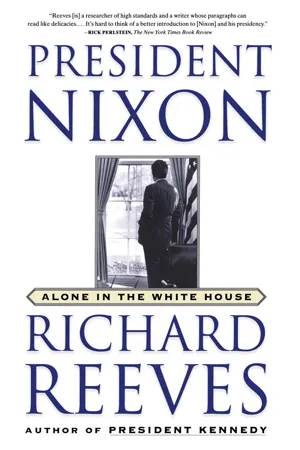
Who was Richard Nixon? The most amazing thing about the man was not what he did as president, but that he became president. In President Nixon, Richard Reeves has used thousands of new interviews and recently discovered or declassified documents and tapes -- including Nixon's tortured memos to himself and unpublished sections of H. R. Haldeman's diaries -- to offer a nuanced and surprising portrait of the brilliant and contradictory man alone in the White House.
President Nixon is a startling narrative of a desperately introverted man who dreamed of becoming the architect of his times. Late at night, he sat upstairs in the White House writing notes to himself on his yellow pads, struggling to define himself and his goals: "Compassionate, Bold, New, Courageous...Zest for the job (not lonely but awesome). Goals -- reorganized govt...Each day a chance to do something memorable for someone. Need to be good to do good...Need for joy, serenity, confidence, inspiration."
But downstairs he was building a house of deception. He could trust no one because in his isolation he thought other people were like him. He governed by secret orders and false records, memorizing scripts for public appearances and even for one-on-one meetings with his own staff and cabinet. His principal assistants, Haldeman and Henry Kissinger, spied on him as he spied on them, while cabinet members, generals, and admirals spied on all of them -- rifling briefcases and desks, tapping each other's phones in a house where no one knew what was true anymore.
Nixon's first aim was to restore order in an America at war with itself over Vietnam. But in fact he prolonged the fighting there, lying systematically about what was happening both in the field and in the peace negotiations. He startled the world by going to communist China and seeking dĂŠtente with the Soviet Union -- and then secretly persuaded Mao and Brezhnev to lie for him to protect petty White House secrets. Still, he was a man of vision, imagining a new world order, trying to stall the deadly race war he believed was inevitable between the West, including Russia, and Asia, led by China and Japan. At home, he promised welfare reform, revenue sharing, drug programs, and environmental protection, and he presided, reluctantly, over the desegregation of public schools -- all the while declaring that domestic governance was just building outhouses in Peoria.
Reeves shows a presidency doomed from the start. It begins with Nixon and Kissinger using the CIA to cover up a 1969 murder by American soldiers in Vietnam that led to the theft and publication of the Pentagon Papers, then to secret counterintelligence units in the White House and finally to the burglaries and cover-up that came to be known as Watergate.
Richard Reeves's President Nixon will stand as the authoritative account of Nixon in the White House. It is an astonishing story.
Frequently asked questions

Yes, you can cancel anytime from the Subscription tab in your account settings on the Perlego website. Your subscription will stay active until the end of your current billing period. Learn how to cancel your subscription.
No, books cannot be downloaded as external files, such as PDFs, for use outside of Perlego. However, you can download books within the Perlego app for offline reading on mobile or tablet. Learn more here.
Perlego offers two plans: Essential and Complete
  • Essential is ideal for learners and professionals who enjoy exploring a wide range of subjects. Access the Essential Library with 800,000+ trusted titles and best-sellers across business, personal growth, and the humanities. Includes unlimited reading time and Standard Read Aloud voice.
  • Complete: Perfect for advanced learners and researchers needing full, unrestricted access. Unlock 1.4M+ books across hundreds of subjects, including academic and specialized titles. The Complete Plan also includes advanced features like Premium Read Aloud and Research Assistant.
Both plans are available with monthly, semester, or annual billing cycles.
We are an online textbook subscription service, where you can get access to an entire online library for less than the price of a single book per month. With over 1 million books across 1000+ topics, we’ve got you covered! Learn more here.
Look out for the read-aloud symbol on your next book to see if you can listen to it. The read-aloud tool reads text aloud for you, highlighting the text as it is being read. You can pause it, speed it up and slow it down. Learn more here.
Yes! You can use the Perlego app on both iOS or Android devices to read anytime, anywhere — even offline. Perfect for commutes or when you’re on the go.
Please note we cannot support devices running on iOS 13 and Android 7 or earlier. Learn more about using the app.
Yes, you can access President Nixon by Richard Reeves in PDF and/or ePUB format, as well as other popular books in Politics & International Relations & Political Biographies. We have over one million books available in our catalogue for you to explore.

CHAPTER 1
image

January 21, 1969

RICHARD M. NIXON arrived at the White House just before 2 P.M. on January 20, 1969, a couple of hours after taking the oath as the thirty-seventh president of the United States. His first question, to his chief of staff, H. R. Haldeman, was: “Is the dog there?”
The dog, an Irish setter, was a gift from the staff. It was a big, photogenic, presidential dog to go with the Nixons’ French poodle, Vickie, and a Yorkshire terrier named Pasha. All three were included in a Nixon-directed campaign to project himself as a warm man. The new president put it this way in a memo to Haldeman: “I would like for you to give me a full report on how adequately the records are being kept on the various meetings in which I participate. I am referring now not to the formal record requiring and noting decisions, but the account of conversations, background, color, etc.”
“He was like a little kid,” Haldeman recorded in his diary that night. Of the Inaugural itself, he recorded: “Expression on his face was unforgettable, this was the time! He had arrived, he was in full command, someone said he felt he saw rays coming from his eyes.”
On his first full day as President, Nixon came down to his office at 7:30 in the morning after four hours of sleep. The schedule for the day was in a brown leather loose-leaf folder placed in the center of the great oak Wilson desk. The first formal appointment was written in for 7:50, a meeting with his national security adviser, Henry Kissinger.
The timing of their first conversation that day was symbolic of the new framework of foreign policy decision making the two men had, crafted in the eleven weeks since the election. The key was National Security Decision Memo 2, issued during the inaugural parade the day before, eliminating a State Department-dominated committee called the Senior Interdepartmental Group. The function of SIG had been to review foreign policy options presented to the National Security Council—and thus to the President—and to act as the “executive agent” for national security decisions. Under NSDM 2 the NSC would prepare options and also execute decisions, the plain signal that the new president intended to centralize power in his office. So from day one there was a new architecture of decision; Nixon intended to use the former Harvard professor as his agent in foreign and security policy. The power of final decision had shifted to an odd couple, both of them secretive and suspicious by nature, both of them ready and anxious to isolate the old foreign policy establishment, symbolized by the cautious men and rituals of the State Department.
Nixon told Kissinger about the desk and said he admired Woodrow Wilson as a man of both thought and action, which was also the way he saw himself. Nixon had used the desk when he was vice president, from 1953 to 1961. Since then it had traveled to Texas. Nixon’s predecessor, Lyndon B. Johnson, had taken it away to his LBJ Ranch office. Now it was back and it was almost bare, with an in-box in one corner and a four-button telephone more than six feet away on another.
The place was simpler than it had been during the LBJ years; Nixon had told his men to get rid of Johnson’s forty-two-button phone, the three television monitors, the wires that had led to the system Johnson used to tape-record both telephone calls and conversations, and the speakers Johnson had used to listen to the daily briefing and questioning of his press secretary. Nixon was not much interested in listening to what reporters had on their minds.
“Where’s the news summary?” he asked Haldeman that first morning.
There was none. During the campaign and the transition, a small staff headed by the President’s political valet, Patrick Buchanan, a thirty-year-old former editorial writer for the St. Louis Globe-Democrat, had prepared a daily digest of the news in six newspapers and the three television networks. The first White House news summary, in a gold-imprinted blue leather loose-leaf book, was on the big desk the next morning. Only five other copies were made—two filed away for the record, one for Haldeman, one for Ehrlichman, and one for Kissinger. The top item that first day was a local story: crime in the President’s new neighborhood. The Washington Daily News, in a front-page editorial, said fear was stalking the streets of the capital city.The New York Times that day said: “President Nixon awoke this morning in a city where during the last week an 81-year-old District of Columbia ‘mother of the year’ was mugged and thrown down a flight of stairs in a pocketbook snatching; Mrs. Gwen Cafritz, a well known society matron, was the victim of a $250,000 armed robbery….”
The President scrawled his reactions across the pages, beginning with: “John Mitchell & John Ehrlichman. Let’s get going with announcement in 48 hours of some action…. We are going to make a major effort to reduce crime in nation—starting with D.C.!! RN.”
The next item was a Washington Star editorial denouncing demonstrators who threw curses and beer cans at the Nixons’ car during the Inaugural parade; it ended: “Despite the presence of police, National Guardsmen and paratroopers, the hoodlums shouted obscenities and made obscene gestures towards the President and Mrs. Nixon. At that point, it appears, there were no arrests….”
Nixon wrote: “Why not? I think an opportunity was missed—when people would have supported strong action … give me a report how it got screwed up.” He also preserved his record as an obsessive minder of details, all the while complaining that he had no time to think. On that first day he dictated word-for-word texts for letters to be sent to people involved in the Inaugural parade and celebrations:
One of our difficulties in the past is that our thank-you notes have been bogged down because of lack of staff and go out two or three weeks, if not a month later. We will be held to a different standard now, and I want these to get out in 48 hours since we have enough staff to do it. I am going to give a little guidance with regards to the form in the dictation now. To the Ministers: something like this:… Dear :_____: I want to express my deep appreciation to you for participating in the _____ (whatever the morning prayer thing was). The problems facing the United States and the world are so serious that we shall all need Divine Guidance if we are adequately to meet the challenge….
He also dictated a memo to his wife:
TO: Mrs. Nixon
FROM: The President
… With regard to RN’s room, what would be most desirable is an end table like the one on the right side of the bed which will accommodate TWO dictaphones as well as a telephone…. In addition, he needs a bigger table on which he can work at night. The table which is presently in the room does not allow enough room for him to get his knees under it.
At 6 P.M. the first day, Nixon and Haldeman crossed the small alley between the White House and the old Executive Office Building to look for a hideaway office in that ornate, hulking gray building built as War Department headquarters in 1888. The President chose EOB 175 for what he called “brainwork”—time alone with his thoughts and his yellow pads. “I must build a wall around me,” he told his most important assistant, the forty-two-year-old advertising executive he and everyone else called Bob. Haldeman’s job was to be the face and voice and muscle of Richard Nixon inside the White House. The President wanted to be alone—and being with Haldeman was, in effect, being alone. The chief of staff’s most important job was taking notes during presidential dialogues and monologues, then dictating Nixon’s thoughts and orders as “action memos” that ricocheted around the building, then around the government.
Nixon liked to be alone—an odd preference for an American politician. But his role model as a national leader was not an American, it was President Charles de Gaulle of France. For years, in political exile, Nixon had compared his fate and his destiny to de Gaulle’s after the general stepped down as president of France in 1946. Reading de Gaulle’s memoir The Edge of the Sword, Nixon had underlined this sentence: “Great men of action have without exception possessed in a very high degree the faculty of withdrawing into themselves.”
He was obsessed with solitude, with the use of his own time, writing, “Time is a person’s most important possession. How he makes use of it will determine whether he will fail or succeed in whatever he is undertaking.” The night was good to Nixon. Sleep was an enemy, or a drug that lesser men used to avoid facing crises. Or so he told his men during periodic monologues on the subject, which often turned into action memos, like this one to a speechwriter, William Safire, with Nixon referring to himself in the third person, just before his Inaugural: “It has been suggested to me that we capitalize upon the work habits of the President-elect: long hours of work, delayed dinners, eighteen-hour days, late reading, no naps, perfunctory and very short lunch and breakfast times (frequently five or ten minutes).”
Only the part about quick meals was true. His men, particularly Haldeman—who had been with Nixon on and off for eight years, beginning as an advance man in his first campaign for the presidency—knew that fatigue was Nixon’s real enemy; he could not focus for more than three or four hours at a time. He took naps and came back to work for a couple of hours more. But the naps were a secret, usually marked “staff time” on his daily schedules. Part of Haldeman’s job, as he saw it, was to protect Nixon from himself. When the President got too tired, he could not sleep; he might take pills or a drink or two—he had trouble with liquor, sometimes slurring his words after only a single drink—and then be unable to concentrate the next day. But Nixon would never admit that, even to himself. He was a man of will, who sometimes persuaded himself that normal human limits were symbols of weakness. Sleep, and vacations, too, he considered a waste of time—or so he said. In fact, he needed EOB 175 for naps as well as brainwork. The hideaway office was a two-room suite without a reception area. He rarely saw anyone there, except for Haldeman; John Ehrlichman, who was a domestic counselor; and Henry Kissinger. The blinds were drawn. Usually the President sat in an old brown velvet easy chair he had brought from the study of the Fifth Avenue apartment he owned from 1963 to 1968, his years as a New York lawyer.
Most of the time, Nixon curled in the chair with his feet up on the settee. No one ever saw him there with his jacket off. Only a select few, Stephen Bull among them, ever saw him with his reading glasses on, or smoking one of his pipes, or sitting with a drink—a martini. One of his assistants, Alexander Butterfield, who spent a great deal of time running presidential errands, told other staffers who rarely saw Nixon that not only had he never seen the jacket off, he had never seen the boss there with the jacket unbuttoned.
On January 23, the White House news summary which included fifteen pages summarizing network television reports from the night before, was prepared by Buchanan and an assistant named Tom Charles Huston, who had been president of a conservative group, Young Americans for Freedom. It began with a report on a U.S. Navy court of inquiry into the seizure of the USS Pueblo, a spy ship that had been intercepting radio signals off the coast of North Korea. “Bucher comes off a decent and honorable officer,” Buchanan and Huston wrote of the ship’s captain. “All three networks reflected sympathetically on Bucher and adversely on the Navy.” Nixon underlined those words, then scrawled: “To Laird. RN agrees—Don’t let Navy make a fool of itself.”*
That was the first “action memo.” The President wanted his marginalia translated into Haldeman memos to the rest of the staff, usually ordering them to have an answer or explanation within twenty-four hours. The second action memo was written beside an account of French students occupying offices at the Sorbonne in Paris and of youthful demonstrators in the streets of several cities around the world—including Tokyo, Cologne, Nairobi, and Dacca—at the same time American students were demonstrating or running wild at dozens of campuses, including San Francisco State, the University of Massachusetts, Penn State, Rice, and Howard. The President wrote: “K—I want to hear a C.I.A. analysis in depth of worldwide common factors of youth disturbances.”
At nine o’clock most mornings Nixon buzzed for Haldeman, and a half hour after that for Kissinger, and those conversations, with Haldeman taking notes on yellow legal pads, would produce a second flurry of notes from on high. Within only a couple of days, members of the staff and the Cabinet began to suspect that “the Boss,” as some called Nixon, intended to meet alone with very few of them, maybe only four: Haldeman and Ehrlichman with their yellow pads, Kissinger with his thick, overwritten briefing books, and Rose Mary Woods.
They were right. The Boss had already told Haldeman that his job was to keep other people away from his two offices. Haldeman memos were the President’s preferred medium of communication. The chief of staff was to do the things Nixon disliked: confronting, criticizing, and disciplining. Haldeman would do the firing and the insulting—and if anyone wanted to actually see the President he had to see Haldeman first. “RN,” as Nixon called himself on paper and often in conversation, sketched out a schedule that might include only a single large meeting in his “public hours,” generally from 10 A.M. to 5 P.M., with a couple of hours set aside for his five-minute lunch, almost always alone, almost always cottage cheese—flown in every week from Knudsen’s Dairy in Los Angeles—and a canned pineapple ring. Then came brainwork or a nap in the solitude of EOB 175.
The meeting of the day on January 23 was the first coming together of the Urban Affairs Council, which the President created as a vague domestic shadow of the National Security Council. The official record of the meeting began with the President signing an executive order creating the new entity and included this: “There was a very exciting atmosphere as the President … spoke of the need for innovation and for exercising judgment ‘I’d like to see more decisions made by the responsible men. John Quincy Adams and Grover Cleveland read every bill and almost killed themselves. You won’t build big men down the line unless you give them responsibility.’” Then Nixon introduced the director of the council, a stranger, Daniel Patrick Moynihan—a New Yorker, a Catholic, a Kennedy Democrat, and a Harvard professor. Moynihan, who was forty-one years old, was set up as a rival to Arthur F. Burns, a sixty-four-year-old Columbia University economist and old friend, who had run a domestic policy task force during the transition and expected to run domestic policy. The meeting minutes indicated that Burns had tried to put Moynihan on the spot and failed: “Dr. Burns and the Vice President asked if Dr. Moynihan could prepare some outline of a national urban policy, and the President agreed. Dr. Moynihan said that ‘I would be glad to undertake such a task, on the condition that—and I realize that one does not ordinarily impose conditions on the President of the United States—on the condition that no one take it seriously.’ Everyone roared, including the President, who first blinked, and then joined in the laughter.”
The next day, January 24, it was the first meeting of a new Cabinet Committee on Economic Policy, a meeting held up for almost a half hour while John Ehrlichman calmly wrote out an executive order creating the thing as Nixon paced restlessly back and forth. The President was ready to get on with it, but in his White House procedure was by the book. Haldeman’s book. The Urban Affairs Council had an executive order, so the economic group would have one, too. The new chairman of the Council of Economic Advisers was Paul McCracken, plucked from the conservative School of Economics at the University of Chicago. He was getting ready for his first testimony before the Joint Economic Committee of the Congress, and the President quickly suggested that he work with Safire, a forty-year-old New York public relations man, an old Nixon hand on the speechwriting staff. Safire took the President’s suggestion as a signal that he was to make sure McCracken did not spend much time on praise of economic growth under two Democratic presidents, John F. Kennedy and Lyndon B. Johnson—particularly given Nixon’s campaign criticism of the Kennedy-Johnson economic record.
McCracken said that the economy was currently growing at a healthy 3.5 percent, and would probably go up to 4.5 percent.
“Why?” asked Nixon.
“The bulge in the birthrate after World War II now going into the labor force means a big demand for capital,” the economist answered. “The plateau of 1.5 million housing starts has been par for the course for years. This year it should be 1.7 million, and more by 1970. And housing takes a lot of money…. The Nixon years ought to be years of extremely rapid...

Table of contents

  1. Cover Page
  2. Title Page
  3. Dedication
  4. Copyright Page
  5. Contents
  6. Introduction
  7. Prologue: August 9, 1974
  8. 1 January 21, 1969
  9. 2 February 23, 1969
  10. 3 March 17, 1969
  11. 4 April 15, 1969
  12. 5 June 19, 1969
  13. 6 July 20, 1969
  14. 7 August 8, 1969
  15. 8 October 15, 1969
  16. 9 December 8, 1969
  17. 10 January 22, 1970
  18. 11 April 8, 1970
  19. 12 April 30, 1970
  20. 13 May 4, 1970
  21. 14 June 30, 1970
  22. 15 September 23, 1970
  23. 16 November 3, 1970
  24. 17 December 31, 1970
  25. 18 March 29, 1971
  26. 19 June 12, 1971
  27. 20 June 30, 1971
  28. 21 August 12, 1971
  29. 22 August 15, 1971
  30. 23 September 8, 1971
  31. 24 October 21, 1971
  32. 25 December 16, 1971
  33. 26 January 2, 1972
  34. 27 January 25, 1972
  35. 28 February 22, 1972
  36. 29 April 7, 1972
  37. 30 May 1, 1972
  38. 31 May 15, 1972
  39. 32 June 17, 1972
  40. 33 June 23, 1972
  41. 34 August 22, 1972
  42. 35 November 7, 1972
  43. 36 December 19, 1972
  44. 37 January 23, 1973
  45. 38 March 23, 1973
  46. 39 April 30, 1973
  47. Epilogue
  48. Notes
  49. Bibliographic Essay
  50. Acknowledgments
  51. Index
  52. Photo Credits
  53. About the Author
  54. Insert