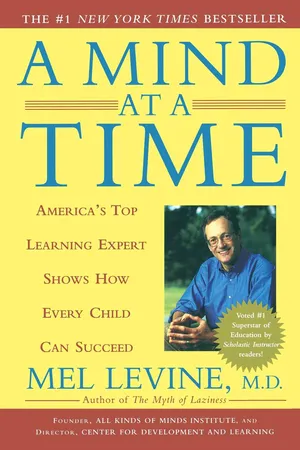
"Different minds learn differently, " writes Dr. Mel Levine, one of the best-known education experts and pediatricians in America today. And that's a problem for many children, because most schools still cling to a one-size-fits-all education philosophy. As a result, these children struggle because their learning patterns don't fit the schools they are in.
In A Mind at a Time, Dr. Levine shows parents and others who care for children how to identify these individual learning patterns. He explains how parents and teachers can encourage a child's strengths and bypass the child's weaknesses. This type of teaching produces satisfaction and achievement instead of frustration and failure.
Different brains are differently wired, Dr. Levine explains. There are eight fundamental systems, or components, of learning that draw on a variety of neurodevelopmental capacities. Some students are strong in certain areas and some are strong in others, but no one is equally capable in all eight. Using examples drawn from his own extensive experience, Dr. Levine shows how parents and children can identify their strengths and weaknesses to determine their individual learning styles.
For example, some students are creative and write imaginatively but do poorly in history because weak memory skills prevent them from retaining facts. Some students are weak in sequential ordering and can't follow directions. They may test poorly and often don't do well in mathematics. In these cases, Dr. Levine observes, the problem is not a lack of intelligence but a learning style that doesn't fit the assignment. Drawing on his pioneering research and his work with thousands of students, Dr. Levine shows how parents and teachers can develop effective strategies to work through or around these weaknesses.
"It's taken for granted in adult society that we cannot all be 'generalists' skilled in every area of learning and mastery. Nevertheless, we apply tremendous pressure to our children to be good at everything. They are expected to shine in math, reading, writing, speaking, spelling, memorization, comprehension, problem solving...and none of us adults can" do all this, observes Dr. Levine. Learning begins in school but it doesn't end there. Frustrating a child's desire to learn will have lifelong repercussions. This frustration can be avoided if we understand that not every child can do equally well in every type of learning. We must begin to pay more attention to individual learning styles, to individual minds, urges Dr. Levine, so that we can maximize children's learning potential. In A Mind at a Time he shows us how.
- 352 pages
- English
- ePUB (mobile friendly)
- Available on iOS & Android
eBook - ePub
A Mind at a Time
About this book
Information
Topic
EducationSubtopic
Education Teaching MethodsTable of contents
- Cover
- Colophon
- Title Page
- Copyright
- Dedication
- Acknowledgments
- 1. A Mind at a Time: Introduction
- A Mind's Possibilities
- A Pediatric Perspective
- 2. The Ways of Learning
- How Learning Works
- Eight Systems
- Neurodevelopmental Profiles
- How A Mind's Profile Comes to Be
- How Lifestyles May Affect Learning Styles
- Splitting Rather Than Lumping
- The Early Detection of Dysfunction
- Some Adult Implications
- 3. Conducting a Mind: Our Attention Control System
- The Mental Energy Controls
- The Intake Controls
- The Output Controls
- The Impacts of the Attention Controls
- Minds Over Time: Keeping a Watchful Eye on the Attention Controls as Children Age
- Practical Considerations
- 4. Remembering to Learn and Learning to Remember: Our Memory System
- Short-term Memory
- Active Working Memory
- Long-term Memory
- A Few More Memory Differences
- The Outlook
- Minds Over Time: Keeping a Watchful Eye on Memory as Children Age
- Practical Considerations
- 5. Ways with Words: Our Language System
- The Different Languages That Make Up Language
- Language Levels
- The Special Challenge of Language Production
- Language and Its Ambassadorial Functions
- Minds Over Time: Keeping a Watchful Eye (or Ear) on Language as Children Age
- Practical Considerations
- 6. Making Arrangements: Our Spatial and Sequential Ordering Systems
- Sequential Ordering
- Spatial Ordering
- Spatial Versus Sequential Ordering: Which Would You Rather Be Good at?
- Minds Over Time: Keeping a Watchful Eye on Sequential and Spatial Ordering as Children Age
- Practical Considerations
- 7. Mind Over Muscle: Our Motor System
- Forms of Motor Function
- Minds Over Time: Keeping a Watchful Eye on Motor Function as Children Age
- Practical Considerations
- 8. Some Peeks at a Mind's Peaks:Our Higher Thinking System
- Conceptual Thinking
- Problem-Solving Thinking
- Critical Thinking
- Rule-Guided Thinking
- Creative Thinking
- The Role of Intuitive Thinking in Influencing all Forms of Higher Thinking
- The Higher Thinking System and the Other Neurodevelopmental Systems
- Minds Over Time: Keeping a Watchful Eye on Higher Thinking as Children Age
- Practical Considerations
- 9. Relating to Relating: Our Social Thinking System
- The Big Three Social Missions
- Social Functions and Dysfunctions
- Are Some Kids Too Successful Socially?
- Minds Over Time: Keeping a Watchful Eye on Social Thinking as Children Age
- Practical Considerations
- 10. When a Mind Falls Behind
- Constructing Neurodevelopmental Profiles
- Identifying the Breakdown Points
- When Bad Things Happen to Good Profiles
- Mining a Child's Precious Assets
- Identifying and Understanding Emotional Complications
- Hows Instead of Whys: Focusing on Identifying and Fixing the Breakdowns Instead of their Causes
- The Benefits and Dangers When a Child's Mind Is Tested
- Roadblocks and Outcomes in Adulthood
- 11. Getting a Mind Realigned (but Not Redesigned)
- Management by Profile
- Accessing Special Services in School
- The Use of Medication
- Coaching and Mentoring
- Raoul: An Example of a Child Who Was Managed by Profile
- 12. Raisin' Brain: Homes for all Kinds of Minds
- Know Thy Child
- Responding to Gaps
- Fostering Strengths, Knacks, Talents, Intuitions, and Affinities
- Trying Not to Harm
- Supporting Education
- Maintaining an Intellectual Life at Home
- Fostering Optimism and a Positive View of the Future
- 13. The Right to Differ: Schools for all Kinds of Minds
- Teachers: Their Roles and their Training for those Roles
- Parents: Their Meaningful Involvement in a Child's Learning
- Students: Learning about Learning and Learning about their Kinds of Minds
- Humane Schools: Protective and Nurturing Settings for all Kinds of Minds
- Pathways: Greater Availability of Options for Success
- The Educational Ambiance
- Results
- Neurodevelopmental Pluralism: A Mind at a Time as an Ethic
- Helpful Readings and Other Resources
- Index
Trusted by 375,005 students
Access to over 1.5 million titles for a fair monthly price.
Study more efficiently using our study tools.
Frequently asked questions
Yes, you can cancel anytime from the Subscription tab in your account settings on the Perlego website. Your subscription will stay active until the end of your current billing period. Learn how to cancel your subscription
No, books cannot be downloaded as external files, such as PDFs, for use outside of Perlego. However, you can download books within the Perlego app for offline reading on mobile or tablet. Learn how to download books offline
We are an online textbook subscription service, where you can get access to an entire online library for less than the price of a single book per month. With over 1.5 million books across 990+ topics, we’ve got you covered! Learn about our mission
Look out for the read-aloud symbol on your next book to see if you can listen to it. The read-aloud tool reads text aloud for you, highlighting the text as it is being read. You can pause it, speed it up and slow it down. Learn more about Read Aloud
Yes! You can use the Perlego app on both iOS and Android devices to read anytime, anywhere — even offline. Perfect for commutes or when you’re on the go.
Please note we cannot support devices running on iOS 13 and Android 7 or earlier. Learn more about using the app
Please note we cannot support devices running on iOS 13 and Android 7 or earlier. Learn more about using the app
Yes, you can access A Mind at a Time by Mel Levine in PDF and/or ePUB format, as well as other popular books in Education & Education Teaching Methods. We have over 1.5 million books available in our catalogue for you to explore.