Reagan, In His Own Hand
eBook - ePub

Reagan, In His Own Hand

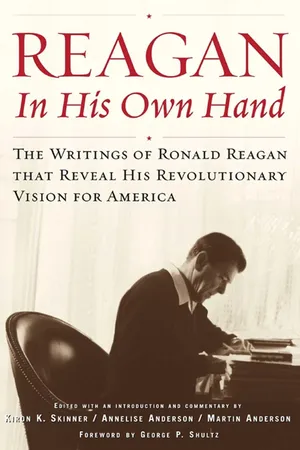
The Writings of Ronald Reagan that Reveal His Revolutionary Vision for America

  1. 576 pages
  2. English
  3. ePUB (mobile friendly)
  4. Available on iOS & Android
eBook - ePub

Reagan, In His Own Hand

The Writings of Ronald Reagan that Reveal His Revolutionary Vision for America

About this book

Until Alzheimer's disease wreaked its gradual destruction, Ronald Reagan was an inveterate writer. He wrote not only letters, short fiction, poetry, and sports stories, but speeches, newspaper articles, and radio commentary on public policy issues, both foreign and domestic.
Most of Reagan's original writings are pre-presidential. From 1975 to 1979 he gave more than 1, 000 daily radio broadcasts, two-thirds of which he wrote himself. They cover every topic imaginable: from labor policy to the nature of communism, from World War II to the second Strategic Arms Limitation Treaty, from the future of Africa and East Asia to that of the United States and the world. They range from highly specific arguments to grand philosophy to personal stories.
Even those who knew him best were largely unaware of Reagan's output. George Shultz, as he explains in the Foreword, was surprised when he first saw the manuscripts, but on reflection he really was not surprised at all. Here is definitive proof that Ronald Reagan was far more than a Great Communicator of other people's ideas. He was very much the author of his own ideas, with a single vision that he pursued relentlessly at home and abroad.
Reagan, In His Own Hand presents this vision through Reagan's radio writings as well as other writings selected from throughout his life: short stories written in high school and college, a poem from his high school yearbook, newspaper articles, letters, and speeches both before and during the presidency. It offers many surprises, beginning with the fact that Reagan's writings exist in such size and breadth at all. While he was writing batches and batches of radio addresses, Reagan was also traveling the country, collaborating on a newspaper column, giving hundreds of speeches, and planning his 1980 campaign. Yet the wide reading and deep research self-evident here suggest a mind constantly at work. The selections are reproduced with Reagan's own edits, offering a unique window into his thought processes.
These writings show that Reagan had carefully considered nearly every issue he would face as president. When he fired the striking air-traffic controllers, many thought that he was simply seizing an unexpected opportunity to strike a blow at organized labor. In fact, as he wrote in the '70s, he was opposed to public-sector unions using strikes. There has been much debate as to whether he deserves credit for the end of the cold war; here, in a 1980 campaign speech draft, he lays out a detailed vision of the grand strategy that he would pursue in order to encourage the Soviet system to collapse of its own weight, completely consistent with the policies of his presidency. Furthermore, in 1984, Reagan drafted comments he would make to Soviet foreign minister Andrei Gromyko at a critical meeting that would eventually lead to history's greatest reductions in armaments.
Ronald Reagan's writings will change his reputation even among some of his closest allies and friends. Here, in his own hand, Reagan the thinker is finally fully revealed.
Frequently asked questions

Yes, you can cancel anytime from the Subscription tab in your account settings on the Perlego website. Your subscription will stay active until the end of your current billing period. Learn how to cancel your subscription.
No, books cannot be downloaded as external files, such as PDFs, for use outside of Perlego. However, you can download books within the Perlego app for offline reading on mobile or tablet. Learn more here.
Perlego offers two plans: Essential and Complete
  • Essential is ideal for learners and professionals who enjoy exploring a wide range of subjects. Access the Essential Library with 800,000+ trusted titles and best-sellers across business, personal growth, and the humanities. Includes unlimited reading time and Standard Read Aloud voice.
  • Complete: Perfect for advanced learners and researchers needing full, unrestricted access. Unlock 1.4M+ books across hundreds of subjects, including academic and specialized titles. The Complete Plan also includes advanced features like Premium Read Aloud and Research Assistant.
Both plans are available with monthly, semester, or annual billing cycles.
We are an online textbook subscription service, where you can get access to an entire online library for less than the price of a single book per month. With over 1 million books across 1000+ topics, we’ve got you covered! Learn more here.
Look out for the read-aloud symbol on your next book to see if you can listen to it. The read-aloud tool reads text aloud for you, highlighting the text as it is being read. You can pause it, speed it up and slow it down. Learn more here.
Yes! You can use the Perlego app on both iOS or Android devices to read anytime, anywhere — even offline. Perfect for commutes or when you’re on the go.
Please note we cannot support devices running on iOS 13 and Android 7 or earlier. Learn more about using the app.
Yes, you can access Reagan, In His Own Hand by Kiron K. Skinner, Martin Anderson, Annelise Anderson, Kiron K. Skinner,Martin Anderson,Annelise Anderson in PDF and/or ePUB format, as well as other popular books in History & North American History. We have over one million books available in our catalogue for you to explore.

Information

Publisher
Free Press
Year
2001
Print ISBN
9780743219389
eBook ISBN
9780743214957

Part One

REAGAN’S PHILOSOPHY

“The ideological struggle

dividing the world is

between communism and

our own belief in freedom

to the greatest extent

possible consistent with

an orderly society.”
The eight radio addresses in this section express concepts and themes found in many of Reagan’s handwritten manuscripts for radio commentaries and speeches given in his pre-presidential years. Taken together, the essays state the political and philosophical views on which his policies as president, both foreign and domestic, were based.
As we look back on what he wrote in the late 1970s from the perspective of the post-Communist era, in a time of economic vitality and with the United States as the world’s only superpower, it is easy to forget how at odds his views were with the accepted wisdom of the day. The late 1970s was a period of high inflation, low economic growth, relatively high unemployment, and questions about the influence of the United States on the world scene. Many believed that the political systems of the United States and the Soviet Union were gradually converging. Some doubted that a political system based on individual freedom and free markets could compete effectively with a centrally controlled command economy that could override and repress political dissent.
Reagan had no such doubts. In spite of the economic and political problems, he found America’s strength in its political system—in liberty, in the system that freed, as he put it, the individual genius of man—a system that, he said, has given the country political stability, the creativity of private enterprise, advanced technology, and a generosity of spirit. He also considered virtue fundamental to representative government and argued against expediency rather than principle in foreign policy.
His condemnation of communism, in words written in 1975, is powerful. Communism, he wrote, is neither an economic nor a political system, but a form of insanity, an aberration. He wonders “how much more misery it will cause before it disappears.” In comparing the statements of past and present leaders of the two systems, he quotes, as he often did, John Winthrop’s 1630 statement on the deck of the Arbella: “We shall be as a city upon a hill.” But as the complete quotation Reagan uses makes clear, the significance of the city’s location on a hill is not only that it is blessed, but that it is open to observation and judgment by the entire world.
The great challenge of the world situation was, Reagan says in 1975, maintaining peace and avoiding the catastrophe of nuclear war, and doing so not through surrender but through military strength backed by economic vitality and credibility. In a radio address that is an elaboration of his extemporaneous speech at the Republican National Convention in 1976 after losing the nomination to Gerald Ford, he tells of writing a letter for a time capsule to be opened one hundred years later. He turns again to the question of nuclear Armageddon, of the potential of the two superpowers to fire missiles at one another. The challenge is not only preserving the beauty he sees as he travels the Pacific Coast Highway, but of preserving a world of peace, prosperity, and freedom of choice.
Reagan reiterated the same themes and concepts of these eight essays in his farewell speech from the Oval Office on January 11, 1989. Not even he had known how far-reaching his philosophy and policies would be, for, he says, “We meant to change a nation, and instead, we changed a world.”
Peace
April 1975
How much is it worth to not have WWIII
I’ll be right back.
While in London I had an opportunity to visit with various govt. officials including those concerned with foreign affairs. Inevitably the conversation turned to the world situation & how to maintain peace. in the world. And just as inevitably the Soviet U. was automatically accepted as the possible threat to peace just as 40 yrs. ago it was Nazi Germany that loomed as the storm cloud on the horizon. And of course that storm cloud did eventually fill the sky & raining rain fire & brimstone on all the world.
The leaders of that generation saw the growing menace & talked of it but reacted to the growing mil. might of Germany with anguished passiveness. Will it be said of todays world leaders th as it was of the pre W.W.II. leaders “they were better at surviving the catastrophe than they were at preventing it?
image
image
image
Several times in the discussions at Whitehall
W.W.II did not happen because the Nat’s. of the free world engaged in a massive mil. buildup. The opposite is true. In most countries including our own, “too little too late” described our the reaction to the Nazi mil. colossus.
What does it take for us to learn? On every hand here & abroad when the suggestion is made that we strengthen the mil. capability of Nato the reply is that it’s not politically expedient to incrs. spending for armaments because the people are against it. Our own Congress which is willing to run an $80 Bil. deficit for every kind of social experiment screams long & loud for reduction of the budget for defense. But have any of the pol. leaders laid the facts out for the people? Of course the overtaxed citizenry in Europe & America want govt. spending reduced. But if we are told the truth, namely that enough evidence of weakness or lack of willpower on our part could tempt
image
the Soviet U. into as it once did tempted Hitler & the mil. rulers of Japan I believe our decision would be in favor of an ounce of prevention. Certainly we havent forgotten that after W.WII the Japanese told us they they were tempted decided on war when they saw our army staging war games with wooden guns. They also took note that One month before Pearl Harbor Congress came within one a single vote of abolishing the draft & sending the bulk of our army home.
It has recently been revealed that for 12 yrs. a behavioral scientist at the U. of Hawaii* has headed up a team of distinguished colleagues in a Federally-Funded, computerized study of International behavior. Summed up in one sentence they have learned that “to abdicate power is to abdicate the right to maintain peace.”
The study focused mainly upon Red China, Russia & the US. Every bit of data from trade to tourism—from threats to treaties—was fed into the computers. The findings prove conclusively that what Laurence Beilenson wrote in his book “The Treaty Trap” is true.** “Nations that place their faith in treaties & fail to keep their hardware up don’t hang around to stick around long enough to write many pages in history.”
According to the report (quote) “It is not equality in power,” “that reduces hostility & conflict. Rather it is power dominance or submission.”—Peace is purchased by making yourself stronger than your adversary—or by dismantling power & submitting to ones enemies.” (unquote).
Power is not only sufficient military strength but it’s also a sound economy, a reliable energy supply and credibility—the belief by any potential enemy that you will not choose surrender as the way to maintain peace. Thomas Jefferson said “The American people won’t make a mistake if they are given all the facts.”
It’s time we were given the facts about
Perhaps Cong. should be given some facts about us, namely that we’d rather prevent a war by being well armed than by surrendering.
This is Ronald Reagan. Thanks for listening.
image
Shaping the World for 100 Years to Come
September 1, 1976
In this election year many of us talk about the world of tomorrow but do we really think about it? I’ll be right back.
Sometimes it’s very easy to get very glib about how the decisions we are making will shape the world for a hundred years to come. Then A few weeks ago I found myself faced with having to really think about it. what we are doing today & what people (not history) PEOPLE LIKE OURSELVES will say about us.
I’d been asked to write a letter for a “time capsule” which would be opened in Los Angeles 100 yrs. from now. It will be The occasion will be the Los Angeles Bicentennial & of course our countrys tri-centennial. It was suggested that I mention some of the problems confronting us in this election year. Since I’ve been talking about those problems for about some 9 months that didn’t look like too much of a chore.
So riding down the coast highway from Santa Barbara—a yellow tablet on my lap (someone else was driving) I started to write my letter to the future.
It was a beautiful summer afternoon. The Pacific stretched out to the horizon on one side of the highway and on the other the Santa Ynez mt’s. were etched against a sky as blue as the Ocean.
I found myself wondering if it would look the same 100 yrs. from now. Will there still be a coast highway? Will people still be travelling in automobiles, or will they be looking down at the mountains from aircraft or moving so fast the beauty of all I saw this would be lost?
Suddenly the simple drafting of a letter became a rather complex ...

Table of contents

  1. Cover Page
  2. Title Page
  3. Copyright Page
  4. Contents
  5. Foreword
  6. Introduction
  7. A Note on Editorial Methods
  8. Part One
  9. Part Two
  10. Part Three Domestic And Economic Policy
  11. Part Four Other Writings
  12. Appendix: Ronald Reagan’s Radio Addresses, 1975–79
  13. Acknowledgments
  14. Index
  15. Footnote