The Right Moment
eBook - ePub

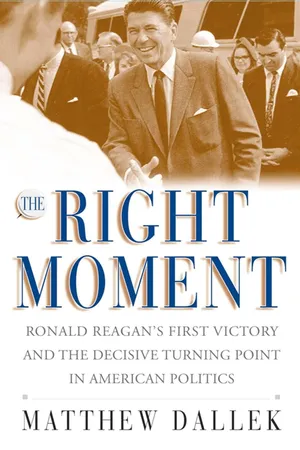
The Right Moment

Ronald Reagan's First Victory and the Decisive Turning Point in American Politics

  1. 304 pages
  2. English
  3. ePUB (mobile friendly)
  4. Available on iOS & Android
eBook - ePub

The Right Moment

Ronald Reagan's First Victory and the Decisive Turning Point in American Politics

About this book

Ronald Reagan's first great victory, in the 1966 California governor's race, seemed to come from nowhere and has long since confounded his critics. Just two years earlier, when Barry Goldwater lost to Lyndon Johnson by a landslide, the conservative movement was pronounced dead. In California, Governor Edmund "Pat" Brown was celebrated as the "Giant Killer" for his 1962 victory over Richard Nixon. From civil rights, to building the modern California system of higher education, to reinventing the state's infrastructure, to a vast expansion of the welfare state, Brown's liberal agenda reigned supreme. Yet he soon found himself struggling with forces no one fully grasped, and in 1966, political neophyte Reagan trounced Brown by almost a million votes.
Reagan's stunning win over Brown is one of the pivotal stories of American political history. It marked not only the coming-of-age of the conservative movement, but also the first serious blow to modern liberalism. The campaign was run amidst the drama of the Berkeley Free Speech Movement, terrible riots in Watts, and the first anti-Vietnam War protests by the New Left. It featured cameo appearances by Mario Savio, Ed Meese, California Speaker Jesse "Big Daddy" Unruh, and tough-as-nails Los Angeles Police Chief William Parker. Beneath its tumultuous surface a grassroots conservative movement swelled powerfully. A group that had once been dismissed as little more than paranoid John Birchers suddenly attracted a wide following for a more mainstream version of its message, and Reagan deftly rode the wave, moving from harsh anticommunism to a more general critique of the breakdown of social order and the failure of the welfare state. Millions of ordinary Californians heeded his call.
Drawing on scores of oral history interviews, thousands of archival documents, and many personal interviews with participants, Matthew Dallek charts the rise of one great politician, the demise of another, and the clash of two diametrically opposing worldviews. He offers a fascinating new portrait of the 1960s that is far more complicated than our collective memory of that decade. The New Left activists were offset by an equally impassioned group on the other side. For every SDS organizer there was a John Birch activist; for every civil rights marcher there was an anticommunist rally-goer; for every antiwar protester there were several more who sympathized with American aims in Southeast Asia. Dallek's compelling history offers an important reminder that the rise of Ronald Reagan and the conservatives may be the most lasting legacy of that discordant time.
Frequently asked questions

Yes, you can cancel anytime from the Subscription tab in your account settings on the Perlego website. Your subscription will stay active until the end of your current billing period. Learn how to cancel your subscription.
No, books cannot be downloaded as external files, such as PDFs, for use outside of Perlego. However, you can download books within the Perlego app for offline reading on mobile or tablet. Learn more here.
Perlego offers two plans: Essential and Complete
  • Essential is ideal for learners and professionals who enjoy exploring a wide range of subjects. Access the Essential Library with 800,000+ trusted titles and best-sellers across business, personal growth, and the humanities. Includes unlimited reading time and Standard Read Aloud voice.
  • Complete: Perfect for advanced learners and researchers needing full, unrestricted access. Unlock 1.4M+ books across hundreds of subjects, including academic and specialized titles. The Complete Plan also includes advanced features like Premium Read Aloud and Research Assistant.
Both plans are available with monthly, semester, or annual billing cycles.
We are an online textbook subscription service, where you can get access to an entire online library for less than the price of a single book per month. With over 1 million books across 1000+ topics, we’ve got you covered! Learn more here.
Look out for the read-aloud symbol on your next book to see if you can listen to it. The read-aloud tool reads text aloud for you, highlighting the text as it is being read. You can pause it, speed it up and slow it down. Learn more here.
Yes! You can use the Perlego app on both iOS or Android devices to read anytime, anywhere — even offline. Perfect for commutes or when you’re on the go.
Please note we cannot support devices running on iOS 13 and Android 7 or earlier. Learn more about using the app.
Yes, you can access The Right Moment by Matthew Dallek in PDF and/or ePUB format, as well as other popular books in History & Political Biographies. We have over one million books available in our catalogue for you to explore.

Information

Publisher
Free Press
Year
2000
Print ISBN
9780684843209
eBook ISBN
9780743213745

Notes


Periodicals and books are cited fully upon first use only. Archives, oral histories, and interviews are abbreviated as follows:

ARCHIVES

image
image

INTERVIEWS AND ORAL HISTORIES

image
image
image
image
image
image
image
image
image
image
image
image

ONE: The Giant Killer

1. Kevin Starr, Endangered Dreams: The Great Depression in California (New York: Oxford University Press, 1996), 115.
2. Roger Rappaport, California Dreaming: The Political Odyssey of Pat & Jerry Brown (Berkeley: Nolo Press, 1982), 24–25.
3. EGBOH, 217.
4. EGBOH, 18. RROH, 47.
5. EGBOH, 24–25. FMBOH, 7. HCBOH, 7. Rappaport, California Dreaming, 20–21
6. EGBOH, 6, 24, 29.
7. EGBOH, 30–31, 37–39. Rappaport, California Dreaming, 22. Years later Brown’s fraternity friends, many of whom had become successful businessmen, would provide crucial financial backing for Brown’s political campaigns. Norton Simon, for example, contributed $100,000 to Brown’s 1950 Attorney General race.
8. EGBOH, 44–46.
9. Rappaport, California Dreaming, 23. PS1966, director Charles Guggenheim, Man against the Actor, Pat Brown Campaign Advertisement (1966). EGBOH, 44–49, 54–55, 62, 66–67. “You know, Mr. Brown,” Schmitt babbled at one point, “I’m like Jesus. I carry a cross like Jesus did. My cross is blindness.” Schmitt told his protege that he was “going to make a million dollars for [him]. I’ll make a million for myself and a million for you.” Soon Schmitt was committed to a mental institution. BLBOH, 42.
10. Rappaport, California Dreaming, 28. BLBOH, 42.
11. EGBOH, 64. BLBOH, 38. NEOH, 5.
12. NEOH, 3, 8. EGBOH, 72, 75. HCBOH, 28. Rappaport, California Dreaming, 28–29.
13. EGBOH, 97–99, 120–25.
14. EGBOH, 9, 13–14, 77–79. Rappaport, California Dreaming, 29.
15. Brown also worked hard to cultivate his image as a friend of the working man. Afraid that his moralizing would alienate working-class voters, Brown let it be known that he hailed from a working-class family and subtly reminded voters that he had ties to organized gambling. He helped Edmund, Sr., register his gambling parlor as “a duly authorized corporation” that, Brown admitted, was “a facade for a gambling operation.” Brown also took $500 a cousin had donated for campaign advertising, brought it to a bookie he knew, and placed a bet: Brown over Brady. The odds were five to one in Brady’s favor, and Brown distributed his fifty $10 tickets to campaign workers. “If I win,” he told them, “you get $60.” The result, as Brown put it, was “fifty of the greatest campaign workers you’d ever seen.” EGBOH, 93–95,124.
16. EGBOH, 100, 122. TLOH, 27–30.
17. Rappaport, California Dreaming, 33–34. EGBOH, 101–2.
18. Rappaport, California Dreaming, 49.
19. TLOH, 122–23.
20. RKOH, 124–25. Kent says Pat “made some noises” about running for Senate in 1956, but that he and his best friends thought that the incumbent, Thomas Kuchel, was “incredibly strong” and wanted Pat to run for governor instead (see Rappaport, California Dreaming, 10). For more information on Bernice’s feelings, see FDOH, “Democratic Campaigns and Controversies, 1954–1966.” On Jerry Brown, see Rappaport, California Dreaming, 10.
21. EGB ctn 1, Correspondence Folder, Letter, Dutton to James Keene, May 17, 1957. Letter Dutton to Jim (no last name), July 3, 1957.
22. EGB ctn 1, Letters Folder, Handwritten Note, Dutton to Brown, no date.
23. EGB ctn 44, Publicity Folder, “Pat Brown’s 8-Point Program,” campaign brochure. Party campaign activists longed for a more ideological campaign. See EGB ctn 1, Letters & Memos Folder, Memo, Dutton to Brown, Jan. 24, 1958.
24. EGBOH, 233. Rappaport, California Dreaming, 14. James Reichley, States in Crisis: Politics in Ten American States, 1950–1962 (Chapel Hill: The University of North Carolina Press, 1964), 183.
25. EGB, “Inaugural Message to the California State Legislature,” Jan. 5, 1959.
26. Ibid.
27. EGB ctn 14, Governor’s Council Meeting Minutes Folder, Transcript, Governor’s Council Meeting Minutes, 1959, 6–8.
28. EGBOH, 365.
29. EGB ctn 353, 1959 Legislation Folder, “A Tentative Over-All Appraisal,” May 27, 1959.
30. EGB ctn 388, Governorship, June–September Folder, Memo, Dutton to Brown, “Specific Action Ahead,” June 20, 1960. HCP ctn 1, Administrative Objectives of Brown Folder, Memo, Dutton to Brown, “Objectives of this Administration,” May 3, 1960.
31. EGBOH, 284.
32. Rappaport, California Dreaming, 66–67.
33. EGB ctn 501, Politics and Government Folder, Memo, Burby to Brown, September 3, 1961.
34. HCP ctn 3, Memo Folder, Champion to Brown, Dec. 6, 1961.
35. RRIOH, 70–72. Ringer recalled the Engle quote.
36. EGB ctn 584, Politics and Government Folder, Memo, Lerner to Brown, March 15, 1962. EGB ctn 585, Politics/Nixon, Jan.–March, Memo, Jack Burby to Bradley, March 6, 1962.
37. EGB ctn 585, Politics and Government, Jan.–March Folder, Letter, Thomas Page to Brown, March 1, 1962.
38. Oliver Carlson, “‘Pat’ Brown: California’s Most Expensive Governor,” Human Events, September 8, 1962.
39. “The Case of the Mysterious Mailer,” CDC Bulletin, March 1965, 15–16. TLOH, 100. EGB ctn 667, Democratic Central Committee Folder, 1962 Campaign Flier, “Pat Brown, The Nation’s Leading Governor.”
40. Christopher Matthews, “Former Governor Called Nixon ‘Psycho,’ ” San Francisco Examiner, December 6, 1998.

TWO: THE ANTICOMMUNIST

1. Matthew Dallek, “The Conservative 1960s,” The Atlantic Monthly, December 1995, 130–35.
2. The two best works on the history of California’s conservative movement are Lisa McGirr, Suburban Warriors: Grassroots Conservatism in the 1960’s (Columbia University, Dissertation, 1995), and Kurt Schuparra, Triumph of the Right: The Rise of the California Conservative Movement, 1945–1966 (Armonk, N.Y.: M.E. Sharpe, 1998).
3. Ibid.
4. RRGP Box 38, Pre-1966 Speeches Folder, “Losing Freedom by Installments,” Speech to the Fargo Chamber of Commerce, Jan. 26, 1962.
5. Garry Wills, Reagan’s America (New York: Penguin Books, 1988), 14–18. Ronald Reagan with Richard . Hubler, Where’s the Rest of Me? (New York: Best Books, 1965), 14. Lou Cannon, Ronnie and Jesse: A Political Odyssey (Garden City, N.Y.: Doubleday & Company, 1969), ...

Table of contents

  1. Cover
  2. Title Page
  3. Copyright
  4. Dedication
  5. INTRODUCTION:
  6. ONE
  7. TWO
  8. THREE
  9. FOUR
  10. FIVE
  11. SIX
  12. SEVEN
  13. EIGHT
  14. NINE
  15. TEN
  16. EPILOGUE
  17. NOTES
  18. ACKNOWLEDGMENTS
  19. INDEX