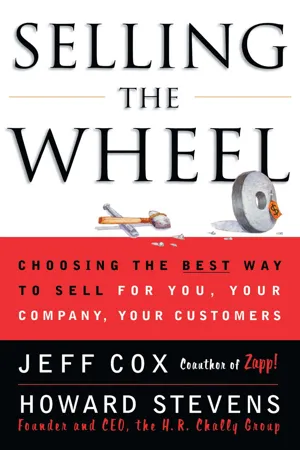
Selling the Wheel
eBook - ePub

Selling the Wheel

Choosing the Best Way to Sell For You, Your Company, and Your Customers

  1. 256 pages
  2. English
  3. ePUB (mobile friendly)
  4. Available on iOS & Android
eBook - ePub

Selling the Wheel

Choosing the Best Way to Sell For You, Your Company, and Your Customers

About this book

Selling the Wheel is a fascinating story about sales and marketing written in the form of an ancient parable: Once upon a time, long ago, a resourceful fellow named Max came up with a brilliant idea and invented the Wheel. But human beings, who had been getting along without the Wheel for thousands of years, did not instantly appreciate their need for this clever invention....
This is the challenge facing Max, as dramatized by Jeff Cox, coauthor of the bestselling business novels Zapp! and The Goal, Selling the Wheel is based on the pioneering research of Howard Stevens's employment-testing and customer-research firm, the H. R. Chally Group. In the story, Max and his wife, Minnie, learn what it takes to market the Wheel. With the help of Ozzie the Oracle, they discover four essential selling styles -- Closer, Wizard, Relationship Builder, and Captain & Crew -- and come to understand how each style is suited to a different type of salesperson. They learn that as markets evolve, selling styles and strategies must change. There is no single right way -- and no company can be all things to all people. This critical lesson is as valuable to salespeople as it is to sales managers.
Writer Jeff Cox has the amazing gift for translating technical ideas into creative, engaging stories, and his collaboration with sales and marketing expert Howard Stevens is based on empirical research collected from 250, 000 salespeople, more than 1, 500 people in corporate sales, and interviews with more than 100, 000 actual customers who rated the strengths and weaknesses of the salespeople serving them.
Packed with practical tips for salespeople, entrepreneurs, marketing managers, and business students, Selling the Wheel is an irresistible guide to sales styles, strategies, and markets.
Frequently asked questions

Yes, you can cancel anytime from the Subscription tab in your account settings on the Perlego website. Your subscription will stay active until the end of your current billing period. Learn how to cancel your subscription.
At the moment all of our mobile-responsive ePub books are available to download via the app. Most of our PDFs are also available to download and we're working on making the final remaining ones downloadable now. Learn more here.
Perlego offers two plans: Essential and Complete
  • Essential is ideal for learners and professionals who enjoy exploring a wide range of subjects. Access the Essential Library with 800,000+ trusted titles and best-sellers across business, personal growth, and the humanities. Includes unlimited reading time and Standard Read Aloud voice.
  • Complete: Perfect for advanced learners and researchers needing full, unrestricted access. Unlock 1.4M+ books across hundreds of subjects, including academic and specialized titles. The Complete Plan also includes advanced features like Premium Read Aloud and Research Assistant.
Both plans are available with monthly, semester, or annual billing cycles.
We are an online textbook subscription service, where you can get access to an entire online library for less than the price of a single book per month. With over 1 million books across 1000+ topics, we’ve got you covered! Learn more here.
Look out for the read-aloud symbol on your next book to see if you can listen to it. The read-aloud tool reads text aloud for you, highlighting the text as it is being read. You can pause it, speed it up and slow it down. Learn more here.
Yes! You can use the Perlego app on both iOS or Android devices to read anytime, anywhere — even offline. Perfect for commutes or when you’re on the go.
Please note we cannot support devices running on iOS 13 and Android 7 or earlier. Learn more about using the app.
Yes, you can access Selling the Wheel by Jeff Cox,Howard Stevens in PDF and/or ePUB format, as well as other popular books in Business & Business General. We have over one million books available in our catalogue for you to explore.

Information

Part One: The Wheel Revolution

1

O nce upon a time, a long, long time ago, way back in the days of the Pharaohs of ancient Egypt, there lived a guy named Max.
One day, Max was traveling on business, and he had a layover between caravans. Stuck with time on his hands, Max got to talking to a few of the locals, and they told him all about this big Pyramid that was under construction—it was the largest stone structure ever attempted in the history of the world.
“Where is it?” Max asked them.
“It’s right on the edge of town,” they said. “You can’t miss it.”
“What the heck,” said Max, “maybe I’ll go have a look.”
So he rented a camel, rode it to the edge of town, and sure enough, there in the distance were the sloping foundations of what would someday be the very first Pyramid. And everywhere Max looked, he saw thousands of sweaty workers cutting big, heavy stones with hammers and chisels, and then dragging the huge stones into place. To move the heaviest of stones, they had elephants, dozens of them, but even with the help of elephants the work was hot, backbreaking, and slow.
Man, it’s going to take them forever to build this thing, thought Max.
Impressed though he was with what he saw, he was very glad that he wasn’t working there.


When Max got home, he couldn’t stop thinking about that huge Pyramid and all those workers dragging the stones around. He even had a dream one night that he was one of the stone-dragging team, toiling in the sun, and after tossing and turning for half the night, he awakened with a terrible thirst.
He got out of bed to get a drink of water—and lo! He had the most brilliant idea he’d ever had in his life.
As he sipped his drink of water, he thought about his idea. He went back to bed, thought about it some more, and the more he thought, the more he was convinced that his idea was really something.
At last, Max nodded off to dreamland, but in the morning when he woke up, his idea was still with him. And it still seemed brilliant to him. So he went downstairs to the workshop he had in a spare room at the back of his house and he set to it.


Years later, after many disappointments and failures, Max had done it. He had turned his idea into a real thing. Very proud of his accomplishment, he rolled it out of the workshop and into the kitchen to show his wife.
“Look, Minnie!” he said. “Look what I’ve invented!”
“What the heck is that?” his wife asked.
“It’s the Wheel!” said Max.
“It’s the what?”
“The Wheel. This is what I’ve been working on all these years.”
“Yeah? What’s it do?”
“What’s it do? You just watch!” And Max rolled the Wheel across the kitchen floor. “See, it goes ’round and ’round!”
“That’s . . . interesting. Does it do anything else?”
“Well, no, that’s pretty much it. But, Minnie, I think the Wheel could turn out to be a very useful thing.”
“What makes you think that?”
“Because people won’t have to drag things the way they always have. With the aid of the Wheel, you see, heavy objects can be made to roll.”
“So?” asked his wife.
“Don’t you get it? The Wheel is going to make it possible to move things much more quickly—and with far less effort! People will get more work done in less time!”
“Well, it sounds good,” said Minnie, trying not to look skeptical.
“And you know what else?” said Max. “The Wheel is going to make us lots of money!”
“Oh?”
“Someday, millions of people all over the world will use the Wheel. And we will own the patent!”
“Uh-huh. Well, that’s nice, dear. You keep at it, and let me know when we’re rich.”


Max did keep at it. He built more and more Wheels. He filled his whole workshop with them—and each Wheel he built was better and more refined.
One evening, Minnie came into the workshop. She stood perplexed amidst Max’s vast inventory of Wheels, and asked, “So, um, how’s it going?”
“Not bad,” said Max. “Take a look at this one. See? It’s rounder!”
“Very nice, dear.”
“And take a look at this!” said Max, holding up a thick wooden pole. “I call it the Axle.”
“Oh? And what does an Axle do?”
“Well, you see, Minnie, with an Axle, I can join together two Wheels, one on each end, and place the object to be moved in the middle! This is eminently more practical than using one Wheel by itself—and just think of it—I can sell twice as many Wheels!”
“I’m glad you brought that up,” said his wife.
“Brought what up?”
“Selling these things. It seems to me that if we’re going to get rich, you’re going to have to go out and sell these Wheels of yours, aren’t you?”
“Sell? Me? Minnie, the Wheel is a brilliant invention! One does not have to sell brilliant inventions; brilliant inventions sell themselves!”
“Uh-huh. Well, I haven’t been seeing the Wheels rolling out the door on their own. I don’t think they know how to sell themselves. I think you’re going to have to do it for them.”
This suggestion gave Max a modest anxiety attack. Because while he now knew a great deal about Wheels, he knew almost nothing about selling.
“You just wait, Minnie. When word of the Wheel gets around, and the idea catches on, there’ll be people lined up outside our door begging me to sell them a Wheel.”
Weeks went by, but nobody lined up outside Max’s door.
Finally, Max could not fit any more Wheels into the workshop. He wanted to start storing them in the living room, but Minnie laid down the law.
“Absolutely not!” his wife said. “You’ve got to get rid of some of these Wheels. Either start selling them or roll them into the river!”
At last Max had to face reality. After grumping about the house for a few hours, he picked out his two roundest Wheels, rolled them into the street, attached them to his best Axle, and pushed his contraption through the neighborhood.
“Look,” Max would say to anyone who would give him the time, “aren’t these terrific? I call them ‘Wheels.’ They’re my own invention. You see, with Wheels, you don’t have to drag things, you can—hey, wait a minute! Come back!”
Unfortunately for Max, no one was interested. After weeks of pushing his Wheels up one street and down the next, knocking on doors, introducing himself, explaining these great things called Wheels—nothing! Nobody wanted them.
Some even laughed at Max’s suggestion that they might want to purchase Wheels of their own.
“You want money? For those? Ha! Ha! Ha-ha-ha!”


It was embarrassing, even humiliating, for poor Max. He began to doubt that he could even give away his Wheels. Finally, very depressed and disappointed, he turned and rolled them toward home.
“All that time and effort I put in! And for what?” he asked aloud as he removed the Wheels from their Axle.
Disgusted, he gave one of the Wheels a kick. It rolled to the wall, bumped it hard enough to make a crack in the plaster, and toppled over. Plop.
Minnie looked at her husband and felt bad. She sat down with him on the sofa, put her hand on his arm.
“I can’t believe it!” Max lamented. “Here I come up with what might possibly be one of the greatest inventions ever, and nobody wants it!”
“Max, there are millions of people in the world. Surely some of them must have a use for the Wheel.”
“But how do I find them? And if I find them, how do I sell it to them?”
Minnie slowly shook her head. “I don’t know.”
They both thought for a moment.
Then Minnie ...

Table of contents

  1. Cover
  2. Title Page
  3. Copyright
  4. Contents
  5. Advance Praise for Selling the Wheel
  6. Dedication
  7. Introduction
  8. Part One:
  9. Part Two:
  10. Part Three:
  11. Part Four:
  12. THE WHEEL OF SALES
  13. Technology
  14. Customers
  15. Salespeople
  16. Strategy
  17. Selling Approach
  18. Marketing
  19. Getting the Sale
  20. Service
  21. THE FUTURE OF SALES
  22. Acknowledgments
  23. ABOUT THE H. R. CHALLY GROUP