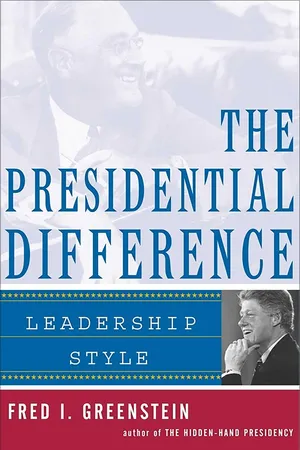
As Americans choose and install a new president for a new century they could do no better than to read this work by one of our keenest observers of the modern presidency. Drawing on a quarter-century's immersion in the presidential record and scores of interviews, Fred I. Greenstein provides a fascinating and instructive account of the qualities that have served well and poorly in the Oval Office from Franklin D. Roosevelt's first hundred days to the end of the Clinton administration.
Greenstein offers a series of bottom-line judgments on each of his eleven subjects and a bold new explanation of why presidents succeed or fail. Previous analysts have placed their bets on the president's political prowess or personal character. Yet by the first standard, LBJ should have been our greatest president, and by the second the nod would go to Jimmy Carter. Greenstein surveys each president's record in public communication, political skill, vision, cognitive style, and emotional intelligence. He concludes that the last is by far the most important.
According to Greenstein, FDR provides endless positive lessons but is a source of warnings. Truman let his bizarre readings of history lead him astray. Eisenhower was wise but failed to communicate a vision. Kennedy had no vision. Reagan was Carter in reverse. It is Ford who is most unappreciated and genuinely interesting. Ford balanced many conflicting demands, kept his poise, and left the office much stronger than he found it.
Presidents can avoid failure if they are willing to accept the warnings of failures past and act accordingly. But it is not only presidents who should read this book with care. Some flaws cannot be overcome no matter how otherwise talented the man. Only three of Greenstein's eleven modern presidents were "fundamentally free of distracting emotional perturbations." When we choose our presidents, we will do well to listen to Greenstein and "Beware the presidential contender who lacks emotional intelligence. In its absence all else may turn to ashes."
eBook - ePub
The Presidential Difference
Leadership Style from Roosevelt to Clinton
- 288 pages
- English
- ePUB (mobile friendly)
- Available on iOS & Android
eBook - ePub
About this book
Information
Table of contents
- Cover
- Title Page
- Copyright
- Contents
- Dedication
- 1.
- 2.
- 3.
- 4.
- 5.
- 6.
- 7.
- 8.
- 9.
- 10.
- 11.
- 12.
- 13.
- Appendix
- Notes
- Further Reading
- Acknowledgments
- Index
Trusted by 375,005 students
Access to over 1.5 million titles for a fair monthly price.
Study more efficiently using our study tools.
Frequently asked questions
Yes, you can cancel anytime from the Subscription tab in your account settings on the Perlego website. Your subscription will stay active until the end of your current billing period. Learn how to cancel your subscription
No, books cannot be downloaded as external files, such as PDFs, for use outside of Perlego. However, you can download books within the Perlego app for offline reading on mobile or tablet. Learn how to download books offline
Perlego offers two plans: Essential and Complete
- Essential is ideal for learners and professionals who enjoy exploring a wide range of subjects. Access the Essential Library with 800,000+ trusted titles and best-sellers across business, personal growth, and the humanities. Includes unlimited reading time and Standard Read Aloud voice.
- Complete: Perfect for advanced learners and researchers needing full, unrestricted access. Unlock 1.5M+ books across hundreds of subjects, including academic and specialized titles. The Complete Plan also includes advanced features like Premium Read Aloud and Research Assistant.
We are an online textbook subscription service, where you can get access to an entire online library for less than the price of a single book per month. With over 1.5 million books across 990+ topics, we’ve got you covered! Learn about our mission
Look out for the read-aloud symbol on your next book to see if you can listen to it. The read-aloud tool reads text aloud for you, highlighting the text as it is being read. You can pause it, speed it up and slow it down. Learn more about Read Aloud
Yes! You can use the Perlego app on both iOS and Android devices to read anytime, anywhere — even offline. Perfect for commutes or when you’re on the go.
Please note we cannot support devices running on iOS 13 and Android 7 or earlier. Learn more about using the app
Please note we cannot support devices running on iOS 13 and Android 7 or earlier. Learn more about using the app
Yes, you can access The Presidential Difference by Fred I. Greenstein in PDF and/or ePUB format, as well as other popular books in History & Teaching History. We have over 1.5 million books available in our catalogue for you to explore.