In this comprehensive, practical, and unsettling look at computers in children's lives, Jane M. Healy, Ph.D., questions whether computers are really helping or harming children's development. Once a bedazzled enthusiast of educational computing but now a troubled skeptic, Dr. Healy examines the advantages and drawbacks of computer use for kids at home and school, exploring its effects on children's health, creativity, brain development, and social and emotional growth.
Today, the Federal Government allocates scarce educational funding to wire every classroom to the Internet, software companies churn out "educational" computer programs even for preschoolers, and school administrators cut funding and space for books, the arts, and physical education to make room for new computer hardware. It is past the time to address these issues. Many parents and even some educators have been sold on the idea that computer literacy is as important as reading and math. Those who haven't hopped on the techno bandwagon are left wondering whether they are shortchanging their children's education or their students' futures. Few people stop to consider that computers, used incorrectly, may do far more harm than good.
New technologies can be valuable educational tools when used in age-appropriate ways by properly trained teachers. But too often schools budget insufficiently for teacher training and technical support. Likewise, studies suggest that few parents know how to properly assist children's computer learning; much computer time at home may be wasted time, drawing children away from other developmentally important activities such as reading, hobbies, or creative play. Moreover, Dr. Healy finds that much so-called learning software is more "edutainment" than educational, teaching students more about impulsively pointing and clicking for some trivial goal than about how to think, to communicate, to imagine, or to solve problems. Some software, used without careful supervision, may also have the potential to interrupt a child's internal motivation to learn.
Failure to Connect is the first book to link children's technology use to important new findings about stages of child development and brain maturation, which are clearly explained throughout. It illustrates, through dozens of concrete examples and guidelines, how computers can be used successfully with children of different age groups as supplements to classroom curricula, as research tools, or in family projects. Dr. Healy issues strong warnings, however, against too early computer use, recommending little or no exposure before age seven, when the brain is primed to take on more abstract challenges. She also lists resources for reliable reviews of child-oriented software, suggests questions parents should ask when their children are using computers in school, and discusses when and how to manage computer use at home. Finally, she offers a thoughtful look at the question of which skills today's children will really need for success in a technological future -- and how they may best acquire them.
Based on years of research into learning and hundreds of hours of interviews and observations with school administrators, teachers, parents, and students, Failure to Connect is a timely and eye-opening examination of the central questions we must confront as technology increasingly influences the way we educate our children.
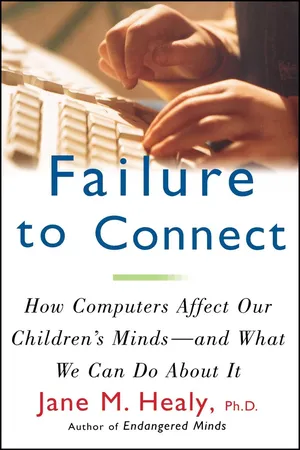
eBook - ePub
Failure to Connect
How Computers Affect Our Children's Minds--For Better and Worse
- 352 pages
- English
- ePUB (mobile friendly)
- Available on iOS & Android
eBook - ePub
About this book
Information
Topic
EducationSubtopic
Education GeneralTable of contents
- Cover
- Colophone
- Title Page
- Dedication
- Copyright
- Contents
- Preface
- Half Title Page
- Part One: Digital Dreams Meet Reality
- Part Two: Digital Childhood
- Part Three: Doing It Right When the Time Is Right
- Suggested Reading
- Books
- Bibliography
- Notes
- Index
Trusted by 375,005 students
Access to over 1.5 million titles for a fair monthly price.
Study more efficiently using our study tools.
Frequently asked questions
Yes, you can cancel anytime from the Subscription tab in your account settings on the Perlego website. Your subscription will stay active until the end of your current billing period. Learn how to cancel your subscription
No, books cannot be downloaded as external files, such as PDFs, for use outside of Perlego. However, you can download books within the Perlego app for offline reading on mobile or tablet. Learn how to download books offline
Perlego offers two plans: Essential and Complete
- Essential is ideal for learners and professionals who enjoy exploring a wide range of subjects. Access the Essential Library with 800,000+ trusted titles and best-sellers across business, personal growth, and the humanities. Includes unlimited reading time and Standard Read Aloud voice.
- Complete: Perfect for advanced learners and researchers needing full, unrestricted access. Unlock 1.5M+ books across hundreds of subjects, including academic and specialized titles. The Complete Plan also includes advanced features like Premium Read Aloud and Research Assistant.
We are an online textbook subscription service, where you can get access to an entire online library for less than the price of a single book per month. With over 1.5 million books across 990+ topics, we’ve got you covered! Learn about our mission
Look out for the read-aloud symbol on your next book to see if you can listen to it. The read-aloud tool reads text aloud for you, highlighting the text as it is being read. You can pause it, speed it up and slow it down. Learn more about Read Aloud
Yes! You can use the Perlego app on both iOS and Android devices to read anytime, anywhere — even offline. Perfect for commutes or when you’re on the go.
Please note we cannot support devices running on iOS 13 and Android 7 or earlier. Learn more about using the app
Please note we cannot support devices running on iOS 13 and Android 7 or earlier. Learn more about using the app
Yes, you can access Failure to Connect by Jane M. Healy in PDF and/or ePUB format, as well as other popular books in Education & Education General. We have over 1.5 million books available in our catalogue for you to explore.