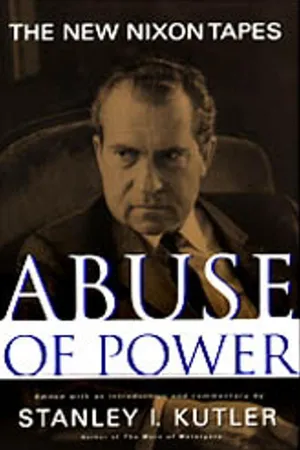
Using thousands of hours of previously concealed tapes, a stunning revelation into the infamous Nixon White House and how far the administration went to cover up the abuse of power. Richard Nixon said he wanted his administration to be "the best chronicled in history." But when Alexander Butterfield disclosed the existence of a voice-activated taping system to a Senate committee in July 1973, Nixon's White House and its recordings quickly became the most infamous in American history. But only sixty hours were actually made public in the 1970s. Thousands of hours remained secret and in Nixon's hands, and he fought fiercely to keep them that way right up to his death. Finally, thanks to a lawsuit brought by historian Stanley I. Kutler, the Nixon estate and the National Archives have brought over three thousand hours of tapes to light.The tapes reveal an extensive cover-up beyond what was previously understood. The recordings, ranging from campaign tactics to controversial discussions, redefine the meaning of power abuse within Nixon's administration and his ultimate demise. A spy planted in Ted Kennedy's Secret Service detail, Nixon's continual insistence on paying the burglars, and talks about a substantial campaign fund showcase the true depth of the cover-up efforts.Packed with revelations on almost every page, Abuse of Power offers a spellbinding portrait of raw power and a Shakespearean depiction of a king and his court. Never have the personalities of Haldeman, Ehrlichman, Colson, Haig, Kissinger, Dean, and Mitchell been so vividly captured. And never has an American President offered such a revealing record of his darkest self.
- 704 pages
- English
- ePUB (mobile friendly)
- Available on iOS & Android
eBook - ePub
Abuse Of Power
About this book
Information
Table of contents
- Cover
- Title Page
- Copyright
- Contents
- Editorial Note
- Cast of Characters
- INTRODUCTION
- PART ONE
- PART TWO
- PART THREE
- PART FOUR
- EPILOGUE
- Acknowledgments
Trusted by 375,005 students
Access to over 1.5 million titles for a fair monthly price.
Study more efficiently using our study tools.
Frequently asked questions
Yes, you can cancel anytime from the Subscription tab in your account settings on the Perlego website. Your subscription will stay active until the end of your current billing period. Learn how to cancel your subscription
No, books cannot be downloaded as external files, such as PDFs, for use outside of Perlego. However, you can download books within the Perlego app for offline reading on mobile or tablet. Learn how to download books offline
Perlego offers two plans: Essential and Complete
- Essential is ideal for learners and professionals who enjoy exploring a wide range of subjects. Access the Essential Library with 800,000+ trusted titles and best-sellers across business, personal growth, and the humanities. Includes unlimited reading time and Standard Read Aloud voice.
- Complete: Perfect for advanced learners and researchers needing full, unrestricted access. Unlock 1.5M+ books across hundreds of subjects, including academic and specialized titles. The Complete Plan also includes advanced features like Premium Read Aloud and Research Assistant.
We are an online textbook subscription service, where you can get access to an entire online library for less than the price of a single book per month. With over 1.5 million books across 990+ topics, we’ve got you covered! Learn about our mission
Look out for the read-aloud symbol on your next book to see if you can listen to it. The read-aloud tool reads text aloud for you, highlighting the text as it is being read. You can pause it, speed it up and slow it down. Learn more about Read Aloud
Yes! You can use the Perlego app on both iOS and Android devices to read anytime, anywhere — even offline. Perfect for commutes or when you’re on the go.
Please note we cannot support devices running on iOS 13 and Android 7 or earlier. Learn more about using the app
Please note we cannot support devices running on iOS 13 and Android 7 or earlier. Learn more about using the app
Yes, you can access Abuse Of Power by Stanley Kutler in PDF and/or ePUB format, as well as other popular books in History & North American History. We have over 1.5 million books available in our catalogue for you to explore.