
eBook - ePub
The 101 Habits Of Highly Successful Screenwriters
Insider's Secrets from Hollywood's Top Writers
- 256 pages
- English
- ePUB (mobile friendly)
- Available on iOS & Android
eBook - ePub
The 101 Habits Of Highly Successful Screenwriters
Insider's Secrets from Hollywood's Top Writers
About this book
Insider Secrets from Hollywood’s Top Writers
This book not only shows how to be a screenwriter, but what it's actually like to be one. An inspiration to all would-be screenwriters, this book is about living the screenwriter's life -- the habits, writing environments, creative processes, daily passions, and obsessions.
In The 101 Habits of Highly Successful Screenwriters, author Karl Iglesias has interviewed 14 top contemporary Hollywood screenwriters who offer their experience, insight, and advice to aspiring screenwriters everywhere.
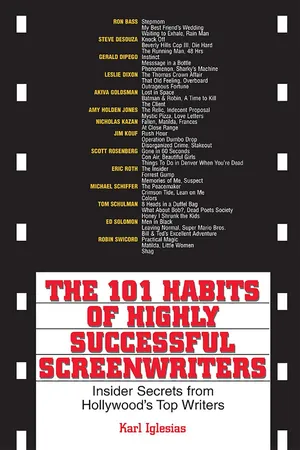
This book not only shows how to be a screenwriter, but what it's actually like to be one. An inspiration to all would-be screenwriters, this book is about living the screenwriter's life -- the habits, writing environments, creative processes, daily passions, and obsessions.
In The 101 Habits of Highly Successful Screenwriters, author Karl Iglesias has interviewed 14 top contemporary Hollywood screenwriters who offer their experience, insight, and advice to aspiring screenwriters everywhere.
Frequently asked questions
Yes, you can cancel anytime from the Subscription tab in your account settings on the Perlego website. Your subscription will stay active until the end of your current billing period. Learn how to cancel your subscription.
No, books cannot be downloaded as external files, such as PDFs, for use outside of Perlego. However, you can download books within the Perlego app for offline reading on mobile or tablet. Learn more here.
Perlego offers two plans: Essential and Complete
- Essential is ideal for learners and professionals who enjoy exploring a wide range of subjects. Access the Essential Library with 800,000+ trusted titles and best-sellers across business, personal growth, and the humanities. Includes unlimited reading time and Standard Read Aloud voice.
- Complete: Perfect for advanced learners and researchers needing full, unrestricted access. Unlock 1.4M+ books across hundreds of subjects, including academic and specialized titles. The Complete Plan also includes advanced features like Premium Read Aloud and Research Assistant.
We are an online textbook subscription service, where you can get access to an entire online library for less than the price of a single book per month. With over 1 million books across 1000+ topics, weāve got you covered! Learn more here.
Look out for the read-aloud symbol on your next book to see if you can listen to it. The read-aloud tool reads text aloud for you, highlighting the text as it is being read. You can pause it, speed it up and slow it down. Learn more here.
Yes! You can use the Perlego app on both iOS or Android devices to read anytime, anywhere ā even offline. Perfect for commutes or when youāre on the go.
Please note we cannot support devices running on iOS 13 and Android 7 or earlier. Learn more about using the app.
Yes, you can access The 101 Habits Of Highly Successful Screenwriters by Karl Iglesias in PDF and/or ePUB format, as well as other popular books in Media & Performing Arts & Film Screenwriting. We have over one million books available in our catalogue for you to explore.
Information
PART I
Passion
The Urge to Screenwrite
Cats gotta scratch. Dogs gotta bite.
I gotta write.
I gotta write.
āJAMES ELLROY
CHAPTER 1
Portrait of a Screenwriter
Before we can explore the habits of highly successful screenwriters, we have to know what theyāre like. Do you have what it takes to be a professional screenwriter? Since all writers are unique, youāll notice that the common traits that follow are unrelated to intelligence, education, environment, sex, age, or race. Youāll also notice few screenwriter comments included with most of the first āobviousā traits, since itās somewhat embarrassing to comment on being creative, having talent, or being a natural storyteller. So what makes a successful screenwriter different from other people?
1. Being Creative and Original
Imagination is being able to think of things that havenāt appeared on TV yet.
āHENRY BEARD
It may seem unnecessary to include this trait, because most people know creativity is an essential part of the writerās makeup, especially in screenwriting. Iāve included it, however, because many beginning writers donāt understand how important it is to be original. Reading hundreds of scripts and listening to thousands of pitches showed me how most of them were derivative of other movies, with familiar characters, uninteresting ideas, and clichĆ©d plot twists. Beginning writers tend to develop the easiest idea that comes to mind, rather than working hard to generate original ones.
Our mentors are highly imaginative and can make creative connections between seemingly unrelated events. Theyāre able to daydream about situations, characters, bits of dialogue, and get immediate answers to āwhat if ā situations. As Pearl Buck eloquently puts it:
The truly creative mind in any field is no more than this: a human creature born abnormally, inhumanly sensitive. To him a touch is a blow, a sound is a noise, a misfortune is a tragedy, a joy is an ecstasy, a friend is a lover, a lover is a god, and failure is death. Add to this cruelly delicate organism the overpowering necessity to create, create, createāso that without the creating of music or poetry or books or buildings or something of meaning, his very breath is cut off from him. He must create, just pour out creating. By some strange, inward urgency, he is not really alive unless he is creating.
No one can tell you what this mysterious creative energy really is. Itās not a formula. You cannot control it, but you can certainly develop a relationship to it so that it will open itself to you more often than not.
Tom Schulman: Screenwriters need a determination to be original and an unwillingness to accept clichĆ©s. Most writers I know donāt hesitate to change, or at least add something special as soon as they sense what they wrote has been done before.
2. Being a Natural Storyteller
Weāre only interested in one thing: Can you tell a story, Bart? Can you make us laugh, can you make us cry, can you make us wanna break out in joyous song?
āBARTON FINK, BY ETHAN AND JOEL COHEN
Usually, a desire to write movies or fiction not only implies an ability to tell storiesāwhether partly natural or gained through experience, reading, and watching moviesābut also a deep love for all stories. But once again, this is a critical trait that is too often missing in todayās aspiring writers. Working screenwriters have an insatiable addiction to all stories, good and bad. They are pushed to captivate an audience, and their work shows it.
Robin Swicord: Writers have the sort of mind that puts together narrative in a way that has a beginning, middle, and end. They notice cause and effect, that because this thing happened, that other thing is happening.
These are the kinds of traits that come together into a mind that makes drama. People who donāt have that natural bend for it have a very hard time really understanding what it is writers do. Thereās nothing more humbling for people who say, āIāve always wanted to be a writerā than to actually try to create an alternate reality, only to find out itās really hard to play God.
3. Being Comfortable with Solitude
Writing is a lonely life, but the only life worth living.
āGUSTAVE FLAUBERT
Writing is a lonely business. As a writer once said, āItās like volunteering for solitary confinement without knowing the length of your stay.ā Writers must spend a lot of time alone, but because they tend to be introverted by nature, they usually find more psychological comfort in a book or in writing than in social interactions. This is not to say that if youāre not comfortable with your solitude, you wonāt be able to write. One of the many surprises in chatting with our mentors is that many of them are actually extroverts who force solitude on themselves in order to do their jobs.
Ron Bass: I really prefer to write alone. Generally, when I have staff meetings, we talk about story and criticism, but I donāt like to write with somebody else sitting there, because Iāll talk out loud and Iāll pace around. I can be physically active when I write. I usually sit but I also have standing desks wherever I go so I can write standing up, which enables me to pace around and charge back and forth, move my arms. Itās a physical process, not just an intellectual one. I cross things out and I write bigger or darker depending on the emotion. If Iām in the park, Iāll pace around. I must look really peculiar to people, so I try to find a place where Iām relatively alone, and certainly where I wonāt hear another human voice.
Leslie Dixon: In order to do the job really well, you must spend prolonged periods of time in total isolation. You must. I loved it for the first few years where I had total control of my time without anybody telling me what to do. But I still havenāt figured out how to strike a balance between spending enough time by myself to produce a better grade of work versus not becoming a hermit.
Amy Holden Jones: The temperament that made me enjoy editing makes me enjoy writing, that solitary work where you get to refine over and over until you get it the way you want it. As a screenwriter, you need to be comfortable with that solitude for long periods of time, unless you work in television where itās a more social environment.
Tom Schulman: You need to create solitude so that you can hear the voices, and you need a willingness to live in the world of the story for long periods of time, forcing yourself into the world of the characters so that you can believe they exist. Many spouses of writers understandably complain that weāre not living in the present.
Robin Swicord: A friend once gave me and fellow writers a personality test, and we all turned out to be introverts, which I donāt think is a coincidence. Something like 20 percent of the general population is introverted, but I think most writers probably fall into that category. They feel very comfortable with solitude. They are probably better in one-on-one situations rather than dealing with lots of people. I know that when Iām in a room full of people, I tend to fall back as an observer.
4. Being a Natural Observer
Everything has beauty but not everyone sees it.
āCONFUCIUS
In order to describe, you need to observe. Most of us go through life only half seeing what goes on around us. We have too much going on to bother with observing details in life and in human nature. As a result, most beginning writers tend to reference what theyāve just seen on television and at the movies, rather than drawing from what theyāve observed in the real world. Successful screenwriters naturally develop the habit of observing others, which gives them an ear for the way people talk and an eye for the way they behave. Theyāre aware of the most minute details of the world around them, silently making notes on everything, and seeing things vividly and selectively. Whether in coffee shops, airports, or restaurants, they cannot resist people-watching or eavesdropping on a conversation. In short, they pay attention.
Gerald DiPego: Many beginning writers donāt do enough observing or enough listening when theyāre out and about in the world, on buses or in restaurants. Often, when I read a beginnerās script, I find that the writer is not referencing life but rather what I see in movies and television.
Jim Kouf: I donāt think the writer can leave it at the office. Itās your life. Youāre constantly thinking, constantly listening to the conversation in the next booth, staring at the character with the eye patch, wondering what kind of character he is. It never leaves you.
Robin Swicord: Writers have the particular makeup of a person who looks at the world, observes human behavior, and finds themselves amused, intrigued, or emotionally moved by watching people.
Eric Roth: Everything is writing-related, you live with it 24 hours a day, so when youāre out in the world, youāre an observer of what people do and details of whatās around you. Unconsciously, you try to save them and hopefully use them in a work at a later time.
5. Being Collaborative
Our mind is like a parachute. It only works when it is open.
āANONYMOUS
In no other form of writingānovels, plays, poems, or journalismāis the habit of collaboration as important as in screenwriting. It is so engrained in the way scripts become movies that without this attitude, no screenwriter, unless heās a genius, can become successful. But as youāll also see later on, collaboration can be a downside.
Ron Bass: By being a screenwriter, you are choosing to be in a medium that is genuinely collaborative, but one in which you do not have the final vote. The collaborative process is wonderful when itās going well and terrible when it doesnāt. You may feel passionately about something, and you get overruled by producers and directors. Anytime you get fired, it kills you. Anytime you get a set of notes and you think you got it, you made it work for you and them, and it works great and you love it, and they hate it, you can be angry at them and feel insecure about yourself. Writing screenplays is such a collaborative medium that not caring if anyone else likes it makes no sense to me. If you cannot handle this and the additional bad feelings that come with those moments when youāre fired and another writer comes on and makes a total mess out of what you thought was wonderful, you should seriously consider another medium.
Gerald DiPego: Itās a whole skill you have to develop apart from writing. Call it compromise, negotiation, or debate. You spend a lot of time in development, trying to do your best to explain and defend the material against harmful ideas, but at the same time, you have to stay open to the good ideas. Some people shut down and say, āThe hell with them! Theyāre all stupid.ā Thatās not going to work. Then again, you canāt sit there like a stenographer and accommodate them because that will kill the material.
Michael Schiffer: You have to collaborate and listen, but you canāt sell out your own work either. You try to navigate between their good and bad ideas and find a way to let them have what they feel they need without damaging what you feel is the emotional core and spirit of your piece. Itās like being on a boat trip, somebody wants to go to the left bank and somebody wants to go to the right bank. Thereās no right or wrong. You have to allow people to go on the journey they want to go on if they are your partners. You try to respect the problems they are bringing up instead of thinking theyāre all a bunch of idiots. If you have that attitude, youāre in big trouble because youāre the idiot who will be fired first.
CHAPTER 2
Desire
6. Having a Driving Reason to Write
Donāt write with sales or money in mindāit poisons the well at its source. If writing isnāt a joy, donāt do it. Life is short. Death is long.
āWILLIAM WHARTON
All the writers interviewed here have been writing for many years. They didnāt last or get to where they are today without having a driving and passionate desire to write. Every writer has a variety of r...
Table of contents
- Front Cover
- Title Page
- Dedication
- Contents
- Foreword
- Introduction: Fade In
- PART I: Passion The Urge to Screenwrite
- PART II: Creativity Summoning the Muse
- PART III: Discipline Applying the Seat of your Pants to the Seat of the Chair
- PART IV: Storycraft Weaving a Great Tale
- PART V: Marketing itās not who you Know, itās your Writing
- PART VI: The Four Ps Keeping the Dream Alive
- Epilogue: Fade Out
- Copyright Page