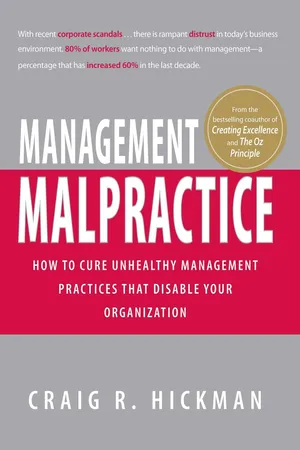
Management Malpractice
eBook - ePub

Management Malpractice

How to Cure Unhealthy Management Practices That Disable Your Organization

  1. 272 pages
  2. English
  3. ePUB (mobile friendly)
  4. Available on iOS & Android
eBook - ePub

Management Malpractice

How to Cure Unhealthy Management Practices That Disable Your Organization

About this book

Cynicism and distrust are rampant in today's business environment. Eighty percent of employees want nothing to do with their organizations, or the managers who run them. Great management principles, once the backbone of successful companies, are now often used and manipulated by corporate leaders for their own gain. If left unchecked, these formerly great principles turn into malpractices that damage morale, thwart productivity and destroy companies. Management Malpractice provides practical advice for preventing and curing abuses and shows how managers and organizations can work together to restore value to their organizations.

Frequently asked questions

Yes, you can cancel anytime from the Subscription tab in your account settings on the Perlego website. Your subscription will stay active until the end of your current billing period. Learn how to cancel your subscription.
At the moment all of our mobile-responsive ePub books are available to download via the app. Most of our PDFs are also available to download and we're working on making the final remaining ones downloadable now. Learn more here.
Perlego offers two plans: Essential and Complete
  • Essential is ideal for learners and professionals who enjoy exploring a wide range of subjects. Access the Essential Library with 800,000+ trusted titles and best-sellers across business, personal growth, and the humanities. Includes unlimited reading time and Standard Read Aloud voice.
  • Complete: Perfect for advanced learners and researchers needing full, unrestricted access. Unlock 1.4M+ books across hundreds of subjects, including academic and specialized titles. The Complete Plan also includes advanced features like Premium Read Aloud and Research Assistant.
Both plans are available with monthly, semester, or annual billing cycles.
We are an online textbook subscription service, where you can get access to an entire online library for less than the price of a single book per month. With over 1 million books across 1000+ topics, we’ve got you covered! Learn more here.
Look out for the read-aloud symbol on your next book to see if you can listen to it. The read-aloud tool reads text aloud for you, highlighting the text as it is being read. You can pause it, speed it up and slow it down. Learn more here.
Yes! You can use the Perlego app on both iOS or Android devices to read anytime, anywhere — even offline. Perfect for commutes or when you’re on the go.
Please note we cannot support devices running on iOS 13 and Android 7 or earlier. Learn more about using the app.
Yes, you can access Management Malpractice by Craig R Hickman in PDF and/or ePUB format, as well as other popular books in Business & Business General. We have over one million books available in our catalogue for you to explore.

Information

PART I
Innovation and Creative Imaginings
PART II
Individuals and Employees
PART III
Corporate Culture and Structure
PART IV
Interpersonal Relationships and Teams
PART V
Visionary Leadership and Strategy
Management_Malpractice_0002_001
MALPRACTICED PRINCIPLE #1
“Develop a Healthy Dissatisfaction with the Status Quo”
JAKE FINDLEY sat in the executive committee meeting waiting for the right time to make his dissatisfaction with certain personnel policies known. Jake was the president of a small division in a rapidly growing $1 billion industrial services company that provided technology, equipment, and services to utilities, oil refineries, and chemical processors. His division specialized in equipment rental and leasing. He was one of seven division presidents in the company and had been in the position for two years.
The discussion turned to human resources. Jake took a deep breath and readied himself to express his dissatisfaction with several rigid and ineffective personnel practices.
“I have concerns about policy development residing at the corporate level. We need more flexibility to deal with our unique needs and I'm not sure that certain standardized policies work anymore,” he said.
“You've been living with these policies for two years … why the concern now?” Don Matlin, chairman and CEO, said with a hint of defensiveness.
“Because we want to introduce new policies like spot bonuses, flextime, and more vacation time to attract and retain the best people,” Jake said.
Management_Malpractice_0003_001
“We can't keep changing policies to accommodate everyone; it isn't fair to the other divisions. It violates the principle of equity, which I firmly believe in,” Don returned.
Mike Rabonich, one of the other division presidents, spoke up. “That's the problem with getting larger … corporate creep. Policies and rules proliferate and then you can't change them.”
“We can't keep changing policies. It will never end,” Don said.
“Why is one of our values ‘cultivate a dissatisfaction with the status quo,’ if we never want to change our policies?” Jake asked.
“I'm not saying we'll never change our policies, but we can't do it willy-nilly, and we certainly can't do it at the drop of a hat,” Don said.
“So what's the process for changing HR policies?” Mike asked.
“Fran, it looks like it's time for a full-blown review of our HR policies,” Don said, looking at Fran Carrera, the company's VP of human resources.
Fran nodded and was about to respond when she was interrupted.
“Jake and Mike are right. We can't make change so difficult that we have to perform a full-blown review every time there's a new idea. We've got to be more flexible than that. Otherwise we should get rid of our ‘dissatisfaction with the status quo value,’ Chief Financial Officer Jessica Walthus said.
“Okay,” Don said with more than a hint of frustration. “We'll come up with an approach to policy changes and get back to you. Right now we need to turn our attention to the proposed cost-cutting measures for this quarter.”
“So much for dissatisfaction,” Jake muttered under his breath but loud enough for Mike to hear him.
Mike smiled. “Don't give up, we'll get there … eventually.”
They both chuckled and then nodded to each other, acknowledging their mutual cynicism.
Facing the Truth
The Status Quo Is an Enemy to Progress
After decades of emphasis on change management in a world of growing complexity and volatility, most business leaders and corporate enterprises agree that healthy dissatisfaction with the status quo is a good thing—in fact, it's something to be encouraged and promoted. But how far should you go? All the way to destruction of the status quo, according to McKinsey & Company consultant Richard Foster, coauthor of the book Creative Destruction: Why Companies That Are Built to Last Underperform the Market—And How to Successfully Transform Them. Old processes, systems, structures, approaches, methodologies, and paradigms must be revolutionized, if we expect to accelerate the growth and advancement of our enterprises. Healthy dissatisfaction means being pissed off enough about the status quo to actually destroy the old and invent the new. The greatest obstacle to future progress is the viewpoints, philosophies, and habits of the past.
Fostering a healthy dissatisfaction with the status quo gives you and your organization the strength to overcome the limits of your past and the ability to boldly create your future. Don't let anyone in your organization think that dissatisfaction with the status quo represents negativity, disloyalty, or untrustworthiness—such dissatisfaction is vital to the future viability of your organization.
The Lie—“We want our employees to develop a healthy dissatisfaction with the status quo so that the organization can quickly adapt to changing circumstances.”
The Truth—Most organizations pay lip service to expressing dissatisfaction with the status quo but few of them want more than incremental change from internally generated efforts. Mergers and acquisitions give the appearance of significant change but rarely do more than combine two slowly changing organizational systems.
The Malpractice—Promoting a healthy dissatisfaction with the status quo when you really want only limited dissatisfaction and incremental change so that it does not disrupt current operations. In other words, you encourage dissatisfaction with the status quo as means of attaining excellence, while discouraging dissent and criticism of corporate policies and procedures.
This management malpractice has arisen because certainty is preferred over uncertainty. The problem is that in a world of extreme and rapid change, any preference for certainty over uncertainty entrenches the status quo and makes progress dependent upon incremental improvements.
The Prescription—Don't ask your people to be dissatisfied unless you're willing to live with the consequences. When your people become more critical and questioning because you've asked them to cultivate a healthy dissatisfaction with the status quo, don't turn around and call them malcontents or label their input as negativity. Dissatisfaction with the status quo leads to new ideas, innovation, and improved processes in the long run.
Won't too much dissatisfaction with the status quo make people unhappy and unproductive? Not according to management guru Tom Peters. In his new book, Reimagine! Business Excellence in a Disruptive Age, Peters makes his dissatisfaction with the status quo abundantly clear. “I'm mad that I—and a lot of people more clever than I—have been screaming and yelling and shouting about bankrupt business processes for twenty-five or thirty years … mostly to no avail.” Agreed! Organizations that foster greater dissatisfaction with the status quo will reap greater benefits, including adaptability, versatility, agility, and perpetual viability. Peters may be right: “We need a lot more outrage and many more pissed-off people if we want to change the world.”
Exposing the Lie
Dissatisfaction with the Status Quo Is Only Favored When It Doesn't Threaten Current Sales
When the status quo feeds and clothes you, provides you with a comfortable lifestyle, and causes you to view change as unnecessary and too uncertain, why would you, unless you're one of those personality types driven by change, want to be dissatisfied with it? Or at the very least, why would you want to stick your neck out to express it? Most people in such situations—and there are more than you think—don't want to nurture a dissatisfaction with the status quo; in fact, they often resent and distrust executives and managers who keep asking them to work and think outside of their comfort level. Furthermore, they detest executives who, after finally convincing their people to embrace dissatisfaction, pull the rug out from underneath them by failing to support or even rejecting change initiatives that come from them.
Take DuPont, the $30 billion chemical giant, as an example. At one of the company's divisions, DuPont Pharmaceuticals, executives are trying to foster a healthy dissatisfaction with the status quo; however, their frontline managers and sales reps don't want to let go of their traditional practices because life is good. Unfortunately, DuPont is not unique. This is a common occurrence in most organizations: corporate executives encourage dissatisfaction with the status quo while frontline managers and sales reps resist change and hold on to the status quo because their livelihood depends on it. Sometimes it happens in reverse; frontline managers want change while senior executives offer up the resistance. In the case of DuPont Pharmaceuticals, senior executives seem to want both—change and stasis. The company's compensation systems are still tied to the traditional business model of drug company sales reps visiting doctors, which is a highly successful practice. On the other hand, the company's senior executives are promoting Internet portals that enable sales reps to build Web sites for their customers. The Internet portals would save time and be more convenient for the doctors—but the sales reps, not surprisingly, are not responding. They're unwilling to sacrifice compensation for the sake of progress.
Getting managers and sales reps to change their methods without giving them sufficient incentive or backup during a period of transition is unlikely to work for DuPont Pharmaceuticals or any other company. At a recent ePharma Summit in Philadelphia, Derek Jones, senior director of e-business for DuPont Pharmaceuticals, commented on the company's struggle to promote new business models while holding on to the old ones: “This is a really tough one, and you have to work on multiple levels to overcome it.”
Promoting a healthy dissatisfaction with the status quo is tricky business because you risk confusing your employees by forcing too much ambiguity on them and exposing them to dilemmas that they are not prepared to resolve. Not surprisingly, DuPont Pharmaceuticals' senior executives have experienced significant internal roadblocks to their e-business strategies. If you want your employees to have a healthy dissatisfaction with the status quo, you must be prepared to support them and guide them in the quest for a better way. If you don't, you may be accused of malpractice.
Avoiding the Malpractice
Dissatisfaction with the Status Quo and Negativity Are Not the Same Things
Five times on Fortune's most admired companies list over the past twenty years, Southwest Airlines built itself upon dissatisfaction with the status quo. Unhappy and dissatisfied with the way things were in the airline industry, Rollin King and Herb Kelleher changed the industry with their simple, streamlined notion: “If you get your passengers to their destinations when they want to get there, on time, at the lowest possible fares, and make darn sure they have a good time doing it, people will fly your airline.” Their dissatisfaction worked, creating an airline with more than $6 billion in revenue, 3,000 flights a day, 35,000 employees, more than 30 consecutive years of profitability in an industry famous for its losses, and “the airline industry's best cumulative consumer satisfaction record,” according to statistics accumulated and published by the U.S. Department of Transportation.
How do they do it? According to President Colleen Barrett, the company has always been innovative and always will be because of its employees. “No matter how often we are copied, no one can duplicate our employees,” who always maintain a healthy dissatisfaction with the s...

Table of contents

  1. Cover
  2. Title Page
  3. Contents
  4. Introduction: A Growing Epidemic of Management Malpractice
  5. Part I: Innovation and Creative Imaginings
  6. #1: “Develop a Healthy Dissatisfaction with the Status Quo”
  7. #2: “Share Ideas of Every Kind at Every Level”
  8. #3: “Constantly Challenge Assumptions and Biases”
  9. #4: “Commit to Rethinking the World”
  10. #5: “Dream and Imagine That Anything Is Possible”
  11. Part II: Individuals and Employees
  12. #6: “Treat Employees as Your Most Valuable Asset”
  13. #7: “Respect Others and Their Individuality”
  14. #8: “Accept Responsibility for Your Actions”
  15. #9: “Value the Contributions of Each Employee”
  16. #10: “Establish a Balance Between Work and Your Personal Life”
  17. Part III: Corporate Culture and Structure
  18. #11: “Create an Environment Where People Feel Free to Raise Concerns”
  19. #12: “Represent the Diversity of the World You Serve”
  20. #13: “Create a Foundation of Trust”
  21. #14: “Develop a Passion for Learning”
  22. #15: “Eliminate Organizational Barriers”
  23. Part IV: Interpersonal Relationships and Teams
  24. #16: “Provide Employees with Meaningful Work Opportunities”
  25. #17: “Clearly Communicate Expectations”
  26. #18: “Enable People to Tap into Their Full Potential”
  27. #19: “Become an Ethical Role Model for Other Employees”
  28. #20: “Listen to All Viewpoints”
  29. Part V: Visionary Leadership and Strategy
  30. #21: “Use the Advantages of Size to Take Risks”
  31. #22: “Do What Matters Most”
  32. #23: “Create a Clear Vision of Where You’re Going”
  33. #24: “Solve Customer Problems”
  34. #25: “Lead the Way Through Change”
  35. Conclusion: Restoring the True Value of Great Management Principles
  36. Acknowledgments
  37. Copyright