Gobbledygook
eBook - ePub

Gobbledygook

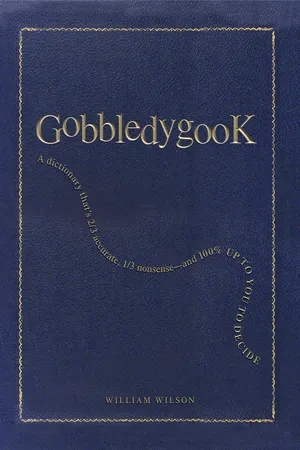
A Dictionary That's 2/3 Accurate, 1/3 Nonsense - And 100% Up to You to Decide

  1. 272 pages
  2. English
  3. ePUB (mobile friendly)
  4. Available on iOS & Android
eBook - ePub

Gobbledygook

A Dictionary That's 2/3 Accurate, 1/3 Nonsense - And 100% Up to You to Decide

About this book

blad: To strike hard or buffet.
kring: To focus on with laser-like intensity.
stridhana: Under Hindi law, property belonging to a woman.Two of these words and their definitions are right. One word and its meaning have been made up. But which one? Only if you've read this book will you know for sure!*This fun, fascinating book boasts hundreds of obscure, outdated, and outrageous words. You and your friends will spend hours of fun debating, shouting, laughing, and mulling over such obtuse gems as galliardise, telestich, and quidnunc. And you'll have even more fun guessing the lexicographical imposters, scoring points, and outwitting your family and friends.Let the word games begin!*And you won't find out which one is fake unless you buy the book!
Frequently asked questions

Yes, you can cancel anytime from the Subscription tab in your account settings on the Perlego website. Your subscription will stay active until the end of your current billing period. Learn how to cancel your subscription.
No, books cannot be downloaded as external files, such as PDFs, for use outside of Perlego. However, you can download books within the Perlego app for offline reading on mobile or tablet. Learn more here.
Perlego offers two plans: Essential and Complete
  • Essential is ideal for learners and professionals who enjoy exploring a wide range of subjects. Access the Essential Library with 800,000+ trusted titles and best-sellers across business, personal growth, and the humanities. Includes unlimited reading time and Standard Read Aloud voice.
  • Complete: Perfect for advanced learners and researchers needing full, unrestricted access. Unlock 1.4M+ books across hundreds of subjects, including academic and specialized titles. The Complete Plan also includes advanced features like Premium Read Aloud and Research Assistant.
Both plans are available with monthly, semester, or annual billing cycles.
We are an online textbook subscription service, where you can get access to an entire online library for less than the price of a single book per month. With over 1 million books across 1000+ topics, we’ve got you covered! Learn more here.
Look out for the read-aloud symbol on your next book to see if you can listen to it. The read-aloud tool reads text aloud for you, highlighting the text as it is being read. You can pause it, speed it up and slow it down. Learn more here.
Yes! You can use the Perlego app on both iOS or Android devices to read anytime, anywhere — even offline. Perfect for commutes or when you’re on the go.
Please note we cannot support devices running on iOS 13 and Android 7 or earlier. Learn more about using the app.
Yes, you can access Gobbledygook by William Wilson in PDF and/or ePUB format. We have over one million books available in our catalogue for you to explore.

Information

Publisher
Adams Media
Year
2011
Print ISBN
9781440528187
eBook ISBN
9781440529245

The fake word is:

stramlished

Hurricanes have wreaked havoc since long before recorded history, but here are some of modern times’ worst:
  • The Okeechobee Hurricane of 1928 killed 2,500 people and caused the equivalent of $300 million worth of damage in Florida, the Bahamas and Puerto Rico.
  • In 1992, Hurricane Andrew caused $30 billion in damages to south Florida.
  • The bizarre movement of 1994’s Hurricane Gordon—which went from Central America to Florida to North Carolina and then back to Florida—killed 1,145 people.
  • Hurricane Katrina not only devastated portions of New Orleans and the Gulf Coast in 2005, but it also killed nearly 2,000 people and became a politically charged storm. Some felt that the government’s response to the disaster was much too slow and led directly to some of the storm’s deaths.
What ever
The so-called Valley Girls, pampered young ladies living in California’s San Fernando Valley, first started using this word religiously in the 1980s. In effect, it means, “What you’re saying is irrelevant, so shut up,” or something equally rude and dismissive. At the turn of the present century, “whatever” began to pop up in the mouths of teenagers (and adults, for that matter). Marist College polls in both 2009 and 2010 rated “whatever” the most annoying phrase in a conversation.

eenamost, barant,
illuminism

  1. eenamost (EE-nuh-most) (adv.): A contraction of even and almost equivalent to the word “nearly.” This is a classic example of what author Lewis Carroll called a “portmanteau word.” A portmanteau is a suitcase, and the idea is that if you were to throw a couple of words in a suitcase and hurl them around, new words would be the result.
  2. barant (buh-RANT) (noun): A reclining wingback chair. The first recliners were made in Michigan in the 1920s.
  3. illuminism (ih-LOOM-uh-nizz-uhm) (noun): Belief in or claim to possess superiority of a personal, intellectual, cultural, or spiritual manner, not accessible to humankind in general. The word shares the same root as “Illuminati,” the supposed “shadowy figures” behind most world powers.

The fake word is:

barant

Monroe, Michigan, cousins Edward Knabusch and Edwin Shoemaker helped to make the world a lazier place by inventing the first recliner, incidentally not ever called a barant. The two quit their day jobs in 1927 in order to build the American dream. They started with shoes before moving on to furniture. In 1928, they designed a wooden model recliner. In 1929, they began making upholstered models and settled on the name “La-Z-Boy.”
Just as they got their business off the ground, the stock market crashed. When customers couldn’t buy chairs with money, the cousins took livestock or other items for trade. The La-Z-Boy has been a success ever since.
Twas Brillig!
Arguably, Lewis Carroll’s most famous poem is “Jabberwocky,” which is chock-full of portmanteau words. It first appeared in Through the Looking-Glass, and What Alice Found There. Although somewhat puzzling, “Jabberwocky” remains a classic because its plot is easy to follow, despite neologisms embedded within the poem like nuts in a brownie. In “Jabberwocky,” a young man goes out to fight a beast called a Jabberwock, is successful, and returns home to much acclaim.
Along the way, readers are confronted with words like “slithy,” which appears to be a conflation of the words “slimy” and “slithery,” and “frumious,” which uses pieces of the words “furious” and “frightening.” In addition, Carroll made up some words that do not appear to be related to other words. Some of them, such as “chortle,” have become a permanent part of our lexicon.

behindhand, urceiform,
elatory

  1. behindhand (bee-HIND-hand) (adv. or adj.): To be in debt; to be behind the times; tardy. As of spring 2011, America’s national debt had climbed at a rate of about $4.07 billion a day since September of 2007!
  2. urceiform (UHRSS-uh-form) (adj.): Shaped like an ancient Roman pitcher with one handle. Most Roman pitchers were made of terra cotta, a clay-based, unglazed ceramic.
  3. elatory (EE-luh-tore-ee) (adj.): Characterized by sudden bursts of excitement. Children, as parents and teachers know, are quite susceptible to elatory actions.

The fake word is:

elatory

One reason so many children are “elatory” is ADHD. Since the 1970s, Attention Deficit Hyperactivity Disorder has become a catch-all for all manner of children’s poor behavior: acting out, not paying attention, not staying on task, being unfocused, etc. We used to scold these children and try to force them to behave. Now, we medicate them.
Even though children are most often associated with ADHD, more than half of diagnosed children continue to show signs of the neurological disorder into adulthood.
Hand Me That Pitcher, Molly!
Molly Pitcher is a name that many children still learn when being introduced to the American Revolution. Most likely, she was a composite of many patriotic women, especially two particular women.
Mary Ludwig Hayes (nicknamed Molly) followed her husband into battle, which was a not uncommon practice. These so-called camp followers would cook and clean for their husbands. Sometimes they would even get involved in battles. Revolutionary-era cannons needed a steady supply of water, and soldiers would call out to Mary (and probably others), “Molly! Pitcher!” One day, as history or legend suggests, Hayes actually took over firing the cannon after her husband was wounded.
Margaret Corbin is another possible source for “Molly Pitcher.” Her story is very similar to Hayes’s. When her husband John was wounded, Corbin took his place at a cannon during the defense of Fort Washington.

cofradia, fushionless,
harfen

  1. cofradia (koe-fruh-DEE-uh) (noun): Roman Catholic laymen in Mexico and Central America who take responsibility for pilgrimages, ceremonies, and the care of religious images. Cofradia also is a town in Honduras.
  2. fushionless (FUSH-uhn-less) (adj.): Insipid or tasteless; alternatively, to be physically weak or mentally dull. He may be anything but mentally dull, but filmmaker John Waters proudly accepts accolades for being considered one of the most “tasteless” auteurs in cinematic history.
  3. harfen (HARFF-uhn) (verb): To make constant attempts at improvement. Horatio Alger Jr. became famous in the nineteenth century for his tales of impoverished young men who harfen their way to success.

The fake word is:

harfen

Today, the name Horatio Alger—if recognized at all—suggests a romanticized worldview that is not actually attainable. But in the nineteenth century, people ate up Alger’s books like teens reading Twilight.
His most popular book, and one that is still in print today, is Ragged Dick. As the novel opens, Dick is a homeless, smoking, drinking fourteen-year-old shoeshine boy. He’s determined (not harfened) to turn over a new leaf. Some of his customers, recognizing Dick’s will to power, befriend the boy, taking him to church, paying him extra, etc.
One day, Dick saves a boy from drowning. In his gratefulness, the boy’s father gives Dick a position in his firm. Voila! Dick becomes a member of the middle class and forever will be known as Richard Hunter, Esq.
The Trashiest Movie Ever Made?
Despite being forty years old, John Waters’s Pink Flamingos still has the power to shock. In this darkest of black comedies, Waters seeks to portray practically every taboo imaginable … and even some that aren’t typically thought of, such as exposing oneself with a large sausage tied to one’s privates.
Most famously, the film about “The Filthiest People Alive” ends with its star, Divine, eating actual dog poop. She follows a poodle around until it does its business, picks up the result, throws it in her mouth, and smiles for the camera. Cut! Print! That’s a wrap!

dicretinous, bobeche,
gomeral

  1. dicretinous (duh-CREET-uh-nuss) (adj.): Two-faced; given to rapid, unpredictable change. The epitome of a dicretinous character is Two-Face, one of comic book hero Batman’s archvillains.
  2. bobeche (boh-BESH) (noun): A collar on a candle socket to catch wax drippings. When chandeliers used candles, one can only imagine the difficulty servants would have had cleaning and replacing each chandelier’s many bobeches.
  3. gomeral (GAHM-uh-rull) (noun): A simpleton; a fool. Jamaican reggae artist Christopher Harrison was better known as “Simpleton.” Simpleton had a 1992 hit with “Coca Cola Bottle Shape.”

The fake word is:

dicretinous

Harvey Dent was once Gotham City’s district attorney, and he was Batman’s friend, helping the Caped Crusader put away legions of bad guys. One day, one of these fiends throws acid in Dent’s face, disfiguring one-half of his visage.
Afterward, Dent goes insane. He carries with him a coin. One side is normal, and the other has an “X” scratched on it. Whenever Dent, now going by the moniker “Two-Face,” faces a decision, he flips the coin. If the unblemished side comes up, Two-Face does what most would consider the right thing. If the other side comes up, however, he will commit heinous acts.
Reggae’s Godfather
Jamaica’s Alton Ellis is called the “Godfather of Rocksteady” because he is widely credited with helping to create this musical precursor to reggae. As such, he could also claim a place as the Godfather of Reggae.
Before rocksteady there was ska, a mishmash of traditional Caribbean music, American jazz, and rhythm and blues. Rocksteady slowed down the tempo, leading the way to the more laid-back grooves of reggae. The term “rocksteady” comes from an Ellis song called—what else—“Rock Steady.”

minnesinger, rowdydow,
codlerize

  1. minnesinger (MIHN-ih-seeng-uhr) (noun): One belonging to a class of German lyric poets and musicians flourishing from the twelfth to fourteenth centuries. Three of the most famous are Heinrich von Veldeke, Wolfram von Eschenbach, and Hartmann von Aue.
  2. rowdydow (ROW [rhymes with cow]-dee-dow) (noun): Noisy excitement. Think hubbub and hullaballoo. It’s almost as much fun to say!
  3. codlerize (KAHD-luhr-ize) (verb): To make someone or something appear insignificant due to a propensity to repeat a point incessantly. History, literature, and politics are filled with individuals who can’t seem to resist revisiting the same point again and again. For example, Herbert Hoover wrote numerous books trying to explain why he wasn’t responsible for the onset of the Great Depression, even though it happened during his watch.

The fake word is:

codlerize

If you do i...

Table of contents

  1. Cover
  2. Title Page
  3. Dedication / Acknowledgments
  4. Copyright
  5. Introduction
  6. ab absurdo, capacitance, bibliometagraphia
  7. eenamost, barant, illuminism
  8. fronch, blinter, craton
  9. About the Author