- 288 pages
- English
- ePUB (mobile friendly)
- Available on iOS & Android
eBook - ePub
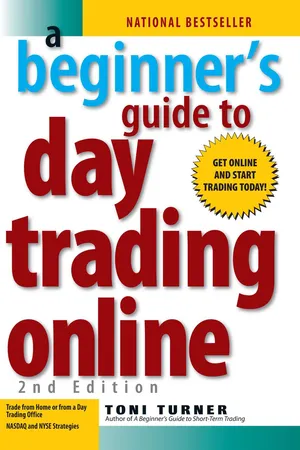
A Beginner's Guide To Day Trading Online 2nd Edition
About this book
The national bestsellerupdated for the new stock market!
"Read the book if you want to know how the market works and how to make it work for you." Greg Capra, president of Pristine.com, coauthor of Tools and Tactics for the Master Day Trader
"By using the tools, trading tactics and strategies revealed in...A Beginner's Guide to Day Trading Online, you will be armed with the skills needed to help you win your battle with the markets." Steve Nison, CMT, president, www.candlecharts.com, author of Japenese Candlestick Charting Techniques
"Read this book, and, two, reread this book. It will help you achieve your trading goal, which is to make money in the markets. Every trader, from a beginner to the advanced professional, should have this book!" John Person, CTA, president, Nationalfutures.com
"There are only a handful of trading educators that I would recommend listening to and...Toni Turner is one of them." Hubert Senters, www.tradethemarkets.com
Day trading is highly profitableand highly tumultuous. Moreover, the financial markets have changed considerably in recent years. Expert author Toni Turner gives you the latest information for mastering the markets, including:
Written in an accessible, step-by-step manner, A Beginner's Guide to Day Trading Online, 2nd Edition shows how to day-trade stocks in today's market.
"Read the book if you want to know how the market works and how to make it work for you." Greg Capra, president of Pristine.com, coauthor of Tools and Tactics for the Master Day Trader
"By using the tools, trading tactics and strategies revealed in...A Beginner's Guide to Day Trading Online, you will be armed with the skills needed to help you win your battle with the markets." Steve Nison, CMT, president, www.candlecharts.com, author of Japenese Candlestick Charting Techniques
"Read this book, and, two, reread this book. It will help you achieve your trading goal, which is to make money in the markets. Every trader, from a beginner to the advanced professional, should have this book!" John Person, CTA, president, Nationalfutures.com
"There are only a handful of trading educators that I would recommend listening to and...Toni Turner is one of them." Hubert Senters, www.tradethemarkets.com
Day trading is highly profitableand highly tumultuous. Moreover, the financial markets have changed considerably in recent years. Expert author Toni Turner gives you the latest information for mastering the markets, including:
- Decimalization of stock prices
- New trading products such as E-minis and Exchange Traded Funds (ETFs)
- Precision entries and exits
- The new breed of trader
Written in an accessible, step-by-step manner, A Beginner's Guide to Day Trading Online, 2nd Edition shows how to day-trade stocks in today's market.
Frequently asked questions
Yes, you can cancel anytime from the Subscription tab in your account settings on the Perlego website. Your subscription will stay active until the end of your current billing period. Learn how to cancel your subscription.
No, books cannot be downloaded as external files, such as PDFs, for use outside of Perlego. However, you can download books within the Perlego app for offline reading on mobile or tablet. Learn more here.
Perlego offers two plans: Essential and Complete
- Essential is ideal for learners and professionals who enjoy exploring a wide range of subjects. Access the Essential Library with 800,000+ trusted titles and best-sellers across business, personal growth, and the humanities. Includes unlimited reading time and Standard Read Aloud voice.
- Complete: Perfect for advanced learners and researchers needing full, unrestricted access. Unlock 1.4M+ books across hundreds of subjects, including academic and specialized titles. The Complete Plan also includes advanced features like Premium Read Aloud and Research Assistant.
We are an online textbook subscription service, where you can get access to an entire online library for less than the price of a single book per month. With over 1 million books across 1000+ topics, weâve got you covered! Learn more here.
Look out for the read-aloud symbol on your next book to see if you can listen to it. The read-aloud tool reads text aloud for you, highlighting the text as it is being read. You can pause it, speed it up and slow it down. Learn more here.
Yes! You can use the Perlego app on both iOS or Android devices to read anytime, anywhere â even offline. Perfect for commutes or when youâre on the go.
Please note we cannot support devices running on iOS 13 and Android 7 or earlier. Learn more about using the app.
Yes, you can access A Beginner's Guide To Day Trading Online 2nd Edition by Toni Turner in PDF and/or ePUB format, as well as other popular books in Business & E-Commerce. We have over one million books available in our catalogue for you to explore.
Information
CHAPTER 1
This Ainât No Dress Rehearsal!
BENEFITS OF DAY TRADING: THE GOOD NEWS
Day trading is a made-to-order profession. By and large, you can work when and where you want to. You can structure your days as you chose, working from your office or home, or even when traveling, when need be.
If you think of it as a small business, the initial investment in equipmentâa good computer, one to three monitors, fast Internet hookup, and softwareâis relatively inexpensive.
You can live anywhere. If you decide to move to Bangor, Maine, from Yeehaw Junction, Florida, just dismantle your electronic monsters, pack them up, and go. If you long to go skiing for a week and can afford it, take your account flat (traderâs jargon for taking your account to cash), and go.
As an active trader, youâre independent and answer to no one but yourself. Forget reporting to a nasty boss. You can stay in bed when you have the flu. You donât have to wear a tie that chokes you or high heels that dislocate your back. You can trade in a torn T-shirt, flannel shorts, and duck slippers.
Youâll develop your own style, fast-paced or easy-going. Days when the market is highly volatile, you can, and should, take the day off. Run errands, play with your kids, or go shopping with the money you saved by staying out of the market on a whippy, choppy day.
THE FLIP SIDE: WALL STREET TAKES NO PRISONERS
All of the above is the good news. Now, letâs look at the less-than-charming realities you need to know before you place that first trade.
When I first started trading, I crawled into bed one night with a bowl of praline ice cream and Trading for a Living.
In the opening pages, author Dr. Alexander Elder writes, âMarkets operate without normal human helpfulness. Every trader tries to hit others. Every trade gets hit by others. The trading highway is lettered with wrecks. Trading is the most dangerous human endeavor, short of war.â
âHumph,â I thought. âDr. Elder certainly has a negative attitude.â
A few weeks and one bloodied trading account later, I knew Dr. Elder was right on the money. In the hands of the wrong person, trading can be hazardous to oneâs wealth.
Hereâs another reality statement: This business crushes most who enter its doors. Nearly 80% of those who try, quit. They lose their trading accounts by ignorance, trading too much, or taking foolish risks. Some canât handle the stress.
You can earn substantial profits day trading. If the rewards are high, however, so are the tradeoffs. The stock market is a ruthless arena. Newsweek once called Wall Street âthe avenue of avarice.â Itâs inhabited by the sharpest minds in the world, all intent on grabbing your money as fast as possible. Itâs a greed-against-greed, fear-versus-fear, trader-battling-trader, if-you-die-I-win world. Every day. No mercy. The more you lose, the harder I laugh.
âBut buying a stock can be a complacent click on my computer screen,â you say, puzzled. âI donât see the greed and fear connection.â
Take my word for it. When I began trading, I didnât see the connection either, but I learned in short order, and the lesson was expensiveââvery expensive.
The best way to start trading is slowly, calmly, and armed with knowledge youâve already accumulated. Watch CNBC or another financial network every day for several weeks, so you can internalize market rhythms. Soak up the gist of the âif, then,â logic. If this happens on Wall Street, then that usually follows. Stare at market indicators and absorb how they act in relation to one another. Listen to market gurus and keep track as to whether their predictions come true.
Place paper trades for a few weeks. Iâll explain how in Chapter 3. Keep in mind, though, that while paper trading is good practice, it doesnât accurately portray how real trades play out. Reason? The absence of emotion.
If you listen and heed my advice, it will save you money and headaches. Every caveat I give you in the pages that follow comes from a lesson I learned the hard way. If you learn from the lessons, youâll keep your losses small and your gains high.
I jumped into trading head first, assuming I knew what I was doing. I didnât.
As a successful investor, I imagined trading was the same thing, but at a faster pace. Not true. Comparing trading and investing is like comparing hamsters with kangaroos. Yes, the time frames are different, but mindsets are different, too. So are entry points, exit points, and risk-reward ratios. Traders concern themselves with market and stock trends, whereas investors want stocks that outperform the overall market.
Please go slowly when you enter this profession. A cautious turtle will keep his or her money, then make more. An impetuous hare will end up in the briar patch.
WHAT DOES A DAY TRADER LOOK LIKE?
Traders in the trenches insist we need three things to trade successfully, namely, the âThree Bs,â or Bucks, Brains, and, uh, . . . Boldness (polite substitute for actual word). Theyâre right.
First, of course, is bucks. Anyone who says you can start trading with $2,000 or less is blowing smoke. Why? Because, at some point in time, you are going to lose money. You may make it back, but you will lose it first. Show me a successful trader who says he or she didnât lose money learning how to trade, and Iâll show you someone growing a Pinocchio nose! If losing money stops your heart, trading is not your game.
Next comes brains. Iâm going to assume you own mental horsepower if youâre reading this book.
If you donât know what I mean by boldness, you will, if you stick around the financial markets long enough. This profession gives you confidence and mental toughness not only when youâre trading, but in every area of your life. After all, if youâre a day trader, you survive in one of the toughest arenas in the world.
My nontrading friends ask me repeatedly, âHow do you do that all day? Isnât it risky?â
You bet. If you donât love jumping blindfolded into the dark unknown, with no guarantee whether youâll land on a pile of feather pillows or into a crater of hot lava, please donât trade.
Successful traders know how to act swiftly. Many times youâll have one second to make a decision that may affect your account by thousands of dollars. If your middle name is Waffle, youâll be happier investing.
The best traders also multitask easily. They scan charts, while listening to CNBC, while watching a list of major market indicators and mentally computing their relationship to one another, while keeping an eye on one or more stock positions, while remembering the strategy and stops for each trade, while executing a momentum play or two, while . . .
Successful traders also pay attention to their intuition. By intuition, I donât mean you should buy a stock because you have a âgut feelingâ itâs going to fly. Thatâs never a good idea. I mean you can use the gut feeling developed by all good traders through experienceâthe hunch that tells you something in the market is good, or amiss, before the actual event takes place.
The traders holding the fattest wallets have the ability to change their minds in a nanosecond. Being right or wrong has nothing to do with it. They know that sticking to a decision they made hours, or even minutes, ago just to prove they are ârightâ is the worst thing a trader can do.
Emotional discipline is a must. The best traders monitor their emotions constantly. In Trading for a Living, Dr. Elder writes, âYour feelings have an immediate impact on your account equity. You may have a brilliant trading system, but if you feel frightened, arrogant, or upset, your account is sure to suffer.â
Iâve traded while feeling scared, smug, and sad. During those times, Iâve always lost money. One emotion I still allow myself, however, is pure, self congratulation. After I close a great trade, I say, âYou go, girl,â and I grab a piece of chocolate.
This is the perfect moment for you to pause for introspection and conduct a reality check as to whether or not youâd be happy and prosperous as an active trader. Forget your ego. Be completely honest and ask yourself these questions: âCan I chance losing part of my account?â âDo I think fast and stay cool under stress?â âCan I control my emotions?â
TO TRADE OR NOT TO TRADE?
As one of my best friends says about life, âThis ainât no dress rehearsal.â
Neither is trading. You canât âsort ofâ ride a roller coaster. Either youâre hurtling through space at mach two with your hair on fire or youâre standing on the ground below. You canât do both. To dangle one foot outside the speeding car is mighty dangerous.
Before you start to trade:


AUTHORâS NOTE
Learning to trade successfully was the most vitalizing, yet the most difficult, undertaking of my life.
As with all professions, the good times, when everything fell into place, delivered a sense of self-satisfaction and composure. The not-so-good times, when everything I touched knocked me down, gave way to discouragement and frustration.
To cope with the challenging times, I studied principles gleaned from motivational teachings. I hoped that if I stepped back from the trading world and observed larger truths of life from a different vantage point, it would empower me to persevere. It did.
Each âCenter Pointâ in this text summarizes various concepts and observations that kept me centered on my goal of becoming an accomplished trader. They also benefited other areas of my life.
I trust you will find these messages to be valuable handrails as you make your way over the stepping stones to success.

CENTER POINT: THE POWER OF COMMITMENT
âUntil one is committed, there is hesitance, the chance to draw back, always ineffectiveness. Concerning all acts of initiative (and creation), there is one elementary truth, the ignorance of which kills countless ideas and splendid plans: that the moment one definitely commits oneself, then providence moves, too. A whole stream of events issues fro...
Table of contents
- Cover
- Dedication
- Foreword
- Introduction
- Chapter 1âThis Ainât No Dress Rehearsal!
- Chapter 2âWall Street: A View from the Top of the Skyscraper
- Chapter 3âDay Trading Is Your Business: Letâs Set It Up That Way
- Chapter 4âThe Winning Market Mentality That Leads to Profits
- Chapter 5âTrading Fundamentals Youâll Build On
- Chapter 6âTechnical Analysis 101: The Trend Is Your Friend
- Chapter 7âChoose a Stock to Trade
- Chapter 8âWhen the Tough Get Going: Beginning Traderâs Boot Camp
- Chapter 9âPlan Your Trade and Trade Your Plan
- Chapter 10âThe Swinging Day Trader
- Chapter 11âScalps and Shorts, or the Quick and the Dead
- Chapter 12âLove Your Losses: Theyâre a Traderâs Best Friend!
- Chapter 13âTrading Survival Techniques
- Chapter 14âThe Future Is Now!
- Recommended Reading List
- Acknowledgments
- About the Author
- Index
- Copyright