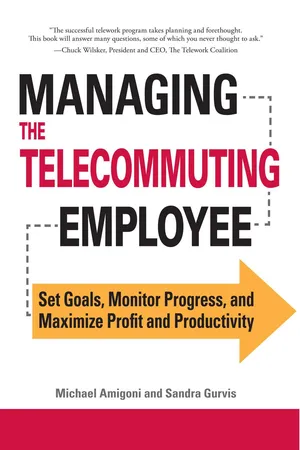
Managing the Telecommuting Employee
eBook - ePub

Managing the Telecommuting Employee

Set Goals, Monitor Progress, and Maximize Profit and Productivity

  1. 320 pages
  2. English
  3. ePUB (mobile friendly)
  4. Available on iOS & Android
eBook - ePub

Managing the Telecommuting Employee

Set Goals, Monitor Progress, and Maximize Profit and Productivity

About this book

A bigger and bigger part of the workforce is telecommuting. And managers need new skills to get the most out of this increasingly far-flung staff. This indispensable guide includes case studies, checklists, and sample forms and charts. It shows managers how to use teleconferencing technology to communicate with distanced workers, make the best use of scheduling software to monitor productivity, and even end the arrangement if it's not working.One of the best ways for companies to save money in lean times is to send their employees home to work. But that requires a different kind of workforce and a different kind of management. This book shows how to make the long-distance relationship work for everyone!
Frequently asked questions

Yes, you can cancel anytime from the Subscription tab in your account settings on the Perlego website. Your subscription will stay active until the end of your current billing period. Learn how to cancel your subscription.
No, books cannot be downloaded as external files, such as PDFs, for use outside of Perlego. However, you can download books within the Perlego app for offline reading on mobile or tablet. Learn more here.
Perlego offers two plans: Essential and Complete
  • Essential is ideal for learners and professionals who enjoy exploring a wide range of subjects. Access the Essential Library with 800,000+ trusted titles and best-sellers across business, personal growth, and the humanities. Includes unlimited reading time and Standard Read Aloud voice.
  • Complete: Perfect for advanced learners and researchers needing full, unrestricted access. Unlock 1.4M+ books across hundreds of subjects, including academic and specialized titles. The Complete Plan also includes advanced features like Premium Read Aloud and Research Assistant.
Both plans are available with monthly, semester, or annual billing cycles.
We are an online textbook subscription service, where you can get access to an entire online library for less than the price of a single book per month. With over 1 million books across 1000+ topics, we’ve got you covered! Learn more here.
Look out for the read-aloud symbol on your next book to see if you can listen to it. The read-aloud tool reads text aloud for you, highlighting the text as it is being read. You can pause it, speed it up and slow it down. Learn more here.
Yes! You can use the Perlego app on both iOS or Android devices to read anytime, anywhere — even offline. Perfect for commutes or when you’re on the go.
Please note we cannot support devices running on iOS 13 and Android 7 or earlier. Learn more about using the app.
Yes, you can access Managing the Telecommuting Employee by Michael Amigoni, Sandra Gurvis in PDF and/or ePUB format, as well as other popular books in Business & Management. We have over one million books available in our catalogue for you to explore.

Information

Publisher
Adams Media
Year
2009
eBook ISBN
9781440513350
Subtopic
Management
PART ONE

TELECOMMUTING
What It Is
and What It Means
CHAPTER 1
What Is Telecommuting?
INTRODUCTION
You’d have to be Rip Van Winkle not to have heard of telecommuting, but as a manager who has probably dealt primarily with full-time, on-site office staff, you may be unsure as to exactly what the term encompasses. Currently 21 million Americans telecommute in one way or another.
Suddenly you’re faced with the daunting and, at the very least, unfamiliar task of managing one or more telecommuters. Possibly you may even have to manage virtual teams, a group of people who rely on electronic forms of communication to communicate in order to achieve goals, some (or all) of whom may work off-site, often in geographically dispersed areas. The first step in your education then, is understanding what telecommuting is, how it came about, and the various advantages and disadvantages as well as the kinds of jobs it most frequently encompasses.
Definition
Telecommuting is the practice of working outside the traditional office or workplace, usually at a small office or home office environment. This workspace is sometimes called a virtual office. Communication with a main office is handled through a computer and/or other technology. More recently, telecommuters also worked through voice and picture communication like voice over Internet protocol (VOIP) via broadband or high-speed Internet, and through groupware/Internet conferencing tools such as Live-Meeting or Windows Meeting Space.
Some people use other terms for telecommuting: e-commuting, e-work, and working at and/or from home. Telework, also frequently used interchangeably with telecommuting, and in this book as well, is in fact a much broader term. Jack M. Nilles, often called the “father of telecommuting,” says telework involves any form of substitution of information technologies for work-related travel; that is anything that moves the work to the workers instead of vice versa. So although all telecommuters are teleworkers, the reverse is not always true.
History
Modern telecommuting was spurred by the development of (no surprise here) the personal computer. In the early 1970s, when programmers were at a premium, companies such as Control Data Corporation (CDC) began offering the option of working at home, an attractive incentive to independent-minded programmers who really hated driving the clogged freeways of Silicon Valley.
Almost at the same time, Jack Nilles was working with the federal government to study how telecommuting might prevent massive traffic jams and ongoing pollution. States, particularly California, continued the studies in the eighties and began adopting telecommuting plans. Private companies, intrigued by the concept, jumped into the act. However, it wasn’t until the 1990s, helped by the passage of the Federal Clean Air Act and the Americans with Disabilities Act that telecommuting came into its own. The Clean Air Act helped raise awareness regarding elimination of pollution and the conservation of fuel and other natural resources; and the Americans with Disabilities Act encouraged equal opportunity for and hiring of physically or otherwise disabled workers. Since 1990, states one study, it has been growing at a rate of 15 percent a year. Other sources claim that 80 percent of Fortune 1000 companies will likely introduce telecommuting by 2010.
Michael Amigoni
The Good Old (?) Days of Telecommuting
Based in Kansas City, Missouri, my company ARO, Inc. provides various industries with leading-edge business process outsourcing (BPO). Over the past several years, our business model drastically changed to employees who worked at home or were otherwise geographically distributed. This means we can save a lot of costs by using at-home workers. Since then, we have deployed this distributed workforce for an array of industries such as insurance, healthcare, pharmaceutical, energy, and seminar/ training. ARO’s business model centers on using our remote workforce for the majority of these processes.
In 1997, when we first implemented our first call center for work-at-home reps, they had to use dial-up to reach a modem bank of phones so they could connect to our computer system. Whether they had a 24kbs or 56kbs modem made all the difference in the world; between say, the speed of molasses and the speed of Heinz ketchup. Both were sluggish—it was just a matter of degree.
Regardless of what they used, if the speed connection was low they would have to sit and wait patiently for the screen to refresh—however long that took. The screen was monochromatic with either green or orange cursors, so that was hard on their eyes. No one had even thought of an ergonomic keyboard or wrist rest to avoid carpal tunnel or other repetitive motion injuries.
Then, as now, the most challenging times occurred during inclement weather. The connection would have to be reset multiple times since the modem was so unstable, and calls often got dropped. When that happened the worker would have to start all over again and wait for the model to slowly reconnect. And does anyone remember DOS?
Sandra Gurvis
The Good Old (?) Days of Telecommuting
I’ve been working from home since Generation X was in diapers, including my own daughter Amy, who is now almost thirty. Back in 1979, it wasn’t known as “telecommuting” but rather a “hobby to prevent Mom from losing her mind.” The only people who were in business for themselves were professionals (such as doctors or lawyers), entrepreneurs, or franchisers. Except for the occasional consultant (then, as now, sometimes a buzzword for the terminally underemployed) most the rest of the jobs were in offices, factories, or other onsite locations. As a female professional, it was hard to be taken seriously; women either stayed at home full-time or worked in offices. In an era when we were supposed to have it all, I was somewhere in between.
Early on, however, I decided to separate my work from my home life and established my own space, usually in the spare bedroom or basement. I spent several hundred dollars on expensive stationery and business cards. In 1984, several months after my son Alex was born, I took out my first bank loan to pay for an Atari computer so I could do word processing. I bought a then-extremely expensive thermal paper fax so I could send and receive articles and information from sources. It raised a few eyebrows. Why go into debt to put such items in your home?
Today, of course, all that has changed. In my condo complex alone (and in the neighborhood where I lived in the late 1990s) about 20 percent of the residents work from their home offices. Who would have thought back in 1979 that I would have as much—if not possibly more—job security than some of my peers whose positions have been downsized or abolished by mergers and acquisitions?
ADVANTAGES/DISADVANTAGES TO THE WORKER
Telecommuting has many advantages for employees. Not only do they have control of their time, but they no longer have to deal with dress codes, office politics, and stressful and sometimes dangerous rush hour traffic. No one’s breathing down their neck to make sure they get their work done. Telecommuting also allows groups that might otherwise be considered marginal to compete in the employment pool: families with young children or ill parents whom the worker must care for; those living in rural or other remote areas; and people with disabilities. As long as you get the job done—and as long as it doesn’t have to be performed within specific hours—you can take the kid to the doctor, wait for the furnace repair person, and even sneak off to a movie during the day. An added advantage is being able to work to the ticking of your own personal clock, when you are most creative and alert.
According to studies, telecommuting reduces stress for over half of the workers who opt for this form of employment. Another factor that contributes to this is that the telecommuter can choose his or her own environment—a telecommuter can work in a yurt as long as it has electricity and Internet access. They are freed from office interruptions. In this sense, the telecommuter’s life is his or her own.
As with everything, there are challenges. The biggest problem facing telecommuters, especially for those new to this type of work, is motivation. The telecommuting employee needs to be a self-starter and disciplined enough to get the job done. For some people this is difficult if not impossible; they need the presence of others—and a “business” atmosphere where work is accomplished— to get them going. Telecommuters—again, often those who are starting out—can feel lonely and isolated, which can have a negative impact on both their work and personal lives.
Many of the issues that make telecommuting so attractive can also contribute to its downfall. Sure, you can work in your pajamas, but do you really want to? Every day of her telecommuting life, Sandra has gotten up, put on makeup and “real” clothes, eaten breakfast, and gone into her office. The ability to spend time with her family (and now, her two cats) could result in procrastination and detract from productivity unless she remains organized and focused. Telecommuters can also have difficulty separating their work life from their home and may become overburdened, putting in all kinds of hours on evenings and weekends, becoming stressed-out and exhausted.
Although telecommuting is growing, there is still a dearth of employers willing to consider how work can be accomplished through telecommuting. They may be intimidated by the technology required or have security concerns. However, there are signs that this is changing. Someday soon every manager may well have to deal with at least some remote workers.
ADVANTAGES/DISADVANTAGES TO THE MANAGER
Because they are happier with their work environments, telecommuters are generally more productive. As any manager knows, employee satisfaction equals increased productivity. Along with a reduction in absenteeism, there’s a decrease in staff turnover. Employees who are effective telecommuters rarely leave their jobs.
Another boon to managers is a reduction in time spent commuting to and from work. Employees who only have to go as far as the next room to get to their desks save hundreds of hours that can be used in actually getting the job done. Not to mention the money they save on gas and the cut in pollution! Telecommuting also reduces the number of unnecessary meetings. Yet, almost paradoxically, telecommuters who work in well-organized programs state that they communicate more effectively with supervisory and other company personnel than when they were in the office every day.
If you’re having difficulty recruiting and retaining skilled employees, telecommuters can fill the gap, possibly saving you six months (or more) in searching for, training, and replacing the lost worker. As the world shrinks, it’s also easier and more convenient to “expand” your team nationally and even globally by having teleworkers located in target areas. They can act as eyes and ears, spotting trends and providing information about the region that you might not otherwise be able to obtain.
However, although telecommuting can decrease overhead, the technology involved can be expensive and problematical. Many times telecommuters will need both a PC (for the office) and a laptop (for on-site meetings and business trips), as well as a company BlackBerry, cell phone, or other PDA. There may also be issues with program incompatibility and platforms—if, for example, the team member owns an Apple, but the company requires Windows. Someone will need to pony up funds for a software patch, replace equipment, and/or train the individual. Often that responsibility falls on the manager.
There’s also the question of whether the telecommuters are actually doing their jobs, a major concern especially among more traditional managers. If the kind of management you do is by observation—for example, if the employee has face-to-face contact with the public and needs to be courteous at all times—telecommuting may not be practical.
However, if your management evaluation of an employee is by objective, measurable results, telecommuting may be effective because you’re looking at the end product (e.g., goals met or number of widgets made or sold) and not the process itself. The...

Table of contents

  1. Cover Page
  2. Title Page
  3. Copyright Page
  4. Contents
  5. Acknowledgments
  6. How to Use This Guide
  7. Foreword
  8. PART ONE: Telecommuting: What It Is and What It Means
  9. PART TWO: Laws of the Jungle: Nuts and Bolts of Managing Telecommuting Employees
  10. PART THREE: Leader of the Pack: How to Effectively Guide and Manage Your Telecommuting Team
  11. Appendix A: Sample Self-Evaluation FAQ for Telework
  12. Appendix B: Sample Work Agreement/Contracts
  13. Appendix C: Home Office Inspection and Safety Guidelines
  14. Appendix D: Ergonomics Guidelines and Information
  15. Appendix E: Glossary and Definitions
  16. For More Information
  17. Bibliography