Bad Apples
eBook - ePub

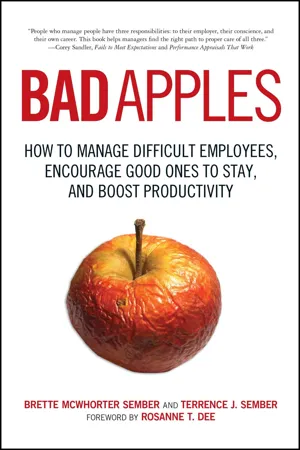
Bad Apples

How to Manage Difficult Employees, Encourage Good Ones to Stay, and Boost Productivity

  1. 256 pages
  2. English
  3. ePUB (mobile friendly)
  4. Available on iOS & Android
eBook - ePub

Bad Apples

How to Manage Difficult Employees, Encourage Good Ones to Stay, and Boost Productivity

About this book

Unlike other career books, this book offers managers a team-focused approach to neutralizing a not-so-pleasant—or productive—working atmosphere. Instead of isolating the one problem employee, relevant teams are considered as part of the solution. The result? Solutions stick and there's less likelihood of the bad apple ruining the bunch.

Complete with situational advice and case studies taken straight from the trenches, this simple and straightforward guide teaches managers how to:
  • Calm down combatants
  • Motivate wasters
  • Silence gossips
  • De-arm backstabbers
  • Convince passive-aggressives to open up
  • Teach narcissists the importance of the team
This book helps managers decide what the right course of action is—whether it means chastising negative behavior, encouraging positive outlooks, separating certain folks, creating teams for success, giving employees warnings, and/or firing the ones who are pretty much rotten through and through. This book is essential reading for any manager looking to ensure a pleasant, productive—and fruitful—work environment.
Frequently asked questions

Yes, you can cancel anytime from the Subscription tab in your account settings on the Perlego website. Your subscription will stay active until the end of your current billing period. Learn how to cancel your subscription.
No, books cannot be downloaded as external files, such as PDFs, for use outside of Perlego. However, you can download books within the Perlego app for offline reading on mobile or tablet. Learn more here.
Perlego offers two plans: Essential and Complete
  • Essential is ideal for learners and professionals who enjoy exploring a wide range of subjects. Access the Essential Library with 800,000+ trusted titles and best-sellers across business, personal growth, and the humanities. Includes unlimited reading time and Standard Read Aloud voice.
  • Complete: Perfect for advanced learners and researchers needing full, unrestricted access. Unlock 1.4M+ books across hundreds of subjects, including academic and specialized titles. The Complete Plan also includes advanced features like Premium Read Aloud and Research Assistant.
Both plans are available with monthly, semester, or annual billing cycles.
We are an online textbook subscription service, where you can get access to an entire online library for less than the price of a single book per month. With over 1 million books across 1000+ topics, we’ve got you covered! Learn more here.
Look out for the read-aloud symbol on your next book to see if you can listen to it. The read-aloud tool reads text aloud for you, highlighting the text as it is being read. You can pause it, speed it up and slow it down. Learn more here.
Yes! You can use the Perlego app on both iOS or Android devices to read anytime, anywhere — even offline. Perfect for commutes or when you’re on the go.
Please note we cannot support devices running on iOS 13 and Android 7 or earlier. Learn more about using the app.
Yes, you can access Bad Apples by Terrence Sember,Brette Sember in PDF and/or ePUB format, as well as other popular books in Business & Business General. We have over one million books available in our catalogue for you to explore.

Information

Publisher
Adams Media
Year
2009
Print ISBN
9781605500041
eBook ISBN
9781440514272
PART 1
ABOUT BAD APPLES
CHAPTER I
WHAT IS A
BAD APPLE?
1
We’ve all worked with employees who weren’t always the best and the brightest, but a bad apple is someone who is especially difficult, troublesome, or hard to work with. Before you were a manager, working with these kinds of people made your life hard, but now you have to manage, control, motivate, and guide that person for the benefit of your company—and deal with any fallout that person causes within your team. This can be challenging for even the most experienced manager, but there are definitely ways to do so without losing your sanity. A bad apple doesn’t have to mean that your team or professional future is down the drain.
BEHAVIOR
To understand what a bad apple is, you need to recognize the basic types of behavior that make a bad employee. There is no one picture of what a bad apple is. These types of workers come with a variety of traits, personalities, and problems. Some are so easy to spot that they may as well have flashing lights on their heads. Things like tardiness, leaving work early, failing to follow instructions, rudeness, argumentativeness, and inability to take direction are obvious indicators that you have a problem on your hands. You won’t feel confident that these employees can adequately do the job, fulfill a task, or be trusted when you need to count on them. Everyone else on your team will also dislike the person, or know that she is trouble.
There are also bad apples who are more difficult to identify because they try to make a good impression on you personally, but make the lives of their coworkers miserable when you’re not there. In these situations, you have to read the signs from the others around them. At meetings, do eyes roll when the questionable employee makes a comment? Does she always volunteer when you ask for something to be done, but doesn’t step up when others ask for help? Are there rumblings among your team members about her work quality, work ethic, or personality? An employee who puts up a good front for you, but makes your team members miserable, is just as dangerous for your team and company as the employee who is obviously bad.
Some undesirable employees can be identified because of the situations they put you in. Compare the everyday, nondisability-related accommodations you are making for one particular employee to those you make for others. If you find that you always have to readjust project deadlines for Tom, or Julie always requests that a sketch be redrawn to make it easier for her to work on, you’ve got a bad apple.
The simplest and best way to identify a bad employee is to determine if he negatively affects the company’s bottom line. This is, after all, the most important test of an employee. If whatever he is or isn’t doing makes it harder for others to get their work done, or for him to complete his, the bottom line will reflect it. The ultimate outcome of his attitude or behavior is that the company is not performing as well as it could.
PERFORMANCE AND PRODUCTIVITY
One of the biggest responsibilities of being a manager is ensuring that all of your employees positively contribute to the company. No business can afford employees who do not have a positive impact on the bottom line. Anyone who causes decreased revenue or increased cost is a problem for both you and the company and you should pay close attention to this bad apple. If your team or department is not producing as expected—or is not showing increased growth at the rate you hoped—you should carefully consider the role that one bad employee is playing in the big picture.
It’s one thing to say that a person has a negative impact on productivity, but it is another to actually show that this is the case. Measuring a person’s productivity is very industry- and job-specific— but here are a few guidelines you can rely on:
• Evaluate the volume and quality of the work that person produces
• Look at billable hours if the employee has an impact on them
• Compare the employee’s productivity with other employees who do similar work in your company
• Make note of employees who produce the right quantity of work, but do not meet the levels of quality they should be achieving
• Determine if the employee is always seeking to improve on the work he puts out
• Notice whether the employee fulfills your company’s standard operating procedures
You should look not only at that employee’s personal productivity, but also at how he influences productivity for the entire team or company. An employee who does not do his job well is an obvious problem, but one who drags down the work of others is just as dangerous—but harder to spot because the drain on the company may be subtle and quiet.
apples to apples A CASE STUDY
Michael and Jenna are both sales associates for a siding company. They were both hired at the same time, but Michael had a little more experience writing proposals. Once Jenna learned this, she came to him with almost every single proposal she wrote, asking for his help and input. Michael was happy to help at first, but Jenna eventually took up so much of his time that he had trouble keeping up with his own work. While he tried to get her to learn from the advice he’d given in the past, Jenna always seemed to have a reason she needed his help. While Michael was able to meet his deadlines and sell successfully, the drain Jenna created on Michael’s productivity prevented him from achieving the level of success he was capable of—and that the company needed. Fortunately, their manager, Jackie, was very in tune with her team and asked Jenna how often she went to Michael for help. Her answer was vague, so Jackie talked to Michael and learned what had been going on. She told Michael that if Jenna needed help, to send her to Jackie’s office. At first Jenna was reluctant to ask Jackie for help, but, with Jackie’s guidance, she soon learned how to successfully write her own proposals. Meanwhile, Michael was able to focus and increased his selling levels.
REASONS FOR BAD APPLE BEHAVIOR
Just as there are a lot of employee behaviors that are problematic, there are many reasons that can explain the behavior. If you can pinpoint and understand the reasons behind your employee’s actions (or inactions), you’ll be in a better position to solve the problem that is causing the behavior.
Some common reasons for below par activity include:
• He doesn’t like his job
• He doesn’t like the work environment
• She doesn’t like her coworkers
• He feels dissatisfied within the company
• She has skill set deficiencies that she is trying to manage or cover up
• He really has no idea he’s not measuring up
• She is experiencing a personal, health, or family problem outside of work
• He has a clash with management
• He has basic personality traits that are incompatible with the job or company
The best way to find out the reason behind your employee’s behavior is to talk to her. Find out what her concerns are, how she feels, and what’s going on in her life. It’s impossible to properly correct something if you can’t identify the cause, and sometimes managers tend to overthink things when there’s a simple explanation. If you have an employee who is not turning in projects on time, you could extrapolate all sorts of complicated reasons for this—she can’t work with the new version of the software, she’s trying to make you look bad, etc.—when the explanation may be as simple as the fact that another manager is giving her work that is more urgent. Remember, you need to find the root of the problem before you can fix it.
Unless you understand the underlying cause of the problem, you may end up solving a symptom, but not resolving the underlying issue. If you spackle a cracked wall in your house, you can mask the problem, but it will crack again if you have a shifting foundation that needs to be repaired. Your employee is in the same situation. You can temporarily change some behavior, but if the root cause of the problem remains untouched, you’ll experience problems with this employee over and over again. You won’t always be able to completely fix the problem, but understanding the cause will help you be a more effective manager.
There are certain problems you can’t solve for your employee, particularly ones that stem from personality traits or from personal problems the employee is dealing with. Karen noticed that Peggy was always late for a Monday morning meeting scheduled at 8 A.M. Peggy was a key component to the meeting and starting without her or waiting until she got there was a problem for the team, which was on a tight schedule. Karen talked to Peggy to find out what was going on. Peggy explained that she has to get her kids on the bus on Monday mornings, since her husband has to be at work early.
If you are aware of a situation such as Peggy’s, you have the power to decide if you want to work around it. But if you have no idea why she’s always late, you have no ability to change the situation. You, as a manager, would need to decide if Peggy is so valuable to you that you want to change the time of the meeting, or if the team’s schedule is more important and Peggy has to find a way to get there or she will no longer be able to keep her position.
EFFECT ON YOUR TEAM AND COMPANY
You’ve heard the saying that a bad apple can spoil the whole bunch. When you have a subpar employee, there is the chance that he could have a negative impact on your team and your company. A bad apple is bad for everyone, whether he causes an emotional drain on the people on the team, a drain on resources, or negatively affects the company’s bottom line.
It may not seem to be such a big deal that Jan spends a lot of time with personal e-mail, or that Rory makes negative comments in meetings. However, this behavior not only reduces the amount of actual work that employee is doing, but may also taint the attitude of the rest of your team. If team members see that Joy never fully completes the purchase orders and that no one cares, your other employees are going to wonder why they’re working so hard to complete their own P.O.s and may start to slack off.
Then there is the employee who has a bad attitude about everything. If there is one person who always sees the glass as half empty, he’s going to share his negative views with the rest of your team. Negativity is insidious. It can easily become part of your team or company culture. One employee who is always negative will eventually wear down the positive attitudes of those around him, and your entire team will end up behaving in a negative manner.
BAD TO THE CORE OR JUST BRUISED?
We all know that people make mistakes and that none of our employees are perfect. You can’t expect perfection, but you can expect solid, dependable work. You can also look for progress after mistakes are made—an employee who learns from her mistakes is a valuable team member.
If you have an employee who slips up and makes an error or does something wrong, you’ll probably be annoyed, but most of the time it’s not a reason to spring into action and analyze whether the person should be fired. It’s counterproductive to overreact to every problem that happens with your employees. If you are looking for problems, you will no doubt find them, but if you expect the best, you will often get it.
There are some employees, though, who may begin to slip up habitually. A bad apple isn’t someone who makes the occasional mistake, but the employee who has a distinct ongoing pattern of a certain type of behavior or failure.
One important clue that can help you sift out minor problems from ongoing patterns is the severity of the incidents. One slightly snitty e-mail is an incident; however a very nasty, inflammatory e-mail can be indicative of a potentially real problem. Once you’ve got two inflammatory e-mails, you’re well on your way to a pattern.
It can sometimes be hard to tell if a pattern is developing with an employee. In the heat of the moment when you’re dealing with the crisis in front of you, it can be hard to really see the big picture. The best way to evaluate the situation is to keep good records. Document every important mistake or problem that happens for every employee. If you simply rely on your memory or impressions, you cannot ensure the situation will be judged fairly and accurately. You may find that over the course of weeks, months, or a year, you’ll see a clear pattern emerging in one person’s file. A written record is important not only so you can know that you’re not losing your mind (yes, Sheila did wear a see-through top to work three different times, you aren’t crazy), but also so you can provide documentation should you reach the point where you need to fire the offender. Try to document as much detail about each occurrence as possible.
Things to make note of include:
• Who was involved (other employees, clients, vendors)?
• What time of day or day of the week did it occur?
• What was the situation that led up to the incident?
• What was the negative result?
• What action did you take?
These records can also help you determine a course of action to correct a problem. For example, at a small law firm, when the receptionist is off for the day, one of the legal assistants will fill in at the front desk. The legal assistants who are there when the firm opens in the morning decide among themselves who will fill that role. Without documentation, you may not be able to confirm that Barb always happens to come in late on the days when everyone knows the receptionist is going to be out so she doesn’t have to take a turn working from the front desk. This might not seem like a big deal at first, but when you take into consideration that she never...

Table of contents

  1. COVER PAGE
  2. TITLE PAGE
  3. COPYRIGHT PAGE
  4. CONTENTS
  5. FOREWORD
  6. INTRODUCTION
  7. PART 1: ABOUT BAD APPLES
  8. PART 2: PROBLEM-SOLVING TECHNIQUES
  9. PART 3: FEND OFF FUTURE BAD APPLES
  10. CONCLUSION: BALANCING THE APPLE CART