All about Coffee
eBook - ePub

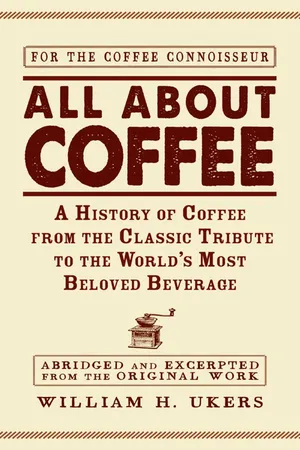
All about Coffee

A History of Coffee from the Classic Tribute to the World's Most Beloved Beverage

  1. 160 pages
  2. English
  3. ePUB (mobile friendly)
  4. Available on iOS & Android
eBook - ePub

All about Coffee

A History of Coffee from the Classic Tribute to the World's Most Beloved Beverage

About this book

The original homage to the world's most extraordinary drink!

In 1922, William H. Ukers wrote the definitive work on coffee. As the founder of The Tea and Coffee Trade Journal, an industry magazine still active today, he spent seventeen years traveling the world and uncovering everything there was to know about both the bean and the beverage. From its historic roots and the drinking customs of different countries to its effects on the mind and the preparation of the perfect cup, this book captures all the rich and complex history of coffee.

Filled to the brim with robust facts, aphorisms, and more, All About Coffee culls the best of Ukers's research and observations sip after sip, page after page.
Frequently asked questions

Yes, you can cancel anytime from the Subscription tab in your account settings on the Perlego website. Your subscription will stay active until the end of your current billing period. Learn how to cancel your subscription.
No, books cannot be downloaded as external files, such as PDFs, for use outside of Perlego. However, you can download books within the Perlego app for offline reading on mobile or tablet. Learn more here.
Perlego offers two plans: Essential and Complete
  • Essential is ideal for learners and professionals who enjoy exploring a wide range of subjects. Access the Essential Library with 800,000+ trusted titles and best-sellers across business, personal growth, and the humanities. Includes unlimited reading time and Standard Read Aloud voice.
  • Complete: Perfect for advanced learners and researchers needing full, unrestricted access. Unlock 1.4M+ books across hundreds of subjects, including academic and specialized titles. The Complete Plan also includes advanced features like Premium Read Aloud and Research Assistant.
Both plans are available with monthly, semester, or annual billing cycles.
We are an online textbook subscription service, where you can get access to an entire online library for less than the price of a single book per month. With over 1 million books across 1000+ topics, we’ve got you covered! Learn more here.
Look out for the read-aloud symbol on your next book to see if you can listen to it. The read-aloud tool reads text aloud for you, highlighting the text as it is being read. You can pause it, speed it up and slow it down. Learn more here.
Yes! You can use the Perlego app on both iOS or Android devices to read anytime, anywhere — even offline. Perfect for commutes or when you’re on the go.
Please note we cannot support devices running on iOS 13 and Android 7 or earlier. Learn more about using the app.
Yes, you can access All about Coffee by William H Ukers in PDF and/or ePUB format, as well as other popular books in History & Historical Theory & Criticism. We have over one million books available in our catalogue for you to explore.

Information

COFFEE
CUSTOMS
IN
EUROPE


France

French: café

Were it not for the almost inevitable high roast and the frequently disconcerting chicory addition, coffee in France might be an unalloyed delight—at least this is how it appears to American eyes. One seldom, if ever, finds coffee improperly brewed in France—it is never boiled.
Second only to the United States, France consumes about 2 million bags of coffee annually. The varieties include: coffee from the East Indies, Mocha, Haitian (a great favorite), Central American, Colombian, and Brazilian.
Although there are many wholesale and retail coffee roasters in France, home roasting persists, particularly in the country districts. The little sheet-iron cylinder roasters, that are hand-turned over an iron box holding the charcoal fire, find a ready sale even in the modern department stores of the big cities. In any village or city in France, it is a common sight on a pleasant day to find the householder turning his roaster on the curb in front of his home. Emmet G. Beeson, in the Tea and Coffee Trade Journal, gives us this vignette of rural coffee roasting in the south of France:
In a certain town in the south of France I saw an old man with an outfit a little larger than the home variety, a machine with a capacity of about ten pounds. Instead of a cylinder in which to roast his coffee, he had perched on a sheet-iron frame a hollow round ball made of sheet iron. In the top of this ball there was a little slide, which was opened by the means of a metal tool. In the sheet-iron frame he had kindled his charcoal fire. Directly in front of his roaster was a home-made cooling pan, the sides of which were of wood, the bottom covered with a fine grade of wire screening.
On this particular afternoon, the old man had taken up his place on the curb; and a big black cat had taken advantage of the warmth offered by the charcoal fire and was curled up, sleeping peacefully in the pan nearest the fire. The old man paid no attention to the cat, but went on rotating his ball of coffee and puffing away pensively on his cigarette. When his coffee had become blackened and burned, and blackened and burned it was, he stopped rotating the ball, opened the slide in the top, turned it over, and the hot, burned coffee rolled out, and much to his delight, on the sleeping cat, which leaped out of the pan and scampered up the street and into a hole under an old building.
I afterward learned that this old fellow made a business of going about the town gathering up coffee from the houses along the way and roasting it at a few sous per kilo.
Nearly all the coffee is ground at home, which is not a bad practice for the consumer; but perhaps is a financial hardship for the dealer, who can mix some grade grinders into his blends without doing them any material harm. Where coffee mills are used in the stores, they are of the Strong-Arm family and of an ancient heritage. To get a growl out of the grocer in France, buy a kilo of coffee and ask him to grind it.
Packaged coffee and proprietary brands have not come into their own to the extent that they have in the United States, although there are at present two firms in Paris which have started in this business and are advertising extensively on billboards, in streetcars, and in the subways. However, most coffee is still sold in bulk. The butter, egg, and cheese stores of France do a very large business in coffee. Prior to the war and high prices, there were some very large firms doing a premium business in coffee, tea, spices, etc. They still exist, and have a very fine trade; but since the high prices of coffees and premiums, the business has gone down very materially. They operate by the wagon route and solicitor method, just as some of our American companies do. One very large firm in Paris has been in this business for more than thirty years, operating branches and wagons in every town, village, and hamlet in France.
The consumption of coffee is increasing very materially in France, some say, on account of the high price of wine; others hold that coffee is simply growing in favor with the people. Among the masses, French breakfast consists of a bowl or cup of café au lait, or half a cup or bowl of strong black coffee and chicory, and half a cup of hot milk, and a yard of bread. The workingman turns his bread on end and inserts it into his bowl of coffee, allowing it to soak up as much of the liquid as possible. Then he proceeds to suck this concoction into his system. His approval is demonstrated by the amount of noise he makes in the operation.
Among the better classes, the breakfast is the same: café au lait, with rolls and butter, and sometimes fruit. The brew is prepared by the drip, or true percolator, method, or by filtration. Boiling milk is poured into the cup from a pot held in one hand together with the brewed coffee from a pot held in the other, providing a simultaneous mixture. The proportions vary from half-and-half to one part coffee and three parts milk. Sometimes, the service is given by pouring into the cup a little coffee, then the same quantity of milk, and alternating in this way until the cup is filled.
Coffee is never drunk with any meal but breakfast, but is invariably served en demi-tasse after the noon and the evening meals. In the home, the usual thing after luncheon or dinner is to go into the salon and have your demi-tasse, liqueur, and cigarettes before a cozy grate fire. A Frenchman’s idea of after-dinner coffee is a brew that is unusually thick and black, and he invariably takes with it his liqueur, no matter if he has had a cocktail for an appetizer, a bottle of red wine with his meat course, and a bottle of white wine with the salad and dessert courses. When the demi-tasse comes along, with it must be served his cordial in the shape of cognac, benedictine, or crùme de menthe. He cannot conceive of a man not taking a little alcohol with his after-dinner coffee, as an aid, he says, to digestion.
Making coffee in France has been, and always will be, by the drip and the filtration methods. The large hotels and cafés follow these methods almost entirely, and so does the housewife. When company comes, and something unusual in coffee is to be served, Mr. Beeson says he has known the cook to drip the coffee, using a spoonful of hot water at a time, pouring it over tightly packed, finely ground coffee, allowing the water to percolate through to extract every particle of oil. They use more ground coffee in bulk than they get liquid in the cup, and sometimes spend an hour producing four or five demi-tasses. It is needless to say that it is more like molasses than coffee when ready for drinking.
It is not unusual in some parts of France to save the coffee grounds for a second or even a third infusion, but this is not considered good practice.
Von Liebig’s idea of correct coffee making (found in the later section on Germany’s coffee customs) has been adapted to French practice in some instances after this fashion: Put used coffee grounds in the bottom chamber of a drip coffee pot. Put freshly ground coffee in the upper chamber. Pour on boiling water. The theory is that the old coffee furnishes body and strength, and the fresh coffee the aroma.
The cafés that line the boulevards of Paris and the larger cities of France all serve coffee, either plain or with milk, and almost always with liqueur. The coffee house in France may be said to be the wine house; or the wine house may be said to be the coffee house. They are inseparable. In the smallest or the largest of these establishments, coffee can be had at any time of day or night. The proprietor of a very large café in Paris says his coffee sales during the day almost equal his wine sales.
In the afternoon, cafĂ© means a small cup or glass of cafĂ© noir, or cafĂ© nature. It is double the usual amount of coffee dripped by percolator or filtration device, the process consuming eight to ten minutes. Some understand cafĂ© noir to mean equal parts of coffee and brandy with sugar and vanilla to taste. When cafĂ© noir is mixed with an equal quantity of cognac alone, it becomes cafĂ© gloria. CafĂ© mazagran is also much in demand in the summertime. The coffee base is made as for cafĂ© noir, and it is served in a tall glass with water to dilute it to one’s taste.

Germany

German: kaffee (coffee tree: kaffeebaum)

Germany originated the afternoon coffee function known as the kaffee-klatsch. Even today, the German family’s reunion takes place around the coffee table on Sunday afternoons. In summer, when weather permits, the family will take a walk into the suburbs, and stop at a garden where coffee is sold in pots. The proprietor furnishes the coffee, the cups, the spoons, and, in normal times, the sugar, two pieces to each cup. The patrons bring their own cake. They put one piece of sugar into each cup and take the other pieces home to the “canary bird,” meaning the sugar bowl in the pantry.
Baron Von Liebig’s method of making coffee, whereby three-fourths of the quantity to be used is first boiled for ten or fifteen minutes, and the remainder added for a six-minute steeping or infusion, is religiously followed by some housekeepers. Von Liebig advocated coating the bean with sugar. In some families, fats, eggs, and eggshells are used to settle and to clarify the beverage.
Coffee in Germany is better cooked (roasted) and more scientifically prepared than in many other European countries. In recent years, during the World War and since, however, there has been an amazing increase in the use of coffee substitutes, so that the German cup of coffee is not the pure delight it was once.
Cheaper coffee is served in some gardens, which conspicuously display large signs at the entrance, saying: “Families may cook their own coffee in this place.” In such a garden, the patron merely buys the hot water from the proprietor, furnishing the ground coffee and cake himself.
While waiting for the coffee to brew, he may listen to the band and watch the children play under the trees. French or Vienna drip pots are used for brewing.
Every city in Germany has its cafĂ©s, spacious places where patrons sit around small tables, drinking coffee, “with or without,” turned or unturned, steaming or iced, sweetened or unsweetened, depending on the sugar supply; nibble, at the same time, a piece of cake or pastry, selected from a glass pyramid; talk, flirt, malign, yawn, read, and smoke. CafĂ©s are, in fact, public reading rooms. Some places keep hundreds of daily and weekly newspapers and magazines on file for the use of patrons. If the customer buys only one cup of coffee, he may keep his seat for hours and read one newspaper after another.

The United Kingdom

In the British Isles, coffee is still being boiled; although the infusion, true percolation (drip), and filtration methods have many advocates. A favorite device is the earthenware jug with or without the cotton sack that makes it a coffee biggin. When used without the sack, the best practice is first to warm the jug. For each pint of liquor, one ounce (three dessert-spoonfuls) of freshly ground coffee is put in the pot. Upon it is poured freshly boiling water—three-fourths of the amount required. After stirring with a wooden spoon, the remainder of the water is poured in, and the pot is returned to the “hob” to infuse, and to settle for three to five minutes. Some stir it a second time before the final settling.
From an American point of view, the principal defects in the English method of making coffee lie in the roasting, handling, and brewing. It has been charged that the beans are not properly cooked in the first place, and that they are too often stale before being ground. The English run to a light or cinnamon roast, whereas the best American practice requires a medium, high, or city roast. A fairly high shade of brown is favored on the South Downs with a light shade for Lancashire, the West Riding of Yorkshire, and the south of Scotland. The trade demands, for the most part, a ripe chestnut brown. Wholesale roasting is done by gas and coke machines; while retail dealers use mostly a small type of inner-heated gas machine.
The British consumer will need much instruction before the national character of the beverage shows a uniform improvement. While the coffee may be more carefully roasted, better “cooked” than it was formerly, it is still remaining too long unsold after roasting, or else it is being ground too long a time before making. These abuses are, however, being corrected; and the consumer is everywhere being urged to buy his coffee freshly roasted and to have it freshly ground. Another factor has undoubtedly contributed to giving England a bad name among lovers of good coffee, and that is certain tinned “coffees,” composed of ground coffee and chicory, mixtures that attained some vogue for a time as “French” coffee. They found favor, perhaps, because they were easily handled. Packaged coffees have not been developed in England as in America; but there is a more or less limited field for them, and there are several good brands of absolutely pure coffee on the market.
The demi-tasse is a popular drink after luncheon, after dinner, and even during the day, especially in the cities. In London, there are cafés that make a specialty of it.
While, in the home it is customary to steep the coffee; in hotels and restaurants, some form of percolating apparatus, extractor, or steam machine is employed.
American visitors complain that coffee in England is too thick and syrupy for their liking. Coffee in restaurants is served “white” (with milk) or black, in earthen stoneware or silver pots. In chain restaurants, one can find on the menu “hot milk with a dash of coffee.”
The steeping method so much favored in England may be responsible for some of the unkind things said about English coffee; because it undoubtedly leads to the abuse of over-infusion, so that the net result is as bad as boiling.
The vast majority of English people are, however, confirmed tea drinkers, and it is extremely doubtful if this national habit, ingrained through centuries of use of “the cup that cheers” at breakfast and at tea time in the afternoon, can ever be changed.
The London coffee houses of the seventeenth and eighteenth centuries gave way to a type of coffee house whose mainstay was its food rather than its drink. In time, these too beg...

Table of contents

  1. Cover
  2. Title Page
  3. Contents
  4. Introduction to this Edition
  5. Foreword
  6. The Philosophy of Coffee
  7. Coffee’s Historic Roots
  8. The Coffee Trade
  9. Coffee Customs in Europe
  10. Coffee Customs in the Americas
  11. Coffee Customs in Africa and the Near and Far East
  12. Coffee in the United States
  13. Coffee As an Art Form
  14. The Properties of Coffee
  15. Coffee Making and Drinking
  16. The Pharmacology of Coffee
  17. Coffee, A Divine Thesaurus
  18. Copyright