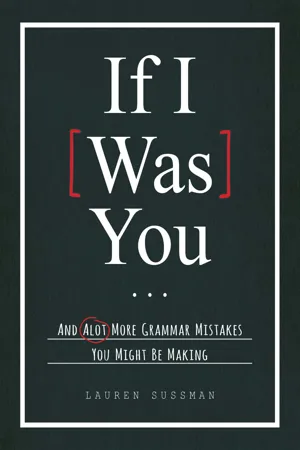
If I Was You...
eBook - ePub

If I Was You...

And Alot More Grammar Mistakes You Might Be Making

  1. 192 pages
  2. English
  3. ePUB (mobile friendly)
  4. Available on iOS & Android
eBook - ePub

If I Was You...

And Alot More Grammar Mistakes You Might Be Making

About this book

An essential handbook for righting grammatical errors!Was the computer affected by a virus or effected by it? Did you see two deers in the woods or two deer? Should the lab report be sent to Tom and me or Tom and I? If I Was You... provides the tools you need to correct the grammatical mistakes you've been making. Each entry includes sample sentences that highlight the error as well as a straightforward explanation of why it's wrong and the correct grammar usage. Whether you're working on a term paper or an important business presentation, this indispensable handbook shows you how to rectify your grammatical goofs and effectively communicate with others.Covering everything from verbs and pronouns to punctuation and sentence structure, If I Was You... is the only guide you need to master the principles of grammar, avoid common errors, and write more impressively.
Frequently asked questions

Yes, you can cancel anytime from the Subscription tab in your account settings on the Perlego website. Your subscription will stay active until the end of your current billing period. Learn how to cancel your subscription.
At the moment all of our mobile-responsive ePub books are available to download via the app. Most of our PDFs are also available to download and we're working on making the final remaining ones downloadable now. Learn more here.
Perlego offers two plans: Essential and Complete
  • Essential is ideal for learners and professionals who enjoy exploring a wide range of subjects. Access the Essential Library with 800,000+ trusted titles and best-sellers across business, personal growth, and the humanities. Includes unlimited reading time and Standard Read Aloud voice.
  • Complete: Perfect for advanced learners and researchers needing full, unrestricted access. Unlock 1.4M+ books across hundreds of subjects, including academic and specialized titles. The Complete Plan also includes advanced features like Premium Read Aloud and Research Assistant.
Both plans are available with monthly, semester, or annual billing cycles.
We are an online textbook subscription service, where you can get access to an entire online library for less than the price of a single book per month. With over 1 million books across 1000+ topics, we’ve got you covered! Learn more here.
Look out for the read-aloud symbol on your next book to see if you can listen to it. The read-aloud tool reads text aloud for you, highlighting the text as it is being read. You can pause it, speed it up and slow it down. Learn more here.
Yes! You can use the Perlego app on both iOS or Android devices to read anytime, anywhere — even offline. Perfect for commutes or when you’re on the go.
Please note we cannot support devices running on iOS 13 and Android 7 or earlier. Learn more about using the app.
Yes, you can access If I Was You... by Lauren Sussman in PDF and/or ePUB format, as well as other popular books in Languages & Linguistics & Grammar & Punctuation. We have over one million books available in our catalogue for you to explore.
[Part I]
CONFUSING PUNCTUATION MARKS (AND HOW TO UNDERSTAND THEM)
Wrong: Hand me the pen that rolled near you

Misplacing Periods

A period is most often used to signal the end of a sentence that states a fact or one that gives a command or makes a request. For instance, both of the following are simple, declarative sentences that end with periods:
• The pen fell down right next to your chair.
• I’m wondering if it would be that hard for you to bend over and pick it up.
Although the latter sentence contains an implied question, the end punctuation should be a period because the sentence as a whole states a fact (that I’m wondering something) rather than asks a question. Periods are also used in abbreviations, such as Dr., Ms., Rev., i.e., and et al.

Good Grammar Tip

If your declarative or imperative sentence ends with an abbreviation that takes a period, don’t put an additional period at the end. Write:
I’ll be at your apartment to pick you up at 8 P.M.
not
I’ll be at your apartment to pick you up at 8 P.M..
Right: Hand me the pen that rolled near you.
Wrong: Are you available for a long, pointless, late-morning meeting.

Misused Question Marks

News flash: Question marks go at the end of direct questions and sentences that end in questions. You knew that, didn’t you? Couldn’t that information have been left out? You get the picture, don’t you? Surely the point has sunk in by now, hasn’t it?
A question mark is also used to show that there’s doubt or uncertainty about something written in a sentence, such as a name, a date, or a word. In birth and death dates, such as (?–1565), the question mark means the birth date hasn’t been verified. Look at this example:
• The police are searching for Richard O. (?) in connection with the crime.
Here, the question mark means that the author is uncertain about the person’s name. But look at this example:
• He’s said to have stolen $5,000 (?) from a children’s charity.
The question mark means that the author is unsure about the exact amount of the theft.
Watch to see if a question mark is part of a title. If it is, be sure to include it in any punctuation that goes with the title:
• I won’t watch that new television program Can You Believe What Scum These Criminals Are?

Good Grammar Tip

Remember, question marks go inside quotation marks if the quoted material forms a question. Otherwise, question marks go outside quotation marks. Notice the difference in these examples:
Brendan asked, ā€œWho on earth steals money from a kids’ charity?ā€
Did Brendan say, ā€œPeople like that should be tossed in jail and the key thrown awayā€?
If you have a series of questions that aren’t complete sentences, a question mark should be included after each fragment:
• Can you believe that it’s ten below zero? or that it’s snowing? or that my electricity has gone off? or that the freaking electric company hasn’t got here to fix the problem?
Right: Are you available for a long, pointless, late-morning meeting?
Wrong: I can’t believe I just won $10 million in the lottery.

Incorrect Exclamation Points

Another news flash: Exclamation points (exclamation marks) are used to express strong feelings! In the preceding example, unless the speaker has the emotions of a fish, there’s a call for something more intense than a period. Exclamation marks add tone and emphasis to a sentence. There’s quite a difference between these two sentences:
• This is the first time I ever bought a lottery ticket.
• This is the first time I ever bought a lottery ticket!
The second sentence tells readers that something quite extraordinary happened when the speaker bought a lottery ticket for the first time.
In formal writing, don’t use exclamation points (unless, of course, you’re quoting a source or citing a title—or working for a tabloid magazine). In informal writing, you might include exclamation points after information that you find to be remarkable or information that you’re excited about:
• The first thing I’m going to do is donate $5,000 (!) to my favorite charity.
or
• The first thing I’m going to do is donate $5,000 to my favorite charity!
Check to see if an exclamation point is part of a title. If it is, be sure to include it:
• I wonder if I’ll be on that new television program I Can’t Believe They’re Millionaires!
On the other hand, it’s sometimes easy to go overboard with exclamation points:
• I met Joan and John for dinner last night! I told them the amazing news! They’re so happy for me! They volunteered to go on my Caribbean vacation with me!
Exciting as this news is (at least to Joan and John), the emotional impact is diminished if every sentence ends with an exclamation point. Use them responsibly.

Good Grammar Tip

Only in informal writing should you use more than one question mark or exclamation mark at a time:
Is this picture of our former roommate for real????
or
I can’t believe that our former roommate is featured in Playboy!!!
Right: I can’t believe I just won $10 million in the lottery!
Wrong: Anna said, Harry, give me the butter, please.

May I Quote You on That?

Use quotation marks (ā€œ ā€) at the beginning and ending of words, phrases, or sentences to show which words belong to you (the writer) and which belong to someone else.
The most commo...

Table of contents

  1. Title Page
  2. Table of Contents
  3. Introduction
  4. Part I: Confusing Punctuation Marks (and How to Understand Them)
  5. Part II: Mixed-Up Words (and How to Unmix Them)
  6. Part III: Complicated Parts of Speech (and How to Untangle Them)
  7. Part IV: Misfiring Sentences (and How to Fix Them)
  8. Appendix A: Some Grammar Resources
  9. Appendix B: Common Irregular Verbs
  10. Appendix C: Commonly Misused Words and Phrases
  11. Copyright
  12. Tables