
eBook - ePub
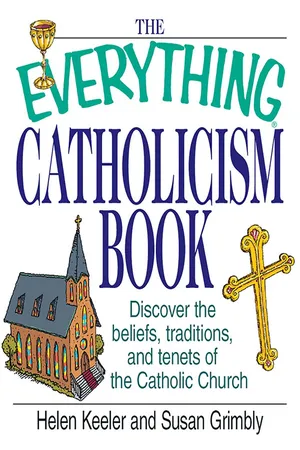
The Everything Catholicism Book
Discover the Beliefs, Traditions, and Tenets of the Catholic Church
- 304 pages
- English
- ePUB (mobile friendly)
- Available on iOS & Android
eBook - ePub
The Everything Catholicism Book
Discover the Beliefs, Traditions, and Tenets of the Catholic Church
About this book
With over one billion members, Catholicism is one of the oldest - and largest - organized religions in the world. The Everything Catholicism Book is an easy-to-follow guide that helps you gain a better understanding of this complex religion. From the Seven Sacraments to basic Church doctrine, this comprehensive book unravels all aspects of the Catholic Church, making it much easier for you to grasp. Thought-provoking and stimulating, The Everything Catholicism Book helps you understand and appreciate the complexity of the traditions and tenets of the Catholic faith.
Frequently asked questions
Yes, you can cancel anytime from the Subscription tab in your account settings on the Perlego website. Your subscription will stay active until the end of your current billing period. Learn how to cancel your subscription.
No, books cannot be downloaded as external files, such as PDFs, for use outside of Perlego. However, you can download books within the Perlego app for offline reading on mobile or tablet. Learn more here.
Perlego offers two plans: Essential and Complete
- Essential is ideal for learners and professionals who enjoy exploring a wide range of subjects. Access the Essential Library with 800,000+ trusted titles and best-sellers across business, personal growth, and the humanities. Includes unlimited reading time and Standard Read Aloud voice.
- Complete: Perfect for advanced learners and researchers needing full, unrestricted access. Unlock 1.4M+ books across hundreds of subjects, including academic and specialized titles. The Complete Plan also includes advanced features like Premium Read Aloud and Research Assistant.
We are an online textbook subscription service, where you can get access to an entire online library for less than the price of a single book per month. With over 1 million books across 1000+ topics, we’ve got you covered! Learn more here.
Look out for the read-aloud symbol on your next book to see if you can listen to it. The read-aloud tool reads text aloud for you, highlighting the text as it is being read. You can pause it, speed it up and slow it down. Learn more here.
Yes! You can use the Perlego app on both iOS or Android devices to read anytime, anywhere — even offline. Perfect for commutes or when you’re on the go.
Please note we cannot support devices running on iOS 13 and Android 7 or earlier. Learn more about using the app.
Yes, you can access The Everything Catholicism Book by Helen Keeler,Susan Grimbly in PDF and/or ePUB format, as well as other popular books in Theology & Religion & Christianity. We have over one million books available in our catalogue for you to explore.
Information
Chapter 1
What Is Catholicism?
Catholicism is founded on the teachings of Jesus Christ, which have evolved over 2,000 years into the religion we have today. It is important for us to understand Catholic beliefs. Non-Catholic Christians can see how many of their own beliefs are mirrored in or developed from Catholicism; non-Christians can gain an understanding of one of the world’s great religious movements.
A Community, a Way of Life, a Religion
Catholics form a diverse community of varied ethnic and national groups that share a sense of belonging to the formal institution of the Catholic Church. The Second Vatican Council defined the Church as “a kind of sacrament or sign of intimate union with God, and of the unity of all mankind.” In joining the Church, each member joins a community that comprises the Body of Christ on earth.
The local congregation, ministered to by a priest, is the basic unit of Catholic community. Each congregation is part of a larger diocese (the territory under a bishop’s jurisdiction), and all the dioceses in the world answer to the Curia in Rome. All these units make up one living, breathing entity that prays and worships in the same way, forming a huge community of souls.
The senses of community and mutual responsibility are reinforced through thousands of service organizations that the Church sponsors around the world. Service to others is elemental to Catholicism. Out of love for the Lord, the Church is expected to serve mankind compassionately, both through its service institutions and through the work of individual Catholics.
In Devotion to God
The religious aspect of Catholicism is its belief in and an understanding of God. Catholics learn how to live their lives based on their devotion to God, and Catholicism offers them a way of life that is based on specific doctrines, faith, theology, and a firm sense of moral responsibility. These elements, based on the Scriptures or “divine revelations,” later evolved through tradition. Other religions may contain some or many of these elements, but these specific liturgical, ethical, and spiritual orientations give Catholicism its unique character.

Tradition is key to understanding Catholicism. According to Catholic thought, the Bible is considered to be a product of traditions, pulled together from numerous sources and over a long period of time.
What It Means to Be Catholic
No study of Catholicism would be complete without an understanding of the word Catholic. The word itself comes from the Greek katholikos, meaning “general” or “universal,” which appeared in Greek writings before the rise of Christianity.
Writing in A.D. 110, St. Ignatius of Antioch was one of the first to use the phrase katholike ekklesia (literally, “catholic church”), but the force behind the phrase’s meaning came from St. Cyril of Jerusalem in 386: “The Church is called Catholic because it extends through all the world and because it teaches universally and without omission all the doctrines which ought to come to human knowledge.”
We know from the New Testament, particularly Matthew 24:14, that Christ intended his Word to extend beyond Jewish Palestine to all nations. By the end of the first century, at least 100 communities of Christians were established in and around the Mediterranean.
Since then, the Word has spread farther still, to nearly one billion people, across state lines and over cultural boundaries. What’s more, these various cultures have adapted Catholic rites and created variations that the Church fully accepts today.
Catholicism and Other Christian Religions
Christians have many ways of practicing their faith—through the Catholic Church, the Eastern Orthodox church, and the many Protestant denominations such as the Baptists, Lutherans, Methodists, and Presbyterians. All Christians share their belief in and acceptance of Jesus Christ, but they also differ in many important ways.
The Church first underwent a split into the Western and Eastern Church in the Great Schism of 1054. (For more details on the Great Schism, see Chapter 4.) Much later, in the sixteenth and seventeenth centuries, the Protestant movements split the Western Church further into the Roman Catholic and Protestant denominations.
The word Protestant comes from “protest.” The Protestant faiths splintered from the Catholic Church because ordinary people protested against the Catholic institution and some of its conduct and practices.

The head of the Catholic Church has been situated in Rome for many centuries. However, the word Roman was first appended to the Catholic Church during the Reformation. The followers of Martin Luther, the group that made the first major split from the Church, also considered themselves Catholic. They described the Church as “Roman” to indicate the distinction between themselves and followers of “Romish” or “Papist” Catholics.
The Protestant Faiths
In some ways, the Protestant churches are similar to the Catholic Church. Most believe in the importance of the Bible, the resurrection of Jesus Christ, the Triune God (Father, Son, and Holy Ghost), the sacraments of Baptism and the Eucharist, and other Christian doctrines and practices.
The main distinction between Catholicism and Protestantism is that Catholicism is a religion of sacraments (seeing the spiritual enfleshed in the secular world) while Protestantism is more a religion of the bodiless Word of God. Sacramentality is the idea that everything reveals God. Over time, Protestantism has retained only parts of this concept. Protestants don’t believe, as Catholics do, in the special significance of Mary. They don’t believe in transubstantiation (that the Eucharist is after declaration by a priest, the Body and Blood of Christ). They believe that priests and ministers are merely members of the laity, trained in the practices of that particular religion, and not that members of the ordained ministry are actually mediators of God’s grace. Finally, they see religious statues and icons more as forms of idolatry than as windows to the spiritual world.
Another fascinating difference is in approaches to the Bible. Catholics believe that the Church—as the authentic moral and theological authority—should be their guide in interpreting the Bible. Peter, who was the first Bishop of Rome, wrote, “There is no prophecy of scripture that is a matter of personal interpretation” (2 Peter 1:20). Protestants challenged this relationship. Many Protestant faiths accept personal interpretation of the Bible as they do a personal (unmediated) relationship between each person and God.
The Protestants also denied that the pope, as the head of the Church hierarchy in matters of faith and morals, was infallible in matters of faith and morals, a belief known as the Petrine Primacy or apostolic succession. In Catholic ideology, the pope is infallible because he is the representative of Christ on earth. He follows a line of succession back to St. Peter, the first bishop of the early Church, who received his appointment directly from Jesus.
There was also a difference in how Protestants and Catholics worshiped. Until recently, Catholics celebrate the Mass with a highly structured, formal ceremony conducted in Latin (today, most Catholic churches in the United States and many other countries have made a switch to having services in the vernacular). Protestant forms of worship were simpler: Believers prayed in their native tongues and there was more preaching. In some denominations, the service was completely unstructured, allowing the congregation a greater degree of participation.
The Grace of God
The Catholic Church is a living, growing entity. Open to changes that come with the times, it also adheres to some basic doctrines it has always held to be true. The most basic of the Church’s doctrines is the idea that man achieves salvation through divine grace, where divine blessings are an expression of God’s love.
The Two Mysteries
God’s grace is expressed through the dual nature of Christ (man and God) and the trinity of persons in God. These two mysteries are fundamental to Catholic belief and the Church’s teachings about God. On his deathbed, just before receiving the Holy Eucharist, the Church’s most precious sacrament, St. Thomas Aquinas, considered to be one of the fathers of the Church, said: “If in this world there be any knowledge of this sacrament stronger than that of faith, I wish now to use it in affirming that I firmly believe and know as certain that Jesus Christ, True God and True Man, Son of God and Son of the Virgin Mary, is in this Sacrament.”
St. Thomas affirms Christ’s humanity, that Jesus was born and died a man, with a man’s physical strengths and weaknesses. The Catholic Church teaches that it is our great gift that Christ walked among us, was one of us, and that he took on the burden of atonement for our sins. St. Thomas also affirms Jesus’ divinity, that the man who walked among us 2,000 years ago was indeed a divine person, a person of God, who made himself over into our image for a brief time.

What is “incarnation”?
Incarnation, which literally means “made into flesh,” describes what happened when Jesus assumed a bodily form and the human condition. Understanding the concept of the Incarnation is essential to the Catholic belief system.
Catholics believe that the world is essentially good but that it has fallen from grace, or the “divine presence,” into original sin. As a result of this falling away, the world had to be redeemed by God in Christ.
The Eucharist
The Catholic belief in God as a real, living presence is best exemplified in the Eucharist, another of the mysteries fundamental to the Catholic faith. Celebration of the Eucharist, the Mass, is the centerpiece of Catholic worship.
During this ceremony, the assembly partakes of bread and wine that, through consecration, are converted into the Mystical Body and Blood of Christ. The process through which the bread and wine are converted is known as “transubstantiation.” Through transubstantiation, the bread and wine are literally changed into Christ’s body and blood. In sharing this sacrament, the entire Catholic community is united in communion with Christ. For this reason, the Mass is also known as the Holy Communion.
The Four Tenets of the Church
The Catholic Church has four basic tenets: tradition, universality, reason, and analogy. Tradition includes all the teachings contained in the Bible. Universality—remember, the word Catholic comes from the Greek word for “universal”—is the openness to all truth, unfettered by any particular culture and unrestricted to all human beings. The last two tenets, analogy and reason, are both used in our quest to understand the Catholic mysteries. Analogy is a common logic device that helps us understand God through our knowledge of the created world...
Table of contents
- Cover
- Title Page
- Dedication
- Copyright
- Contents
- Top Ten Catholic Heroes and Heroines
- Introduction
- 1 What Is Catholicism?
- 2 The Birth of the Church
- 3 The Church Grows and Develops
- 4 During the Middle Ages
- 5 Chapter 5: Modernizing the Catholic Church
- 6 One God, Three Persons
- 7 Chapter 7: Mary, the Mother of God
- 8 The Seven Sacraments
- 9 Essential Beliefs
- 10 Devotional Practices
- 11 The Catholic Liturgy
- 12 The Catholic Approach to Scriptures
- 13 Heaven and Hell: The Afterlife
- 14 The Catholic Ministry
- 15 Receiving the Call
- 16 Salvation in Community
- 17 Milestones of a Catholic Life
- 18 Conversion to Catholicism
- 19 Catholics in the Greater Society
- 20 Looking into the Future
- Appendix A Liturgical Calendar
- Appendix B A Timeline of Notable Events
- Appendix C Q&A: The Eucharist
- Index