eBook - ePub
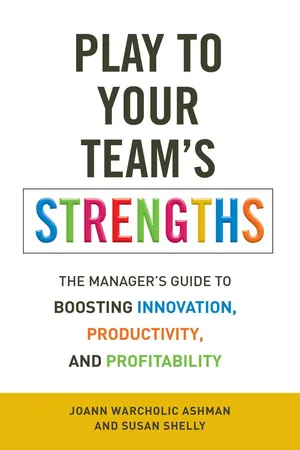
Play to Your Team's Strengths
The Manager's Guide to Boosting Innovation, Productivity, and Profitability
- 84 pages
- English
- ePUB (mobile friendly)
- Available on iOS & Android
eBook - ePub
Play to Your Team's Strengths
The Manager's Guide to Boosting Innovation, Productivity, and Profitability
About this book
Why is it a struggle for managers to get their staff to meet or exceed their goals? The answer is simple: employees are working at jobs that are not based on their individual strengths. JoAnn Warcholic Ashman and Susan Shelly, seasoned management consultants, show managers how to tap into the true potential of their staff and create the workplace that keeps them challenged and working at peak efficiency by using the latest strength-based management principles and techniques.
Frequently asked questions
Yes, you can cancel anytime from the Subscription tab in your account settings on the Perlego website. Your subscription will stay active until the end of your current billing period. Learn how to cancel your subscription.
No, books cannot be downloaded as external files, such as PDFs, for use outside of Perlego. However, you can download books within the Perlego app for offline reading on mobile or tablet. Learn more here.
Perlego offers two plans: Essential and Complete
- Essential is ideal for learners and professionals who enjoy exploring a wide range of subjects. Access the Essential Library with 800,000+ trusted titles and best-sellers across business, personal growth, and the humanities. Includes unlimited reading time and Standard Read Aloud voice.
- Complete: Perfect for advanced learners and researchers needing full, unrestricted access. Unlock 1.4M+ books across hundreds of subjects, including academic and specialized titles. The Complete Plan also includes advanced features like Premium Read Aloud and Research Assistant.
We are an online textbook subscription service, where you can get access to an entire online library for less than the price of a single book per month. With over 1 million books across 1000+ topics, weâve got you covered! Learn more here.
Look out for the read-aloud symbol on your next book to see if you can listen to it. The read-aloud tool reads text aloud for you, highlighting the text as it is being read. You can pause it, speed it up and slow it down. Learn more here.
Yes! You can use the Perlego app on both iOS or Android devices to read anytime, anywhere â even offline. Perfect for commutes or when youâre on the go.
Please note we cannot support devices running on iOS 13 and Android 7 or earlier. Learn more about using the app.
Yes, you can access Play to Your Team's Strengths by JoAnn Warcholic Ashman,Susan Shelly in PDF and/or ePUB format, as well as other popular books in Personal Development & Business General. We have over one million books available in our catalogue for you to explore.
Information
Topic
Personal DevelopmentSubtopic
Business GeneralChapter 1
What Is Strengths-Based Management?
We probably all know a couple of people who seem to be good at everything. These are the people who, as kids, always knew the answers to the teacherâs questions, were the captains of the football or field hockey teams, starred in the class musicals, and were everyoneâs friends. As adults, they seem equally competent, well rounded, and emotionally well equipped.
For the great majority of us, however, life doesnât come this easily. Most of us are good at some thingsâoften really goodâbut not so good at others. You might excel at gourmet cooking but couldnât begin to address a mechanical problem in your home. Or perhaps you can perform a stunning rendition of a classical piano composition but couldnât begin to hit a tennis ball over the net.
Some of us are strong and steady when an emergency occurs, while others fall apart at the thought of a crisis. Maybe youâre incredibly patient in the middle of a traffic jam, while the person sitting next to you rants and raves.
These sorts of inclinations, talents, and skills apply to both our private and professional lives. Just as most of us have strengths and weaknesses in our private lives, we also have areas of strengths and weaknesses at work.
And, over the years, smart managers have learned that when they concentrate on an employeeâs strengths instead of focusing on what he doesnât do so well, they, along with their employees, can achieve amazing results. In this book, youâll learn about strengths-based management, why it works, and how it can benefit your employees, you, and your overall organization.
A Strong Approach to Management
When a manager focuses on the strengths of employees instead of fussing over what they donât do well, employees are empowered and energized. This makes perfect sense when you consider that most people enjoy performing work that theyâre good at.
If Barbara absolutely excels at helping customers solve problems, chances are she will thrive as a customer service representative. If Adam is the ultimate strategic thinker who loves coming up with visionary ideas, you definitely want him in a position in which heâs able to do so.
To assign people to jobs that they donât enjoy and donât perform particularly well is counterproductive. They wonât be happy, you wonât be happy, and the higher-ups in the company wonât be happy, either. But enabling employees to work every day at jobs that match their strengths, talents, and personalities will energize workers. And when you get them to recognize not only their own strengths but the strengths of their coworkers and to understand how all of those strengths fit together and complement one another, youâre looking at a breakthrough team thatâs capable of great things.
The Evolution of Strengths-Based Management
For decades, managers have pondered how to get the most from their employees, and smart employees have worked to tap into the characteristics that serve them well on the job. There are many tools available for measuring traits and characteristics of employees employed by organizations and individuals to assess behaviors, psychological preferences, and personality.
Examples of these are the Belbinâs Self-Perception Inventory, which identifies behaviors that indicate the role an employee might play in a team setting, and the Myers Briggs Type Indicator, which measures psychological preferences and categorizes employees according to their attitudes and functions.
While employers and managers found these tools useful, and some still use them, most find that they are not completely satisfactory because while they reveal employee perceptions or how someone might work with others on a team, they donât really indicate individual strengths and talents that can be directly applied to organizational function.
That all changed in the late 1990s. Gallup, a Washington, D.C.-based polling firm that has studied human nature and behavior for more than seventy-five years and also provides consulting services for companies looking to increase employee productivity, released the results of a comprehensive thirty-year research project, attracting attention from around the world and changing the way many managers lead.
Gallup began publishing books about the strengths-based approach to leadership, and the movement grew. In 2001, Gallup created an online test called StrengthsFinder, which determines a personâs five greatest strengths, whittled down from a list of thirty-four aptitude areas. Strengths range in alphabetical order from Achiever to Woo (winning others over), and include other aptitudes including Communication, Deliberative, Empathy, Harmony, Individualization, Learner, Positivity, Responsibility, and Strategic.
The StrengthsFinder test became particularly popular after the publication of Strengths Based Leadership, published by Gallup Press in 2009. The book quickly became a bestseller, and called attention to the test, which could be accessed online with a code found in each volume.
To take the test, participants quickly select phrases that describe themselves. It takes about thirty minutes to complete the test, after which the results are compiled and the participantâs greatest strengths determined. Managers can use the test to determine and capitalize on her own strengths or to determine the greatest strengths of employees and assign jobs that correspond to those strengths. Take a look at http://scholar.google.com/scholar?hl=en&q=evolution+of+strength+based+management to learn more about the evolution of strengths-based management.
What the Polls and Experts Say
During the course of the thirty-year study, Gallup researchers and pollsters observed more than 1 million work teams and interviewed more than 20,000 managers. They also traveled around the world to ask employees about the most influential and best leaders they knew, and what it was about those leaders that attracted them. From manager and employee responses, researchers began to recognize the power of strengths-based management. Some conclusive information that emerged from the study includes the following:
- In work situations where managers do not focus on employeesâ strengths, only about 9 percent of employees reported feeling that they were engaged in their work.
- When managers do focus on the strengths of employees and match them to certain jobs and positions, almost 75 percent of workers reported feeling that they were engaged in their work.
- Only one in three workers worldwide reported that they have the opportunity to use their greatest strengths every day. India reported the highest percentage of workers with 36 percent, France was the lowest at 13 percent, and the United States reported 32 percent.
- Traditional managers spend only about 20 percent of their time reviewing an employeeâs successes during a review. The rest of the time focuses on weaknesses.
- While the best leaders were not well rounded in their work strengths, the combined strengths of their team members were. These leaders built teams that complemented one anotherâs strengths and compensated for strengths that the leaders, themselves, were lacking.
- The best leaders understood what their workers needed and were intentional about meeting those needs.
- Employees who were asked why they followed particular leaders cited the following qualities that attracted them to the leader: trust, compassion, stability, and hope.
Many different management styles have come and gone over the past decades. Strengths-based management, however, is more than a management style; it is an innate and practical means of enabling employees to do their best work in a meaningful matter, boosting morale and keeping them invested and productive.
And, although the StrengthsFinder test is popular and useful, managers and employees can work together to determine strengths without the benefit of the test. Youâll learn more about how to do that in Chapter 3.
The Benefits of Strengths-Based Management
As researchers continue to observe and study strengths-based management, there is ongoing and definitive evidence of its benefits. Research indicates that employees who are able to employ their strengths in the workplace are more likely than those who are not to have higher job satisfaction, make more money, and even enjoy better health in the long term.
Letâs take a look at how strengths-based management works, and, more importantly, why it works.
How It Works
Strengths-based management is the process of assessing the strengths of each employee, then assigning jobs and positions that match those strengths. Itâs different from traditional management, which tends to focus on the areas in which an employee is not particularly strong in hopes of improving those areas, or fixing the employee.
In addition to focusing on the attributes of employees, strengths-based training encourages employees to pool their strengths, using them for the advancement of the team and the organization.
Strengths-based management forces...
Table of contents
- Cover
- Title Page
- Contents
- Introduction
- Chapter 1. What Is Strengths-Based Management?
- Chapter 2. Your Role as a Strengths-Based Manager
- Chapter 3. Take a Good Look at Your Team
- Chapter 4. Establish Objectives and Assign Employee Strengths
- Chapter 5. How to Manage Your Strengths-Based Team
- Chapter 6. Building a Unified Strengths-Based Team
- Chapter 7. Creating a Great Environment
- Chapter 8. Looking Beyond the Team
- Chapter 9. How to Keep Your Strengths-Based Team Moving Forward
- Also Available
- Copyright Page