eBook - ePub
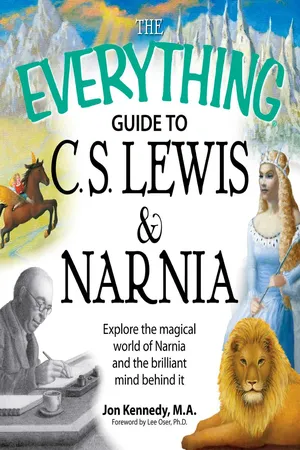
The Everything Guide to C.S. Lewis & Narnia Book
Explore the magical world of Narnia and the brilliant mind behind it
- 304 pages
- English
- ePUB (mobile friendly)
- Available on iOS & Android
eBook - ePub
The Everything Guide to C.S. Lewis & Narnia Book
Explore the magical world of Narnia and the brilliant mind behind it
About this book
Now, more than ever, the works of C.S. Lewis enthrall and entertain readers of all ages. But who was this man of intellect and imagination? The Everything C.S. Lewis and Narnia Book gives you an in-depth look at this master storyteller, his life and times, and his best known works. You’ll learn how he:
You’ll also gain a deeper understanding of Lewis’s body of literary works including the enchanting characters of Narnia. This is the essential guide to the man who inspired the imaginations of millions of children and adults alike!
- Overcame his tragic childhood
- Journeyed from atheism to faith
- Created the magical world of Narnia
- Inspired other writers, philosophers, and political thinkers
- Found—and tragically lost—the love of his life
You’ll also gain a deeper understanding of Lewis’s body of literary works including the enchanting characters of Narnia. This is the essential guide to the man who inspired the imaginations of millions of children and adults alike!
Frequently asked questions
Yes, you can cancel anytime from the Subscription tab in your account settings on the Perlego website. Your subscription will stay active until the end of your current billing period. Learn how to cancel your subscription.
No, books cannot be downloaded as external files, such as PDFs, for use outside of Perlego. However, you can download books within the Perlego app for offline reading on mobile or tablet. Learn more here.
Perlego offers two plans: Essential and Complete
- Essential is ideal for learners and professionals who enjoy exploring a wide range of subjects. Access the Essential Library with 800,000+ trusted titles and best-sellers across business, personal growth, and the humanities. Includes unlimited reading time and Standard Read Aloud voice.
- Complete: Perfect for advanced learners and researchers needing full, unrestricted access. Unlock 1.4M+ books across hundreds of subjects, including academic and specialized titles. The Complete Plan also includes advanced features like Premium Read Aloud and Research Assistant.
We are an online textbook subscription service, where you can get access to an entire online library for less than the price of a single book per month. With over 1 million books across 1000+ topics, weâve got you covered! Learn more here.
Look out for the read-aloud symbol on your next book to see if you can listen to it. The read-aloud tool reads text aloud for you, highlighting the text as it is being read. You can pause it, speed it up and slow it down. Learn more here.
Yes! You can use the Perlego app on both iOS or Android devices to read anytime, anywhere â even offline. Perfect for commutes or when youâre on the go.
Please note we cannot support devices running on iOS 13 and Android 7 or earlier. Learn more about using the app.
Yes, you can access The Everything Guide to C.S. Lewis & Narnia Book by Jon Kennedy in PDF and/or ePUB format, as well as other popular books in Literature & Classics. We have over one million books available in our catalogue for you to explore.
Information
Chapter 1
All of His Roads Before Him
Clive Staples Lewis was born November 29, 1898, in his familyâs home in Dundela Villas, overlooking the Belfast Lough (an inlet from the strait dividing Ireland from Scotland) in Belfast, in County Down in what is now Northern Ireland. Clive was the second of two sons to Flora Hamilton Lewis and Albert James Lewis, a successful Belfast attorney. The infant Clive was looked after by servants in the style common in professional-class British homes of the time, and he played mostly indoors because of Irelandâs wet weather and the dangers of diseases that took a high toll on young children of the time.
Childhood in Victorian Ireland
C. S. Lewisâs first friend and playmate was his brother Warren, called Warnie, who was three years old when Clive was born and to whom he remained close the rest of his life. The grandson on his motherâs side of a rector in the Church of Ireland (as the Anglican Church is called there) and great-grandson of a Methodist minister on his fatherâs, his family regularly attended Saint Markâs Church in Dundela, where his parents had met. The northern Ireland weather and their long periods of playing inside surrounded by a well-stocked family library are thought to have ignited the Lewis brothersâ literary imaginations.
FACT
Though imagination and fantasy play were common for children before the age of TV kidsâ networks and computer games, it must have been an especially strong factor for boys living in Ireland with its surfeit of storytellers and fantastic characters like selkies (human by night and seals by day) and âlittle people,â including leprechauns.
All of Ireland in the closing years of Queen Victoriaâs reign (1837â1901) was part of the British Empire, the worldâs major superpower at the time on which it was frequently said into the 1940s that the sun never set. From London to Hong Kong to India and colonies in Africa, the sun, indeed, was shining on some part of the empire at all hours.
Home rule for Ireland was already being debated, with several of the Queenâs prime ministers and parliaments taking divergent stands back and forth, but when Lewis lived as a child in Ulster, Irelandâs northeast province, the island was not yet partitioned between the Irish Republic and the six-county region of Northern Ireland as it now is. But special initiatives, âplantingsâ by Oliver Cromwell (who ruled England from 1599 to 1658) and King William III (1672â1702, known as William of Orange,) gave Scottish Presbyterians and English Puritans and Anglicans land to develop and, indirectly, âProtestantizeâ Ulster. These efforts resulted in Ulster being Irelandâs only Protestant-majority province.
Religious Rivalry
Unlike most cities in Britain and Ireland, Belfast is a relatively new development. Belfast was founded in 1609, less than twenty-five years earlier than the original settlements at New Amsterdam (New York) and Boston, Massachusetts, and two years after the establishment of the first permanent English settlement (Jamestown) in Virginia. Belfast and the six counties of Northern Ireland are still known as the site of the most intense and often violent rivalry in the world between Protestants and Roman Catholics. And it was into that milieu that the author of the most influential book promoting peace based on mutual respect among disparate orthodox Christian communionsâC. S. Lewisâs Mere Christianityâwas born and spent his childhood in a strongly Protestant family.
âIf aesthetic experiences were rare [in my childhood], religious experiences did not occur at all. Some people have got the impression from my books that I was brought up in strict and vivid Puritanism, but this is quite untrue. I was taught the usual things and made to say my prayers and in due time [was] taken to church.â
The House of Lewis
On his fatherâs side of the family, Lewis told his friend and later biographer, George Sayer, that he was descended from a Welsh farmer and it was the Welsh genes he considered his most characteristic ethnic line. Richard Lewis, Cliveâs great-great-grandfather, born in 1775, had owned a farm south of the border of England and Wales and was atypical in that he was Anglican when most Welsh had become chapel, or Methodists.
Richard Lewisâs fourth son, Joseph, Cliveâs great-grandfather, settled near Chester, across the border from Wales in central England, and apparently fell out with his Anglican vicar over the limited role he was allowed to take in services. He subsequently joined the local Methodists and eventually became their minister. He is recalled as a âpowerful preacher.â Though C. S. Lewis omits mentioning his paternal great-grandfatherâs Methodist ministry in his 1955 biography, Surprised by Joy, Sayer attributes to this ancestor Cliveâs âreligious enthusiasm, fine resonant voice, and real rhetorical ability.â
Grandfather Richard
Josephâs fourth son (of a family of eight), also named Richard, joined the ship-building trade in Liverpool, Englandâs âsecond city,â and from there moved to Cork, Ireland, to continue that trade. In Cork he and his wife Martha Gee had six children, the youngest of whom was Albert, Cliveâs father, born in 1863. Richard took the family from Cork to Dublin, where he joined John H. MacIlwaine and moved with him to establish MacIlwaine and Lewis Boiler Makers, Engineers, and Iron Ship Builders in Belfast.
Though initially prosperous, the business relationship was eventually dissolved, with Richard falling into hard times after his children were grown. His sons, especially Albert, helped sustain him in his older years, until his death (in 1908) at age seventy-six when Clive was nine years old. Grandfather Richard was remembered as both boorish (for example, having bad table manners) and snobbish, and was known for mood swings ranging from extreme optimism to extreme depression, a trait that some biographers say Cliveâs father Albert inherited.
Among uncles on the Lewis side, Clive and Warnie were fondest of their eldest uncle, Joseph, Richardâs first son, remembered as the most balanced Lewis of Albertâs generation. But he died in Cliveâs tenth year.
Richardâs second son, William (1858â1946) was remembered by Clive and Warnie as the least amiable of their paternal uncles. He was the first Lewis to send his sons to English boarding schools, an example that Albert followed by sending Warnie and Clive abroad in their preteens.
The Motherâs Side
Clive considered his motherâs side, the Hamiltons, as âSouthern Irishâ because, though originating in Scotland, they had been landed (given land) in County Down (south and east of what is now Belfast), Ireland, in the seventeenth century, under King James I. From their first home in Ulster, the line migrated to Dublin (southern Ireland), where Cliveâs great-great-grandfather was a fellow of Trinity College and later a bishop of the Church of Ireland.
FACT
Though Scots-Irish (or Scotch-Irish) is the term used to describe families like the Hamiltons who emigrated to northern Ireland from Scotland, not as well known is the fact that most Scottish families are descended from Irish immigrants who flooded Scotland following St. Columba (or, in Gaelic, Colm), a sixth-century Irish monk who evangelized the sparse population of Picts then inhabiting the Scottish highlands. âScotland,â Scotia, is actually the Latin name for Ireland.
Clive and Warnie held more affection for their Hamilton ancestors and were disinclined to like the Lewis side, though biographers see both sides as flawed. The Hamilton grandparents are recalled as poor parents who openly favored their elder two children, Lilian and Cecil, at the expense of the younger pair, Flora and younger brother Augustus. Grandmother Mary Warren Hamilton, the vicarâs wife, was active in politics, especially advocating home rule for Ireland (meaning a local parliament but not separation from the British Empire). She also irked parishioners and Protestant neighbors by hiring Catholic Irish servants rather than the Protestant ones preferred by most northern Ireland non-Catholics. Maryâs parental family, the Warrens, landed in Ireland during the reign of Henry II (1154â1189).
Mary Hamilton is said to have kept an untidy vicarage, presumably evidencing a calling higher or more cerebral than housekeeping. The house was overrun by cats whose presence was said to assault the olfactory senses of visitors when the door was opened by the familyâs maid.

Flora Lewis. Used by permission of The Marion E. Wade Center, Wheaton College, Wheaton, IL.
Grandfather Thomas
The vicar of St. Markâs is remembered as a preacher often carried away by his own sermons and shedding tears in the pulpit, which embarrassed parishioners including members of his family and the Lewises. Sayer attributes to him Cliveâs strong devotion to his principles as well as the kind of bravery Clive would later show while serving in the First World War.
After graduating from Dublinâs Trinity College where he took top marks in theology, Thomas volunteered as a navy chaplain for the duration of the Crimean War (1854â1856) and ministered in camps where cholera was as likely as combat to take sailorsâ lives. He considered swearing a deadly sin and openly reprimanded officers for using bad language in front of their troops. His preaching, not unusual in Ulster Protestant pulpits then and for generations afterward, was often virulently anti-Catholic, even referring to Catholics as demon-possessed or agents of Satan.
The aunt and uncles on the Hamilton side of their family were remembered by Clive and Warnie as bad-tempered and unkind. The eldest, Uncle Cecil, was recalled as âinsolentâ and always sarcastic with his sister, Lilian. Aunt Lilian was always âat war with as many members of the family as possible,â Sayer claims in Jack, and was accused by a servant of having driven her short-lived husband to a lunatic asylum. Uncle Augustus, or Gussie, a late bloomer, was called selfish and mean, but with a sense of humor and âan original thinker.â Despite his shortcomings and frequent requests for financial assistance, Albert considered him a close friend.
Parentsâ Marriage
Cliveâs father Albert turned to Flora after his older brother, William, had been rebuffed in attempts to court her. Though Albert had earlier maintained a long correspondence with a previous love interest, from age sixteen to twenty-two, he was more persistent through ups and downs with Flora. Albert, whose sons thought he could have had a career in politics, may have plied both the skill and the interest in befriending Floraâs mother by being a willing and ready sounding board for her opinions about home rule and other social reforms. It seems a safe assumption that his alliance with his future mother-in-law helped him win Floraâs affections.
THEY SAID
âFloraâs father also found a way to make use of Albertâs love for his daughter. He had Albert arrange and pay for a series of short holidays that he felt he needed, probably as a change from the unhappy and untidy life at the vicarage.â
âGeorge Sayer, Jack
Biographer Sayer insinuates that by this time Flora, who had finished her bachelor of arts from Queenâs College, Belfast, in mathematics and logic in 1881, was approaching spinsterhood and may have feared remaining an unclaimed treasure. Albert and Flora were united in marriage in 1894 by her father in St. Markâs Church, when he was thirty-one and she thirty-two.
Childâs Play and Fantasy
Lewis writes that his brother Warnie was his ally and confederate from the start. He never perceived him as an older brother, and they played and plotted together. From the earliest times Clive could remember, they were captivated by stories. They enjoyed creating their own characters and settings in which to play out their own fantasies and heroic feats. Though Warnie gravitated toward ships, trains, and stories of battles, Clive was more interested in magic and magical beings like elves, fairies, and classical heroes. Though they played indoors during inclement weather, as they became more independent they were able to explore the nearby countryside by foot and their bicycles.
âJacksie,â Then Jack
At about age four, Clive started insisting on being called âJacksieâ and refused to answer by any other name. Though George Sayer, who titles his biography simply Jack, doesnât provide an origin for the boyâs preference, an encyclopedia entry on Lewis claims Jacksie was the name of his beloved dog who died at that time. After he outgrew the childish âJacksie,â family and friends ever after called Clive âJack,â and thus from this point on so will he be called here.
FACT
With the release of the film The Lion, The Witch, and the Wardrobe, the Northern Ireland Tourist Board introduced a C. S. Lewis Trail in East Belfast, featuring a sculpture of the author as a young man, the home of his paternal grandfather, the sites of his first and second homes, St. Markâs Church, and other related sites. See Appendix A for the tourist boardâs Internet address.
Jackâs Ireland
Though Sayer makes more of Jackâs claim to Welsh roots than his Irish birth and childhood, a historian claims Lewis showed a strong affini...
Table of contents
- Cover
- Title Page
- Copyright
- Contents
- Acknowledgements
- The Top Ten Things Youâll Learn about C. S. Lewis & Narnia
- Introduction
- Foreword
- 1 All of His Roads Before Him
- 2 Life with Father and Warnie
- 3 Back to England to Stay
- 4 First Friend, War, and Oxford
- 5 A Career in Oxford
- 6 Journey to Faith
- 7 Life at The Kilns and Oxford
- 8 War and Writing
- 9 Mere Christianity
- 10 Into the Fantasy World
- 11 The Lion, the Witch, and the Wardrobe
- 12 Prince Caspian: The Return to Narnia
- 13 The Voyage of the Dawn Treader
- 14 The Silver Chair
- 15 The Horse and His Boy
- 16 The Magicianâs Nephew
- 17 The Last Battle
- 18 Books Meanwhile and After
- 19 Life with Joy
- 20 C. S. Lewisâs Legacy
- A Web Resources
- B Bibliography
- Index