eBook - ePub
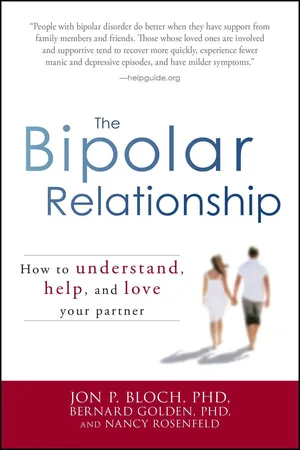
The Bipolar Relationship
How to understand, help, and love your partner
- 256 pages
- English
- ePUB (mobile friendly)
- Available on iOS & Android
eBook - ePub
The Bipolar Relationship
How to understand, help, and love your partner
About this book
Bipolar is a condition that affects peoples' relationships with others as much as it affects their own mental state. When one person in a couple is experiencing the extreme highs and lows of a disorder like this one, it's impossible for their partner not to feel the strain too.Reassuring yet realistic, Dr. Bloch, Dr. Golden, and Nancy Rosenfeld explain what's normal, what's not, what might change, and what definitely won't. They provide information and advice on typical troubling relationship topics, such as:
- Communication
- Trust and loyalty
- Family planning
- Finances
- Sex
- Maintaining a sense of self
By understanding the reality of bipolar and what it means for a relationship, couples will relate to each other better today and plan for a successful future together tomorrow.
Frequently asked questions
Yes, you can cancel anytime from the Subscription tab in your account settings on the Perlego website. Your subscription will stay active until the end of your current billing period. Learn how to cancel your subscription.
No, books cannot be downloaded as external files, such as PDFs, for use outside of Perlego. However, you can download books within the Perlego app for offline reading on mobile or tablet. Learn more here.
Perlego offers two plans: Essential and Complete
- Essential is ideal for learners and professionals who enjoy exploring a wide range of subjects. Access the Essential Library with 800,000+ trusted titles and best-sellers across business, personal growth, and the humanities. Includes unlimited reading time and Standard Read Aloud voice.
- Complete: Perfect for advanced learners and researchers needing full, unrestricted access. Unlock 1.4M+ books across hundreds of subjects, including academic and specialized titles. The Complete Plan also includes advanced features like Premium Read Aloud and Research Assistant.
We are an online textbook subscription service, where you can get access to an entire online library for less than the price of a single book per month. With over 1 million books across 1000+ topics, we’ve got you covered! Learn more here.
Look out for the read-aloud symbol on your next book to see if you can listen to it. The read-aloud tool reads text aloud for you, highlighting the text as it is being read. You can pause it, speed it up and slow it down. Learn more here.
Yes! You can use the Perlego app on both iOS or Android devices to read anytime, anywhere — even offline. Perfect for commutes or when you’re on the go.
Please note we cannot support devices running on iOS 13 and Android 7 or earlier. Learn more about using the app.
Yes, you can access The Bipolar Relationship by Jon P Bloch, Bernard Golden, Nancy Rosenfeld in PDF and/or ePUB format, as well as other popular books in Psychology & Personality in Psychology. We have over one million books available in our catalogue for you to explore.
Information
9
Can You Have a Normal Household?
“Normal” can mean many things and is often a subjective concept. Many individuals report coming from a “normal” home environment in spite of some very serious and destructive family behaviors. The fictional Addams Family considered itself a normal family with a normal household, and why not? All their family members appear happy and share the same strong values. So, if by “normal” you mean a household devoid of tension and turmoil, the answer is yes! A “normal” household can be yours — although sometimes it will be easier to achieve this goal than others.
Financial Issues
We have discussed financial issues in relation to symptoms of mania and how these issues impact the trust you have in your partner. The focus now is on how you can protect yourself and your relationship from the potential financial hardships that can occur when living with a bipolar partner. The following specific strategies can be practiced on a day-to-day basis.
Spend a Little Time to Save a Lot
A major financial challenge you may face in your relationship is ensuring your partner stays within the budget that you — as a couple — agree upon (during his most stable period). You may want to seek the assistance of an attorney to achieve this goal. Specifically, an attorney can help you form an agreement which specifies that your bipolar partner cannot spend, sell, give away, or trade past a certain monetary amount without your signature. If you cannot afford an attorney, see if free or low-cost legal help is available in your community. The nearest law school may also have students who are eager for legal experience. When initiating this action, you may feel uneasy or guilty about setting limits or anxiety that your partner will react with anger. Remember that it will be easier to secure a commitment from your partner if you engage him in an open and frank discussion.
If your partner cannot work or has proven to be a serious financial risk, you can set up a fixed weekly or monthly allowance. If given weekly, she may be less likely to impulsively spend large amounts at once, but it may also make her more likely to ask for “advances.” Whatever plan you follow, you must remain firm.
Limit your credit cards so you can monitor your expenses more closely. You may, for example, avoid obtaining credit cards from retail businesses and keep only one or two cards that will be accepted for most purchases. Additionally, even if you qualify for high credit lines, keep your credit cards and bank overdraft lines at low levels. Maintaining an accurate record of your liquid assets and limiting them will also make it less likely that your bipolar partner will overspend. Keep in mind that while you want to avoid becoming preoccupied with the worst-case scenarios, these strategies may be important should your bipolar partner impulsively decide to divorce you with no forewarning.
Other Bipolar Traits and Money
While forgetfulness is common for everyone, it's most identifiable in bipolar patients because of the symptoms associated with the disorder and/or the medications. Your partner may forget conversations you had five minutes ago about money, to note a check he wrote, or the fact that he used the credit card. If, at times, you think that your partner is forgetting on purpose, this is an issue of honesty that needs to be addressed. However, if his forgetfulness occurs frequently, you should be mindful not to immediately draw this conclusion. Meanwhile, you may want to further curtail your partner's access to finances if he cannot remember what was discussed.
ASK THE DOCTOR
Could my partner have attention deficit hyperactivity disorder?
People with a diagnosis of bipolar disorder are more likely than others to also have attention deficit hyperactivity disorder (ADHD). This may include difficulties with concentration, impulsiveness, and distractibility, all symptomatic of forgetfulness.
Another problem that may arise during a financial discussion is your bipolar partner's manic tendency to talk a lot, and in very complex ways. A simple question like, “Did you bounce a check?” can turn into a confusing verbal epic of knots and tangles. There is a good chance that extending the conversation at such a time may simply add to the chaos. It may, instead, be helpful to have your partner write down what he is trying to say. Tell him outright that you cannot follow his conversation, so he needs to jot it down. Having the time and solitude to put his answer in writing may allow your partner an opportunity for increased concentration and a reduction in emotionality that can arise when questioned about how the money was spent. Similarly, it will spare you the frustration of having a conversation that may seem convoluted and difficult to follow. After you read your partner's letter, give yourself some time and space, perhaps even sleep on it, in the effort to sort through possible contradictions and superfluous information. Your response should be brief.
At times, you may provide a structured request rather than an open-ended inquiry for information. For example, requesting that your partner enter a log of expenses that includes the amount spent, the date, the purpose, and a two-sentence description may spare you the frustration of reading a multipage document of a detailed expenditure. If contradictions exist, you can then be more focused in your request for further information. By cutting through the nonsense and keeping things simple, you will be able to put the matter to rest.
WORD TO THE WISE:
Set Money Aside
When playing the game “Monopoly” some players put a $500 bill under the board at the start of the game so they will have extra money when needed. Silly as it may seem, once the game gets going it is easy to forget about the $500, which may come in handy when the player needs additional funds. Likewise, it's important in the real world to have money set aside in case of an emergency and to plan according to your specific needs.
If Your Partner Works
Whenever both partners earn an income, they are faced with the task of deciding how to best manage their shared earnings. Although a challenge for any couple, this is especially important when your partner has bipolar disorder. One of the main decisions you'll need to make is what percentage of the paycheck should be deposited into your joint accounts. Many couples resolve the issue by setting up three accounts: an individual account for each partner and a joint account to which each contributes an identical percentage of their earnings. While this financial arrangement may be suitable for most couples, giving your partner access to a joint account may not provide you with the financial security you need. If this is the case, you may want to refer to the recommendations at the beginning of this chapter or place a cap on the amount of money in your joint account while you maintain control over the remaining difference.
Your partner may argue that it is her money and doesn't belong to anyone else. Should this occur, gently remind her that the money belongs to both of you, your children, and other family members when needed. Reassure your partner that you are keeping the money safe for everyone to enjoy together.
Job Stress and the Home
It is common for everyone to experience stress in the workplace, and it's also common to take work-related tension out on those with whom we live. With a bipolar partner, it is important to remain vigilant to this — and the level of stress your partner is experiencing — because of the impact it could have on your relationship. For example, your partner may experience periods of time during which all of his energy is focused to meet the demands of his job. During these times he may have little energy for anything else and might devote an entire weekend to regroup and maintain the level of energy required for the week ahead.
While each of us may, at times, experience an escalation in work-related stress, it deserves increased attention if it becomes a pattern with your partner. This may reflect increased demands of the workplace, but also a diminished capacity to handle ongoing stress due to some impending depressive episode. Addressing this reaction early on may significantly reduce the likelihood of an episode or the intensity of one should it occur.
Occasions may also arise when everyone brings stress about specific tasks and their deadlines home from their workplace. This may happen more frequently if the job is particularly meaningful. With bipolar disorder, minimal or moderate levels of stress are favored. It's best if the job is one that will not lead your partner to have more than an occasional worrisome night. Air traffic controllers, police officers, or even social workers who deal with abuse cases all deal with high levels of stress. If your partner is choosing a first career or job, bear in mind the potential challenges and level of stress associated with that choice. Even the most interesting job may be unsuitable for your partner if it involves major shifts in the workload with impending deadlines, overtime, and confrontation with difficult people — coworkers and/or supervisors.
Because of the demands of the workplace, people with bipolar disorder often do well when self-employed. They can manage their own schedules while working in the area most suitable to their individual talent and interest level, be it freelance writing, consulting, or a home-based business. However, working at home has its own challenges. To maintain a healthy relationship, both partners must establish acceptable parameters. Another problem confronted by the person who works from home is the isolated environment. Although writers usually prefer a secluded setting, people in other professions may find the solitude of working at home very lonely. In addition, distractions caused by children or even the family pet can be disruptive. For someone with bipolar disorder, the benefits often outweigh the disadvantages, and the responsibility falls on both partners to confront the challenges and resolve them together.
Case Study: Christopher and Mary
Working from home can be challenging, as Christopher, a thirty-five-year-old literary agent well knows. For Christopher, developing the self-discipline required to avoid working excessive hours was a large hurdle. He says, “It's so hard to stop in the middle of an interesting writing project, the review of a new manuscript, or even the occasional editing project. Also, website updates and our monthly newsletter are sometimes delegated to evening hours since the normal business day is filled with phone calls and project submissions.” However, these excessive working hours can result in poor health and discord in the relationship unless these occurrences are kept to a minimum.
Christopher admits to having trouble putting his work down due to his passionate interest in the publishing industry. He often picks up a manuscript and remains riveted to the chair. Sometimes he looks up hours after he's supposed to have finished working and realizes that he's accomplished little else. He says, “Since manuscripts and book proposals arrive daily, it's easy to fall behind without enforcing some measure of self-discipline. For a person who lives with bipolar disorder, managing a business while monitoring an illness can be quite an undertaking. Especially since I'm working with authors and publishers in different time zones, my normal business day begins on Eastern time and ends on Pacific time.”
Christopher's two sons are both adults with families of their own, but his wife Mary's life is impacted by his long and erratic working hours. When dinner is served late, Christopher tries to compensate by preparing special meals. But hardest of all is knowing when to quit for the day, as Christopher usually returns to his office before bedtime to “check e-mail.” He admits that he has trouble putting down work:
“Whereas I can function on less than five or six hours of sleep, Mary requires a minimum of seven hours. ‘What's taking so long?’ she'll ask when my e-mail check stretches beyond the anticipated amount of time. ‘Just one more email and I'm done,’ I reply, and if I don't make it in time Mary goes to sleep without me. Still, as an avid reader, she knows to expect that when I do come to bed it's with a book in hand. I wait until she's sleeping before switching on the nightlight, and then read until I fall asleep. Fortunately, the low light is adequate for reading and doesn't disturb Mary's rest.”
Help Around the House
Every couple that shares a household faces the challenge of chores essential to maintaining their home. Whether these tasks involve cleaning, cooking, organizing, or decorating, it is important that couples discuss how they will address their household duties. Frequently one partner may, without fanfare, assume responsibility for certain duties without discussing them with his mate. Others may find that listing each chore and who will attend to them is the most effective way to balance the household duties. If both are content with their respective chores there will be little conflict, but some couples take on tasks that they grow to resent and then fail to discuss their feelings with each other. The mounting tension that inevitably results can be damaging to any relationship.
Similarly, it is important to emphasize that people, whether bipolar or not, may have very different standards and different priorities regarding how clean or organized their home must be. As in any partnership, if harmony is to prevail, some compromise must be met. If you have a strong need for cleanliness and bristle if crumbs are left on the table, it's important to remember that your mate does not have to maintain the same standards unless she agrees to do so. Your partner is not responsible for your anxiety, nor does her attitude mean that she does not love or respect you. Don't be resentful at such moments and pick up the crumbs. You need to be responsible for maintaining your own standards if your partner is neither available to or does not wish to maintain them. Remember that when their differing attitudes are extreme, even nonbipolar couples split up over such issues.
If your bipolar partner's symptoms are under control, household duties should be shared. Even if one of you is a full-time homemaker, extra tasks that require an extra pair of hands may pile up. Conversely, if your partner's symptoms are not always under control, even basic household chores can pose a serious problem. Always maintain realistic expectations of your partner during these periods.
WORD TO THE WISE
Share Housecleaning Duties
In today's world, women still assume more housecleaning duties than men even when both the man and the woman are employed outside the home. If your bipolar partner is hung up on gender stereotypes, you might see this behavior amplified around the house. A bipolar woman might be fanatical about keeping the house clean while a bipolar man may insist that housework is only for women. But, this may not apply if your mate is less conservative about gender norms.
Household Extremes
Given the extreme nature of mood shifts in bipolar disorder, your bipolar partner, at times, may be obsessively neat or exceptionally sloppy. Periods of mania may be accompanied by a frenetic level of cleaning and organizing. Alternatively, her mania may foster disorganization when she is simultaneously involved in several projects but isn't capable of completing any of them. In the midst of a deep depression, she may be too lethargic to accomplish even the simplest tasks. When your partner is more stable, her attitude should more accurately reflect her true preferences.
Excessive Neatness
You may think, “Gee, what is wrong with someone who loves to keep a clean house?” (Or maintain a perfectly trimmed lawn or the shiniest hand polished car?) True, most people would rather live in a clean home than a dirty one, and if someone other than you wants to keep it that way … what's the problem? Such organization may be manageable and reflects a constructive way to channel energy. However, fanatical housecleaning can be a symptom of mania or escalating mania or it could precipitate high levels of stress that will set a manic attack in motion.
A clean kitchen floor is nice, but a speck of dust does not mean the floor must be scrubbed with a toothbrush. Enjoyable and hygienic as a clean environment can be, fanaticism makes others unhappy and nervous and the cleaner is missing the point of maintaining a household. If the home is not the place where family members experience love and peace, then the home is merely a dwelling.
During a manic mood the “crisis” of spilling some milk on the floor can lead to an episode of anger, despair, and frustration. Such accidents may trigger intense feelings of inadequacy and even acting out. When this happens, your partner should be reminded that he is not in complete control of his life. It is the emotional intensity associated with your partner's focus on cleaning that signals a compulsion rather than just the inclination toward cleanliness and neatness.
This intensity may be reflected when your partner gets carried away doing something, and his intensity brings out the opposite of what he was attempting to do in the first place. For example, he mops the floor and becomes so frustrated that he hurls the bucket against a window and breaks it. She may stay up all night sewing new curtains for the living room, and the next morning cut them up into little pieces. In the throes of mania, such behavior is in keeping with the bipolar sufferer's vacillating moods and impaired judgment.
Case Study: Carmen and Miguel
Rooted in our deepest caring and devotion for a loved one is a powerful desire to reduce their pain. Empathy allows us to experience our loved one's anguish, and compassion moves us to alleviate it. This was the driving force for Miguel, whose wife, Carmen, had been diagnosed with bipolar illness two years after their wedding. His concern for Carmen intensified when she seemed overwhelmed by an obsessive concer...
Table of contents
- Cover Page
- Title Page
- Copyright
- Dedication
- Acknowledgments
- Contents
- Introduction
- UNDERSTANDING BIPOLAR DISORDER
- What You Need to Know
- Bipolar Is Different for Each Individual
- Forms of Treatment
- Addressing Differences and Maintaining Realistic Expectations
- What to Avoid
- BUILDING BLOCKS OF A RELATIONSHIP
- Is Good Communication Possible?
- Is Trust Possible?
- Sex and Intimacy
- DAY TO DAY WITH BIPOLAR DISORDER
- Can You Have a Normal Household?
- Planning a Family
- Responding to Your Partner's Episodes
- What to Emphasize
- Putting Yourself First
- Resources
- About the Authors
- Author's Note