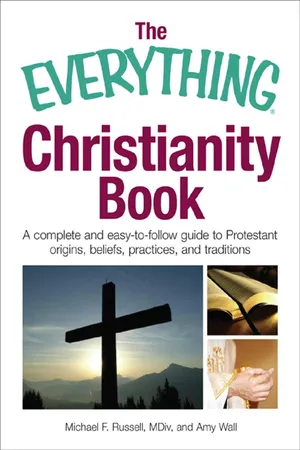
The Everything Christianity Book
A Complete and Easy-To-Follow Guide to Protestant Origins, Beliefs, Practices and Traditions
- 304 pages
- English
- ePUB (mobile friendly)
- Available on iOS & Android
The Everything Christianity Book
A Complete and Easy-To-Follow Guide to Protestant Origins, Beliefs, Practices and Traditions
About this book
A complete and easy-to-follow guide to Protestant origins, beliefs, practices, and traditions Christians make up about one third of the world's population. Among those two billion followers, over 185 million are of the Protestant faith. What are the differences between Protestant and Catholic? Both are of the Christian faith, right? These questions and more are answered in The Everything Christianity Book âan easy-to-read, inclusive treatment to one of the world's oldest religions. Among the many questions answered:
- Who was Martin Luther?
- When did the Protestantism split from the Catholic Church?
- What are the differences between the different branches of Protestantism (Presbyterian, Methodist, Baptist, et. al.)?
- Do Protestant churches have a hierarchy similar to that of the Catholic Church?
- How are Christian holidays observed from the Protestant perspective?
Christians and non-Christians alikeâno matter what their denominationâwill gain a new understanding of the rich diversity and complexities of Protestant practices and traditions. Full of facts and figures, names, dates, and places, The EverythingÂŽ Christianity Book is a stimulating, thought-provoking book on the Protestant faith.
Frequently asked questions
- Essential is ideal for learners and professionals who enjoy exploring a wide range of subjects. Access the Essential Library with 800,000+ trusted titles and best-sellers across business, personal growth, and the humanities. Includes unlimited reading time and Standard Read Aloud voice.
- Complete: Perfect for advanced learners and researchers needing full, unrestricted access. Unlock 1.4M+ books across hundreds of subjects, including academic and specialized titles. The Complete Plan also includes advanced features like Premium Read Aloud and Research Assistant.
Please note we cannot support devices running on iOS 13 and Android 7 or earlier. Learn more about using the app.
Information

Chapter 1
Early Christianity
In the Beginning
Jesus Christ

Roman Catholics believe in the doctrine of âImmaculate Conception,â which recognizes that Mary was sinless (or without sin) when she conceived Jesus. Other Christians simply believe that Jesusâ birth was a miracle.
The Roman Empire
Christian Influence

Although many refer to Jesus as âJesus Christ,â Christ wasnât his last name, but a title. In Hebrew, âThe Christ,â means âThe Messiahâ and serves as the root of the word Christianity. In his time, Jesus would have been referred to as Jesus of Nazarethâ the area in which he was raised.
Religion Before Jesus
The Pagans

What is a pagan?
Judaism in the Midst of Change
Politics and Jewish Factions
- The Pharisees: A group of staunchly restrictive Jewish leaders.
- The Sadducees: A conservative political group that represented the aristocracy of the Jewish society.
- The Zealots: A group that believed in armed conflict against the Romans.
- The Essenes: A group that was neither politically active nor violent, but that took to the wilderness to study religious writings.
Jesus and His Apostles

The Message
The Followers
- Simon: From Bethsaida; Jesus gave him the name of Peter (Greek) or Cephas (Aramaic), both of which mean ârockâ; he is often considered the leader of the twelve.
- Andrew: From Bethsaida; Simon Peterâs brother; he and John were the first disciples Jesus called.
- James (son of Zebedee): Johnâs brother; he was killed in A.D. 44 by Herod Agrippa I and is considered the first apostle to die as a martyr.
- John (son of Zebedee): Jamesâ brother; one of the closest friends of Jesus; the author of the Gospel of John.
- Philip: From Bethsaida, as Peter and Andrew.
- Matthew: The tax collector; also known as Levi; the author of the Gospel of Matthew.
- Thomas: He has the nickname âDoubting Thomasâ because he wanted to actually see and touch Jesusâ scarred body after his resurrection; Didymus is the Greek version of his name.
- Bartholomew: From Cana; one of the disciples to whom Jesus appeared at the Sea of Tiberias after his resurrection.
- James (son of Alphaeus): He is also known as James the Younger, or James the Less; the author of Johnâs epistle.
- Thaddeus: Also known as âJudas, the brother of James.â
- Simon: Also known as the Zealot; evangelized Persia and Ethiopia.
- Judas Iscariot: The only disciple not from Galilee; the one who betrayed Jesus and then committed suicide after Jesus w...
Table of contents
- Cover
- Title Page
- Contents
- Acknowledgments
- Top Ten Protestant Reformers and Reform Movements
- Introduction
- Chapter 1: Early Christianity
- Chapter 2: The Early Years of the Catholic Church
- Chapter 3: Christians and Rome
- Chapter 4: Early Christian Leaders
- Chapter 5: The Monks
- Chapter 6: The Early Middle Ages
- Chapter 7: The Late Middle Ages
- Chapter 8: Pre-Reformation
- Chapter 9: The Renaissance
- Chapter 10: Protestant Inspiration
- Chapter 11: The Lutheran Movement
- Chapter 12: Protestant Reformation
- Chapter 13: Protestant Globalization
- Chapter 14: Calvinism
- Chapter 15: Presbyterianism
- Chapter 16: Reformation in England
- Chapter 17: The Church of England
- Chapter 18: Counter (Catholic) Reformation
- Chapter 19: The New World
- Chapter 20: The Great Awakening
- Chapter 21: Revolution and Reform
- Chapter 22: Christianity in the Modern Age
- Appendices
- Copyright