eBook - ePub
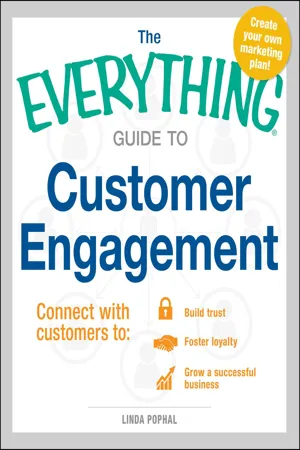
The Everything Guide to Customer Engagement
Connect with Customers to Build Trust, Foster Loyalty, and Grow a Successful Business
- 304 pages
- English
- ePUB (mobile friendly)
- Available on iOS & Android
eBook - ePub
The Everything Guide to Customer Engagement
Connect with Customers to Build Trust, Foster Loyalty, and Grow a Successful Business
About this book
Expert advice and strategies for winning--and keeping--customers!
Apple, L.L. Bean, Zappos.com, Nordstrom, Lego, Southwest Airlines. All of these extraordinarily successful businesses have one thing in common: They have famously loyal customers. These companies understand that customer engagement is just as important as quality products and services when it comes to customer loyalty and retention. With The Everything Guide to Customer Engagement, you can learn the highly successful strategies that have been working for business all over the world. Inside, you'll find essential information on how you can better:
- Reach customers in person and online
- Create a community
- Build your social media presence
- Bring in new business
- Grow your reputation
Frequently asked questions
Yes, you can cancel anytime from the Subscription tab in your account settings on the Perlego website. Your subscription will stay active until the end of your current billing period. Learn how to cancel your subscription.
No, books cannot be downloaded as external files, such as PDFs, for use outside of Perlego. However, you can download books within the Perlego app for offline reading on mobile or tablet. Learn more here.
Perlego offers two plans: Essential and Complete
- Essential is ideal for learners and professionals who enjoy exploring a wide range of subjects. Access the Essential Library with 800,000+ trusted titles and best-sellers across business, personal growth, and the humanities. Includes unlimited reading time and Standard Read Aloud voice.
- Complete: Perfect for advanced learners and researchers needing full, unrestricted access. Unlock 1.4M+ books across hundreds of subjects, including academic and specialized titles. The Complete Plan also includes advanced features like Premium Read Aloud and Research Assistant.
We are an online textbook subscription service, where you can get access to an entire online library for less than the price of a single book per month. With over 1 million books across 1000+ topics, weâve got you covered! Learn more here.
Look out for the read-aloud symbol on your next book to see if you can listen to it. The read-aloud tool reads text aloud for you, highlighting the text as it is being read. You can pause it, speed it up and slow it down. Learn more here.
Yes! You can use the Perlego app on both iOS or Android devices to read anytime, anywhere â even offline. Perfect for commutes or when youâre on the go.
Please note we cannot support devices running on iOS 13 and Android 7 or earlier. Learn more about using the app.
Yes, you can access The Everything Guide to Customer Engagement by Linda Pophal in PDF and/or ePUB format, as well as other popular books in Business & Business General. We have over one million books available in our catalogue for you to explore.
Information
CHAPTER 1
The Basics of Customer Engagement
Good companies know that the ability to engage customers is one of the most important aspects of running a successful business. Customer engagement is the process of connecting with customers in meaningful ways. Decades ago these interactions took place most frequently face-to-face, across counters in corner stores. Today they still take place face-to-face, but technology has expanded the opportunities for connecting significantly. Every company, whether it provides goods or services, is for-profit or not-for-profit, and regardless of the industry or geography it serves, benefits from the ability to attract and retain customers.
Small Businesses and Customer Engagement
Research about the percentage of new businesses that fail each year, or within a certain period of time after the business launches, is widespread. The Small Business Administration, for instance, indicates that more than half of all new businesses fail in their first five years.
Why? The reasons are many, but generally boil down to a companyâs failure to effectively engage with consumers. Engaging with customers is, after all, what business is all about. Some of the âbig rocks,â or most important issues, in this area are:
- Going into business for you, rather than for them. The bottom line is that regardless of what type of business youâre going into, you have to have a marketâyou have to have a clearly defined group of people who are likely to want what it is you have to sell.
- Not knowing what it is your customers are buying. You may know what youâre selling, but you may not know what your potential customers are buying. These two things are not always the same. As entrepreneur Victor Kiam, president and CEO of Remington Products, famously understood, he may have been selling a razor, but his customers were buying a smooth shave.
- Failing to read the tea leaves. Many businesspeople who ultimately fail in their efforts will shake their heads and lament that they âjust donât know what happened.â Other, more insightful businesspeople will admit that they ignored a number of warning signs along the way, like new competition, a decline in number of customers, indications of customer dissatisfaction, etc.
- Undercapitalizing. As the old saying goes, âyou have to spend money to make money.â Often undercapitalization is exhibited through lack of focus on two key areasâemployees and marketing. Your employees have a direct impact on how your business is perceived; if you underpay or make quick decisions here, youâll likely regret it later. Even small businesses need to be competitive, especially businesses in service industries where employees are the product. These interactions matter. Hiring the most skilled and capable staff members you can afford reflects, ultimately, on you. Similarly, your marketing efforts need to be designed to make your target audiences aware of what you have to offer and informed about the reasons why what you have to offer is better than other alternatives.
- Ignoring the competition. You will have competition. In fact, the better your product or idea, the more likely you will have competitionâand quickly. Ignore the competition at your own peril. To succeed long-term you need to be continually updating, upgrading, and reinventing what you have to offer.
- Cutting corners. Particularly during tough economic times it can be tempting to âcut back.â Many businesses feel that theyâre cutting back on the little things, but sometimes those little things can make a big difference. It can be difficult to see the value that customers place on some of the value-added attributes they enjoy as they interact with the businesses they frequentâthe exceptional service, the no-questions-asked guarantee, the free shipping. Difficult, that is, until those little things are taken away. Then it becomes quickly apparent.
- Losing interest. Youâve probably interacted with businesses that seem to lose their energy and enthusiasm over time. Their products become stale and outdated. Their service becomes ho-hum. Their marketing materials become irrelevant. Their employeesâeven their ownersâbecome complacent and out of touch.
- Losing touch. Does anybody use a typewriter anymore? Who owns a VHS machine? And whatever happened to Borders? There are examples all around us, stemming back for decades, of successful businesses that failed to identify and respond to disruptive innovation that threatened their livelihood. On the other hand, there are also examples of businesses that have been around for hundreds of years: CIGNA (insurance company) since 1792, Old Farmerâs Almanac since 1792, Jim Beam since 1795, DuPont since 1802. The fact that these companies are still in business suggests that theyâve found a way to remain relevant, to defy the competition and, importantly, to continue to meet the always changing needs of the markets theyâre serving.
These are just the tip of the iceberg when it comes to the issues that large and small companies face as they attempt to remain relevant and valued by the markets they serve. When you think about the âbest of the bestâ and the âworst of the worst,â which names come to mind? And, if you were to arrange these companies or products along a continuum, where would yours fall?
The Evolution of the Customer
Customers are the basis of success for pretty much every business, of every kind, everywhere in the world. Without them businesses literally could not exist. The exchange of goods and services for something of value has fueled the economy for centuries. According to Etymonline.com, the term âcustomerâ originated in the late Middle Ages from the term âcustoms official,â and originally broadly referred to âa person with whom one has dealings.â Therefore, in a sense, both a buyer and a seller could be seen as a âcustomerâ based on this early definition.
Going back throughout history, there have always been âcustomers.â For example, food, raw materials, and other basic items were often traded for prized luxury items, such as obsidian (volcanic glass) in the Ancient Near East, according to ArchAtlas.org. In this sense, ancient peoples trading basic goods were essentially both proprietor and customer. Possessors of obsidian were customers for other goods, but also proprietors who âsoldâ obsidian to their customers.
Trade was a natural progression from a time of self-sufficiency, when humans barely hunted or produced enough food to survive, to a time when agriculture allowed for a surplus of goods that could be bartered with other humans. Currency has also evolved, yet its remnants remain part of our business culture. For instance, salt was used as an early form of currency, given its relatively limited availability. In fact, according to SaltWorks.us, the word âsalaryâ has its origins in the Roman word for salt rations given to Roman soldiersâsalarium argentum.
As the economy in the United States has changed from agrarian, or farming-centric, to manufacturing, then to service, and now to technology-driven, or e-commerce, one thing has remained constant: the critical role that the customer plays.
Yet some companies do ignore customers or, at a minimum, take them for granted. As a consumer yourself, you can probably think of any number of businesses you have interacted with that did not pay enough attention to you or your needs. What have you done when youâve encountered those companies? If faced with readily available and comparable alternatives to what they had to offer, chances are you decided to take your business elsewhere.
Thatâs what customers do. Thatâs what your customers will do if you fail to engage them.
Big Business Icons
Fortunately, small businesses can take many cues from big business icons that have become known for exceptional customer service and effective customer engagement. Names like Zappos, Southwest Airlines, and Nordstrom come to mind. What are their customer engagement philosophies? Here are some examples of what they say about themselves:
- Nordstrom: âAn unerring eye for whatâs next in fashion. A relentless drive to exceed expectations. For more than 100 years, Nordstrom has worked to deliver the best possible shopping experience, helping customers possess styleânot just buy fashion ⌠Since 1901, weâve been committed to providing our customers with the best possible serviceâand to improving it every day.â
- Zappos: âWeâve been asked by a lot of people how weâve grown so quickly, and the answer is actually really simple ⌠Weâve aligned the entire organization around one mission: to provide the best customer service possible. Internally, we call thi...
Table of contents
- Title Page
- Dedication
- Contents
- Top Ten Ways to Connect with Your Customers in the Twenty-First Century
- Introduction
- Chapter 1: The Basics of Customer Engagement
- Chapter 2: Who Is Your Customer?
- Chapter 3: Defining Your Target Audience
- Chapter 4: Understanding Your Target Audience
- Chapter 5: Understanding Your Competition
- Chapter 6: Defining, Refining, and Managing Your Brand
- Chapter 7: Your Employees and Customer Engagement
- Chapter 8: Using Business Development for Customer Engagement
- Chapter 9: Using Traditional Media for Customer Engagement
- Chapter 10: Using Social Media for Customer Engagement
- Chapter 11: Using YouTube for Customer Engagement
- Chapter 12: Using Facebook for Customer Engagement
- Chapter 13: Using Twitter for Customer Engagement
- Chapter 14: Using LinkedIn for Customer Engagement
- Chapter 15: Using Google+ for Customer Engagement
- Chapter 16: Using Pinterest and Other Visual Platforms
- Chapter 17: Using Online Communities for Customer Engagement
- Chapter 18: Using Public Relations for Customer Engagement
- Chapter 19: Creating an Engagement Plan
- Chapter 20: When Things Go Wrong
- Appendix A: Customer Engagement Case Studies and Success Stories
- Appendix B: Additional Resources
- Acknowledgments
- Copyright

