eBook - ePub
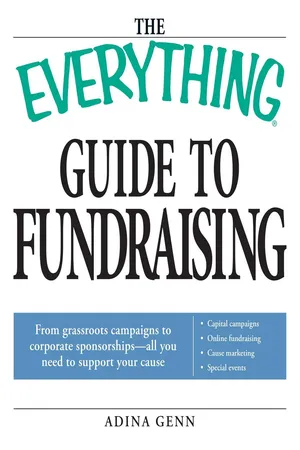
The Everything Guide to Fundraising Book
From grassroots campaigns to corporate sponsorships -- All you need to support your cause; Capital campagins/ Online fundraising / Cause marketing / Special Events
- 320 pages
- English
- ePUB (mobile friendly)
- Available on iOS & Android
eBook - ePub
The Everything Guide to Fundraising Book
From grassroots campaigns to corporate sponsorships -- All you need to support your cause; Capital campagins/ Online fundraising / Cause marketing / Special Events
About this book
Thousands of nonprofit organizations, charities, political campaigns, causes, and groups rely on fundraising dollars to succeed. But competition for donations is stronger than ever. This guide teaches you how to set goals, create a plan, and tap into a financial goldmine of corporate and government endowments. It features timely information on how to: attract and work with volunteers; choose and organize campaigns and events; use corporate fundraisers to increase visibility; pitch to reluctant donors and sponsors; and more! This edition also includes completely new material on: Intranet sites to communicate with team members; cause marketing; social networking fundraising; and giving circles.
Frequently asked questions
Yes, you can cancel anytime from the Subscription tab in your account settings on the Perlego website. Your subscription will stay active until the end of your current billing period. Learn how to cancel your subscription.
At the moment all of our mobile-responsive ePub books are available to download via the app. Most of our PDFs are also available to download and we're working on making the final remaining ones downloadable now. Learn more here.
Perlego offers two plans: Essential and Complete
- Essential is ideal for learners and professionals who enjoy exploring a wide range of subjects. Access the Essential Library with 800,000+ trusted titles and best-sellers across business, personal growth, and the humanities. Includes unlimited reading time and Standard Read Aloud voice.
- Complete: Perfect for advanced learners and researchers needing full, unrestricted access. Unlock 1.4M+ books across hundreds of subjects, including academic and specialized titles. The Complete Plan also includes advanced features like Premium Read Aloud and Research Assistant.
We are an online textbook subscription service, where you can get access to an entire online library for less than the price of a single book per month. With over 1 million books across 1000+ topics, weāve got you covered! Learn more here.
Look out for the read-aloud symbol on your next book to see if you can listen to it. The read-aloud tool reads text aloud for you, highlighting the text as it is being read. You can pause it, speed it up and slow it down. Learn more here.
Yes! You can use the Perlego app on both iOS or Android devices to read anytime, anywhere ā even offline. Perfect for commutes or when youāre on the go.
Please note we cannot support devices running on iOS 13 and Android 7 or earlier. Learn more about using the app.
Yes, you can access The Everything Guide to Fundraising Book by Adina Genn in PDF and/or ePUB format, as well as other popular books in Business & Business General. We have over one million books available in our catalogue for you to explore.
Information
CHAPTER 1
Fundraising Basics
Fundraising Basics
Whether itās to fix a leaky roof on an old church or help keep the homeless warm this winter, you have identified a need. But what next? How do you go about raising money to do the good deeds you want to do? This chapter introduces you to the world of fundraising.
Why Have a Fundraiser?
Fundraising can encompass a wide range of possibilities, from raising several million dollars for a new hospital wing to raising a few hundred dollars for new costumes for a high school performance. The idea of fundraising, however, offers a community, school, or organization more than just a means of raising money. It can also help your team develop cohesiveness, provide a place for individuals to use skills and talents they may not use in their everyday lives, and create a sense of community.
Your fundraiser may be the starting point for members of your neighborhood to meet other likeminded individuals and start discussing various community issues. It may also be a way of generating support for a cause you believe in.
Today, it is common to find schools encouraging students from grade school through college to engage in fundraising activities. While the parents could raise substantial amounts of money without the help of their children, these activities provide young people with a sense of teamwork and civic responsibility. Of course, there is also the personal satisfaction you get from involvement with a cause that you want to help.
Support and Involvement
When a group or organization, whether fraternal, charitable, or political, holds a fundraiser, they take some of the burden of financial support off of their membership and gain the support of a wider audience. This can help spur public involvement and promote public awareness.
For example, when individuals pledge money to PBS, they are becoming involved, in a small way, in the work of that organization. At the same time, they demonstrate their support by donating money to help the organization. Not unlike showing up at a stockholders meeting, they can become a small part of something larger, something they find meaningful. Many people are involved in fundraising for the dual purposes of helping others and socializing. Helping to organize and run the annual book fair at your sonās middle school not only raises money to help the school, itās also a great way to meet other parents and get to know more people in the community.
Good Public Relations
While raising money for a specific goal is the primary objective, fundraising objectives also highlight and promote the work of your group or organization. Often, while promoting a specific fundraising effort, you will also distribute literature and tell others by word of mouth about the goals and mission of your group and the cause behind your fundraiser.
For example, representatives from the American Lung Association collecting money at a street fair will probably distribute fliers and data so the public can learn more about what they do, as well as provide health-related news and information. Fundraising often provides a means of educating the public by providing pertinent information gathered by your organization.

To run a successful fundraising drive or event, you need to introduce your members, volunteers, and everyone involved in the activities to one another. You want to establish a cohesive team for a successful fundraising effort.
Setting a Goal
Before you can start the process, it is important that you, and everyone involved in the fundraising efforts, are clear regarding what the money will be used for. Determining your primary goal can often be the cause for great debate in groups or organizations. You must establish priorities for your organizationādoes the school need new textbooks more than it needs a new gymnasium?
Establishing priorities requires careful examination of the available data. For example, the purpose of your organization may be to fight the HIV/AIDS epidemic. There are many ways to support this causeāyou must look at the data and determine what will allow you to be most effective. Is there a greater need in your community to raise funds to help HIV/AIDS patients or to support researchers at a medical facility who are seeking a cure for this disease?
Preliminary research, polls, and analysis of existing programs can help you determine which needs to prioritize and establish and fine-tune your goals. Studies in your community may show money has been pouring in to support HIV/AIDS research, while little money has been donated to local housing for patients.

Even when the purpose seems obvious, such as raising money after a natural disaster, make sure you are clear regarding how you envision the use of the funds. After Hurricane Katrina devastated the Gulf Coast, many groups specifically raised funds for victims and their families, while other groups sent money to help the relief workers.
Having a clear goal keeps your organization on track and inspires confidence. The more clearly you have stated your goal, the more easily you will be able to convince others to spend their hard-earned money to help your cause. Do your homework. The best way to convince others to give money toward achieving a specific goal is to have the data to support your need for funding.
Setting a specific goal will help your organization structure its fundraising plans. A larger-scale goal, such as building a new auditorium, will require a more detailed, larger-scale plan of action. Conversely, the goal of buying new volleyball uniforms will require less involved planning. Nonetheless, the goal should be clearly communicated to everyone involved, directly and indirectly, in the fundraising effort.
Targeting an Audience
It is important to establish your target audience even before you plan the details of your fundraising events or activities. Your goal is to raise money, but someone needs to be on the other end of that equation, writing out checks or handing over cash. Can you profile potential donors? Do you know who will be interested in helping you meet your goal? Can you reach these people?
It is in your best interest to establish who will be donating money. This way, your fundraising project is more likely to be successful. It will help you establish the magnitude of the project and determine whether your goal is feasible. If, for example, you are going to try to collect funds from students at the local high school, it is highly unlikely that you are going to raise the cash needed to build a new gymnasium. You will need to either establish a fundraising plan that attracts the corporate leaders in your community or scale down your goal to converting the old auditorium into a part-time gymnasium, rather than having a new structure built from the ground up.

One of the biggest downfalls of local fundraisers is not knowing the target community. Lofty goals and inappropriate fundraisers are a bad combination. Determine who comprises your target audience, what will attract it to your cause, and whom you may realistically tap for funding.
It is also presumptuous to expect everyone on campus or in the neighborhood to get involved and donate money. A large, high-profile organization such as the Red Cross has arms that extend nationwide and even worldwide. It can expect a large return based on calculating percentages and maintaining a database to track the number of people that donate money annually. The majority of local fundraising efforts have neither such a database nor such a far-reaching network. Therefore, you need to do some preliminary research and look into the potential donor base for your project.
If, for example, you are raising money for a sports program for underprivileged kids, you might want to tap into the local athletes and sports enthusiasts in your area. Studies show that women will more readily donate to a school-based, education-related fundraiser than men. College students have a greater passion for environmental and ecological concerns. Minorities have a greater concern for social and human rights issues.
Rallying Some Troops
āI wish I could, but Iām just too busy.ā Thatās a phrase you will hear all too often when trying to rally troops to work on your fundraising efforts. But there are many people out there who will be ready to give some time and effort to support a good causeāyou just have to find them.
Reasonable Goals
Set attainable goals. This may seem obvious, but it is important to consider how much work can reasonably be accomplished by the number of volunteers you have. Trying to do too much will only frustrate everyone and may even drive away some volunteers.
It is also very important that you rally people behind the idea in a positive, but not pushy, manner. You need to gather prospective team members and promote the reasons behind the need for funding. In addition, you want to emphasize the idea of FUNdraising, or having a good time.
Getting others involved in a fundraiser can be very easy if the cause, or need, is obvious and touches the members, students, or community personally. The less informed your audience is about an issue, the more you need to be prepared. Gathering facts and figures isnāt very difficult if you utilize the library, town records, and the Internet. Your enthusiasm for a cause may very well spread among your circle.
Show Them!
A simple example of winning over an audience with research and presentation comes from a father of two young children, who went before a local town board in his New England community to propose a fundraiser for new and better playground facilities. Many of the people sitting before him were elderly and had no idea what was wrong with the current playground. His idea didnāt get off the drawing board.
At the next town meeting, the father brought documented proof of several injuries that had resulted directly from the old equipment. In addition to a polished proposal with facts and figures, he also brought a few of the local kids, including one who was injured on the playground. He got the town behind him and they offered their assistance for his fundraising efforts.
You should prepare appropriate literature that supports your fundraising goal or goals. Such literature should clearly illustrate your mission to potential contributors and volunteers. It should also address the urgency behind...
Table of contents
- Cover Page
- Title Page
- Copyright Page
- Dedication
- Contents
- Top Ten Fundraising Tips You Will Learn from This Book
- Introduction
- 1: Fundraising Basics
- 2: Selecting the Fundraiser for You
- 3: Getting Started
- 4: Where and When? The Details of Your Fundraiser
- 5: Organizing the Troops
- 6: The Big Bucks
- 7: Honing Your Skills for Effective Fundraising
- 8: A Lesson in Ethics
- 9: Communication Tools and Practices
- 10: Spreading the Word
- 11: Corporate Fundraising
- 12: Community Fundraising
- 13: Grassroots Fundraising
- 14: Fundraising with Kids and Teens
- 15: Political Fundraising
- 16: Odds and Ends
- 17: All about Grants
- 18: Grant Writing 101
- 19: Taxes and Accounting
- 20: Measuring Success
- Appendix A: Fundraising Resources
- Appendix B: PBS: Forty Years of Successful Fundraising