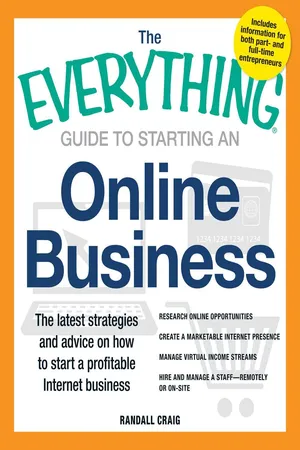
The Everything Guide to Starting an Online Business
eBook - ePub

The Everything Guide to Starting an Online Business

The Latest Strategies and Advice on How To Start a Profitable Internet Business

  1. 304 pages
  2. English
  3. ePUB (mobile friendly)
  4. Available on iOS & Android
eBook - ePub

The Everything Guide to Starting an Online Business

The Latest Strategies and Advice on How To Start a Profitable Internet Business

About this book

Create and run your own virtual business!

Whether it is a full-time online consulting business or just selling your crafts on the side, starting an Internet enterprise is a very appealing prospect to a budding entrepreneur! The Everything Guide to Starting an Online Business is the perfect guide as you navigate the online market—no matter your experience level. From developing an idea to sharing it with the world, this expert manual provides information on:
  • Determining what kind of business to create
  • Developing a smart business plan and online presence
  • Transitioning from brick and mortar to the virtual world
  • Using vendor sites like Etsy
  • Promoting the business with social media

Perfect for part-time entrepreneurs who want to make some extra cash or for full-timers who want one income stream, The Everything Guide to Starting an Online Business will help you get your businesses off the ground and onto the web!

Frequently asked questions

Yes, you can cancel anytime from the Subscription tab in your account settings on the Perlego website. Your subscription will stay active until the end of your current billing period. Learn how to cancel your subscription.
No, books cannot be downloaded as external files, such as PDFs, for use outside of Perlego. However, you can download books within the Perlego app for offline reading on mobile or tablet. Learn more here.
Perlego offers two plans: Essential and Complete
  • Essential is ideal for learners and professionals who enjoy exploring a wide range of subjects. Access the Essential Library with 800,000+ trusted titles and best-sellers across business, personal growth, and the humanities. Includes unlimited reading time and Standard Read Aloud voice.
  • Complete: Perfect for advanced learners and researchers needing full, unrestricted access. Unlock 1.4M+ books across hundreds of subjects, including academic and specialized titles. The Complete Plan also includes advanced features like Premium Read Aloud and Research Assistant.
Both plans are available with monthly, semester, or annual billing cycles.
We are an online textbook subscription service, where you can get access to an entire online library for less than the price of a single book per month. With over 1 million books across 1000+ topics, we’ve got you covered! Learn more here.
Look out for the read-aloud symbol on your next book to see if you can listen to it. The read-aloud tool reads text aloud for you, highlighting the text as it is being read. You can pause it, speed it up and slow it down. Learn more here.
Yes! You can use the Perlego app on both iOS or Android devices to read anytime, anywhere — even offline. Perfect for commutes or when you’re on the go.
Please note we cannot support devices running on iOS 13 and Android 7 or earlier. Learn more about using the app.
Yes, you can access The Everything Guide to Starting an Online Business by Randall Craig in PDF and/or ePUB format, as well as other popular books in Business & Business General. We have over one million books available in our catalogue for you to explore.

Information

Publisher
Everything
Year
2012
eBook ISBN
9781440555312

CHAPTER 1

Setting the Stage!

Making your start in a new business, even if it is only new to you, can be one of the most thrilling and rewarding experiences of your life. No one sets off expecting to fail, nor should you. Success will only be yours though if you follow through with preparation, diligence, guts, risk taking, and perseverance. Read on to see if you are ready to launch your idea.

Self-Evaluation

While it is true that starting and running a business is difficult, it’s done all the time, and done very successfully, by many individuals who have built empires large and small. Building a business is done by Wall Streeters and by everyday people who simply want to be their own bosses. Google, Apple, Microsoft all started very small—Apple in a garage.
Before you even consider starting your own business, you need to determine whether you’re the right person for the job. Would you hire you? The position in question involves being your own boss and running the show, which includes marketing, sales, customer service, and possibly maintaining an inventory, supervising other employees, bookkeeping, planning, and establishing investor relations. Most importantly, the job hinges on your ability to make many key decisions, some on short notice, and the effectiveness of your people skills, since nearly every online business involves interaction with others. You may be skilled in all of these key areas, but if you aren’t, you’ll either have to find other people who can assist you or tool up yourself.
Here’s a list of traits and characteristics that will help you run a business successfully:
  • The ability to gather facts and make important decisions
  • The ability to stay motivated, even when the business starts off slowly, as most businesses do
  • Good organizational skills
  • Good communication skills—verbal and written
  • A base understanding of web technology
  • A stick-to-it drive that keeps you working long hours to get the job done
  • Physical stamina to weather the long hours and lack of sleep that may be part of the job, especially in the early stages of the business
  • The ability to get along well with many different types of personalities
  • A diplomatic manner of harnessing or managing anger and frustration
  • Confidence in your skills, knowledge, and abilities to run a specific type of business
  • Confidence in your ability to find the answers to questions you don’t yet know
  • The ability to be firm or flexible, as required, so you can make adjustments or changes in your plans
  • The ability to successfully balance a business life and a personal life
The last item on this list is the toughest one. Many entrepreneurs report that the toughest transition is moving from a 9 A.M. to 5 P.M. job, to a 5 A.M. to 9 P.M. job. While running a business takes many hours and extreme dedication, if you sacrifice everything else in your life, you will eventually have regrets. A business is not worth building if you can’t stick around to see it prosper.
You will need to know every aspect of your business, not just the areas that involve your particular interests or strengths. Even if you delegate some tasks, such as bookkeeping or inventory management, you will need to be aware of how things stand at all times. Sometimes small mistakes can sink an otherwise sound business. As you read through this book, highlight the areas that need more attention. Don’t get blindsided.
Be honest with yourself and determine how many of the previously listed skills and talents you possess. How many do you see yourself learning? How many indicate the need for a business partner (or partners) to fill the void? How many simply do not describe you? If it’s more than 40 percent, then you may not be ready right now to go into your own business. It’s better to make that determination early on.

Pros of Starting Your Own Business

If you aren’t looking to reach a goal by opening up a business, then why go through all the trouble? As it turns out, there are quite a lot of pros associated with being an entrepreneur. Here are a few:
  • You are your own boss. No longer are you working for someone else. You only have to answer to yourself (and your investors, the bank, the IRS, and regulatory agencies). You get to make the big decisions for a change.
  • The sky’s the limit. Working for yourself may afford you the opportunity to make more money than working for somebody else. The risks are greater, but the potential rewards are too.
  • You can prove yourself. You have the opportunity to use your skills, abilities, and creativity to do things your way. You can fully use your skills, including ones that your former workplace may have stifled.
  • You’ll be involved in all areas of the business—from funding and finance to many of the smaller daily details.
  • You’ll take pride in promoting and marketing your own company—there is a special feeling you get when touting your own business.
  • You can make money while you sleep. One of the unique aspects of most online businesses is that the company—or website—continues to earn twenty-four hours a day, seven days a week. There is tremendous satisfaction when you wake up in the morning and see a number of transactions … and money in your bank.
  • You decide where to locate your business. Tired of commuting an hour or more every day in slow-moving traffic to get to the office? Now you can set up the office closer to home—or in your home.
  • The chance of a big payday. Beyond the income that you earn along the way, you may eventually sell the company.
From the design of the website and company logo to the sales strategy and marketing plan, it’s your call, your ball game, and your business. Like a roller coaster ride, starting a business has the proverbial ups and downs—and that’s what makes it fun.
You’ll see many websites about earning money with little effort. Don’t believe them. If there was a way to make a fortune that easily, the promoters would be doing it themselves—not trying to sell the concept to you.

Cons of Starting Your Own Business

Whenever there are pros, there are offsetting cons. In the previous section, you saw some of the positive aspects of starting your own business. It’s important also to be aware of some of the negatives:
  • You don’t get a guaranteed salary or paycheck. There is always a financial risk involved in starting a business. Not only may you not make money for some period of time, you will have to invest your own money into the business. It may be some time before you’re in a position to pay yourself. Depending on the type of business, it often takes several years before you show a profit.
  • Everything’s all on your shoulders. While it’s good to be the king during times of prosperity, you will also occupy the throne during lean times. Along with making the exciting and fun decisions, you’ll also have some tough decisions, such as choosing which of two employees to lay off because you can’t afford to keep them both on the payroll.
  • You can’t please everyone. When you work for someone else, you may be able to excel in the art of making your boss happy, or even thrilled, with your performance. As the boss, however, there will be occasions when you won’t be able to make everyone (or anyone) happy. Keeping customers satisfied, employees feeling valued, and investors happy can be a dicey balancing act.
  • You only have the 168-hour week. There are 168 hours in a seven-day week. You may find yourself sacrificing other aspects of your life to work a good portion of those hours. If finances allow, you can hire people to handle much of this work. However, you will need to train them, review their work, and maintain some control over all areas of the business.
  • You are both president … and janitor. While having a fancy title on your card may give you prestige, a founder’s job also includes taking out the garbage, cleaning the washrooms, going to the post office, boxing inventory for shipping, and anything else that you can’t afford others to do. If you’re not willing to get your hands dirty, then starting a business might not be for you.
  • Growing pains are common. Some businesses grow smoothly while (most) others experience growing pains. These are the times when there may be a drop-off in progress because the market, industry, or economy slows down, or because competition heats up.
Some of these points may not seem so challenging, and some of them may be show-stoppers. Remember, your friends and family will be on the entrepreneurial ride with you—ask them what they think of both the pros, and the cons.

Before You Start

Some of the most successful entrepreneurs will tell you that if they had realized what they were getting into, they probably would have lost the nerve to start their businesses in the first place. Other business owners say that they wish they had thought it all through more carefully and been able to foresee some of the pitfalls of running a business. To get a basic feel for the road that lies ahead, it’s important to ask yourself three basic questions.
As crazy as it sounds, it’s possible to bring a product to market too soon, before customers know they need it. You also don’t want to be too late coming to market. The last thing you want to do is invest in launching a product or service if there is no ready market for it. Investigate the market to find if it is the right time and place for your idea before investing too much time and money in your plan.

What Are My Goals?

Yes, you want to make money, but how much and how fast? Do you see yourself running a small online service business, or do you hope to become the next Google? Is this a business you hope to pass to your children after you retire, or do you hope to build a successful business over the next few years, sell it, and retire to some exotic locale? Are you looking at altruistic goals? There are many goals beyond the obvious one of making money. And how will you know if you have created a successful business if you have nothing by which to gauge success?

How Well Do I Understand Business?

You don’t need to be a regular reader of the Wall Street Journal to open a business. Eight-year-olds who can barely read can set up a lemonade stand and rake in some cash on a hot day. However, it’s important that you understand business principles as they pertain to your business concept. Do you have a basic understanding of bookkeeping, paying taxes, paying employees and vendors, signing contracts, making deals, marketing, and operating in accordance with state, local, and county rules, laws, and regulations? Because we are talking about an online business, it also means understanding the basics of web technology. You don’t have to know how to do all of this before you start, but you will need to research—and learn along the way.

How Will Running a Business Impact My Life?

Can you emotionally and financially roll with the uncertainty a business faces until it shows a profit? Can your family handle it? Will you be able to maintain a life outside of the business? How motivated are you?
You need to assess how well you can balance the many demands of a business, emotionally and physically, with the rest of your life. You need to be able to have a life away from your business; otherwise, you’ll lose all perspective. If you neglect other areas of your life, such as family and health, in the end the business will also suffer as a result. If running a business means sleepless nights and ulcers, then perhaps the security of working for someone else isn’t so bad after all.

The Upside of a Down Economy

Economists can tell you about business cycles that produce prosperity and times of economic retraction. When you are considering starting your business it is important to have a solid understanding of what is happening in the larger economy overall. It is more challenging for start-ups when credit is tight, consumers hold back, and online competitors come from everywhere. Yet whenever there is economic change, there is opportunity—especially online. Here are some of the special considerations for starting a business when times are tough.

Test Your Concept for the Times

Every idea has to be put into context. In tough times, families might not be able to afford a trip to Disney, but will look for value online. A shopping referral site that focuses on discounts in a specific niche may be more successful than a “lifestyle” site selling luxuries.

Consumers Still Need Basics

Can you become a discount resource for everyday items? You may have to trim your margins, but online businesses do not have the overheads that weigh down traditional businesses. Even in prosperous times folks like a bargain.

Squeezed Out? Jump Back In

Perhaps you find yourself on the wrong side of “right sizing” at your now former employ...

Table of contents

  1. Cover
  2. Title Page
  3. Dedication
  4. Contents
  5. Top 10 Tips You’ll Learn about Online Business
  6. Introduction
  7. Chapter 1: Setting the Stage!
  8. Chapter 2: How Much Time Will You Spend?
  9. Chapter 3: When Opportunity Knocks
  10. Chapter 4: Meet the Expert: You
  11. Chapter 5: Finding That Killer Idea
  12. Chapter 6: Networking
  13. Chapter 7: Researching the Market
  14. Chapter 8: Online Businesses
  15. Chapter 9: Working “in” the Web Machine
  16. Chapter 10: Caution—Online on the Edge
  17. Chapter 11: Structuring Your Business
  18. Chapter 12: Crafting a Business Plan
  19. Chapter 13: Get Your Capital Act Together
  20. Chapter 14: Put a Financing Plan in Place
  21. Chapter 15: Regulations and Legal Matters
  22. Chapter 16: Locating Your Business
  23. Chapter 17: Furnishings and Equipment
  24. Chapter 18: Building Your Online Presence
  25. Chapter 19: The Laws of Website Attraction
  26. Chapter 20: Selling Online
  27. Chapter 21: Advanced Concepts: Converting Browsers to Buyers
  28. Chapter 22: Customer Relationship Management
  29. Chapter 23: Product and Services Management
  30. Chapter 24: Employees: Choose Well, Manage Well
  31. Chapter 25: Bookkeeping, Record Keeping, and Administrative Tasks
  32. Chapter 26: Insurance and Tax Information
  33. APPENDIX A: A Winner’s Checklist—Tips and Tricks
  34. APPENDIX B: Case Templates
  35. APPENDIX C: Additional Resources
  36. Copyright