The Everything Guide to Day Trading
eBook - ePub

The Everything Guide to Day Trading

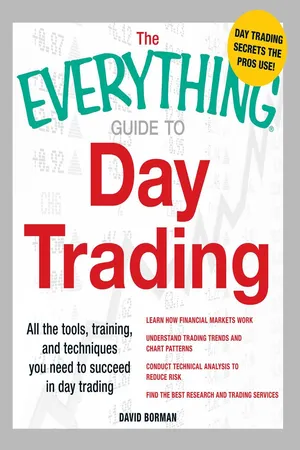
All the tools, training, and techniques you need to succeed in day trading

  1. 304 pages
  2. English
  3. ePUB (mobile friendly)
  4. Available on iOS & Android
eBook - ePub

The Everything Guide to Day Trading

All the tools, training, and techniques you need to succeed in day trading

About this book

Expert advice on becoming a successful day trader!

Day trading can be perilous or profitable—depending upon the expertise of the trader. In this no-nonsense, take-no-prisoners guide, you learn how the market works and how to make it work for you. From screening stocks to conducting technical analyses, you learn everything active traders need to succeed in this tumultuous world, including:

-What goes on behind the scenes in the market

-How things can go wrong and how to reduce risk

-Which kind of technical analyses work—and why

-The best research and trading services to turn to for help

-The ins and outs of chart patterns, like Candlesticks, Triangles, and Head and Shoulders

With real-life examples that illustrate the ups and downs inherent in this high-risk, high-profit business, this guide is all you need to trade wisely, quickly, and lucratively, no matter how new you are to the challenging game of day trading.
Frequently asked questions

Yes, you can cancel anytime from the Subscription tab in your account settings on the Perlego website. Your subscription will stay active until the end of your current billing period. Learn how to cancel your subscription.
At the moment all of our mobile-responsive ePub books are available to download via the app. Most of our PDFs are also available to download and we're working on making the final remaining ones downloadable now. Learn more here.
Perlego offers two plans: Essential and Complete
  • Essential is ideal for learners and professionals who enjoy exploring a wide range of subjects. Access the Essential Library with 800,000+ trusted titles and best-sellers across business, personal growth, and the humanities. Includes unlimited reading time and Standard Read Aloud voice.
  • Complete: Perfect for advanced learners and researchers needing full, unrestricted access. Unlock 1.4M+ books across hundreds of subjects, including academic and specialized titles. The Complete Plan also includes advanced features like Premium Read Aloud and Research Assistant.
Both plans are available with monthly, semester, or annual billing cycles.
We are an online textbook subscription service, where you can get access to an entire online library for less than the price of a single book per month. With over 1 million books across 1000+ topics, we’ve got you covered! Learn more here.
Look out for the read-aloud symbol on your next book to see if you can listen to it. The read-aloud tool reads text aloud for you, highlighting the text as it is being read. You can pause it, speed it up and slow it down. Learn more here.
Yes! You can use the Perlego app on both iOS or Android devices to read anytime, anywhere — even offline. Perfect for commutes or when you’re on the go.
Please note we cannot support devices running on iOS 13 and Android 7 or earlier. Learn more about using the app.
Yes, you can access The Everything Guide to Day Trading by David Borman in PDF and/or ePUB format, as well as other popular books in Personal Development & Trading. We have over one million books available in our catalogue for you to explore.

Information

Publisher
Everything
Year
2010
Print ISBN
9781440506215

APPENDIX A

Glossary

2 percent rule
A method of building in stop-loss settings (automatic closing of a position) to limit the overall loss of a position to 2 percent of the cash balance of your total day trading account.
American Depository Receipt (ADR)
An ADR is a share of stock that is directly tied to the price of a share of stock of a company that is listed on a non-U.S. exchange.
Annual report
An audited listing of a publicly traded company's financial statements and statements to shareholders.
Arbitrage
The buying and selling of securities on different exchanges at the same instant in an attempt to gain on the price difference between the two markets.
Arms index
Attempts to read the conditions of the stock market by looking at the number of shares on the NYSE that have fallen and risen and the volume of these shares.
Asset valuation
A method of determining the value of property or claims on property without the actual sale of the property. To arrive at an effective valuation, the two pieces of property must be similar in nature, quality, and quantity.
Available margin
A form of a credit card for buying stock or other tradable sector.
Balance sheet
A financial document that shows the assets, liabilities, and owner's equity of a business. A balance sheet is divided into two parts; the asset side must equal the liability and equity side.
Bear market
A market condition when the investor's and trader's risk sentiment is low; also when a market is falling in overall price.
Beta (ß)
A measure of a securities' volatility in relation to the overall market. A beta of 1.0 would indicate the security moves in tandem with the market, while a beta of 2.0 would indicate the security's movement is twice as volatile as the overall market.
Basis point
The commission in FX accounts, equal to .01 percent.
Big Mac Index
A term coined by the publishers of the periodical The Economist. The Economist publishes their version of a PPP measurement by recording the cost of a McDonald's Big Mac in several countries around the world. The thought is that the Big Mac is a good measure of PPP, as it is the same commodity worldwide.
Book entry format
Accounting entries made to record the transfer of gold reserves from vault to vault.
Bourses
A European term for a trading area, usually where financial products, art or numismatics are traded in an organized exchange-like arena.
Bretton Woods system
Financial system in which the U.S. dollar was linked to gold. Foreign nations could easily exchange the dollars they had in reserve for the gold that was held in the vaults of the U.S. government.
Broker
The financial intermediary required in order to trade securities. A firm that holds trading and investing accounts for clients.
Bubble in the market
A condition of securities that are greatly overpriced due to ease of credit, allowing greater and greater price expansion in the market.
Bull market
A market where there is an overall good feeling; usually indicated by rising prices over an extended time.
Buy and hold
An investment strategy that uses security selection as its main requirement; usually for longer timeframe investors.
Buy on the dips
A method of allocating a certain amount of your portfolio to one security and adding to your position of this security when the price naturally hits low points throughout the trading horizon.
Capital gain
The money made on an investment when the sales price is higher than the purchase price.
Capitalization
The sum of the long-term debt and the stock in the set up of a company. This is often called the structure of the company, and the amount of debt in relation to the amount of equity in the company will tell you how conservatively the company is structured; the lower the amount of debt, the more conservative.
Carry trades
Trading long, high-yielding currencies versus low-yielding currencies.
Cash flow
A measurement of the inflows and outflows through a company for a given length of time.
CBOE Volatility Index
An intraday index; its main use is as an indicator of traders' and investors' emotional feelings about the market. The higher the VIX number is, the greater the negative feelings in the market. A normal reading is anywhere from 15 to 25. Also known as the VIX Index.
Certificate of Deposit (CD)
A financial product sold by a bank that operates much like a savings account, only with a maturation date.
Coffers
A term from the Italian Renaissance referring to the chest in money traders and banker's vaults that held the actual gold and silver coinage.
Combination brokerage firms
Firms that have trained licensed brokers available to assist in the setting up of a trade or a hedge trade. They have two types of pricing structures, one for online trading at the discount rate, and one for broker-assisted trades, at a higher, full-service rate.
Commodity
Any raw materials that are fully interchangeable and uniform and used in the manufacture of processed goods.
Commodity currencies
Currencies of commodity-producing economies.
Deep-discount firms
These brokerages will offer a discount on the price if you exceed a certain amount of trades, usually above fifty in a monthly period.
Defensive cash account
The mindset that your cash account is the source of your paycheck and the source of a day trading business's self sufficiency. You should get to the point that your day trading business is completely self-sufficient and in no way harms your total picture of economic well-being.
Depreciation expense
A deduction allowed by the IRS that spreads the cost of fixed assets over an assigned lifespan of three, five, or seven years depending on the classification of the equipment or fixed asset.
Discount firm
Discount firms offer the same back office, order entry, and market access as a full-service firm. The only difference is that you will not have a representative to speak with, and most likely the discount firm will not offer its own research, but will rely on outside sources for this critical information instead.
Dollar cost averaging
Buying at regular intervals, at high points of the market and at low points of the market.
Dow Theory
A method used to plot the future movement of a security using the Dow Jones industrial 30 average and the Dow Jones transportation averages as base lines.
Earnings per share (EPS)
Found by taking the net earnings and dividing it by the total number of shares outstanding. The relative value of the market as a whole, measured by comparing the ratio of the S&P 500 average earnings per share to the percentage yield of a ninety-day U.S. government T-bill.
Earnings season
During earnings season, companies can exceed or miss what the market expected their profits to be, and this can lead to exaggerated and unpredictable price movements in a stock's price.
Elliott Wave Theory
Employs past information of a security movement to predict the securities future direction. The basis is that securities in the market have five distinct steps, and these steps form three separate waves. The theory is that once all of the five of the different parts of the wave have worked their way through, a top (or bottom) is in play. When a top or bottom is reached, this also marks the beginning of a fresh trend.
E-mini futures contracts
Futures contracts that are structured much like the full-sized contracts, except the they have much smaller lot sizes. Because they have smaller lot sizes, they are easier to manage, and it is easier to have multiple positions in your account at any one time.
Endowments
Often referred to as “institutional investors” or “inst...

Table of contents

  1. Cover Page
  2. Title Page
  3. Copyright
  4. Contents
  5. The Top 10 Tips for Successful Day Trading
  6. Introduction
  7. 01: Introduction to Markets and Trading
  8. 02: What Is Day Trading?
  9. 03: Is Day Trading for You?
  10. 04: Getting Set Up for Trading
  11. 05: Sectors to Day Trade
  12. 06: Deciding What to Trade
  13. 07: Choosing a Brokerage Firm
  14. 08: How to Navigate the Online World of Day Trading
  15. 09: Listening to the Market
  16. 10: Reading the Fundamentals
  17. 11: Adding Charts to Market Analysis
  18. 12: Cash and Margin Management
  19. 13: Preparing for Your First Trade
  20. 14: Building Positions and Risk Management
  21. 15: Developing Your Own System
  22. 16: Advanced Trading
  23. 17: Evaluating Your Performance
  24. 18: Emotions and Trading
  25. 19: Accounting and Taxes
  26. 20: Making Day Trading Your Job
  27. Appendix A: Glossary
  28. Appendix B: Additional Resources
  29. Appendix C: What to Trade When
  30. Appendix D: Financial Publications