eBook - ePub
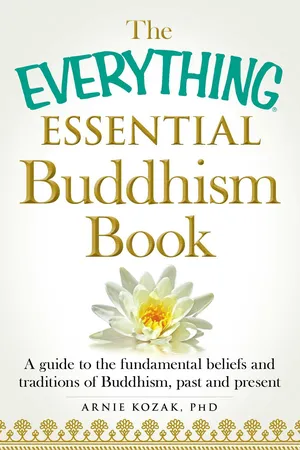
The Everything Essential Buddhism Book
A Guide to the Fundamental Beliefs and Traditions of Buddhism, Past and Present
- 288 pages
- English
- ePUB (mobile friendly)
- Available on iOS & Android
eBook - ePub
The Everything Essential Buddhism Book
A Guide to the Fundamental Beliefs and Traditions of Buddhism, Past and Present
About this book
Your concise guide to Buddhism, mindfulness, and meditation!
The Everything Essential Buddhism Book is your beginner's guide to the Buddhist principles of nonviolence, mindfulness, and self-awareness. Learn about the deceptively simple truths of this enigmatic religion, including:
- The life of Buddha and his continuing influence throughout the world
- Buddha's teachings and the Four Noble Truths of Buddhism
- The Noble Eightfold Path and how it should guide you
- What the Sutras say about education, marriage, sex, and death
- The proven physiological effects of meditation
- The growing impact of Buddhism on modern American culture
Frequently asked questions
Yes, you can cancel anytime from the Subscription tab in your account settings on the Perlego website. Your subscription will stay active until the end of your current billing period. Learn how to cancel your subscription.
No, books cannot be downloaded as external files, such as PDFs, for use outside of Perlego. However, you can download books within the Perlego app for offline reading on mobile or tablet. Learn more here.
Perlego offers two plans: Essential and Complete
- Essential is ideal for learners and professionals who enjoy exploring a wide range of subjects. Access the Essential Library with 800,000+ trusted titles and best-sellers across business, personal growth, and the humanities. Includes unlimited reading time and Standard Read Aloud voice.
- Complete: Perfect for advanced learners and researchers needing full, unrestricted access. Unlock 1.4M+ books across hundreds of subjects, including academic and specialized titles. The Complete Plan also includes advanced features like Premium Read Aloud and Research Assistant.
We are an online textbook subscription service, where you can get access to an entire online library for less than the price of a single book per month. With over 1 million books across 1000+ topics, weâve got you covered! Learn more here.
Look out for the read-aloud symbol on your next book to see if you can listen to it. The read-aloud tool reads text aloud for you, highlighting the text as it is being read. You can pause it, speed it up and slow it down. Learn more here.
Yes! You can use the Perlego app on both iOS or Android devices to read anytime, anywhere â even offline. Perfect for commutes or when youâre on the go.
Please note we cannot support devices running on iOS 13 and Android 7 or earlier. Learn more about using the app.
Yes, you can access The Everything Essential Buddhism Book by Arnie Kozak in PDF and/or ePUB format, as well as other popular books in Theology & Religion & Buddhism. We have over one million books available in our catalogue for you to explore.
Information
Chapter 1
The Buddha, the Teachings, and the Community of Practitioners
Buddhism is one of the worldâs great religions. Behind Christianity, Islam, and Hinduism, it is the fourth most populous religion in the world. And the question might be raised: Is Buddhism a religion at all? What is Buddhism, who was the Buddha, and why is he as relevant today as he was 2,500 years ago? Buddhism promises a path to happiness through the eradication of suffering. Can it do this? This chapter will address these questions.
Religion or Philosophy?
Can you have a religion without god, a supreme being that created the world and intervenes in the lives of his (or her) creatures? Does Buddhism qualify as a religion? Or is Buddhism a philosophical and ethical system for living? It appears that Buddhism can be considered a nontheistic religion, according to Buddhist scholar Damien Keown, when considered along seven dimensions common to religion. These seven dimensions include:
- Practical and Ritual
- Experiential and Emotional
- Narrative and Mythic
- Doctrinal and Philosophical
- Ethical and Legal
- Social and Institutional
- Material
Practical and Ritual
While the ritual elements of Buddhism may seem bare bones compared to the Catholic Church, for example, Buddhism certainly has rites and rituals that are public and private, many of which are associated with monastic life. Different Buddhist traditions place different emphases on ritual. For instance, Zen is almost entirely ritual compared to other systems like the Theravada.
Experiential and Emotional
The experiential dimension is the most important dimension of Buddhism. The Buddha was the exemplar. He transformed his life not through belief but through experiential practice. And Buddhists follow a similar path. The truth of Buddhism must be experienced personally. Karen Armstrong notes that the Buddha âconfined his researches to his own human nature and always insisted that his experiencesâeven the supreme truth of Nibbana [Nirvana] were entirely natural to humanity.â In other words, there is nothing supernatural about the experiences found in Buddhist practice.
Narrative and Mythic
Buddhism is not without its myths and legends, including those surrounding the life of the Buddha, which can be read as a parable as well as a biographical account of the historical figure known as Siddhartha Gautama. There are many narrative elements in Buddhism, including the Jataka tales.
Doctrinal and Philosophical
The Buddha chafed at âdoctrineâ and idle philosophical speculation and sought to teach through direct experience. However, Professor Keown says of doctrine, âif by âdoctrineâ we understand the systematic formulation of religious teachings in an intellectually coherent form,â then Buddhism qualifies as having doctrine in this sense. For example, there are the Four Noble Truths that are the foundation of the Buddhaâs teachings.
Ethical and Legal
Buddhism is widely regarded as one of the worldâs most ethical religions, having incorporated ethics into the foundation of the experiential practices. The central ethic is to âdo no harm.â Buddhism is predominately a path of peace. For example, the Dalai Lama has consistently advocated peaceful resistance to the Chinese occupation of his country, an occupation that has, by some estimates, claimed a million lives and destroyed 6,000 monasteries.
Social and Institutional
The sangha is the community of Buddhist practitioners and it is one of humanityâs oldest continuous institutions. Yet the sangha is not an institution in the sense that it has a central authority such as the Vatican. It is a diverse collection of people across nations and cultures that practice the Buddhaâs teachings in diverse ways. Buddhism is also a socially engaged religion seeking to make positive changes in society.
Material
The material dimensions of Buddhism are vast, majestic, and colorful. Buddhists have built breathtaking monasteries, caves, and carvings of the Buddha. King Ashoka left a legacy of iconic structures called stupas across India. Buddhist art is colorful and narrative. Buddhists make pilgrimages to holy sites such as the birth and death place of the Buddha and the places where he became enlightened and gave his first sermon.
As you can see, while Buddhism does not have a god and the Buddha is not regarded as a god, it fulfills the other criteria for a religion. You can consider it what you like. You can adopt Buddhism as your religion or you can regard it as a set of experiential practices, such as meditation, that you can integrate with your own religious beliefs. Or, as many do, Buddhism can be approached in an entirely secular manner, as a philosophical system for living, eschewing all rituals, beliefs, and doctrine, just as the Buddha did 2,500 years ago in his search for a way to end suffering. You, just like the Buddha, have the same potential for awakening.
Buddha versus Buddhism
Throughout this book a distinction will be made between Buddha (the life and teachings of Siddhartha Gautama) and Buddhism (the religious institutions that have developed over the past 2,500 years in many different parts of the world). Buddhism often goes beyond Buddha as these social organizations have migrated, proliferated, and developed over the centuries.
The first written evidence of the existence of Buddhism is found 400 years after the life of Buddha. King Ashoka of the Maurya Empire in northern India made inscriptions containing references to Buddhism that date from about 269 to 232 B.C.E.
In the West, both Buddha and Buddhism have been an attractive and ever-growing force for both personal growth and social change. You can embrace Buddha without embracing Buddhism. Buddha requires no beliefs, no affiliations, and, therefore, no conflict with your own belief system, whether you are devoutly religious or an atheist. Buddhaâs teachings are universal, transcending time and culture. If you have a mind, then Buddha is relevant to you. Many of the presentations of Buddhism in the West are more Buddha than Buddhism. For example, you will find mindfulness meditation being taught at major medical centers with no Buddhist context or affiliation.
Are You a Buddhist?
How do you become a Buddhist? What does it mean to be a card-carrying Buddhist? Buddhism represents a great diversity of traditions, so there is no single way to become a Buddhist and perhaps, ironically, no need to become a âBuddhist.â There is a curious situation in America where many teachers teaching Buddhist meditation would not consider themselves âBuddhist,â although they lead lives entirely consistent with the principles and practices of this religion. Buddhism in America has become quite popular, and many people might identify themselves as Buddhists.
According to the Pew Research Centerâs Forum on Religion & Public Life, as of 2010, 488 million or 7.1 percent of the worldâs population are Buddhists. Nearly 99 percent reside in the Asia-Pacific region, where Buddhism started. Itâs estimated that there are 3.9 million in North America (1.1 percent of the population) and 1.3 million in Europe (0.2 percent of the population).
One prerequisite to identification as a Buddhist would be to take refuge in the Triple Jewels: buddha, the dharma, and the sangha. Buddha is not just the historical person of the Buddha; it is what the Buddha representsâthe potential for awakening (buddha-nature) that you have. Taking...
Table of contents
- Letter to the Reader
- Welcome to the Everything Series!
- Title Page
- Copyright Page
- Introduction
- Chapter 1: The Buddha, the Teachings, and the Community of Practitioners
- Chapter 2: The Buddha: History and Legend
- Chapter 3: The Buddhaâs Teachings: The Four Noble Truths
- Chapter 4: The Noble Eightfold Path
- Chapter 5: The Buddhaâs Ethics
- Chapter 6: The Buddhist Community
- Chapter 7: Karma and Worldview
- Chapter 8: The Three Vehicles
- Chapter 9: Tibetan Buddhism
- Chapter 10: The Origins and Practice of Zen
- Chapter 11: Buddhist Practice
- Chapter 12: Life and Death and Other Practical Matters
- Chapter 13: Buddhism and the West
- Chapter 14: Brain of a Buddha
- Chapter 15: Can Buddhism Save the Planet?
- Chapter 16: Buddha in Daily Life
- Appendix A: Glossary
- Appendix B: Additional Resources
