
eBook - ePub
Philosophy 101
From Plato and Socrates to Ethics and Metaphysics, an Essential Primer on the History of Thought
- 288 pages
- English
- ePUB (mobile friendly)
- Available on iOS & Android
eBook - ePub
Philosophy 101
From Plato and Socrates to Ethics and Metaphysics, an Essential Primer on the History of Thought
About this book
Discover the world's greatest thinkers and their groundbreaking notions!
Too often, textbooks turn the noteworthy theories, principles, and figures of philosophy into tedious discourse that even Plato would reject. Philosophy 101 cuts out the boring details and exhausting philosophical methodology, and instead, gives you a lesson in philosophy that keeps you engaged as you explore the fascinating history of human thought and inquisition.
From Aristotle and Heidegger to free will and metaphysics, Philosophy 101 is packed with hundreds of entertaining philosophical tidbits, illustrations, and thought puzzles that you won't be able to find anywhere else.
So whether you're looking to unravel the mysteries of existentialism, or just want to find out what made Voltaire tick, Philosophy 101 has all the answers--even the ones you didn't know you were looking for.
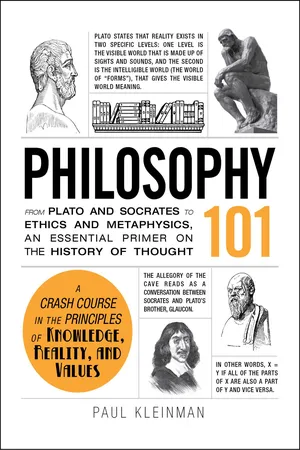
Too often, textbooks turn the noteworthy theories, principles, and figures of philosophy into tedious discourse that even Plato would reject. Philosophy 101 cuts out the boring details and exhausting philosophical methodology, and instead, gives you a lesson in philosophy that keeps you engaged as you explore the fascinating history of human thought and inquisition.
From Aristotle and Heidegger to free will and metaphysics, Philosophy 101 is packed with hundreds of entertaining philosophical tidbits, illustrations, and thought puzzles that you won't be able to find anywhere else.
So whether you're looking to unravel the mysteries of existentialism, or just want to find out what made Voltaire tick, Philosophy 101 has all the answers--even the ones you didn't know you were looking for.
Frequently asked questions
Yes, you can cancel anytime from the Subscription tab in your account settings on the Perlego website. Your subscription will stay active until the end of your current billing period. Learn how to cancel your subscription.
At the moment all of our mobile-responsive ePub books are available to download via the app. Most of our PDFs are also available to download and we're working on making the final remaining ones downloadable now. Learn more here.
Perlego offers two plans: Essential and Complete
- Essential is ideal for learners and professionals who enjoy exploring a wide range of subjects. Access the Essential Library with 800,000+ trusted titles and best-sellers across business, personal growth, and the humanities. Includes unlimited reading time and Standard Read Aloud voice.
- Complete: Perfect for advanced learners and researchers needing full, unrestricted access. Unlock 1.4M+ books across hundreds of subjects, including academic and specialized titles. The Complete Plan also includes advanced features like Premium Read Aloud and Research Assistant.
We are an online textbook subscription service, where you can get access to an entire online library for less than the price of a single book per month. With over 1 million books across 1000+ topics, we’ve got you covered! Learn more here.
Look out for the read-aloud symbol on your next book to see if you can listen to it. The read-aloud tool reads text aloud for you, highlighting the text as it is being read. You can pause it, speed it up and slow it down. Learn more here.
Yes! You can use the Perlego app on both iOS or Android devices to read anytime, anywhere — even offline. Perfect for commutes or when you’re on the go.
Please note we cannot support devices running on iOS 13 and Android 7 or earlier. Learn more about using the app.
Yes, you can access Philosophy 101 by Paul Kleinman in PDF and/or ePUB format, as well as other popular books in Philosophy & Ancient & Classical Philosophy. We have over one million books available in our catalogue for you to explore.
Information
EASTERN PHILOSOPHY
Philosophies from the other side of the world
Eastern philosophy refers to the philosophies that came about from the various regions of Asia (to a certain extent, the philosophies that came out of the Middle East have also been grouped into this term). The notion of Eastern philosophy can be a misleading one, however, due in part to the wide variety of cultures it encompasses. The philosophies that came out of China, for example, are drastically different than those that came from India.
In a very general sense, however, if the goals of Western philosophy are defined as seeking out and proving the notion of “truth,” then the goals of Eastern philosophy are defined as accepting “truths” and finding balance. While Western philosophy places emphasis on the individual and the rights of the individual, Eastern philosophy emphasizes unity, social responsibility, and the interrelation of everything (which, in turn, cannot be separated from the cosmic whole). It is for this reason that, oftentimes, schools of Eastern philosophy are indistinguishable from the different religions of the land.
INDIAN PHILOSOPHY
The various philosophies to come out of India, called darshanas in Sanskrit, are disciplines that set out to improve life. These include orthodox schools (Hindu philosophies) and heterodox schools (non-Hindu philosophies).
Orthodox Schools
The orthodox, or Hindu, schools draw philosophical principles from the ancient Hindu sacred text, the Vedas.
Samkhya
The oldest of the orthodox philosophical schools is Samkhya. This philosophical system states that all things in reality come from prakriti (meaning energy, matter, and creative agency) and purusha (meaning the soul, mind, or self). Samkhya is based on dualism; however, unlike Western philosophy’s definition of dualism as being between the mind and body, the dualism of Samkhya is based on the soul (an eternal, indivisible, and absolute reality that is pure consciousness) and matter. Total liberation occurs when one understands the differences between the soul and dispositions of matter (such as dullness, activity, and steadiness).
Yoga
The Yoga school draws upon the metaphysics and psychology of Samkhya; however, it features the presence of a divine entity. The goal of Yoga, as laid out in the Yoga Sutras (written in the second century b.c.), is to quiet the mind in order to attain a solitariness or detachment known as kaivalya.
Nyaya
The Nyaya philosophical school greatly influenced many other Indian schools of thought. The Nyaya philosophy is based on a system of logic, and followers believe that obtaining knowledge that is valid comes from inference, perception, testimony, and comparison. By obtaining knowledge in these ways, one becomes released from suffering. The Nyaya school also created criteria to determine what knowledge is valid and what knowledge is invalid.
Vaisheshika
Created in the sixth century b.c., the Vaisheshika school is based on pluralism and atomism. According to Vaisheshika, everything in the physical universe can be reduced to a finite number of atoms, and Brahman (the ultimate reality behind the gods and the universe) is what creates consciousness in the atoms. Eventually, the Nyaya and Vaisheshika schools merged together; however, Vaisheshika only accepted the sources of valid knowledge to be inference and perception.
Purva Mimamsa
The Purva Mimamsa school was based on interpreting the Vedas and being the authority on the sacred text. Purva Mimamsa involved an absolute faith in the sacred text and included the performance of fire-sacrifices in order to, it was believed, sustain the universe. While the Purva Mimamsa school believed in the philosophical and logical teachings of other schools, they argued that the only way one could attain salvation was by living in accordance with the teachings of the Vedas. Later on, the Purva Mimamsa school shifted to insist that in order to release one’s soul, one must partake in enlightened activity.
Vedanta
The Vedanta school focused on the philosophical teachings of the mystic contemplations that were found within the Vedas, known as the Upanishads. The Vedanta school emphasized the importance of meditation, spiritual connectivity, and self-discipline.
Heterodox Schools
The four heterodox, or non-Hindu, schools did not accept the authority that was present in the Vedas.
Carvaka
This school was based on materialism, atheism, and skepticism. Perception, according to the Carvaka school, is the only valid source of knowledge.
Indian Political Philosophy
Political philosophy in India dates back to the fourth century b.c., with the Arthashastra, a text that discusses economic policy and statecraft. In the twentieth century, another political philosophy was made popular by Mahatma Gandhi and was greatly influenced by the writings of Jesus, Leo Tolstoy, John Ruskin, Henry David Thoreau, and the Hindu Bhagavad Gita. Gandhi emphasized a political philosophy based on ahimsa, or nonviolence, and satyagraha, or nonviolent resistance.
Buddhism
The philosophical principles of Buddhism are based on the Four Noble Truths (the truth of suffering, the truth of the cause of suffering, the truth of the end of suffering, and the truth of the path that frees one from suffering). Buddhism advocates that in order to end suffering, one must follow the Noble Eightfold Path. The philosophy of Buddhism touches on ethics, metaphysics, epistemology, phenomenology, and the notion that God is irrelevant.

Jainism
One of the most basic ideas in Jainism is anekantavada, the notion that different points of view perceive reality differently, and therefore, there are no points of view that are completely true. In Jain philosophy, the only people who have true knowledge and know the true answer are referred to as Kevalis; anyone else can only know part of an answer. Jainism places great emphasis on equality of life, spiritual independence, nonviolence, and the fact that an individual’s behavior has immediate consequences. Self-control, according to Jain philosophy, is crucial for one to understand the soul’s true nature.
CHINESE PHILOSOPHY
The four most influential philosophical schools to come out of Chinese philosophy came about in 500 b.c. (the same time that ancient Greek philosophy began to emerge), and this period is referred to as the “Contention of a Hundred Schools of Thought.” The dominant philosophical schools were Confucianism, Taoism, Mohism, and Legalism. During the various Chinese dynasties, these schools of thought, along with Buddhism, became incorporated into official doctrine.
Confucianism
Based on the teachings of Confucius, Confucianism was a philosophical system that touched on subjects related to politics, society, and morality, and was quasireligious in nature (though it was not a religion and allowed for one to follow a faith while still following Confucianism). Confucius created the idea of a meritocracy, the Golden Rule (which states that one should treat others as they would wish to be treated), the notion of yin and yang (two forces that oppose one another are permanently in conflict, which, in turn, creates endless change and contradiction), and the idea that in order to find middle ground, one must reconcile opposites. The major ideas of Confucianism are ren (humanness for others), zhengming (a rectification of names), zhong (loyalty), xiao (filial piety, a respect for one’s parents and elders), and li (ritual).

✦ The symbol of yin and yang
Taoism
Taoism began as a philosophy and later turned into a religion. Tao means “way” or “path,” and is often used in a metaphysical way to represent the flow of the universe or the drive behind the natural order. Taoist philosophy focuses on humanism, relativism, emptiness, spontaneity, flexibility, and nonaction. Like Confucianism, Taoism places great emphasis on yin and yang, and it also places great importance on the Eight Trigrams, eight interrelated principles of reality, and feng shui, an ancient Chinese system of laws that uses colors and arrangement to attain harmony and balance in flow of energy.

Legalism
Legalism was a political philosophy based on the idea that there should be strict and clear laws for people to abide by, or else there will be harsh punishment. Legalism is based on jurisprudence, meaning “philosophy of law.” Legali...
Table of contents
- Cover
- Introduction
- Pre-Socratic
- Socrates (469–399 b.c.)
- Plato (429–347 b.c.)
- Existentialism
- Aristotle (384–322 b.c.)
- The Ship of Theseus
- Francis Bacon (1561–1626)
- The Cow in the Field
- david hume (1711–1776)
- Hedonism
- Prisoner’s Dilemma
- St. Thomas Aquinas (1225–1274)
- Hard Determinism
- Jean-Jacques Rousseau (1712–1778)
- The Trolley Problem
- Realism
- Immanuel Kant (1724–1804)
- Dualism
- Utilitarianism
- John Locke (1632–1704)
- Empiricism Versus Rationalism
- Georg Wilhelm Friedrich Hegel (1770–1831)
- René Descartes (1596–1650)
- A-Theory
- The Liar Paradox
- Thomas Hobbes (1588–1679)
- Philosophy of Language
- Metaphysics
- Jean-Paul Sartre (1905–1980)
- Free Will
- Philosophy of Humor
- The Enlightenment
- Friedrich Nietzsche (1844–1900)
- The Sorites Paradox
- Ludwig Wittgenstein (1889–1951)
- Aesthetics
- Philosophy of Culture
- Epistemology
- Twin Earth
- Arthur Schopenhauer (1788–1860)
- Karl Marx (1818–1883)
- Martin Heidegger (1889–1976)
- Voltaire (1694–1778)
- Relativism
- Eastern Philosophy
- Avicenna (980–1037)
- Bertrand Russell (1872–1970)
- Phenomenology
- Nominalism
- Gottfried Wilhelm Leibniz (1646–1716)
- Ethics
- Philosophy of Science
- Baruch Spinoza (1632–1677)
- Philosophy of Religion
- Photograph Insert
- Copyright