eBook - ePub
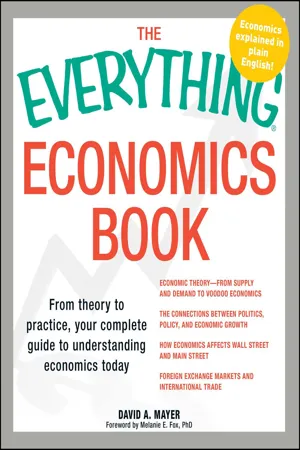
The Everything Economics Book
From theory to practice, your complete guide to understanding economics today
- 304 pages
- English
- ePUB (mobile friendly)
- Available on iOS & Android
eBook - ePub
The Everything Economics Book
From theory to practice, your complete guide to understanding economics today
About this book
The Dismal Science. The Worldly Philosophy. The Science of Scarcity. Most people think economics is one of the most challenging and complex fields of study. But with this book, it doesn't have to be! You will learn how the U.S. economy works in unbiased, easy-to-understand language. And you can learn it without the complex equations, arcane graphs, and technical jargon you'll find in most economic texts.
David A. Mayer and Melanie E. Fox explain:
- Why and how we trade
- How the government intervenes in markets
- Unemployment and inflation
- Supply and demand
- Competitive, financial, and foreign exchange markets
- How the economy is measured
Frequently asked questions
Yes, you can cancel anytime from the Subscription tab in your account settings on the Perlego website. Your subscription will stay active until the end of your current billing period. Learn how to cancel your subscription.
At the moment all of our mobile-responsive ePub books are available to download via the app. Most of our PDFs are also available to download and we're working on making the final remaining ones downloadable now. Learn more here.
Perlego offers two plans: Essential and Complete
- Essential is ideal for learners and professionals who enjoy exploring a wide range of subjects. Access the Essential Library with 800,000+ trusted titles and best-sellers across business, personal growth, and the humanities. Includes unlimited reading time and Standard Read Aloud voice.
- Complete: Perfect for advanced learners and researchers needing full, unrestricted access. Unlock 1.4M+ books across hundreds of subjects, including academic and specialized titles. The Complete Plan also includes advanced features like Premium Read Aloud and Research Assistant.
We are an online textbook subscription service, where you can get access to an entire online library for less than the price of a single book per month. With over 1 million books across 1000+ topics, weโve got you covered! Learn more here.
Look out for the read-aloud symbol on your next book to see if you can listen to it. The read-aloud tool reads text aloud for you, highlighting the text as it is being read. You can pause it, speed it up and slow it down. Learn more here.
Yes! You can use the Perlego app on both iOS or Android devices to read anytime, anywhere โ even offline. Perfect for commutes or when youโre on the go.
Please note we cannot support devices running on iOS 13 and Android 7 or earlier. Learn more about using the app.
Yes, you can access The Everything Economics Book by David A Mayer in PDF and/or ePUB format, as well as other popular books in Economics & Business General. We have over one million books available in our catalogue for you to explore.
Information
APPENDIX A
Economics Glossary
absolute advantage
This exists when an individual or a nation can produce goods and services either quicker or in greater abundance than can others. Absolute advantage implies greater efficiency.
acceptability
The condition that exists when people readily accept some form of money as a means of payment.
aggregate demand
The inverse relationship that exists between the real GDP and the price level in the economy. Aggregate demand (AD) is the willingness and ability of households, firms, government, and the foreign sector to buy the new, domestic production of a nation.
aggregate supply
The real gross domestic product that firms are willing to produce at each and every price level. In the short run, real GDP and price level are directly related, but in the long run, real GDP is independent of the price level.
allocation
The act of getting resources to where they are needed or wanted most.
allocative efficiency
The condition where marginal benefit equals marginal cost.
Animal Spirits
Keynes's term to describe his contention that people's actions are motivated at times by fear or hubris rather than reason.
arbitrage
Taking advantage of different prices in different markets in order to profit.
assets
Everything that is owned by an individual or firm. For banks, assets include its reserves, loans to customers, securities, and real estate.
autonomous consumption
The level of household spending that occurs independent of disposable income. Autonomous consumption does not vary with changes in the business cycle.
balance of trade deficit/surplus
The degree to which either exports or imports exceed each other. When exports exceed imports, a balance of trade surplus exists. If imports exceed exports, then a balance of trade deficit exists.
bank balance sheet
Comparison of a bank's assets to its liabilities and equity. Changes in the balance sheet influence the bank's ability to lend.
bank run
A situation where fact or rumor motivates bank customers to immediately demand their funds from their bank. Because banks only hold a fraction of their reserves as cash, the first to demand their funds are usually the only ones who walk away with money.
barter
Exchanging one good or service for another good or service.
Beige Book
A survey of anecdotal economic information gathered by each of the Federal Reserve's twelve district banks that is used by the FOMC in making interest rate decisions.
black market
Term used to describe a market where illegal goods or services are exchanged.
Board of Governors
The government part of the Federal Reserve System. Members of the Board of Governors are appointed by the president of the United States and are confirmed by the Senate. The Board of Governors is responsible for making the rules and regulations for the Federal Reserve System. The chairman of the board is appointed every four years and serves as the Federal Reserve System's leader as well as representing the United States's economic interests with the International Monetary Fund and the World Bank.
bonds
A security that is a promise from a borrower to pay a lender on a specified date with interest.
budget constraint
The amount of disposable income available to consumers for purchasing goods and services.
business cycle
Changes in the real GDP over time. The real GDP has periods of sustained increase punctuated with brief contractions also known as recessions.
capital
Capital in economics does not refer to money but to all of the tools, factories, and equipment used in the production process. Capital is the product of investment.
capital controls
Restrictions on the inflow and outflow of foreign investment in a country.
capital deepening
The process by which the amount of tools, factories, and equipment increases relative to the size of the labor force so that each worker has more available capital with which to work.
capital gain
An increase in the price of a real or financial asset. For example, if you buy Coca-Cola stock at $30.00 per share and then sell it at $50.00 a share, then you earned a $20.00 per share capital gain.
capital requirements
These ensure that banks are able pay depositors if some of the bank's borrowers are unable to repay their loans. Banks are required by law to maintain capital requirements.
capitalism
A hybrid economic system that emphasizes markets as the best means of allocating goods and services while recognizing a role for government as a provider of public goods and as a regulator.
cartel
A group of producers that agree to cooperate instead of compete with each other. Cartels seek higher profits for their members by collectively reducing production in order to increase prices.
ceteris paribus
When studying the relationship between different economic variables, economists hold all variables constant except for what is being studied. The assumption allows economists to find the relationships between different variables.
classical economics
The school of economic thought that assumes that market forces are able to efficiently and effectively allow an economy to remain fully employed. Freedom from government intervention in the economy is a logical conclusion of classical economics.
Coase theorem
Ronald Coase suggested that an efficient outcome could be achieved if polluters and those who bear the cost directly negotiated a payment that was acceptable to both parties. Some assumptions of the Coase theorem are that there are no bargaining costs for either party, property rights are clearly defined, and the number of people involved is small.
COLA
COLA stands for cost of living adjustment. Social Security recipients in addition to many pensioners receive COLA to offset the effects of inflation on their income.
collateralized debt obligation (CDO)
A packaged bundle of mortgage loans sold as a security similar to a bond. By bundling different loans together, investment banks sought to diversify the risk that investors faced.
collusion
This occurs when businesses illegally cooperate in order to make higher profits.
command economic system
The key characteristic of the command economy is centralized decision-making. Either one or a group of powerful individuals make...
Table of contents
- Cover Page
- Title Page
- Copyright
- Contents
- The Top 10 Things You Should Know about Economics
- Foreword
- Introduction
- 01: What Is Economics?
- 02: Why Do We Trade?
- 03: That's Not the Way We Do Things!
- 04: The Story of Money
- 05: Banks
- 06: Supply and Demand
- 07: Competitive Markets
- 08: Imperfectly Competitive Markets
- 09: Government in the Marketplace
- 10: Financial Markets
- 11: Foreign Exchange and the Balance of Payments
- 12: The Circular Flow of Economic Activity
- 13: Keeping Score: The Gross Domestic Product
- 14: Where Did My Job Go?
- 15: Inflation
- 16: Putting It All Together: Macroeconomic Equilibrium
- 17: The Federal Reserve and Monetary Policy
- 18: Voodoo Economics
- 19: Economic Growth
- 20: The Great Recession of 2007โ20??
- 21: The Environment and the Economy
- Appendix A: Economics Glossary
- Appendix B: Additional Resources