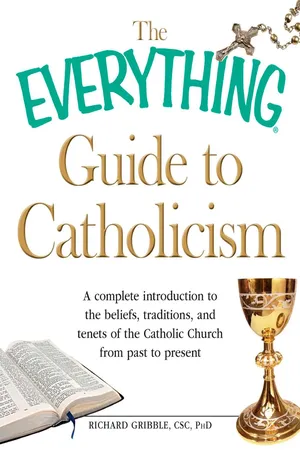
The Everything Guide to Catholicism
eBook - ePub

The Everything Guide to Catholicism

A complete introduction to the beliefs, traditions, and tenets of the Catholic Church from past to present

  1. 288 pages
  2. English
  3. ePUB (mobile friendly)
  4. Available on iOS & Android
eBook - ePub

The Everything Guide to Catholicism

A complete introduction to the beliefs, traditions, and tenets of the Catholic Church from past to present

About this book

Why do Catholics confess their sins? What does Jesus' second coming mean? How does someone, such as Mother Teresa, become a saint?

This guide answers these questions and more. This resource addresses the teachings, tradition, history, and theology of the Catholic Church. With this guide, you'll learn the foundations of the faith. Featuring explanations of:
  • What the parts of the Mass mean
  • Baptism, confirmation, and the other sacraments
  • The priesthood and religious life today
  • The life, death, and resurrection of Jesus Christ
  • Mary's relationship with modern Catholics
  • Sin, judgment, and salvation
This approachable book also highlights twenty-first-century issues and questions modern Catholics face, including gay marriage, abortion, and the death penalty. It's the ultimate guide to understanding Catholicism for readers of all backgrounds and faiths.

Frequently asked questions

Yes, you can cancel anytime from the Subscription tab in your account settings on the Perlego website. Your subscription will stay active until the end of your current billing period. Learn how to cancel your subscription.
No, books cannot be downloaded as external files, such as PDFs, for use outside of Perlego. However, you can download books within the Perlego app for offline reading on mobile or tablet. Learn more here.
Perlego offers two plans: Essential and Complete
  • Essential is ideal for learners and professionals who enjoy exploring a wide range of subjects. Access the Essential Library with 800,000+ trusted titles and best-sellers across business, personal growth, and the humanities. Includes unlimited reading time and Standard Read Aloud voice.
  • Complete: Perfect for advanced learners and researchers needing full, unrestricted access. Unlock 1.4M+ books across hundreds of subjects, including academic and specialized titles. The Complete Plan also includes advanced features like Premium Read Aloud and Research Assistant.
Both plans are available with monthly, semester, or annual billing cycles.
We are an online textbook subscription service, where you can get access to an entire online library for less than the price of a single book per month. With over 1 million books across 1000+ topics, we’ve got you covered! Learn more here.
Look out for the read-aloud symbol on your next book to see if you can listen to it. The read-aloud tool reads text aloud for you, highlighting the text as it is being read. You can pause it, speed it up and slow it down. Learn more here.
Yes! You can use the Perlego app on both iOS or Android devices to read anytime, anywhere — even offline. Perfect for commutes or when you’re on the go.
Please note we cannot support devices running on iOS 13 and Android 7 or earlier. Learn more about using the app.
Yes, you can access The Everything Guide to Catholicism by Richard Gribble in PDF and/or ePUB format, as well as other popular books in Theology & Religion & Christian Denominations. We have over one million books available in our catalogue for you to explore.

Information

PART I

History of Roman Catholicism

CHAPTER 1

The Apostolic, Patristic, and Medieval Church (0–1400)

History provides a rich context to what Christians believe through the movements, events, and significant personalities that have molded both the beliefs and legacy of the faith. The study of Roman Catholicism, therefore, must begin by providing insight to the 2,000 years of Christian history. This story has been the foundation for Western civilization in the Common Era. The first 1,400 years of Christian history describe a movement from obscurity to a position of dominance in society.

Life, Death, and Resurrection of Jesus

Christian history begins with and is centered on the person of Jesus Christ, whom believers proclaim to be the Son of God and divine. Unfortunately, extant historical sources give us very little information about the historical Jesus. The first-century Jewish historian, Josephus, in his treatise The Antiquities of the Jews, provides some information on the career of one named Jesus. A second passage in the same work describes Jesus as the brother of James, possibly James the Just, who became the leader of the nascent Christian community in Jerusalem after Jesus' death. The Roman historian Tacitus in Book 15 of his work Annals mentions a certain Christus who was crucified by the order of Pontius Pilate during the reign of the Emperor Tiberius. The principal source of information about Jesus is found in the Gospels of Matthew, Mark, Luke, and John. From these latter four texts the basic story of Jesus' life, death, and resurrection, which is central to all Christian thought, emerges.
illustration
Why do some scholars challenge the historical accuracy of the Gospels?
The simple answer is that these four accounts of Jesus' life often describe similar events but with many differences in details concerning time, place, and specifics of what occurred. The evangelists sought to explain the events to specific peoples; contemporary historical accuracy was not a significant concern.

Jesus of History and Faith

The question of the historical Jesus has captivated scholars since the late eighteenth century, and it continues to be a question today. What precisely can we know about Jesus from a historical perspective? As discussed in Chapter 5, the Gospels were not written as historical biographies of Jesus of Nazareth, but rather as expressions of faith that sought to present to various communities in antiquity the life and mission of Jesus. This question of the historical veracity of the sources that describe Jesus' life reached its peak in late-nineteenth-century work The Quest for the Historical Jesus by Albert Schweitzer. What Schweitzer said was that, from an academic historical perspective, little can be verified historically about the actual events of Jesus' life save that he was born, lived and traveled in Palestine, was ordered executed, and was proclaimed by his followers to have risen from the dead.
Christianity, and, therefore, Roman Catholicism, while premised on a strong historical foundation, is rooted in faith. The Christ of faith, which affirms that Jesus of Nazareth was the long-awaited Messiah, is the concept of how Jesus Christ was understood by his followers, both during his lifetime and through two millennia of Christian history. Belief in the mission and message of Jesus as the Messiah sent by God as Savior of the world is the foundation upon which Roman Catholicism is based. It is essential to understand that the Christ of faith — that is, how people understand Jesus' mission and message — is rooted in the historical reality of Jesus' life. Pope Benedict XVI, in his book Jesus of Nazareth, accurately responds to the perception by some that the historical and faith elements of Jesus cannot be reconciled. He wrote, “Where is the post-Easter faith supposed to have come from if Jesus made no foundation for it before Easter?” In other words, the Christ of faith must be based on a historical Jesus.
illustration
illustration
The confession of faith by Peter in Matthew's Gospel (16:15–16) is central to idea of the Christ of faith: “He [Jesus] said to them, ‘But who do you say that I am?’ Simon Peter answered, ‘You are the Messiah, the Son of the living God.’” Peter and the other apostles believed Jesus was divine.

What the Gospels Say about Jesus

While the Gospel accounts vary in details, the life, mission, and message of Jesus is clear and consistent. Jesus of Nazareth was born in Bethlehem, in 3 B.C.E. He lived in relative obscurity in Nazareth, the hometown of Mary, his mother, and Joseph, his foster father, until he was approximately thirty years old. For the next one to three years, the Gospel accounts vary. Jesus was engaged in an active apostolic ministry, traveling throughout the regions of Galilee and Judea, and on occasion outside Palestine, proclaiming a message that sought to fulfill the predictions of Hebrew prophets and to blaze a new path that, as Jesus himself says, brings fulfillment to the Hebrew law (Matthew 5:17). During his active ministry, Jesus gathered a select group of twelve men, whom he named apostles. After Jesus' death, these were the ones specifically tasked with evangelization of the nations.
illustration
Jesus' final instructions to his apostles before leaving the earth were to evangelize the nations: “Go therefore and make disciples of all nations, baptizing them in the name of the Father and of the Son and of the Holy Spirit and teaching them to obey everything that I have commanded you.” (Matthew 28:19–20a)
Jesus' message was highly controversial with the Jewish religious elite, for he challenged their authority and belief in the absolutism of the law. This conflict became so severe that ultimately in 30 C.E. Jesus was sentenced to death and executed by crucifixion at the hands of the Romans, the occupying force in Palestine. The Gospel accounts all agree that this event happened on a Friday and that on the ensuing Sunday morning, Jesus rose from the dead, appearing to his apostles and to others on numerous occasions. After some time (tradition has set this as forty days), Jesus ascended to heaven.

Acts of the Apostles

Commonly called the fifth Gospel, the Acts of the Apostles narrates two important stories: the growth of the nascent Christian community and the travels of St. Paul. Acts says that shortly after Jesus' ascension, the Holy Spirit (see Chapter 10) came upon the apostles and a few other disciples, providing the community with special gifts to continue the work of Jesus and removing fear that had gripped the community since the ascension. This book also speaks of Peter, leader of the apostles, and his initial evangelization efforts. Additionally, we learn of the growth and spread of the community that was first referred to as Christians in the city of Antioch. Lastly, we are told that the tensions between the Jewish religious elite and the fledgling Christian community continued until it became clear that Christians must separate; they could no longer be a group within Judaism.

Life and Ministry of St. Paul

The significance of the career of Paul of Tarsus, the first and primary evangelist and theologian of Christianity, cannot be underestimated. Paul, a zealous Pharisaic Jew, well-educated and schooled in the law, experienced conversion when Jesus appeared to him while traveling to Damascus on a mission to persecute Christians. Paul spent the next several years preparing for what became a ministry to Gentiles. Biblical scholars suggest Paul spent the years 47–60 traveling the eastern Mediterranean on three arduous missionary journeys, during which he established Christian communities. As a Jew, he went initially to the local synagogue, but then branched out to present the message of Jesus to all who would listen, most notably Greek Gentiles.
illustration
At the Council of Jerusalem (49 C.E.), it was determined that Gentiles did not need to abide by Jewish law and undergo ritual circumcision in order to be baptized as Christians. This decision was critically important for the advancement of Christianity since the emerging faith could now expand on its own and not as a subcategory of Judaism.
All of Paul's letters (save Romans and Philemon, see Chapter 5) were addressed to Christian communities that Paul founded during these three missionary journeys. Although not systematic in their theology, the teachings in these documents became fundamental church doctrine, including instructions on marriage and divorce, the second coming of Christ, church organization, and justification and salvation.

Christianity and the Roman Empire

Initially, Christians were viewed by the Romans as a sect of Judaism and thus tolerated. However, beginning with the reign of Emperor Nero (64– 66 C.E.), Christians were persecuted due to their perceived threat to the state, their abandonment of the Roman gods, and their repugnance of military service. Christians were used as scapegoats when external problems such as war and economic failure threatened the empire. Persecutions of Christians were both general and more localized. The campaigns of Nero, Domitian (95), and Trajan (111) were strong but local in character. However, Decius (249–251), Valerian (258–260), and Diocloetian (303–305) conducted general persecutions, leading many to apostatize and creating many martyrs. These persecutions ended in 313 with the publication of the Edict of Milan by the Emperor Constantine the Great. The conversion of the emperor shortly thereafter was transformative for Christianity, as almost overnight the faith went from being forbidden to being the standard religion of the empire.

Orthodoxy and Heresy

Recognition of Christianity in the early fourth century did not mean that within the community of faith all was settled; rather, many disagreements concerning theology arose, most especially teachings concerning God as Trinity (see Chapter 8) and Jesus Christ (see Chapter 9). There was no clear division between orthodoxy — that which is accepted as correct and proper teaching — and heresy — false teachings (heterodoxy). In their attempts to understand and articulate the faith, Christians lapsed into various teachings that over the course of history have been condemned as heretical.
During the patristic church (0–600), these heresies were grouped in two basic categories: those associated with the Trinity and those associated with Jesus Christ. During the third, fourth, and fifth centuries, Christians battled each other in an effort to try to understand the mystery of God. Subordinationism, the idea that the Father, Son, and Holy Spirit are not co-equal; Sabellianism, or modalism, the belief that God appears in different modes throughout history (Creator, Redeemer, and Sanctifier); and tritheism, the belief that the Trinity was actually three gods, were the principal heresies concerning the theology of God. Heresies also arose concerning the person of Jesus. Arianism, which dominated the church in the fourth century, was the belief that Jesus, because he was the only begotten Son of God, could not be divine.
In response to Arianism, in the fourth century, Appolinarius emphasized the divinity of Christ to the detriment of his humanity. In the fifth century, Nestorius went to the opposite extreme, denying that Mary was the mother of God (Theotokos) but rather was only the mother of the human Jesus. This meant that at some time, God “adopted” the human Jesus, making him divine. Only in 451 at the Council of Chalcedon was the orthodox teaching regarding Jesus formally defined.

Saints Augustine and Thomas Aquinas

The first 1,400 years of Christian history generated numerous significant personalities, both pious and saintly individuals and others who made significant contributions. Two of the most famous during this period were Saints Augustine (354–430) and Thomas Aquinas (1215–1274). Each of these men became towering figures in the history of Christianity and Roman Catholic theology.

St. Augustine

Augustine was the son of a saintly woman, Monica, and a pagan father, Patricius. During his youth and early adulthood he searched for a way to harness and utilize his brilliant intellect. A teacher of rhetoric, he initially tried Manichaeism, a dualistic philosophy contrasting good and evil, but after some years found it empty of meaning. Eventually he was converted to Christianity, becoming bishop at Hippo (North Africa). Through his voluminous writings, including his autobiography, The Confessions, he became known as the “Father of grace,” a title he earned through his insistence that the grace of God was absolutely necessary for human salvation. In his long life he gained recognition for his intellect and his courageous fight against two heretical groups, the Donatists and the Pelagians.

St. Thomas Aquinas

Thomas Aquinas was a Dominican friar whose theology, called Scholasticism, based on the philosophy of Aristotle, was dominant in the church for nearly 800 years and continues to be highly significant today. His Summa Theologica was his magnum opus; its methodology, theology, and philosophical approach became standard in the Catholic world for several centuries and re-emerged in the nineteenth century as Neoscholasticism.

Catholicism in the Medieval World

The church's integral position in society was fundamental to medieval Europe. It was a time when only those who held orthodox beliefs could be considered worthy mem...

Table of contents

  1. Cover Page
  2. Title Page
  3. Copyright
  4. Contents
  5. The Top 10 Things Everyone Should Know about Catholicism
  6. Introduction
  7. PART I: HISTORY OF ROMAN CATHOLICISM
  8. 01: The Apostolic, Patristic, and Medieval Church (0–1400)
  9. 02: The Reformation and Counter Reformation (1400–1648)
  10. 03: Revolution and Restoration (1648–1962)
  11. 04: The Church of Vatican II (1962–Present)
  12. PART II: REVELATION IN ROMAN CATHOLICISM
  13. 05: The Bible and Sacred Tradition
  14. 06: The Magisterium
  15. 07: The Creed
  16. PART III: GOD
  17. 08: The Trinity
  18. 09: Jesus Christ
  19. 10: The Holy Spirit
  20. PART IV: ROMAN CATHOLIC THEOLOGY
  21. 11: The Sacraments of Initiation
  22. 12: The Sacraments of Commitment and Healing
  23. 13: Moral Theology
  24. 14: Salvation
  25. 15: Mariology
  26. PART V: STUDY OF THE CHURCH (ECCLESIOLOGY)
  27. 16: The Church: One, Holy, Catholic, and Apostolic
  28. 17: Priesthood, Religious Life, and Lay Ministry
  29. PART VI: SPIRITUALITY
  30. 18: Life of Prayer
  31. 19: The Liturgical Year
  32. PART VII: CONTEMPORARY ISSUES
  33. 20: Social Catholicism
  34. 21: Contemporary Moral Issues
  35. 22: Dissent in the Church
  36. 23: Catholics and Other Religions
  37. Appendix A: A List of Significant Dates in Church History
  38. Appendix B: Basic Roman Catholic Prayers