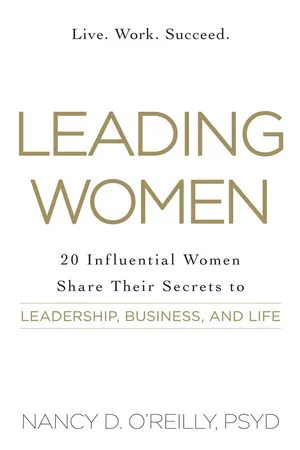
Leading Women
eBook - ePub

Leading Women

20 Influential Women Share Their Secrets to Leadership, Business, and Life

  1. 256 pages
  2. English
  3. ePUB (mobile friendly)
  4. Available on iOS & Android
eBook - ePub

Leading Women

20 Influential Women Share Their Secrets to Leadership, Business, and Life

About this book

Now is the time...Stop waiting around for the career--and life--that you deserve and start taking the reins! Leading Women shows you how to claim power and respect, conquer your internal barriers, and change the world by helping other women do the same. Featuring stories from twenty nationally acclaimed female leaders, this empowering guide offers real-life advice for breaking free of the predetermined roles in the business world and life. Powerful women such as New York Times bestselling author Marci Shimoff, advocacy leader Gloria Feldt, and Emmy-winning television host Aurea McGarry describe what it's like to go beyond their comfort zones, hold their own in a male-dominated environment, and take control of the situations that keep many women from achieving their goals. From corporate coach Lois Frankel's key ways to becoming a natural and necessary leader to bestselling author M. Bridget Cook-Burch's struggles after years of abuse, their insight will help you embrace your purpose, seize important opportunities, and overcome any obstacle that comes your way.With the guidance of these influential, resourceful leaders, you'll maximize your personal power, exceed your business goals, and establish a network designed to support and celebrate your fellow women.Contributors include: Kristin Andress, Cheryl Benton, Claire Damken Brown, PhD, M. Bridget Cook-Burch, Vivian Diller, PhD, Gloria Feldt, Lois P. Frankel, PhD, Joanna L. Krotz, Aurea McGarry, Lisa Mininni, Shirley Osbourne, Lois Phillips, PhD, Birute Regine, PhD, Linda Rendleman, Marcia Reynolds, PhD, Marci Shimoff, Rebecca Tinsley, Sandra Ford Walston, Michele Willens, and Janet Rose Wojtalik, EdD
Frequently asked questions

Yes, you can cancel anytime from the Subscription tab in your account settings on the Perlego website. Your subscription will stay active until the end of your current billing period. Learn how to cancel your subscription.
No, books cannot be downloaded as external files, such as PDFs, for use outside of Perlego. However, you can download books within the Perlego app for offline reading on mobile or tablet. Learn more here.
Perlego offers two plans: Essential and Complete
  • Essential is ideal for learners and professionals who enjoy exploring a wide range of subjects. Access the Essential Library with 800,000+ trusted titles and best-sellers across business, personal growth, and the humanities. Includes unlimited reading time and Standard Read Aloud voice.
  • Complete: Perfect for advanced learners and researchers needing full, unrestricted access. Unlock 1.4M+ books across hundreds of subjects, including academic and specialized titles. The Complete Plan also includes advanced features like Premium Read Aloud and Research Assistant.
Both plans are available with monthly, semester, or annual billing cycles.
We are an online textbook subscription service, where you can get access to an entire online library for less than the price of a single book per month. With over 1 million books across 1000+ topics, we’ve got you covered! Learn more here.
Look out for the read-aloud symbol on your next book to see if you can listen to it. The read-aloud tool reads text aloud for you, highlighting the text as it is being read. You can pause it, speed it up and slow it down. Learn more here.
Yes! You can use the Perlego app on both iOS or Android devices to read anytime, anywhere — even offline. Perfect for commutes or when you’re on the go.
Please note we cannot support devices running on iOS 13 and Android 7 or earlier. Learn more about using the app.
Yes, you can access Leading Women by Nancy D O'Reilly in PDF and/or ePUB format, as well as other popular books in Personal Development & Business General. We have over one million books available in our catalogue for you to explore.

Information

Part One

Mastering Our External Environment

A woman must exercise courage to push herself forward into a world that often feels unwelcoming if not outright hostile. One thing is certain, without the support and encouragement of our sisterhood, few of us would carry on. While you do this important work, remember to take the time to bring your women friends together to celebrate your successes.
The authors in this first section offer specific tools and techniques in their answers to my question, “What are the keys women must acquire if they are to unlock their personal power and create a better world?” Each of these authors is a thought leader in her profession who works to inspire and educate other women. After reading and adopting the strategies in this section, you will feel more comfortable exercising your power so that you can move forward confidently to achieve your goals.
As women sharpen their skills, they will continue to advance in the former off-limit areas of corporate business and government. Look around you. Reach out to other like-minded women in your world so you can help each other. When a woman meets success using her feminine skills, she can and should help others learn to do the same thing. Together, we can accomplish the powerful results we want to achieve.

From Oppression to Leadership: Women Redefine Power

by Gloria Feldt Cofounder and president of Take the Lead

“We will shift from the oppressive, outdated, patriarchal model of ‘power-over’ to an expansive model of ‘power-to’ that transforms how we lead, and how we live.”
What is your relationship to power? On a scale of one to ten, with one being, “I don’t like the idea of power so I don’t seek it,” ten being, “I love having power,” and the middle range being, “I’m not so comfortable with power, but I know I need to deal with it,” where do you place yourself?
I recently keynoted a conference of two hundred of the most powerful women lawyers and judges in the country. Not one of them raised her hand when I asked who rated herself a perfect “ten.” A few hands went up at the other end of the scale, ones or twos. Most hands raised in the five-to-seven range. After a few minutes discussing the question, one table of women burst out in laughter. “We agreed we could own up to being nines,” they told the group, “but ten just seemed too pushy.”
I wasn’t surprised. I see this bell curve in almost every predominantly female group. Men are far more likely to claim to be tens without hesitation. In one mixed group, a man, trying to be encouraging, chided a young woman who pegged herself as a two, whereupon she curled up into a fetal position in her beanbag chair and I had to coax her back into the conversation.
In another example, a colleague conducted a focus group of executive women to learn their preferences for a leadership course she was developing. These women were leaders in their respective professions or companies. When my colleague threw out ideas for names of the leadership program, those containing the word power drew the most controversy. One participant said she did not like the word because “it speaks to dominance.” Another said the program should not use “power” because “it is highly offensive to some people.”
I started studying women’s relationship with power in 2008, when it appeared we might have our first female president. I wrote an article for Elle magazine about women in politics, assuming it would be an optimistic look at how women are ascending to elective office. How surprised I was to learn, however, that at the rate we were progressing, it would take another seventy years for women to achieve parity in Congress.
Whether we are talking work, politics, or personal life, the dynamics of power are the same.
Women currently represent 51 percent of the population, 57 percent of college graduates, half the workplace, and 54 percent of voters, but only hold 18 percent of the top leadership positions across all sectors. Despite the potential power of sheer numbers in all these areas, we have barely moved the dial toward meaningful leadership parity in the last two decades.
The business case for women in leadership is clear: more women equal greater profits. Yet the 2013 Catalyst Census reports found women flatlined again compared to the previous year’s 14.6 percent of executive officer positions in Fortune 500 companies and 16.9 percent overall of board seats—the eighth year in a row of no appreciable increase.
Many efforts (some of them listed here) aim to change the gender ratio in leadership. One blog called change:the:ratio focuses on gender equality in the tech world and social media. Vision 2020 at Drexel University College of Medicine works across all sectors. Thousands of women’s leadership programs attract hundreds of thousands of women each year. Facebook COO Sheryl Sandberg’s Lean In initiative gives women, especially in corporate America, much encouragement to stay in the game even when the work environment feels hostile. Women Don’t Ask authors Linda Babcock and Sara Laschever teach negotiating skills, after documenting that the gender pay gap can be attributed to women’s reticence to self-advocate and negotiate aggressively for raises and promotions. This reluctance to ask costs each of us a cool half million dollars or more over a lifetime’s earnings.
Nonpartisan groups like the Women’s Campaign Forum and the White House Project and partisan groups such as Emily’s List (Democratic) and the Wish List (Republican) have long attempted with minimal success to get more women to run for office. When a woman runs, she is as likely as a man to win. She is as able to raise money and starts with greater voter trust than male candidates—which after partisan gridlock and numbing scandals featuring the likes of Spitzer, Weiner, Sanford, and Petraeus is hardly eyebrow-raising news.
It became clear to me that the problem is no longer external barriers and biases holding women back, though those certainly still exist. Women now have the necessary resources and the power to move forward; and the world is crying out for women’s leadership.
Power unused is power useless.
That is why I recently cofounded Take the Lead (find it at www.TakeTheLeadWomen.com). To break through the logjam and speed progress toward parity, women must transform our own relationship with power. When women change the way we think about power, we will then shift from the oppressive, outdated, patriarchal model of “power-over” to an expansive model of “power-to” that transforms how we lead and how we live.
There are good reasons for women’s ambivalence about embracing power. We must understand them in order to progress. First, political scientist Jennifer Lawless, author of It Takes a Candidate, attributes the deficit of women in political office to a deficit of ambition. But the more I dug into the research, interviewed women across the country, and looked into my own heart and performance as a leader, the more I came to attribute the disparity not to lack of ambition but to women’s socialization that leads to less intention. Ambition is aspirational—having a goal, hope, or desire. Intention implies assuming you are empowered to achieve your ambition and that you take the responsibility to make it happen. Boys are typically socialized from birth to see the world as their oyster and have no reticence about claiming their power. Girls are typically raised to attune themselves first to the needs of others, to respond rather than assume their own agency, even though today they are simultaneously told they can become anything they want to be.
Second, women have been discriminated against; we have been raped; we have had countless bad things happen to us because people have had power over us. These experiences have created so much pain that we know we do not want to receive the oppressive kind of power. Sexism is merely a form of humiliation in order to assert power-over. Sexism belittles and diminishes, whether by denial (the right to vote, equal seats in the corporate boardroom) or false elevation (the gilded cage, the pedestal).
Third, the belief that power is a finite pie; when you take a slice, there is less for me. While we’re well past the time when brawn alone ruled the social order (and physical strength was the measure of power), the notion that if a woman has power, there’s less for the man still lurks in the recesses of our prehensile minds. Moreover, women who assume powerful positions by merely adopting male models of power and leadership do not advance the cause of equality.
Fourth, it is hard to change a culture while you are living in it. It is challenging to see injustices, just as fish cannot see the water they swim in. In addition, it is risky—changing power structures changes relationships, and women may fear losing relationships they value.
For all these reasons, women may shy away from power. However, when I suggest we redefine power as the power to accomplish their goals, women respond, “Yes, I want that kind of power!” Power-to lets you innovate and make the world a better place for yourself, your family, your community, and the world. Power-to is possibility. Power-over makes you feel powerless. Power-to lets you feel powerful. I like the quote by Audre Lorde, “When I dare to be powerful—to use my strength in the service of my vision, then it becomes less and less important whether I am afraid.” Power-over is oppression. Power-to is leadership.
A leader needs her power tools.
There is not space here to share all nine of the power tools I created in No Excuses: Nine Ways Women Can Change How We Think about Power. My greatest pleasure is conducting workshops where we have the chance to practice all of them. So I will share one power tool that is probably the most singularly effective in women’s quest for equality and leadership parity. It’s No Excuses Power Tool #2:
Define your own terms—first, before someone else defines you. Because we are all going to be defined. Branded. Named. Framed in culture, media, and language. All language is ultimately the discourse of power.
Here are four tips to help you define your terms.
  1. Be intentional. Whoever sets the terms of the debate usually wins it. Whoever sets the agenda usually gets what she wants accomplished in the meeting. Women are generally smart enough not to be interested in attaining power for its own sake—to wield power over others just because it is there for the taking. Nevertheless, to get things done, we must think proactively and intentionally about what we want to have happen, and then frame the conversation so that it will happen.
  2. Be fluent in the language of power. This requires women to become, in a sense, bilingual—to speak male as well as female language. Because men still control most of the clout positions, women must be able to communicate successfully across both communication styles, while retaining authenticity. For example, men tend to ask directly for what they want rather than hoping indirect statements will be interpreted correctly. Speaking in simple, declarative sentences and avoiding “upspeak,” which makes it sound as though one’s declarative sentences are questions, are simple techniques to communicate power and confidence. It is perfectly legitimate for women to expect men to reciprocate by learning to understand and appreciate female communication styles, too. In our increasingly diverse world, it can only benefit all men and women to become more fluent in the nuances of gender language patterns just as they are becoming more fluent in the language patterns of their colleagues around the globe.
  3. Say the first word. Set the tone for the conversation. Be poised, prepared, and ready to say the first word in any debate or meeting. Do not hesitate or wait just to be polite. Do not apologize for what you are about to say, or for having ideas or expectations, and do not sound like you are apologizing by ending every sentence with an intonation rise as though it were a question. You are ready—so dive in. No Excuses.
  4. Say the last word. If you are in a tough discussion, stick with it to the end. Speak with authority and clarity. Make eye contact. That does not mean to be rude or pushy, or that you should not seek input from others. Continue to use those simple declarative sentences referenced earlier and ask straightforward questions, actively listening to answers. Do not hedge your words or append endless qualifiers to your arguments. Speak your piece to your satisfaction.
Practical tools like these enable us to shift from a culture of oppression to a culture of positive intention, to make life better for everyone. We are on the right side of history. We can choose power over fear. By changing our relationship with power and redefining it from the oppressive power-over to the expansive power-to, we can embrace it to lead authentically as women...

Table of contents

  1. Title Page
  2. Table of Contents
  3. Dedication
  4. Introduction
  5. Part One: Mastering Our External Environment
  6. Part Two: Mastering Our Internal Environment
  7. Part Three: Connecting to Support Each Other
  8. In Conclusion
  9. About the Contributing Writers
  10. Resources
  11. Acknowledgments
  12. Copyright