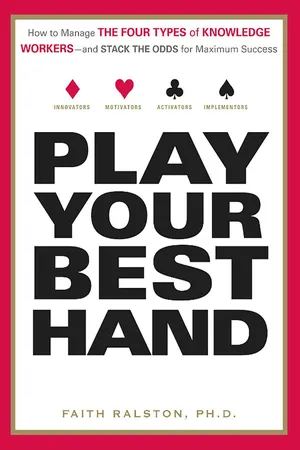
Play Your Best Hand
eBook - ePub

Play Your Best Hand

How to Manage the Four Types of Knowledge Workers--and Stack the Odds for Maximum Success

  1. 224 pages
  2. English
  3. ePUB (mobile friendly)
  4. Available on iOS & Android
eBook - ePub

Play Your Best Hand

How to Manage the Four Types of Knowledge Workers--and Stack the Odds for Maximum Success

About this book

The number of knowledge workers has doubled in the last decade. Unlike yesterday's workers their value is not measured in hours logged, but in how much quality and innovation they create for your organization. Talent is the new wildcard in today's competitive marketplace. If you want to tap your employee's full potential you have to manage differently. Play Your Best Hand shows you how to align knowledge worker's talents with strategic business goals. Using practical exercises and assessments, managers learn to apply strength-based leadership principles to leverage individual and team talents.
Play Your Best Hand also covers:

  • the four employee talent types
  • key challenges of managing knowledge workers - and recommended solutions
  • the five talent-based leadership principles and how to apply them
  • and more!


Play Your Best Hand is the innovative leadership approach you need to keep today's knowledge workers motivated and productive!

Frequently asked questions

Yes, you can cancel anytime from the Subscription tab in your account settings on the Perlego website. Your subscription will stay active until the end of your current billing period. Learn how to cancel your subscription.
No, books cannot be downloaded as external files, such as PDFs, for use outside of Perlego. However, you can download books within the Perlego app for offline reading on mobile or tablet. Learn more here.
Perlego offers two plans: Essential and Complete
  • Essential is ideal for learners and professionals who enjoy exploring a wide range of subjects. Access the Essential Library with 800,000+ trusted titles and best-sellers across business, personal growth, and the humanities. Includes unlimited reading time and Standard Read Aloud voice.
  • Complete: Perfect for advanced learners and researchers needing full, unrestricted access. Unlock 1.4M+ books across hundreds of subjects, including academic and specialized titles. The Complete Plan also includes advanced features like Premium Read Aloud and Research Assistant.
Both plans are available with monthly, semester, or annual billing cycles.
We are an online textbook subscription service, where you can get access to an entire online library for less than the price of a single book per month. With over 1 million books across 1000+ topics, we’ve got you covered! Learn more here.
Look out for the read-aloud symbol on your next book to see if you can listen to it. The read-aloud tool reads text aloud for you, highlighting the text as it is being read. You can pause it, speed it up and slow it down. Learn more here.
Yes! You can use the Perlego app on both iOS or Android devices to read anytime, anywhere — even offline. Perfect for commutes or when you’re on the go.
Please note we cannot support devices running on iOS 13 and Android 7 or earlier. Learn more about using the app.
Yes, you can access Play Your Best Hand by Faith Ralston in PDF and/or ePUB format, as well as other popular books in Business & Management. We have over one million books available in our catalogue for you to explore.

Information

Publisher
Adams Media
Year
2006
Print ISBN
9781593376857
eBook ISBN
9781440517303
Subtopic
Management
1
Part 1

Learn the New Game
Chapter 1

Lead the Wild Card—
Managing Knowledge Workers
GETTING THINGS DONE IS important. Really important! As a leader, you’re under constant pressure to achieve business goals in less time with fewer resources. You have employees to manage—as well as a full plate of your own. Whether you have 3 or 300 individuals reporting to you, they all want your time. And time is the one thing you don’t have! You’ve got to do more with less—and maximizing talent is the most effective way to do it.
Customers Want More
Welcome to the new economy. Hierarchy, silos, and order, so essential to the industrial world, are now the enemies of speed and innovation. Successful innovation from idea generation to execution drives such products as the iPod into the marketplace. Customers’ demand for new products, competitive pricing, shorter time to market, plus more partners in the collaborative mix means that you and your staff have four times the work and less time to do it.
Leaders Want More
As a leader, you dream of having talented employees. You want engaged and committed workers. You’ve seen the power of individuals collaborating and making things happen. But too often it’s not that way. Your time is squandered on turf issues, poor performance, and projects that run over time and budget.
So you fantasize about starting with a blank slate, hiring a new group of employees, cloning the high performers, and someday becoming agile and results-oriented like the entrepreneurial companies your see in the marketplace.
Employees Want More
Employees also dream of doing great and wonderful things. What motivates and excites employees is the opportunity to develop their skills, learn from others, and tackle new endeavors. For many it’s stressful and disheartening to deliver less than their best. Some employees are dedicated and driven—often working fifty to sixty hours a week. Yet these same employees confide to their friends, “I’m frustrated with my job. There’s so much more I could do for this organization. If only I could find a way.”
So employees fantasize. They dream about leaving and starting their own business, writing a book, becoming a consultant, and finding a place where they will be appreciated and given the opportunity to do meaningful work.
Ironically, the goals of employees and leaders have never been more aligned. Leaders want high performance, innovative solutions, and fast results. And employees want to use their talents and contribute in meaningful ways.
Yet according to the latest studies, most leaders are not even close to realizing employees’ full potential. A recent Conference Board survey reported that a whopping 66 percent of employees do not feel highly motivated to drive their employer’s business goals—and 25 percent say they are just showing up for a paycheck. If taken to heart, this means the average knowledge worker is contributing only 50 percent of what they are capable of delivering.
Whether these individuals leave their position in six weeks, six months, or six years, they’ve already checked out mentally. And the company’s performance reflects their lackluster commitment.
The New Game of Business
The workplace is radically different than it was even ten years ago. To capture the talents and potential of today’s work force, leaders must recognize the dramatic rise in the number of knowledge workers and the implications of this change. In a high-growth business, up to 50 percent of employees might be knowledge workers.
What’s a Knowledge Worker?
Management guru Peter Drucker described knowledge workers as individuals who use knowledge, theories, and concepts, rather than physical labor, to complete work tasks. Knowledge workers are the individual contributors and professional managers who work as financial analysts, information specialists, planners, researchers, legal and human resources personnel, software designers, health care professionals, and social service employees in your business—just to name a few. Their talents are measured in the quality of their ideas and the value they contribute to a company’s products, services, and processes.
Knowledge Workers Fuel Economic Growth
Knowledge workers are the fuel that fire economic growth. Smart knowledge workers offer a competitive advantage. Through their ingenuity and creativity, knowledge workers create new products and services, shrink cycle times, re-engineer outdated processes, solve customer problems, implement strategic initiatives, develop software solutions, and offer expert advice.
Knowledge workers are no longer “cogs” in your business but virtual wheels of information and peer networks that drive the success of new initiatives. The speed at which these employees maximize and leverage their collective talents directly impacts your bottom line.
Knowledge workers enjoy working on productive teams and interacting with bosses and colleagues who inspire them to new heights. Essentially, knowledge workers want nothing more than to see their talents take your business to the top!
Knowledge Workers Are the Wild Card
In the end, it’s the hearts and minds of knowledge workers that ensure business success. Knowledge workers are the “wild card” in business today. By definition, a wild card is the card that completes your hand. These talented individuals want to help you create the vision; they want abundant opportunities to develop their talents and make things happen. Your job as a leader is to help them succeed.
The challenge is that knowledge workers do not respond to traditional management practices. They are independent, often ego-driven, and chafe at micromanaging or corporate bureaucracy. Some days you may wonder if they even need you at all! However, without effective leadership, knowledge workers can spin off on tangents, make costly decisions, and waste valuable time and resources.
For the first time in organizational history, knowledge workers have the ball in their court. They can leave or they can stay. They can offer their best—or just get by with the minimum. Your role is to help employees grab the ball and run with it. But taking hold is difficult. In today’s chaotic environment, roles and responsibilities are fuzzy and decision-making is complicated. The real business needs exist in the white spaces between departments and organizational lines. With limited time and scant resources at your disposal, how do you help knowledge workers take charge and get things done? And how do you ensure high performance and results?
A New Approach to Leadership
Leading knowledge workers requires a new approach. To access 100 percent of knowledge workers’ talents, you must help individuals leverage their strengths. Focusing on strengths—rather than deficiencies—helps knowledge workers make powerful contributions. Knowledge workers want to develop their skills—and they don’t respond well to criticism and nitpicking. They’re more talented and educated than the workers of previous decades—and thus, more independent and ego-driven. Micromanaging their projects and mistakes will quickly deflate their initiative. You still need to address problems and deficiencies, but not at the expense of asking, “How can we build on your strengths? Where can you best contribute?” All the time and attention currently being spent on employee weaknesses is as effective in today’s fast-paced economy as a buggy whip on high-tech automobiles.
Focusing on Strengths Yields Benefits
Contradicting years of management training and methodology, leaders who adopt a strengths-based approach are able to increase productivity, lower costs, and accelerate business results. A strengths focus helps knowledge workers discover their hidden talents, recognize blind spots, compensate for weaknesses, and contribute greater value.
Focusing on strengths helps knowledge workers:

a
Recognize and contribute their best talents.
a
Take initiative and accept responsibility for results.
a
Mix and match talents to meet changing requirements.

A strengths focus also helps leaders:

a
Transform C players into A players.
a
Retain talented employees.
a
Do more with fewer resources.

Play Your Best Hand is a practical guide to help you get more done with the resources you have. The skills and ideas in this book are ideal for leaders of knowledge workers. This is a practical how-to book, full of insights and approaches you can immediately use to improve individual and...

Table of contents

  1. Cover
  2. Title Page
  3. Dedication
  4. Contents
  5. Part 1: Learn the New Game
  6. Part 2: Maximize Employee Talents
  7. Part 3: Play to Win
  8. Part 4: Take the Lead
  9. Appendix A: Play Your Best Hand Tool Kit
  10. Appendix B: Great Resources
  11. About the Author
  12. Copyright