eBook - ePub
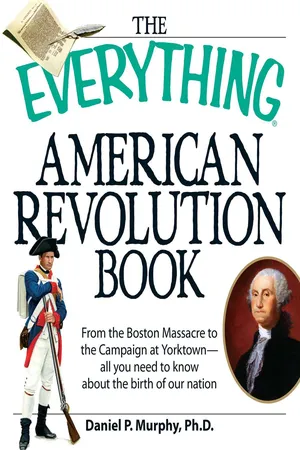
The Everything American Revolution Book
From the Boston Massacre to the Campaign at Yorktown-all you need to know about the birth of our nation
- 304 pages
- English
- ePUB (mobile friendly)
- Available on iOS & Android
eBook - ePub
The Everything American Revolution Book
From the Boston Massacre to the Campaign at Yorktown-all you need to know about the birth of our nation
About this book
Scrappy farmers. Aristocratic landowners. Eccentric geniuses. These were the rebels who took on the world's greatest power - and won.
From the rebellion against "taxation without representation" to the beginnings of American self-government, readers will learn how this unlikely group of colonists shaped a new nation. This book features all readers need to know about this exciting time:
- The beginnings of colonial unrest and rebellion
- The drafting and signing of the Declaration of Independence
- Major battles, including Lexington and Concord, Trenton, Saratoga, Valley Forge, and Yorktown
- Daily life for soldiers and ordinary colonists on both sides of the war
- The birth of the United States
Frequently asked questions
Yes, you can cancel anytime from the Subscription tab in your account settings on the Perlego website. Your subscription will stay active until the end of your current billing period. Learn how to cancel your subscription.
At the moment all of our mobile-responsive ePub books are available to download via the app. Most of our PDFs are also available to download and we're working on making the final remaining ones downloadable now. Learn more here.
Perlego offers two plans: Essential and Complete
- Essential is ideal for learners and professionals who enjoy exploring a wide range of subjects. Access the Essential Library with 800,000+ trusted titles and best-sellers across business, personal growth, and the humanities. Includes unlimited reading time and Standard Read Aloud voice.
- Complete: Perfect for advanced learners and researchers needing full, unrestricted access. Unlock 1.4M+ books across hundreds of subjects, including academic and specialized titles. The Complete Plan also includes advanced features like Premium Read Aloud and Research Assistant.
We are an online textbook subscription service, where you can get access to an entire online library for less than the price of a single book per month. With over 1 million books across 1000+ topics, we’ve got you covered! Learn more here.
Look out for the read-aloud symbol on your next book to see if you can listen to it. The read-aloud tool reads text aloud for you, highlighting the text as it is being read. You can pause it, speed it up and slow it down. Learn more here.
Yes! You can use the Perlego app on both iOS or Android devices to read anytime, anywhere — even offline. Perfect for commutes or when you’re on the go.
Please note we cannot support devices running on iOS 13 and Android 7 or earlier. Learn more about using the app.
Yes, you can access The Everything American Revolution Book by Daniel P Murphy in PDF and/or ePUB format, as well as other popular books in History & Early American History. We have over one million books available in our catalogue for you to explore.
Information
CHAPTER 1
The English Colonies
The English colonies were unique in the New World. The Spanish and French colonies were governed by viceroys and governors who reported directly to their monarchs. Spanish and French colonists were unable to develop representative institutions. By contrast, the English colonies were largely self-governing. From an early date, the English colonists were able to establish legislatures that wielded real authority in local matters. This long-established tradition of American political autonomy lay at the heart of the dispute over taxation by the British government following the French and Indian War.
Patterns of Settlement
In the seventeenth century, England acquired its North American colonies “in a fit of absent-mindedness.” England’s kings were distracted by domestic strife and civil war. The English settlement of the New World was driven by private initiative.
The First Colonies
Late in 1606, the Virginia Company, an association of merchants interested in the economic possibilities of the New World, dispatched a small fleet of three ships to America. The English made landfall on April 26, 1607, and built a small settlement that they named Jamestown. Over the next months, most of the settlers died of disease. Only the iron discipline established by Captain John Smith saved the struggling colonists. The English settlements in Virginia survived the ravages of disease and fierce wars with the local Indians. The colonists discovered a valuable cash crop in tobacco, which held out the promise of prosperity. In 1619, the settlers organized the House of Burgesses, the first colonial legislature.

Credited by legend with saving the life of Captain John Smith, Pocahontas did help to bridge the gap between Native American and English culture. She converted to Christianity, married John Rolfe, the promoter of tobacco, and died during a visit to England in 1617.
Far to the north, a small band of religious dissenters known as the Pilgrims established the settlement of Plymouth on Cape Cod. Before landing, the men signed the Mayflower Compact, a social contract for the new colony. The Pilgrims suffered heavily from disease, but their settlement survived to celebrate the first Thanksgiving in October 1621. A much larger and better-organized group of Puritan dissenters organized the Massachusetts Bay Company. Disgusted with what they perceived as the corruption in England, they hoped to establish a godly commonwealth in America. In 1630, led by John Winthrop, they settled near the Pilgrims, founding Boston and six other towns. Massachusetts prospered and absorbed Plymouth.
The Expansion of England in America
In 1634, Cecilius Calvert, Lord Baltimore, established Maryland as a refuge for England’s persecuted Roman Catholics. Farther south, a group of aristocratic proprietors established the Carolinas in the 1660s. Charleston was founded in 1670. Much later, Georgia was chartered, in 1732.
New York began its life as New Amsterdam, a Dutch settlement. It became New York in 1664, when the English conquered and occupied the town. New Jersey began its life as two proprietary colonies granted to a pair of well-connected owners. In 1702 the Jerseys were united as one royal colony. Pennsylvania also started as a proprietary colony. In 1681, William Penn received his charter as payment for a debt the King owed his father. A fervent Quaker, Penn set out to make Pennsylvania a refuge for all Christians. He encouraged immigrants from across Europe to settle in his colony. Delaware was originally settled by the Swedes. William Penn was given this colony in 1682. In 1703, the colonists in Delaware received their own assembly.

William Penn wanted all to live in harmony in his new colony of Pennsylvania. He expressed his idealism in the name that he gave to his capital. Philadelphia is a translation of the Greek words for “brotherly love.”
Meanwhile, the Massachusetts Bay Colony grew and prospered. Roger Williams, a minister who clashed with the authorities over the separation of church and state, was banished from Massachusetts in 1635. He and some followers founded the town of Providence. In 1644, Providence joined with some neighboring communities to become the colony of Rhode Island. In 1636, Thomas Hooker, another dissenting minister, left Massachusetts and founded Hartford. This was the origin of the colony of Connecticut, which received a royal charter in 1662. New Hampshire was given to proprietors who failed to attract colonists. It was settled instead by immigrants from Massachusetts. The King made it a royal colony in 1679.
A New Society
Though deeply rooted in England, the North American colonies quickly developed into distinctive societies. The experience of carving out new homes from what they regarded as a wilderness shaped new perspectives among the colonists. The economic imperatives of a colonial society wrenched many colonists from traditional ways. Over time, the populations of some of the colonies became increasingly diverse, challenging habits formed in villages back home.
A Plantation Economy in the South
Beginning in Virginia and Maryland along Chesapeake Bay, a plantation monoculture developed. Tobacco became the foundation of the economy.
The concentration on one cash crop led to boom or bust cycles, following the vagaries of the market. Planters competed for fertile land, especially along rivers, which made it easier to get crops to market. Set apart from each other, plantations became largely self-sufficient. This helped discourage the growth of large towns. Because tobacco cultivation eventually exhausted the nutrients in the soil, there was a constant demand for new land, leading to conflict with the Indians.

America soon came to be seen as a land of opportunity. The heroine of Daniel Defoe’s Moll Flanders (1722) is transported to Virginia as an indentured servant. In the New World she finds success and security.
Tobacco was also a labor-intensive crop. The earliest planters tried to force Indians into service, but they resisted and fled into the interior. Planters then turned to indentured servants, people who had sold themselves into service for a fixed period of time, usually seven years, in return for passage to America and the promise of some land at the expiration of their term. The supply of indentured servants was never equal to the demand for labor. In 1619, a Dutch ship carrying African slaves made a fateful landfall in Virginia, selling part of its cargo in exchange for supplies. Gradually over the course of the seventeenth century, slavery became increasingly important to the plantation economy.
An economic pattern similar to the Chesapeake developed farther south in the Carolinas. Here the chief staple crop was rice. A class of wealthy planters established themselves at Charleston, trading in rice, indigo, and naval stores from nearby forests. The planters quickly became dependent on slave labor. By the early eighteenth century, slaves outnumbered whites by a two-to-one margin in South Carolina.
A Diversified Economy in the North
Though the first settlers in New England came looking for a land where they could practice their Puritan religion without royal interference, they could not ignore the practical necessities of life. Soon they were supporting themselves and prospering by harvesting a variety of natural resources. The soil and climate of New England did not lend themselves to the plantation monoculture of the southern colonies. Family farms raised enough food to feed the population and provide a surplus that could be sold in the south or in the sugar-producing islands of the Caribbean.
To market their agricultural surplus, the New Englanders quickly took to the sea, engaging in commerce with Europe and other colonies. Many New Englanders made a living exploiting the fisheries of the North Atlantic, catching and drying rich crops of fish that fed slaves in the south as well as Europeans observant of meatless Fridays. Taking advantage of their extensive forests, the New Englanders became major shipbuilders as well as shippers. They were soon a major force in the Atlantic trade routes.
The middle colonies of New York and Pennsylvania followed a similar economic path. Initially, New York was chiefly supported by the fur trade with the Indians. New York City gradually grew in importance as a port. Pennsylvania flourished because of a bountiful agriculture. The Quaker merchants of Philadelphia became the wealthiest men in English America.
A Self-Governing People
American society became much more dynamic and less stratified than the Europe the colonists had left behind. The notion of a social hierarchy was deeply ingrained in the colonists, but it came to mean something different in a land where making one’s fortune was a genuine possibility and there was no formal aristocracy. Inevitably, social distinctions were narrower and much more fluid in America.
A Taste for Representative Government
By the standards of the seventeenth and eighteenth centuries, the original thirteen colonies were the most democratic polities in the world. The first Virginia House of Burgesses was elected by all males seventeen years of age and older; only later was the vote restricted to landowners. In the Massachusetts Bay Colony, the vote was initially a privilege of all adult male members of the church. As Massachusetts and New England drifted away from the rigors of their Puritan origins, religious te...
Table of contents
- Cover Page
- Title Page
- Copyright
- Contents
- The Top Ten Things You Might Not about the American Revolution
- Introduction
- 1: The English Colonies
- 2: Strains to the System
- 3: The Road to Revolution
- 4: A Widening Conflict
- 5: The Fighting Men
- 6: The Decision for Independence
- 7: Times That Try Men’s Souls
- 8: A Cause Is Saved
- 9: The Saratoga Campaign
- 10: The Battle for Pennsylvania
- 11: The Politics of War
- 12: A War of Attrition
- 13: The War on the Frontier
- 14: An International War
- 15: Britain Turns South
- 16: Recovery in the South
- 17: The Yorktown Campaign
- 18: The End of the War
- 19: War and Society
- 20: The New Republic
- Appendix A: Eighteenth-Century Warfare: On Land and at Sea
- Appendix B: Who's Who in the American Revolution
- Appendix C: The Declaration of Independence
- Appendix D: The Articles of Confederation
- Appendix E: The Constitution of the United States of America
- Appendix F: Suggestions for Further Reading