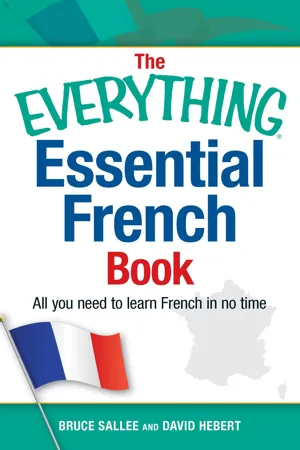
The Everything Essential French Book
eBook - ePub

The Everything Essential French Book

All You Need to Learn French in No Time

  1. 288 pages
  2. English
  3. ePUB (mobile friendly)
  4. Available on iOS & Android
eBook - ePub

The Everything Essential French Book

All You Need to Learn French in No Time

About this book

All the basics of French--fast and easy!Whether you are planning a vacation, adding a valuable second language to your resume, or simply brushing up on your skills, The Everything Essential French Book is your perfect introduction to the French language. With easy-to-follow instructions and simple explanations, this portable guide covers the most important basics, including:

  • The French alphabet, accents, and translation.
  • Common French phrases and greetings.
  • Everyday questions and answers.
  • Verb tenses and sentence structure.
  • How to place an order and give commands.

The Everything Essential French Book has all you need to get from bonjour to au revoir in no time!

Frequently asked questions

Yes, you can cancel anytime from the Subscription tab in your account settings on the Perlego website. Your subscription will stay active until the end of your current billing period. Learn how to cancel your subscription.
No, books cannot be downloaded as external files, such as PDFs, for use outside of Perlego. However, you can download books within the Perlego app for offline reading on mobile or tablet. Learn more here.
Perlego offers two plans: Essential and Complete
  • Essential is ideal for learners and professionals who enjoy exploring a wide range of subjects. Access the Essential Library with 800,000+ trusted titles and best-sellers across business, personal growth, and the humanities. Includes unlimited reading time and Standard Read Aloud voice.
  • Complete: Perfect for advanced learners and researchers needing full, unrestricted access. Unlock 1.4M+ books across hundreds of subjects, including academic and specialized titles. The Complete Plan also includes advanced features like Premium Read Aloud and Research Assistant.
Both plans are available with monthly, semester, or annual billing cycles.
We are an online textbook subscription service, where you can get access to an entire online library for less than the price of a single book per month. With over 1 million books across 1000+ topics, we’ve got you covered! Learn more here.
Look out for the read-aloud symbol on your next book to see if you can listen to it. The read-aloud tool reads text aloud for you, highlighting the text as it is being read. You can pause it, speed it up and slow it down. Learn more here.
Yes! You can use the Perlego app on both iOS or Android devices to read anytime, anywhere — even offline. Perfect for commutes or when you’re on the go.
Please note we cannot support devices running on iOS 13 and Android 7 or earlier. Learn more about using the app.
Yes, you can access The Everything Essential French Book by Bruce Sallee,David Hebert in PDF and/or ePUB format, as well as other popular books in Languages & Linguistics & Languages. We have over one million books available in our catalogue for you to explore.

CHAPTER 1
Pronouncing and Writing French

This chapter lets you dive into French, with a little speaking and a little writing. Here, you discover how to pronounce basic French letters, letter combinations, and words. You begin writing by focusing on punctuation marks and accents. You’ll be pronouncing and writing like a French pro in no time!

The Alphabet

While French and English use the same alphabet, in French, the letters are pronounced a little differently. If you ever have to spell your name out at a hotel, for example, you want to make sure that you’re understood.
Table 1-1
THE FRENCH ALPHABET
Letter Sound Letter Sound
a ahh n ehnn
b bay o ohh
c say p pay
d day q koo
e ehh r aihr
f eff s ess
g jhay t tay
h ahsh u ooh
i ee v vay
j jhee w doo-bluh-vay
k kahh x eex
l ehll y ee-grek
m ehmm z zed
Keep the following points in mind when pronouncing letters in French:
  • The sound of the letter “e” in French is very similar to the beginning of the pronunciation of the English word “earl.”
  • The letter “g” is pronounced jhay, with a soft “j” sound, like in “Asia.”
  • The pronunciation of the letter “j” uses the same soft “j,” but with an “ee” sound at the end.
  • The letter “n,” especially when appearing at the end of words, is pronounced very softly, with a nasal quality.
  • “Q” in English has a distinct “ooh” sound in it; it is pronounced similarly in French, but without the “y” sound.
  • When two letter “l”s appear together, it creates a “yeh” sound. The letters are not pronounced the same as one letter; it sounds like the beginning of the English word “yearn.”
  • The French “r” is more guttural than the English one, made at the back of the throat instead of at the front.

Sounds

Most of the consonants in French are pronounced the same as in English, but many of the vowel sounds differ. It is almost impossible to describe the true sound of French using text. For best results, try to listen to actual French being spoken; only then can you appreciate the sound of the language. The following, however, is a list of sounds used in the French language. Practice making the sounds a few times, and say the example words out loud.
  • on: Sounds much like “oh” in English, with just a hint of a soft “n” at the end. You will find it in words such as maison (meh-zohn, meaning “house”) and garçon (gar-sohn, meaning “boy”).
  • ou: An “ooh” sound that you’ll encounter in words such as tout (tooh, meaning “all”).
  • oi: A “wha” sound, much like the beginning of the English word “waddle.” A French example is soir (swahr, meaning “evening”).
  • oin: Sounds much like the beginning of “when” in English, with only a hint of the “n” coming through, very softly. Coin (kwheh, meaning “corner”) and moins (mwheh, meaning “less”) are examples.
  • ai: Sounds like “ehh.” You’ll find it in a great many words, including maison and vrai (vreh, meaning “true”).
  • en: Sounds similar to “on” in English, but with a much softer “n” sound. You’ll find it in words like encore (ahnk-ohr, meaning “again”) and parent (pahr-ahn, meaning “parent”).
  • an: Is pronounced the same way as en.
  • eu: To make this sound, hold your mouth like you’re going to make an “eee” sound, but say “oooh” instead; it sounds much like the beginning of the English word “earl.” Heure (ehhr, meaning “hour”) is an example.
  • in: Pronounced like the beginning of the English word “enter,” but again with a much softer “n” sound. Magasin (may-guh-zehn, meaning “store”) and pain (pehn, meaning “bread”) are examples.
  • er: Sounds like “ayy.” You will find this at the end of many verbs, such as parler (parl-ay, meaning “to speak”) and entrer (ahn-tray, meaning “to enter”).
Sometimes, letters are silent and are not pronounced; this often occurs with letters at the end of words. The letters are still required in written French, of course, but you don’t hear them. Here are the letters to watch:
  • Words ending in -d: chaud (show), meaning “hot.”
  • Words starting with h-: heureux (er-rooh), meaning “happy.”
  • Words ending in -s: compris (com-pree), meaning “included.”
  • Words ending in -t: ...

Table of contents

  1. Title Page
  2. Contents
  3. Introduction
  4. Chapter 1: Pronouncing and Writing French
  5. Chapter 2: Using Everyday Expressions
  6. Chapter 3: Developing a Basic Vocabulary
  7. Chapter 4: Understanding Articles
  8. Chapter 5: Using Nouns
  9. Chapter 6: Forming Present-Tense Verbs
  10. Chapter 7: Asking Questions and Giving Orders
  11. Chapter 8: Negating Words and Phrases
  12. Chapter 9: Using Objects, Prepositions, and Pronouns
  13. Chapter 10: Using Adjectives
  14. Chapter 11: Understanding Adverbs
  15. Chapter 12: Forming Past-Tense Verbs
  16. Chapter 13: Using Reflexive Verbs
  17. Chapter 14: Forming the Future Tense
  18. Chapter 15: Forming the Conditional Tense
  19. Chapter 16: Understanding the Subjunctive Mood
  20. Chapter 17: Traveling in French-Speaking Countries
  21. Chapter 18: Studying and Working in French-Speaking Countries
  22. Chapter 19: Family, Friends, and You
  23. Chapter 20: Your House or Apartment
  24. Appendix: French-to-English Dictionary
  25. Copyright