Us Against You
eBook - ePub

Us Against You

A Novel

  1. 448 pages
  2. English
  3. ePUB (mobile friendly)
  4. Available on iOS & Android
eBook - ePub

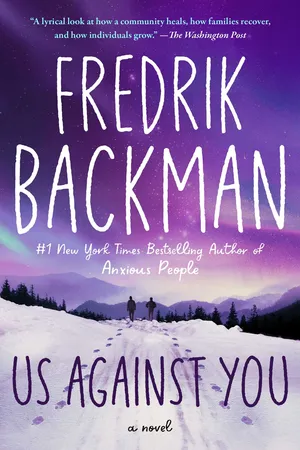
Us Against You

A Novel

About this book

The #1 New York Times bestselling author of A Man Called Ove and Beartown returns with an unforgettable novel “about people—about strength and tribal loyalty and what we unwittingly do when trying to show our boys how to be men” (Jojo Moyes).

Have you ever seen a town fall? Ours did.
Have you ever seen a town rise? Ours did that, too.

A small community tucked deep in the forest, Beartown is home to tough, hardworking people who don’t expect life to be easy or fair. No matter how difficult times get, they’ve always been able to take pride in their local ice hockey team. So it’s a cruel blow when they hear that Beartown ice hockey might soon be disbanded. What makes it worse is the obvious satisfaction that all the former Beartown players, who now play for a rival team in the neighboring town of Hed, take in that fact. As the tension mounts between the two adversaries, a newcomer arrives who gives Beartown hockey a surprising new coach and a chance at a comeback.

Soon a team starts to take shape around Amat, the fastest player you’ll ever see; Benji, the intense lone wolf; always dutiful and eager-to-please Bobo; and Vidar, a born-to-be-bad troublemaker. But bringing this team together proves to be a challenge as old bonds are broken, new ones are formed, and the town’s enmity with Hed grows more and more acute.

As the big game approaches, the not-so-innocent pranks and incidents between the communities pile up and their mutual contempt intensifies. By the time the last goal is scored, a resident of Beartown will be dead, and the people of both towns will be forced to wonder if, after everything, the game they love can ever return to something as simple and innocent as a field of ice, two nets, and two teams. Us against you.

Here is a declaration of love for all the big and small, bright and dark stories that give form and color to our communities. With immense compassion and insight, Fredrik Backman—“the Dickens of our age” (Green Valley News)—reveals how loyalty, friendship, and kindness can carry a town through its most challenging days.
Frequently asked questions

Yes, you can cancel anytime from the Subscription tab in your account settings on the Perlego website. Your subscription will stay active until the end of your current billing period. Learn how to cancel your subscription.
At the moment all of our mobile-responsive ePub books are available to download via the app. Most of our PDFs are also available to download and we're working on making the final remaining ones downloadable now. Learn more here.
Perlego offers two plans: Essential and Complete
  • Essential is ideal for learners and professionals who enjoy exploring a wide range of subjects. Access the Essential Library with 800,000+ trusted titles and best-sellers across business, personal growth, and the humanities. Includes unlimited reading time and Standard Read Aloud voice.
  • Complete: Perfect for advanced learners and researchers needing full, unrestricted access. Unlock 1.4M+ books across hundreds of subjects, including academic and specialized titles. The Complete Plan also includes advanced features like Premium Read Aloud and Research Assistant.
Both plans are available with monthly, semester, or annual billing cycles.
We are an online textbook subscription service, where you can get access to an entire online library for less than the price of a single book per month. With over 1 million books across 1000+ topics, we’ve got you covered! Learn more here.
Look out for the read-aloud symbol on your next book to see if you can listen to it. The read-aloud tool reads text aloud for you, highlighting the text as it is being read. You can pause it, speed it up and slow it down. Learn more here.
Yes! You can use the Perlego app on both iOS or Android devices to read anytime, anywhere — even offline. Perfect for commutes or when you’re on the go.
Please note we cannot support devices running on iOS 13 and Android 7 or earlier. Learn more about using the app.
Yes, you can access Us Against You by Fredrik Backman in PDF and/or ePUB format, as well as other popular books in Literature & Literature General. We have over one million books available in our catalogue for you to explore.

Information

1 It’s Going to Be Someone’s Fault

Have you ever seen a town fall? Ours did. We’ll end up saying that violence came to Beartown this summer, but that will be a lie; the violence was already here. Because sometimes hating one another is so easy that it seems incomprehensible that we ever do anything else.

We’re a small community in the forest; people say that no roads lead here, just past. The economy coughs every time it takes a deep breath; the factory cuts its workforce each year like a child that thinks no one will notice the cake in the fridge getting smaller if you take a little bit from each side. If you lay a current map of the town over an old one, the main shopping street and the little strip known as “the center” seem to shrink like bacon in a hot pan. We have an ice rink but not much else. But on the other hand, as people usually say here: What the hell else do you need?
People driving through say that Beartown doesn’t live for anything but hockey, and some days they may be right. Sometimes people have to be allowed to have something to live for in order to survive everything else. We’re not mad, we’re not greedy; say what you like about Beartown, but the people here are tough and hardworking. So we built a hockey team that was like us, that we could be proud of, because we weren’t like you. When people from the big cities thought something seemed too hard, we just grinned and said, “It’s supposed to be hard.” Growing up here wasn’t easy; that’s why we did it, not you. We stood tall, no matter the weather. But then something happened, and we fell.
There’s a story about us before this one, and we’re always going to carry the guilt of that. Sometimes good people do terrible things in the belief that they’re trying to protect what they love. A boy, the star of the hockey team, raped a girl. And we lost our way. A community is the sum of its choices, and when two of our children said different things, we believed him. Because that was easier, because if the girl was lying our lives could carry on as usual. When we found out the truth, we fell apart, taking the town with us. It’s easy to say that we should have done everything differently, but perhaps you wouldn’t have acted differently, either. If you’d been afraid, if you’d been forced to pick a side, if you’d known what you had to sacrifice. Perhaps you wouldn’t be as brave as you think. Perhaps you’re not as different from us as you hope.
This is the story of what happened afterward, from one summer to the following winter. It is about Beartown and the neighboring town of Hed, and how the rivalry between two hockey teams can grow into a mad struggle for money and power and survival. It is a story about hockey rinks and all the hearts that beat around them, about people and sports and how they sometimes take turns carrying each other. About us, people who dream and fight. Some of us will fall in love, others will be crushed; we’ll have good days and some very bad days. This town will rejoice, but it will also start to burn. There’s going to be a terrible bang.
Some girls will make us proud; some boys will make us great. Young men dressed in different colors will fight to the death in a dark forest. A car will drive too fast through the night. We will say that it was a traffic accident, but accidents happen by chance, and we will know that we could have prevented this one. This one will be someone’s fault.

People we love will die. We will bury our children beneath our most beautiful trees.

2 There Are Three Types of People

Bang-bang-bang-bang-bang.

The highest point in Beartown is a hill to the south of the last buildings in town. From there you can see all the way from the big villas on the Heights, past the factory and the ice rink and the smaller row houses near the center, right over to the blocks of rental apartments in the Hollow. Two girls are standing on the hill looking out across their town. Maya and Ana. They’ll soon be sixteen, and it’s hard to say if they became friends in spite of their differences or because of them. One of them likes musical instruments; the other likes guns. Their mutual loathing of each other’s taste in music is almost as recurrent a topic of argument as their ten-year-long fight about pets. Last winter they got thrown out of a history class at school because Maya muttered, “You know who was a dog person, Ana? Hitler!” whereupon Ana retorted, “You know who was a cat person, then? Josef Mengele!”
They squabble constantly and love each other unquestioningly, and ever since they were little they have had days when they’ve felt it was just the two of them against the whole world. Ever since what happened to Maya earlier in the spring, every day has felt like that.
It’s the very start of June. For three-quarters of the year this place is encapsulated in winter, but now, for a few enchanted weeks, it’s summer. The forest around them is getting drunk on sunlight, the trees sway happily beside the lakes, but the girls’ eyes are restless. This time of year used to be a time of endless adventure for them; they would spend all day out in nature and come home late in the evening with torn clothes and dirty faces, childhood in their eyes. That’s all gone. They’re adults now. For some girls that isn’t something you choose, it’s something that gets forced upon you.
Bang. Bang. Bang-bang-bang.
A mother is standing outside a house. She’s packing her child’s things into a car. How many times does that happen while they’re growing up? How many toys do you pick up from the floor, how many stuffed animals do you have to form search parties for at bedtime, how many mittens do you give up on at preschool? How many times do you think that if nature really does want people to reproduce, then perhaps evolution should have let all parents grow extra sets of arms so they can reach under all the wretched sofas and fridges? How many hours do we spend waiting in hallways for our kids? How many gray hairs do they give us? How many lifetimes do we devote to their single one? What does it take to be a good parent? Not much. Just everything. Absolutely everything.
Bang. Bang.
Up on the hill Ana turns to her best friend and asks, “Do you remember when we were little? When you always wanted to pretend that we had kids?”
Maya nods without taking her eyes from the town.
“Do you still want kids?” Ana asks.
Maya’s mouth barely opens when she replies. “Don’t know. Do you?”
Ana shrugs her shoulders slightly, halfway between anger and sorrow. “Maybe when I’m old.”
“How old?”
“Dunno. Thirty, maybe.”
Maya is silent for a long time, then asks, “Do you want boys or girls?”
Ana replies as if she’s spent her whole life thinking about this, “Boys.”
“Why?”
“Because the world is kind of shitty toward them sometimes. But it treats us like that nearly all the time.”
Bang.
The mother closes the trunk, holding back tears because she knows that if she lets out so much as a single one, they will never stop. No matter how old they get, we never want to cry in front of our children. We’d do anything for them; they never know because they don’t understand the immensity of something that is unconditional. A parent’s love is unbearable, reckless, irresponsible. They’re so small when they sleep in their beds and we sit beside them, shattered to pieces inside. It’s a lifetime of shortcomings, and, feeling guilty, we stick happy pictures up everywhere, but we never show the gaps in the photograph album, where everything that hurts is hidden away. The silent tears in darkened rooms. We lie awake, terrified of all the things that can happen to them, everything they might be subjected to, all the situations in which they could end up victims.
The mother goes around the car and opens the door. She’s not much different from any other mother. She loves, she gets frightened, falls apart, is filled with shame, isn’t enough. She sat awake beside her son’s bed when he was three years old, watching him sleep and fearing all the terrible things that could happen to him, just like every parent does. It never occurred to her that she might need to fear the exact opposite.
Bang.
It’s dawn, the town is asleep; the main road out of Beartown is empty, but the girls’ eyes are still fixed on it from up on the hilltop. They wait patiently.
Maya no longer dreams about the rape. About Kevin’s hand over her mouth, the weight of his body stifling her screams, his room with all the hockey trophies on the shelves, the floor the button of her blouse bounced across. She just dreams about the running track behind the Heights now; she can see it from up here. When Kevin was running on his own and she stepped out of the darkness with a shotgun. Held it to his head as he shook and sobbed and begged for mercy. In her dreams she kills him, every night.
Bang. Bang.
How many times does a mother make her child giggle? How many times does the child make her laugh out loud? Kids turn us inside out the first time we realize that they’re doing it intentionally, when we discover that they have a sense of humor. When they make jokes, learn to manipulate our feelings. If they love us, they learn to lie shortly after that, to spare our feelings, pretending to be happy. They’re quick to learn what we like. We might tell ourselves that we know them, but they have their own photograph albums, and they grow up in the gaps.
How many times has the mother stood beside the car outside the house, checked the time, and impatiently called her son’s name? She doesn’t have to do that today. He’s been sitting silently in the passenger seat for several hours while she packed his things. His once well-toned body is thin after weeks in which she’s struggled to get food into him. His eyes stare blankly through the windshield.
How much can a mother forgive her son for? How can she possibly know that in advance? No parent imagines that her little boy is going to grow up and commit a crime. She doesn’t know what nightmares he dreams now, but he shouts when he wakes up from them. Ever since that morning she found him on the running track, motionless with cold, stiff with fear. He had wet himself, and his desperate tears had frozen on his cheeks.
He raped a girl, and no one could ever prove it. There will always be people who say that means he got away with it, that his family escaped punishment. They’re right, of course. But it will never feel like that for his mother.
Bang. Bang. Bang.
When the car begins to move along the road, Maya stands on the hill and knows that Kevin will never come back here. That she has broken him. There will always be people who say that means she won.
But it will never feel like that to her.
Bang. Bang. Bang. Bang.
The brake lights go on for a moment; the mother casts one last glance in the rearview mirror, at the house that was a home and the gluey scraps on the mailbox where the name “Erdahl” has been torn off, letter by letter. Kevin’s father is packing the other car alone. He stood beside the mother on the track, saw their son lying there with tears on his sweater and urine on his trousers. Their lives had shattered long before then, but that was when she first saw the shards. The father refused to help her as she half carried, half dragged the boy through the snow. That was two months ago. Kevin hasn’t left the house since then, and his parents have barely said a word to each other. Men define themselves in more distinctive ways than women, life has taught her that, and her husband and son have always defined themselves with one single word: winners. As long as she can remember, the father has drummed the same message into the boy: “There are three types of people: winners, losers, and the ones who watch.”
And now? If they’re not winners, what are they? The mother takes her foot off the brake, switches the radio off, drives down the road, and turns the corner. Her son sits beside her. The father gets into the other car, drives alone in the opposite direction. The divorce papers are in the mail, along with the letter to the school saying that the father has moved to another town and the mother and son have gone abroad. The mother’s phone number is at the bottom in case anyone at the school has any questions, but no one’s going to call. This town is going to do everything it can to forget that the Erdahl family was ever a part of it.
After four hours of silence in the car, when they’re so far from Beartown that they can’t see any forest, Kevin whispers to his mother, “Do you think it’s possible to become a different person?”
She shakes her head, biting her bottom lip, and blinks so hard she can’t see the road in front of her. “No. But it’s possible to become a better person.” Then he holds out a trembling hand. She holds it as if he were three years old, as if he were dangling over the edge of a cliff. She whispers, “I can’t forgive you, Kevin. But I’ll never abandon you.”
Bang-bang-bang-bang-bang.
That’s the sound of this town, everywhere. Perhaps you understand that only if you live here.
Bangbangbang.
On the hilltop stand two girls, watching the car disappear. They’ll soon be sixteen. One of them is holding a guitar, the other a rifle.

3 Like a Man

The worst thing we know about other people is that we’re dependent upon them. That their actions affect our lives. Not just the people we choose, the people we like, but all the rest of them: the idiots. You who stand in front of us in every line, who can’t drive properly, who like bad television shows and talk too loud in restaurants and whose kids infect our kids with the winter vomiting bug at preschool. You who park badly and steal our jobs and vote for the wrong party. You also influence our lives, every second.

Dear God, how we hate you for that.

In the Bearskin pub a number of silent old men are sitting in a row. They’re said to be in their seventies but could easily be double that. There are five of them, but they have at least eight opinions, and they’re known as the “five uncles” because they always stand by the boards and lie and argue at all the practices at Beartown Ice Hockey Club. Afterward they go to the Bearskin and lie and argue there instead, and occasionally they amuse themselves by trying to trick the others into thinking that senile dementia has crept up on them: they sometimes change one another’s house numbers at night and hide their keys when they’ve had a few drinks. One time four of them towed the fifth one’s car out of his driveway and replaced it with an identical rental, just so he would end up terrified that it was finally time to go into a home when he couldn’t get the car started the next morning. When they go to games they pay with Monopoly money, and for almost an entire season they all pretended to believe that they were at the 1980 Winter Olympics. Every time they caught sight of...

Table of contents

  1. Cover
  2. Title Page
  3. Dedication
  4. Chapter 1: It’s Going to Be Someone’s Fault
  5. Chapter 2: There Are Three Types of People
  6. Chapter 3: Like a Man
  7. Chapter 4: Women Are Always the Problem
  8. Chapter 5: Everyone Is a Hundred Different Things
  9. Chapter 6: If There Isn’t a War, They Start One
  10. Chapter 7: Start by Eating Lunch
  11. Chapter 8: When a Relationship Breaks Down
  12. Chapter 9: He’s Going to Need Someone to Fight Tonight
  13. Chapter 10: How Do You Tell Your Children?
  14. Chapter 11: One Last Chance to Be a Winner
  15. Chapter 12: I Am Prepared to Burn in Here
  16. Chapter 13: So They Gave Him an Army
  17. Chapter 14: A Stranger
  18. Chapter 15: Vidar Rinnius
  19. Chapter 16: Beartown Against the Rest
  20. Chapter 17: Smells Blood and Catches Fire
  21. Chapter 18: A Woman
  22. Chapter 19: The Same Blue Polo Shirt
  23. Chapter 20: Shaving Cream in Your Shoes
  24. Chapter 21: He’s Lying on the Ground
  25. Chapter 22: Team Captain
  26. Chapter 23: “All It Takes for the Only Thing That Matters”
  27. Chapter 24: But the Bear Inside Her Has Just Woken Up
  28. Chapter 25: “Mother’s Song”
  29. Chapter 26: Whose Town Will It Be?
  30. Chapter 27: Hatred and Chaos
  31. Chapter 28: “Goddamn homo!”
  32. Chapter 29: She Kills Him There
  33. Chapter 30: They Aren’t the Kind of People Who Get Happy Endings
  34. Chapter 31: Darkness
  35. Chapter 32: Then He Takes the Shotgun and Goes Out into the Forest
  36. Chapter 33: Not Waking Up
  37. Chapter 34: Violence Against a Horse on Official Service
  38. Chapter 35: But Only if You’re the Best
  39. Chapter 36: “Don’t Psychopaths Go for Walks, Then?”
  40. Chapter 37: What We’re Capable Of
  41. Chapter 38: The Game
  42. Chapter 39: Violence
  43. Chapter 40: Always Fair. Always Unfair
  44. Chapter 41: If You Stand Tall
  45. Chapter 42: They Take It by Storm
  46. Chapter 43: We’re Everywhere
  47. Chapter 44: Storm and Longing
  48. Chapter 45: Cherry Tree
  49. Chapter 46: We’ll Say It Was a Road Accident
  50. Chapter 47: A Love Story We Will Never Forget
  51. Chapter 48: “Oh God! Oh God! Oh God! My Baby!”
  52. Chapter 49: Everyone Gets a Stick. Two Goals. Two Teams
  53. Reading Group Guide
  54. ‘Anxious People’ Teaser
  55. About the Author
  56. Copyright