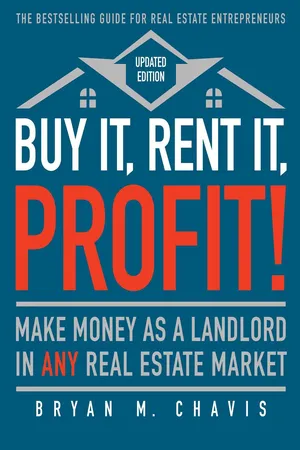
Buy It, Rent It, Profit! (Updated Edition)
eBook - ePub

Buy It, Rent It, Profit! (Updated Edition)

Make Money as a Landlord in ANY Real Estate Market

  1. 320 pages
  2. English
  3. ePUB (mobile friendly)
  4. Available on iOS & Android
eBook - ePub

Buy It, Rent It, Profit! (Updated Edition)

Make Money as a Landlord in ANY Real Estate Market

About this book

Now updated for today’s bullish real estate market, this is the go-to, classic entrepreneurial guide for landlords and real estate investors who want to buy and manage rental properties for long-term wealth.

There’s never been a better time for buying rental properties—interest rates are low and credit is more freely available to those who want to buy and invest. But where does one begin?

With more than twenty plus years of experience in real estate and as the founder of The Landlord Property Management Academy, Bryan M. Chavis knows all phases and aspects of working with rental properties. In Buy It, Rent It, Profit! he explains why rental properties are such a wise investment in today’s real estate world and outlines the steps and systems you need to implement to become a successful landlord and property manager.

This updated edition of the modern classic includes advice on being a profitable and professional landlord, protecting your investment, learning what types of property you should be purchasing, and adapting to the ever-changing world of technology in real estate. Chavis also provides systems on how to attract quality tenants, negotiate lease agreements, collect rent, finance a mortgage, and manage the property overall—everything you need to become a smart, profitable, and professional property manager.

In addition, this updated edition features a workbook section with easy-to-use, universal forms for leases, evictions, property evaluations, and more. Buy It, Rent It, Profit! is the ultimate how-to procedures manual for buying and managing rental properties and a practical, realistic tool you can follow to become a profitable landlord and property manager.
Frequently asked questions

Yes, you can cancel anytime from the Subscription tab in your account settings on the Perlego website. Your subscription will stay active until the end of your current billing period. Learn how to cancel your subscription.
No, books cannot be downloaded as external files, such as PDFs, for use outside of Perlego. However, you can download books within the Perlego app for offline reading on mobile or tablet. Learn more here.
Perlego offers two plans: Essential and Complete
  • Essential is ideal for learners and professionals who enjoy exploring a wide range of subjects. Access the Essential Library with 800,000+ trusted titles and best-sellers across business, personal growth, and the humanities. Includes unlimited reading time and Standard Read Aloud voice.
  • Complete: Perfect for advanced learners and researchers needing full, unrestricted access. Unlock 1.4M+ books across hundreds of subjects, including academic and specialized titles. The Complete Plan also includes advanced features like Premium Read Aloud and Research Assistant.
Both plans are available with monthly, semester, or annual billing cycles.
We are an online textbook subscription service, where you can get access to an entire online library for less than the price of a single book per month. With over 1 million books across 1000+ topics, we’ve got you covered! Learn more here.
Look out for the read-aloud symbol on your next book to see if you can listen to it. The read-aloud tool reads text aloud for you, highlighting the text as it is being read. You can pause it, speed it up and slow it down. Learn more here.
Yes! You can use the Perlego app on both iOS or Android devices to read anytime, anywhere — even offline. Perfect for commutes or when you’re on the go.
Please note we cannot support devices running on iOS 13 and Android 7 or earlier. Learn more about using the app.
Yes, you can access Buy It, Rent It, Profit! (Updated Edition) by Bryan M. Chavis in PDF and/or ePUB format, as well as other popular books in Business & Entrepreneurship. We have over one million books available in our catalogue for you to explore.

Information

Publisher
Touchstone
Year
2017
Print ISBN
9781501145827
eBook ISBN
9781501147081
Images

PART I


YOU CAN BUILD WEALTH THROUGH REAL ESTATE

ONE


INVEST IN YOUR FUTURE


How You Can Become Wealthy as a Landlord

Gold slippeth away from the man who invests it in businesses or purposes with which he is not familiar or which are not approved by those who are skilled in its keep.
—The Richest Man in Babylon
We are all looking for ways to get wealthy. Some people might not state this so bluntly, but let’s face it—we all crave the security that money can bring. But it’s important to note that wealth doesn’t have to mean greed. Wealth can buy you more time off to spend with your family, good education for your children, better health care, and the freedom to live the life you want to live.
Wealth to me means freedom. I want to have enough money to take time off to travel with my wife. I want to be able to help my parents live out their retirement years in comfort. And I want to give back to my community, particularly to help at-risk children have opportunities to make something out of their lives. All this takes time and money. Money buys me this time, and it provides me with these things that are so important to me.
The bookstore shelves are lined with titles that promise to reveal the “secrets to success.” I was once one of those staring at a wall of titles and wondering which one would help get me to the place I wanted to be. If you’re anything like me, you’ve probably already learned what makes the “millionaire next door” tick and how to “think and grow rich.” These are great motivational books—they help you figure out what path you want to take toward building your own life of financial security and freedom. But if you’ve picked up this book, you probably want something more . . . specific advice on how to build that wealth through one of the smartest methods around: real estate.
I’ve been working in the apartment industry, where I received my Certified Apartment Manager (CAM) designation, for more than twenty years, first as a manager of large rental complexes and later as an owner. I’ve worked on every type of property—from single-family homes to thousand-unit apartment buildings, and just about everything in between. Several years ago, before the first edition of Buy It, Rent It, Profit! was published, I decided to put all the advice, systems, and “best practices” I’ve developed over the years into a book and seminar series called The Landlord Academy (www.landlordacademy.com). After working in real estate for so long, I had grown really dissatisfied by what I’d seen in the marketplace and by all of these speakers blowing into town to host seminars on how to get rich in real estate. Typically, they had a line out the door of people looking for advice, but I knew that those so-called experts were just opportunists who were taking advantage of people who legitimately wanted to create wealth through real estate. Almost everything they were teaching people about successfully investing in real estate was wrong, and I made it my mission to show people the right way.
I was going around to real estate associations and sharing my information with their members. At one of them, I met a guy who was a manager at Kinko’s. He let me use his store’s broom closet to host my own small meetings, and that was the beginning of my company, which came to be called The Landlord Academy. Meanwhile, I had also written a manual that would guide real estate professionals through every step of the investment process, including how to run their properties on a day-to-day basis and treat every investment like a business. It was called the Landlord’s Operations Manual, and I was selling it directly from that Kinko’s broom closet and out of the trunk of my car.
That manual ultimately became the basis for the book you now hold in your hands. When Touchstone (part of Simon & Schuster) first agreed to publish Buy It, Rent It, Profit!, they started with just a tiny printing. It was 2009, the world was in the throes of an economic crisis, and of course the real estate sector had been hit especially hard. The good people at Simon & Schuster were probably more than a little apprehensive about how well a book on real estate investing would sell during the Great Recession (in fact, my editor later confessed as much!). But I knew the answer: The principles, strategies, and systems I teach in this book are time tested, and they work in any economy. And sure enough, that small first printing turned into a dozen more reprints, and Buy It, Rent It, Profit! became a category bestseller on Amazon. Since then, through the book, my website, and many, many speaking engagements (in rooms much larger than a broom closet, thankfully), I’ve trained hundreds of thousands of would-be rental property owners, some of whom have gone on to be property moguls in their own right. Our academy has become one of the industry’s leading consulting and coaching programs.
And the good news is that, in order to be successful, you don’t have to have a hundred units—a single-family home or a duplex is just as viable for your first move as a rental investor. And, as I’ll show you, it’s a heck of a lot safer to hang on to property for the long term than to try to work the market with risky “fix-it-and-flip-it” schemes. That’s part of the reason so many investors got in trouble in 2008. The beauty of rental investing is that you can choose the steps you want to take and decide when you are ready to take them. The key, of course, is performing your SEOTA (my own method for evaluating the right rental properties, which you’ll learn in this book) and allowing this process to help you choose wisely. I’ll give you all the tools, checklists, and operating systems you will need to make that first choice with confidence. That is my commitment to you. And I also promise that these principles will work every time, no matter what the current economic state is. Read on to learn how Mitchell and Thelma, two of my Landlord Academy success-story clients, put these systems into practice and used them to succeed even in the midst of the market crash.

MITCHELL AND THELMA’S STORY


Mitchell and his wife, Thelma, attended several of my Landlord Academy training courses around 2004. They were recently married with two young children, and were looking for a way to build wealth. Their financial state was OK (but not perfect) when they came to me. They both had steady jobs (though neither was pulling in the big bucks) and they had decent credit (with some outstanding credit card debt). But they also had a dream for the future: They wanted their kids to go to college (something neither of them had done), they wanted to be able to offer some security to their parents, and they had decided the 401(k)s they contributed to at work weren’t going to get them where they wanted to go fast enough. They wanted to take their financial destiny into their own hands.
Mitchell and Thelma were living in an apartment and needed more space for their growing family. As a two-income family, they decided they were ready to buy a home. However, after attending some of my classes, they were excited to start their rental investment portfolio and were unsure if they should use their limited funds to buy a new home for their family, or continue to live in their apartment and buy a home to rent out.
I get questions like this all the time. I usually suggest this: Why not do both? Why don’t you buy a rental property in which you can live and rent out the other units to help pay down the debt you’ll be taking on?
Mitchell and Thelma had been looking at single-family homes in the $240,000 price range. I suggested that they explore buying a duplex for the same amount. They could live in one apartment and rent out the other apartment in the building to help defray the cost of the mortgage. The rental income would get them started on their journey to real estate wealth, and the family would have a larger place to live in.
Mitchell called me a few months later to report that while the lure of that bigger, more expensive home had been powerful, they’d resisted the temptation. They thought about their long-term plans and realized that this first investment move needed to be a wise one. Buying a more expensive home would be okay. It would appreciate in value, and they would have some equity to use in the future for college or a real estate investment. But by buying a duplex instead, they would advance two moves, rather than one. They might not have some of the upgrades found in the more expensive home, but they would have more space to live in and an income-producing rental unit. If they had bought the single-family home to live in, they would have had to save up more money or wait a few years for the equity to build up to use to buy a rental property. Mitchell and Thelma had just accelerated their journey to wealth.
They were smart in another sense as well. Now that they had a rental property, they used The Landlord Academy as a resource to get the training, operations manuals, and forms they needed to manage this rental profitably and legally. They took their first step seriously. It always amazes me when I see people put their entire savings at risk by buying a rental property without getting some training on how to run that property. The time and money you spend in training to be a landlord and researching the best property-management systems (whether you take a class, or you use the guidance offered in this book) will pay off tenfold. For Mitchell and Thelma, the price of enrolling in my Landlord Academy was far less than the cost of one eviction! You can use the same methods Mitchell learned in class by using the processes and forms you find in this book to purchase and operate your own rental property. Mitchell and Thelma found that by using tried and true methods of operation, they were spending less time running the place than they once did worrying about their financial future.
Mitchell and Thelma knew why their goal of wealth was so important to them. They wanted to be able to pay for their kids’ educations. They didn’t want to work second jobs to earn more, because they wanted to remain actively engaged in their kids’ lives. And they wanted to have enough of a financial cushion to assist family members who might need assistance down the line. They wisely chose real estate as their method of achieving wealth. Then they were smart enough to find a step-by-step system to follow. This book will give you the tools to do the same thing.

WHAT ABOUT MY CREDIT?

Are you thinking that you might as well put this book down now, because you don’t have good enough credit to get a loan? Don’t do it! When I started my real estate journey, my credit score was a shaky 582! One of the smartest things I did was immediately get some advice on improving my credit. As I was planning my path to wealth and educating myself on real estate investing, I was also taking small but steady steps to improve my credit. By the time I was ready to make an investment move, my credit had improved dramatically.
The worst thing you can do if you have less than desirable credit is wait to do something about it. There are many companies that can help you improve your credit, as well as some simple steps you can take on your own. I’ll talk more about improving your credit in chapter 6. So, don’t be discouraged if your credit isn’t stellar right at this moment—you can still become a successful real estate investor. For a list of creditable credit repair services, visit landlordacademy.com.


YOU CAN HAVE IT ALL—WITHIN REASON


Mitchell and Thelma decided that purchasing a single-family home wasn’t the be-all and end-all for them at that moment. While that remained a desire, they were willing to put off realizing that dream for a while. They knew that if they acted strategically, eventually they’d be able to own a much nicer single-family home.
What really convinced them that buying the duplex and renting the other unit was the wisest choice for them was that they understood and put to use the basic principle of leverage—using other people’s money to purchase an asset. We will talk more about the power and potential drawbacks of leverage later on, but for now you need to understand only that their down payment entitled them to own an investment valued at $240,000. In other words, they put a small percentage down and got to own a much more valuable property because the bank loaned them the rest of the value of that property. If you were going to make your riches in the stock market, to buy $240,000 of stock, you would have to write a check for $240,000! In real estate, you have to have only a portion of the purchase price in cash. The rest is loaned to you by a bank. Real estate is one of the few investment paths you can take that allows average people like you and me (who don’t have huge trust funds to get started with) in the door. In addition, your property will also appreciate in value. Let’s look again at Mitchell and Thelma to see several benefits of investing in rental properties.

The Benefits of Mitchell and Thelma’s Investment

• The monthly mortgage of $1,350 that Mitchell and Thelma assumed with their first property was more than they had been paying before, but they had a tenant who was paying $850 a month to lease the smaller two-bedroom unit in the duplex. So, in effect, they were paying only $500 a month of their own money on the mortgage. That was far less than they had paid previously in rent. They were actually again using other people’s money—in this case, their tenant’s rent payments—to pay down the debt on the property.
• As the mortgage balance decreases over time, they can refinance to have lower payments—until eventually the property is paid off. The rent Mitchell and Thelma collect (which has risen, and is likely to continue to rise over time) will eventually be equal to or greater than their monthly mortgage payment. Eventually, once that balance is paid off, they will be making a profit each month in addition to being free and clear of that original debt.
• The appraised value of Mitchell and Thelma’s property will also continue to increase. Whenever they decide to sell the place, they will see an increase in their investment, which they can use to reinvest in other properties.
• Perhaps just as important, they will benefit from 3-D tax advantages—deductible, depreciable, and deferrable. I’ll address each of these in more depth later on, but for now, keep in mind all these benefits of investing in rental property.

MITCHELL AND THELMA TODAY


Because Mitchell and Thelma followed my Strategic Evaluation of a Target Area (SEOTA) process to pick the right investment property (which we’ll learn about later in the book), they were able to locate the right rental investment for themselves in a desirable neighborhood. As the value of the property increased, so did the rents in the area. (If they’d bought a single-family home, all they would have gotten was the theoretical increase in value of the property and no actual increase in cash flow.) After a year, they were able to get an additional fifty dollars a month for the unit. Over time, that $850 two-bedroom unit was able to command a nice, even $1,000 a month: That meant only $350 of their monthly mortgage had to come from their own income.
Mitchell and Thelma decided the benefits of rental property ownership were so great, they bought a small apartment complex with the money they had saved by renting out the second unit in their first building and using some of the equity that had built up.
When they began eyeing other investments, they reached out to me again because they noticed a new trend in the market: Everyone was buying properties with “no money down.” I had noticed it, too.
Right before the housing market crashed, the U.S. economy looked incredibly robust, but something just didn’t feel right. I believed it was all falsified, just an illusion created by Wall Street. It was funny money. They were packaging loans and products, and giving people money who really couldn’t afford it, and I was seeing it firsthand. I had a tenant who worked as a cashier at my local grocery store—a woman who could barely make rent every month—invite me to a barbecue at her new house after she secured financing from a lender.
I saw this game of shells and knew that at some point it all had to come crashing down. So when Mitchell and Thelma asked me how they should go into their next investment, I said to be smart and put a little more money down. I told them things wouldn’t always be as rosy as they seemed now, so they needed to t...

Table of contents

  1. Cover
  2. Dedication
  3. Prologue to the Second Edition
  4. Part I: You Can Build Wealth Through Real Estate
  5. Part II: Investing in Rental Properties
  6. Part III: Landlording Essentials
  7. Part IV: Building Wealth with Real Estate
  8. Acknowledgments
  9. Appendix: SEOTA and Due Diligence Forms
  10. About the Author
  11. Index
  12. Copyright