Lies We Believe About God
eBook - ePub

Lies We Believe About God

  1. 400 pages
  2. English
  3. ePUB (mobile friendly)
  4. Available on iOS & Android
eBook - ePub

Lies We Believe About God

About this book

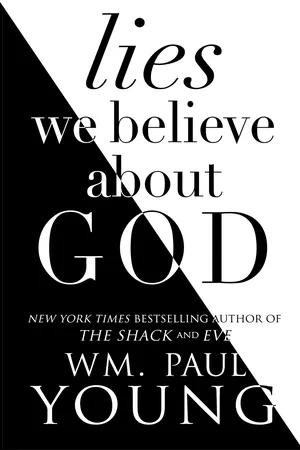
From the author of the 20-million copy bestselling novel The Shack and the New York Times bestsellers Cross Roads and Eve comes a compelling exploration of the wrong-headed ideas we sometimes have and share about God. Wm. Paul Young has previously faced charges of heresy for the ways he vividly portray's God through his novels. Here he shares 33 commonly uttered things we say about God, revealing how they keep us from having a full, loving relationship with God.
Using personal anecdotes and drawing on the touching comments from his readers of The Shack, Wm. Paul Young encourages readers to think anew about important issues, including sin, religion, hell, politics, identity, creation and human rights. In the process, he helps us discover God's deep and abiding love.
Frequently asked questions

Yes, you can cancel anytime from the Subscription tab in your account settings on the Perlego website. Your subscription will stay active until the end of your current billing period. Learn how to cancel your subscription.
No, books cannot be downloaded as external files, such as PDFs, for use outside of Perlego. However, you can download books within the Perlego app for offline reading on mobile or tablet. Learn more here.
Perlego offers two plans: Essential and Complete
  • Essential is ideal for learners and professionals who enjoy exploring a wide range of subjects. Access the Essential Library with 800,000+ trusted titles and best-sellers across business, personal growth, and the humanities. Includes unlimited reading time and Standard Read Aloud voice.
  • Complete: Perfect for advanced learners and researchers needing full, unrestricted access. Unlock 1.4M+ books across hundreds of subjects, including academic and specialized titles. The Complete Plan also includes advanced features like Premium Read Aloud and Research Assistant.
Both plans are available with monthly, semester, or annual billing cycles.
We are an online textbook subscription service, where you can get access to an entire online library for less than the price of a single book per month. With over 1 million books across 1000+ topics, we’ve got you covered! Learn more here.
Look out for the read-aloud symbol on your next book to see if you can listen to it. The read-aloud tool reads text aloud for you, highlighting the text as it is being read. You can pause it, speed it up and slow it down. Learn more here.
Yes! You can use the Perlego app on both iOS or Android devices to read anytime, anywhere — even offline. Perfect for commutes or when you’re on the go.
Please note we cannot support devices running on iOS 13 and Android 7 or earlier. Learn more about using the app.
Yes, you can access Lies We Believe About God by Wm. Paul Young in PDF and/or ePUB format, as well as other popular books in Theologie & Religion & Religion. We have over one million books available in our catalogue for you to explore.

Information

1


ā€œGod loves us, but doesn’t like us.ā€

It is the middle of winter in northern Alberta, Canada. The temperature is well below zero, one of those days that is so cold your nose hairs feel like little sticks plugging up your nostrils and every exhalation of breath becomes its own fogbank. I was born not too far from this city, up in the northern prairies.
ā€œAt least it’s a dry cold,ā€ someone offers, which is true, but not that comforting.
We enter the building and I unwrap the layers of protection, trading them for the warmth of this place of incarceration. We are visiting a women’s prison. The women who have asked me to come and speak said that dozens of copies of The Shack have been making the rounds and having an impact. The government has given these inmates a ā€œtime-out,ā€ an invitation to think about their lives and choices, something that people outside these walls have little opportunity to do. These women are here today to spend an hour with me, by their own choosing. Their presence is a gift.
Those who have eyes to see will find much wonder beneath tough exteriors and callous hearts. Most of the women are here because of a relationship gone wrong, and their suffered betrayals and losses are visible in their bluster of defiance or barely concealed shame. I feel quite at home here, among the bruised and wounded. These are my people, our people.
I don’t remember what I talked about. It probably had to do with the prisons in my own life, places that became precious to me because they were all I knew. About how we hold on to the certainty of our pain rather than take the risk of trusting anyone ever again. Deeply wounded souls in the room began to weep. Bruce Cockburn, the Canadian poet and musician, would call these ā€œrumours of glory.ā€ Lost coins, lost sheep, lost sons, but not just any. These are my sons, my sheep, and my coins.
I finish my talk and only a few leave. Others wait to have me sign a book. I hug everyone, which I am certain is a violation of all sorts of rules. But I have been breaking such codes for a while, and no one ever interferes with these sacred encounters. A woman stands waiting, her body tense with emotion. When I simply take her in my arms, it is as if I set off a charge that lets the dam burst. She sobs uncontrollably, for minutes. I whisper that it is okay, that I have other shirts, that I have her and she is safe. I can’t comprehend all the misery and humanity that is flooding through this one small touch, but it is real and visceral and wrenching.
Finally, she stops the heaving enough to find some words.
ā€œDo you really think,ā€ she whispers in short bursts, ā€œthat Papa is fond of me?ā€
And there it is, the question. This tender human being is entrusting me with this monumental question. Even those who don’t believe that God exists are desperate to know that love does and that love knows who we are. More, we are driven from within to take the risk to ask of someone or Someone, Do you find anything in me that is lovable, that is enough, that is worthy of being loved?
There is a scene in The Shack in which the main character, Mackenzie, is having his assumptions challenged. Mack is face-to-face with Sophia, the Wisdom of God, and she is asking him about the love he has for his children. In particular, she asks which of his five children he loves the most.
Even moderately healthy parents would tell you this question is impossible to answer. My wife, Kim, and I have six children. When our eldest was born, we couldn’t imagine ever having the capacity to love another child. Our first used it all up. But then our second arrived, and suddenly there was a new depth of love that either hadn’t existed or had been dormant before his arrival. It is as if each child brings with him or her a gift of love that is deposited into the hearts of the parents.
In the religious subculture in which I was raised, we all knew that God is love. We said it and sang it all the time, until it didn’t mean that much. It was simply the way that God is. It is like the grandchild who says, ā€œBut you have to love me. You’re my gramps.ā€
But saying ā€œGod is loveā€ doesn’t capture our question, does it? So I’ve made a habit of rephrasing the line ā€œGod loves you,ā€ and instead of making it about God, I make it about the object of God’s relentless affection—us. So throughout The Shack, Papa would say, ā€œI am especially fond of her or him.ā€ There is a world of difference between saying ā€œI love you,ā€ which is about me, and saying ā€œI am especially fond of you,ā€ which is about you. Both are correct, but the latter somehow pierces the disquiet of our souls and says, ā€œYes, I know you love me, but do you know me and do you like me? You love because that is the way you are, but is there anything about me that is worth loving? Do you ā€˜see’ me, and do you like what you ā€˜see’?ā€
ā€œDo you really think,ā€ she whispers in short bursts, ā€œthat Papa is fond of me?ā€
I squeeze her tight. ā€œYes,ā€ I whisper back as we both dissolve into torrents of tears. ā€œPapa is especially fond of you!ā€
Minutes later she regains a semblance of emotional control and looks up into my face for the first time.
ā€œThat’s all I needed to know. That’s all I needed to know.ā€
With another hug, she exits, leaving me thinking, Darlin’, that is all any of us needs to know!

2


ā€œGod is good. I am not.ā€

This lie is huge! And it is devastating! So why is it so largely believed?
Many of us believe that God sees us all as failures, wretches who are utterly depraved. We’ve written songs to reinforce our assumptions, penning lyrics about our own ugliness and separation. We think, When I hate myself, am I not simply agreeing with God?
If we took the time to listen to one another’s stories, we would discover that most of us have something in common—shame is the centerpiece of our self-appraisements. But we didn’t get there alone. Some of us heard a constant barrage reinforcing this lie.
You are worthless.
You are stupid.
You are not valuable.
You are just dumb.
I hate you.
Why can’t youĀ .Ā .Ā .Ā ?
You have made my life miserable.
You are trash.
You are damaged goods.
We then turned these messages into self-declarations, ā€œI am notĀ .Ā .Ā .ā€ followed by a litany of our failures as human beings: ā€œI am not smart enough, or skinny or tall or colored enough. I am not a boy; I am not strong; I am notĀ .Ā .Ā .ā€ We forget that every ā€œI am notā€ began with an ā€œI amā€: ā€œI am worthy; I am smart; I am loved; I amĀ .Ā .Ā .ā€ But we even turn ā€œI amā€ against ourselves, and follow it with another list of shames: ā€œI amĀ .Ā .Ā . a loser, a loner, bad, ugly, overweight, alone, dumb, worthless.ā€
Is this how God sees me? Is this how God sees you? Does God agree with how I see myself and what others have told me about who I am at the core of my being?
Growing up with my father was too often terrifying. Being around him was like walking through a minefield, with the explosive devices changing positions every night while I slept. It wasn’t all terrible. There were moments of kindness, attempts at being a loving father, but these were disconcerting in themselves. They felt like an invitation to let my guard down. I’m not making value statements about my dad: his ā€œchipā€ for being a father was smashed by his own father long before I showed up. But when his switch flipped, when he went from absent to furiously present, I felt as if I were being torn apart and scattered to the winds.
My father was a missionary. He was the righteous man who was never wrong, and he was a strict disciplinarian.
I believed I deserved his anger, of course, because there was nothing good in me. I was being rightfully punished, even when I didn’t have any idea what sin I had committed by omission or commission. I did try to defend myself, sometimes by lying, but when that didn’t work, I resorted to three words, which I screamed over and over and over as the waves of his rage approached.
ā€œI’ll be good! I’ll be good! I’ll be good!ā€
What I have come to understand over the years is that with every scream of ā€œI’ll be good!ā€ I was making a declaration to the core of my being that has taken me decades to unravel. That declaration was brutally simple:
ā€œI am not good.ā€
Only a few days ago I was speaking to a beautiful gathering of young people, high school students, who had invited me to be a part of ā€œspiritual emphasis weekā€ on their campus. They opened with a song that I am familiar with. Many of the lyrics are truth, but it begins with a massive lie.
[God] You are good, when there’s nothing good in me.
The truth is that we have inherent value because we are made in the image of God. Our value and worth are not dependent on us. But those of us who are desperately broken and wounded may believe that if there is nothing good in us, there is no hope for real transformation. We think that the best we can do is some form of temporary self-discipline, a way to cover up our shame through faƧade and performance. All the positive speaking in the world won’t change a rock into a bird of paradise. Many of us learn to fake it until we are completely exhausted from trying to keep all the lies spinning. Inevitably, the poisons in our inside-house begin to seep out in ways we can’t control. Or we simply give up and act out what we have already determined about ourselves.
If I believe the deepest truth about me is worthlessness, then why are you surprised when I act like I’m worthless? Am I not at least being honest? Yes, I would be, if that were the truth about who I am; but it is not the truth.
Does anything that is ā€œnot goodā€ originate in God?
No!
Are we still image bearers, made in the image of God?
Yes, we are!
God, who is only good, creates only good—very good! This is why Jesus asked the rich young ruler, ā€œWhy are you calling me good? There is only One who is Good, and that is Godā€ (Matthew 19:17). This is not Jesus saying, ā€œThere is nothing good in me,ā€ but asking, ā€œDo you see God in me, young brother? Is that why you are calling me good, or is this still about performance?ā€ If you read the rest of that story, you will see that it is still about performance.
What would you think if you happened on a parent berating his or her child with these words: ā€œThe truth about you is that there is nothing good about you. You are sick and twisted and totally and utterly depraved. You have always been and always will be worthless. May God have mercy on your soul!ā€ Sadly, there are some who think this is the ā€œgospel,ā€ and worse, it is preached by people in positions of power behind pulpits.
Yes, we have crippled eyes, but not a core of un-goodness. We are true and right, but often ignorant and stupid, acting out of the pain of our wrongheadedness, hurting ourselves, others, and even all creation. Blind, not depraved, is our condition. Remember, God cannot become anything that is evil or inherently badĀ .Ā .Ā . and God became human.
Our children will always have an essential identity that is linked to us, their mother and fatherĀ .Ā .Ā . forever. They have the potential to make disastrous choices, even harm themselves and others, but their core nature is an expression of us. It is who they are. Just as our identity does not exist independently, neither does our goodness. I am fundamentally good because I am created ā€œin Christā€ as an expression of God, an image bearer, imago dei (see Ephesians 2:10). This identity and goodness is truer about us than any of the damage that was done to us or by us.
God doesn’t have a low view of humanity, because God knows the truth about us. God is not fooled by all the lies we have told ourselves and each other. Jesus is the truth about who we are—fully human, fully alive. Deeper than all the hurt and broken bits and pieces is a ā€œvery goodā€ creation, and we were created in the image and likeness of God. But we have become blind in the deceit-darkness we believe. It is time for us to stop agreeing with these devastating lies instead of surrendering to them; it is time to ā€œburn the white flagā€!

3


ā€œGod is in control.ā€

I was sitting in a hotel lobby in Orlando, Florida, having a conversation with my friend K, from Germany. Her world-cl...

Table of contents

  1. Cover
  2. Dedication
  3. Foreword by C. Baxter Kruger, PhD
  4. Introduction
  5. 1. ā€œGod loves us, but doesn’t like us.ā€
  6. 2. ā€œGod is good. I am not.ā€
  7. 3. ā€œGod is in control.ā€
  8. 4. ā€œGod does not submit.ā€
  9. 5. ā€œGod is a Christian.ā€
  10. 6. ā€œGod wants to use me.ā€
  11. 7. ā€œGod is more he than she.ā€
  12. 8. ā€œGod wants to be a priority.ā€
  13. 9. ā€œGod is a magician.ā€
  14. 10. ā€œGod is a prude.ā€
  15. 11. ā€œGod blesses my politics.ā€
  16. 12. ā€œGod created (my) religion.ā€
  17. 13. ā€œYou need to get saved.ā€
  18. 14. ā€œGod doesn’t care about what I’m passionate about.ā€
  19. 15. ā€œHell is separation from God.ā€
  20. 16. ā€œGod is not good.ā€
  21. 17. ā€œThe Cross was God’s idea.ā€
  22. 18. ā€œThat was just a coincidence.ā€
  23. 19. ā€œGod requires child sacrifice.ā€
  24. 20. ā€œGod is a divine Santa Claus.ā€
  25. 21. ā€œDeath is more powerful than God.ā€
  26. 22. ā€œGod is not involved in my suffering.ā€
  27. 23. ā€œYou will never find God in a box.ā€
  28. 24. ā€œNot everyone is a child of God.ā€
  29. 25. ā€œGod is disappointed in me.ā€
  30. 26. ā€œGod loves me for my potential.ā€
  31. 27. ā€œSin separates us from God.ā€
  32. 28. ā€œGod is One alone.ā€
  33. A Catena: God’s Drama of Redemption
  34. A Final Word from Dietrich Bonhoeffer
  35. Acknowledgments
  36. About Wm. Paul Young
  37. Copyright