Convergence
eBook - ePub

Convergence

The Deepest Idea in the Universe

  1. 576 pages
  2. English
  3. ePUB (mobile friendly)
  4. Available on iOS & Android
eBook - ePub

Convergence

The Deepest Idea in the Universe

About this book

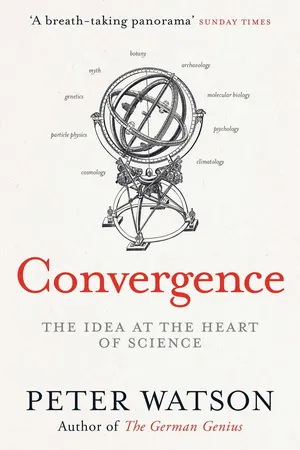
Convergence is a history of modern science with an original and significant twist. Various scientific disciplines, despite their very different beginnings, and disparate areas of interest have been coming together over the past 150 years, converging and coalescing, to identify one extraordinary master narrative, one overwhelming interlocking coherent story: the history of the universe.
     Intimate connections between physics and chemistry have been revealed as have the links between quantum chemistry and molecular biology. Astronomy has been augmented by particle physics, psychology has been increasingly aligned with physics, with chemistry and even with economics. Genetics has been harmonised with linguistics, botany with archaeology, climatology with myth. This is a simple insight but one with profound consequences. Convergence is, as Nobel Prize-winning physicist Steven Weinberg has put it, ‘The deepest thing about the universe.’
     This book does not, however, tell the story by beginning at the beginning and ending at the end. It is much more revealing, more convincing, and altogether more thrilling to tell the story as it emerged, as it began to fall into place, piece by piece, converging tentatively at first, but then with increasing speed, vigour and confidence. The overlaps and interdependence of the sciences, the emerging order that they are gradually uncovering, is without question the most enthralling aspect of twenty-first-century science. 
Frequently asked questions

Yes, you can cancel anytime from the Subscription tab in your account settings on the Perlego website. Your subscription will stay active until the end of your current billing period. Learn how to cancel your subscription.
No, books cannot be downloaded as external files, such as PDFs, for use outside of Perlego. However, you can download books within the Perlego app for offline reading on mobile or tablet. Learn more here.
Perlego offers two plans: Essential and Complete
  • Essential is ideal for learners and professionals who enjoy exploring a wide range of subjects. Access the Essential Library with 800,000+ trusted titles and best-sellers across business, personal growth, and the humanities. Includes unlimited reading time and Standard Read Aloud voice.
  • Complete: Perfect for advanced learners and researchers needing full, unrestricted access. Unlock 1.4M+ books across hundreds of subjects, including academic and specialized titles. The Complete Plan also includes advanced features like Premium Read Aloud and Research Assistant.
Both plans are available with monthly, semester, or annual billing cycles.
We are an online textbook subscription service, where you can get access to an entire online library for less than the price of a single book per month. With over 1 million books across 1000+ topics, we’ve got you covered! Learn more here.
Look out for the read-aloud symbol on your next book to see if you can listen to it. The read-aloud tool reads text aloud for you, highlighting the text as it is being read. You can pause it, speed it up and slow it down. Learn more here.
Yes! You can use the Perlego app on both iOS or Android devices to read anytime, anywhere — even offline. Perfect for commutes or when you’re on the go.
Please note we cannot support devices running on iOS 13 and Android 7 or earlier. Learn more about using the app.
Yes, you can access Convergence by Peter Watson in PDF and/or ePUB format, as well as other popular books in History & World History. We have over one million books available in our catalogue for you to explore.

Information

PART ONE

The Most Important Unifying Ideas of All Time

The world knows that in 1851 Victorian Britain held a Great Exhibition in London’s Hyde Park, under a startling new construction, made almost entirely of glass: the Crystal Palace. Over five months, 6 million people from twenty-eight different countries visited the exhibition, the main theme of which, as one reviewer put it, in the London Times, was ‘The Gifts of Science to Industry’. At that time, more people probably knew about science, and its practical possibilities, than ever before. This was no more than fitting because the decade around and following the Crystal Palace exhibition was arguably the most important in the history of science.
Most histories of science begin either with the Ionian Enchantment, in ancient Greece, with the observations and discoveries of Copernicus-Kepler-Galileo-Newtonian astronomy, or with the creation of the Royal Society in London and the AcadĂ©mie Royale in Paris in the 1660s, the so-called scientific revolution. Our theme – the coming together of the sciences, the great convergence – starts later, beginning in the 1850s. For, besides the Crystal Palace and all that it represented, that decade saw the emergence of the two most powerful unifying theories of all time.
The idea of the Conservation of Energy and the theory of Evolution by Natural Selection were both introduced to the world in the 1850s. Each was the fruit of the coming together of several sciences: the sciences of heat, optics, electricity, magnetism, food and blood chemistry in the case of the conservation of energy; deep-space astronomy, deep-time geology, palaeontology, anthropology, geography and biology in the case of evolution. This was the first great coming together, meaning that the 1850s were in many ways the most momentous decade in the history of science, and possibly, as it has turned out, the years which saw the most exciting intellectual breakthrough of all time – the way one science supports and interconnects with another, the beginning of a form of understanding like no other in history. As a result, there was a massive increase in the authority of science, an authority that has gone on expanding as the emerging order of the overlapping and increasingly interlinked sciences has been progressively exposed. These interconnections have been there for all to see but, until now, they have scarcely received the attention they merit.

1

‘THE GREATEST OF ALL GENERALISATIONS’

One morning in late August 1847, James Prescott Joule, a wealthy Manchester brewer but also a distinguished physicist, was walking in Switzerland, near Saint-Martin, beneath the Col de la Forclaz, in the south of the country, not too far from the Italian border. On the road between Saint-Martin and Saint-Gervais he was surprised to meet a colleague, William Thomson, a fellow physicist, later even more distinguished as Lord Kelvin. Thomson noted in a letter the next day to his father – a professor of mathematics – that Joule had with him some very sensitive thermometers and asked if Thomson would assist him in an unusual experiment: he wanted to measure the temperature of the water at the top and bottom of a local waterfall. The request was particularly unusual, Thomson suggested in his letter, because Joule was then on his honeymoon.
The experiment with waterfalls came to nothing. There was so much spray and splash at the foot of the local cataract that neither Joule nor Thomson could get close enough to the main body of water to make measurements. But the idea was ingenious and it was, moreover, very much a child of its time. Joule was homing in on a notion that, it is no exaggeration to say, would prove to be one of the two most important scientific ideas of all time, and a significant new view of nature.
He was not alone. Over the previous few years as many as fifteen scientists, working in Germany, Holland and France as well as in Britain, were all thinking about the conservation of energy. The historian of science Thomas Kuhn says that the conservation of energy ‘offers no more striking instance of the phenomenon known as simultaneous discovery’. Four of the men – Sadi Carnot, in Paris in 1832, Marc Seguin, in Lyon in 1839, Carl Holtzmann in Mannheim in 1845, and Gustave-Adolphe Hirn, in Mulhouse in 1854 – had all recorded their independent convictions that heat and work are quantitatively interchangeable. Between 1837 and 1844, Karl Mohr in Koblenz, William Grove and Michael Faraday in London and Justus von Liebig in Giessen all described the world of phenomena ‘as manifesting but a single “force”, one which could appear in electrical, thermal, dynamical, and many other forms but which could never, in all its transformations, be created or destroyed’.1 And between 1842 and 1847, the hypothesis of energy conservation was publicly announced, says Kuhn, by four ‘widely scattered’ European scientists – Julius von Mayer in TĂŒbingen, James Joule in Manchester, Ludwig Colding in Copenhagen and Hermann von Helmholtz in Berlin, all but the last working in complete ignorance of the others.
Joule and his waterfalls apart, perhaps the most romantic of the different stories was that of Julius von Mayer. For the whole of 1840, starting in February, Julius Robert von Mayer served as a ship’s physician on board a Dutch merchantman to the East Indies. The son of an apothecary from Heilbronn, WĂŒrttemberg, he was a saturnine, bespectacled man who, in the fashion of his time, wore his beard under – but not actually on – his chin. Mayer’s life and career interlocked in intellectually productive yet otherwise tragic ways. While a student he was arrested and briefly imprisoned for wearing the colours of a prohibited organisation. He was also expelled for a year and spent the time travelling, notably to the Dutch East Indies, a lucky destination for him, as it turned out. Mayer graduated in medicine from the University of TĂŒbingen in 1838, though physics was really his first love, and that was when he enlisted as a ship’s doctor with the Dutch East India Company. The return to the East was to have momentous consequences.
On the way there, in the South Atlantic, off South Africa, he observed that the waves that were thrown about during some of the wild storms that the three-master encountered were warmer than the calm seas. That set him thinking about heat and motion. Then, during a stopover in Jakarta in the summer of 1840, he made his most famous observation. As was then common practice, he let the blood of several European sailors who had recently arrived in Java. He was surprised at how red their blood was – he took blood from their veins (blood returning to the heart) and found it was almost as red as arterial blood. Mayer inferred that the sailors’ blood was more than usually red owing to the high temperatures in Indonesia, which meant their bodies required a lower rate of metabolic activity to maintain body heat. Their bodies had extracted less oxygen from their arterial blood, making the returning venous blood redder than it would otherwise have been.2
Heat and Motion are the Same
Mayer was struck by this observation because it seemed to him to be self-evident support for the theory of his compatriot, the chemist and agricultural specialist Justus von Liebig, who argued that animal heat is produced by combustion – oxidation – of the chemicals in the food taken in by the body. In effect, Liebig was observing that chemical ‘force’ (as the term was then used), which is latent in food, was being converted into (body) heat. Since the only ‘force’ that enters animals is their food (their fuel) and the only form of force they display is activity and heat, then these two forces must always – by definition – be in balance. There was nowhere else for the force in the food to go.
Mayer originally tried to publish his work in the prestigious Annalen der Physik und Chemie. Founded in 1790, the Annalen der Physik was itself a symptom of the changes taking place. By the 1840s it was the most important German journal of physics, though many new journals proliferated in that decade. The Annalen’s editor since 1824, Johann Christian Poggendorff, a ‘fact-obsessed experimentalist and scientific biographer’, had a very firm idea of what physics was. By the middle of the century, there had emerged ‘a distinctive science of physics that took quantification and the search for mathematical laws as its universal aims’. (This, it will be recalled, is what drew Mary Somerville to the subject.) Poggendorff could make or break scientific careers. All the more so because he edited the Annalen for fifty-two years until he died in 1877.
Owing to a number of basic mistakes, however, due to his poor knowledge of physics, Mayer’s paper was rejected by Poggendorff. Disappointed but undeterred, he broached his ideas to the physics professor at TĂŒbingen, his old university, who disagreed with him but suggested some experiments he might do to further develop his ideas. If what Mayer was proposing was true, the professor said, if heat and motion are essentially the same, water should be warmed by vibration, the same thought that had occurred to Joule.
Mayer tried the experiment, and found not only that water is warmed by vibration (as he had spotted, months before, aboard the merchantman), but that he was able to measure the different forces – vibration, kinetic energy and heat. These results, ‘Remarks on the Forces of Inanimate Nature’, were therefore published in the Annalen der Chemie und Pharmacie in 1842, and it was here that he argued for a relationship between motion and heat, that ‘motion and heat are only different manifestations of one and the same force [which must] be able to be converted and transformed into one another’. Mayer’s ideas did not have much impact at the time, no doubt because he was not a ‘professional’ physicist, though obviously enough the editor of the Annalen der Chemie und Pharmacie thought them worth printing. That editor was none other than Justus von Liebig.3
‘Interwoven into One Great Association’
These experiments, ideas and observations of Mayer and Joule did not come quite out of the blue. Throughout the early nineteenth century, and apart from Liebig’s observations, provocative experimental results had been obtained for some time. In 1799, Alessandro Volta, in Como, north Italy, had stunned the world with his invention of the battery, in which two different metals, laid alternately together in a weak solution of salt, like a multilayered sandwich, generated an electric current. In 1820 Hans Christian Ørsted, in Copenhagen, had noticed that a magnetised compass needle was deflected from magnetic north when an electric current from a battery was switched on and off and passed through a wire near the needle. Five months later, in September that same year, in London, Michael Faraday, working in his basement laboratory in the Royal Institution in Albemarle Street, repeated Ørsted’s experiment, and found the same result. Then he moved on to new ground. He brought together a cork, some wire, a glass jar and a silver cup. He inserted the wire into the cork and put some water in a jar with mercury lying at the bottom. Then he floated the cork in the water, in such a way that the end of the wire in the cork made contact with the mercury. Faraday next fixed the top of the wire into an inverted silver cup with a globule of mercury held under its rim. When connected to a battery, this comprised a circuit that would allow the wire to flex without breaking the flow of electricity. Next, he brought up a magnet near the wire – and it moved. He repeated the action on the other side of the wire, with the same result.
Now came a crucial adjustment. He fixed the magnet in a glass tube and arranged the other contents so that the wire on its cork in the mercury could revolve around it when the current was switched on. Then he joined the circuit and – flick-flick-flick – the wire did a jig around the magnet. Faraday, we are told, did a jig of his own around the workbench.4
In Volta’s battery, chemical forces produced electricity. Ørsted had demonstrated a link between electricity and magnetism and, in Faraday’s experiments, electricity and magnetism together produced movement. On top of this, the new technology of photography, invented in the 1830s, used light to produce chemical reactions. Above all, there was the steam engine, a machine for producing mechanical force from heat. Steam technology would lead to the most productive transformations of all, at least for a time. During the 1830s and 1840s the demand for motive power soared. In an age of colonial expansion, the appetite for railways and steamships was insatiable, and these needed to be made more efficient, with less and less leakage of power, of energy.
But Thomas Kuhn also observes that, of these twelve pioneers in the conservation of energy, five came from Germany itself, and a further two came from Alsace and Denmark – areas of German influence. He put this preponderance of Germans down to the fact that ‘many of the discoverers of energy conservation were deeply predisposed to see a single indestructible force at the root of all natural phenomena’. He suggested that this root idea could be found in the literature of Naturphilosophie. ‘Schelling, for example, [and in particular] maintained that magnetic, electrical, chemical and finally even organic phenomena would be interwoven into one great association.’ Liebig studied for two years with Schelling.5
A final factor, according to science historian Crosbie Smith, was the extreme practical-mindedness of physicists and engineers in Scotland and northern England, who were fascinated by the commercial possibilities of new machines. All of this comprised the ‘deep background’ to the ideas of Mayer, Joule and the others. But the final element, says John Theodore Merz (1840–1922) in his four-volume History of European Thought in the Nineteenth Century (1904–12), was that the unification of thought that was brought about by all those experiments and observations ‘needed a more general term . . . a still higher generalisation, a more complete unification of knowledge . . . this greatest of all exact generalisations [was] the conception of energy’.6
Nature’s Currency System: ‘Continual Conversion’
The other men who did most, at least to begin with, to explore the conservation of energy – Joule and William Thomson in Britain, Hermann von Helmholtz and Rudolf Clausius in Germany – fared better than Mayer, though there were interminable wrangles in the mid-nineteenth century as to who had discovered what first.
Joule (1818–1889), born into a brewing family from Salford, had a Victorian – one might almost say imperial – mane, hair which reached almost as far down his back as his beard did down his front: his head was awash in hair. He is known for just one thing, but it was and is an important thing and was one for which he conducted experiments over a number of years to provide an ever more accurate explanation.
As a young man he had worked in the family’s brewery, which may have ignited his interest in heat. This interest was no doubt fanned all the more when he was sent to study chemistry in Manchester with John Dalton. Dalton was famous for his atomic theory – the idea that each chemical element was made up of different kinds of atom, and that the key difference between different atoms was their weight. Dalton thought that these ‘elementary elements’ could be neither created nor destroyed, based on his observations which showed that different elements combined to produce substances which contained the elements in set proportions, with nothing left over.
With his commercial background, Joule was always interested in the practical end of science – in the possibility of electric motors, for instance, which might take over from steam. That didn’t materialise, not then anyway, but his interest in the relation between heat, work and energy did eventually pay off. ‘Eventually’, because Joule’s early reports, on the relationship between electricity and heat, were turned down by the Royal Society – just as Mayer’s ideas had been turned down by Poggendorff – and Joule was forced to publish in the less prestigious Philosophical Magazine. But he continued his experiments, which, by stirring a container of water with a paddle wheel, sought to show that work – movement – is converted into heat. Joule wrote that ‘we consider heat not as substance but as a state of vibration’. (This implicit reference to movement echoes his idea about the different temperatures of water at the top and bottom of waterfalls, and Mayer’s observation that storm waves were warmer than calm seas.) Over his lifetime, Joule sought ever more accurate ways to calculate just how much work was needed to raise the temperature of a pound of wat...

Table of contents

  1. Cover
  2. Epigraph
  3. Dedication
  4. Preface: Convergence: ‘The Deepest Idea in the Universe’
  5. Introduction: ‘The Unity of the Observable World’
  6. Part One The Most Important Unifying Ideas of All Time
  7. Part Two The Long Arm of the Laws of Physics
  8. Part Three ‘The Friendly Invasion of the Biological Sciences by the Physical Sciences’
  9. Part Four The Continuum from Minerals to Man
  10. Conclusion: Overlaps, Patterns, Hierarchies: a Pre-existing Order?
  11. Acknowledgements
  12. Notes and References
  13. Index
  14. Copyright