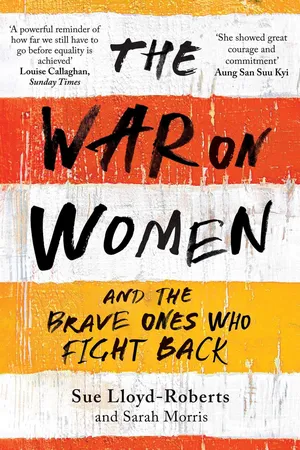
The War on Women
eBook - ePub

The War on Women

  1. 320 pages
  2. English
  3. ePUB (mobile friendly)
  4. Available on iOS & Android
eBook - ePub

The War on Women

About this book

'She showed great courage and commitment in reporting from Burma and exemplified my belief that the best journalists are also the nicest' – Aung San Suu Kyi 'One of the most distinguished television journalists of her generation' – Huw Edwards 'Brilliant and indefatigable' – Jeremy Bowen 'She had something you call moral courage and it rubbed off on others' – David Aaronovitch 'She set the standard for bravery in many of the world's nastiest places' – John Fisher Burns, New York Times 'She went to dangerous places to give a voice to people who otherwise would not be heard' – Tony Hall, BBC Director General
In 1973, Sue Lloyd-Roberts joined ITN as a news trainee and went on to be one of the UK's first video-journalists to report from the bleak outposts of the Soviet Union.Travelling as a tourist, she also gained access to some of the world's most impenetrable places like China, Tibet and Burma.During her 40-year-long career she witnessed the worst atrocities inflicted on women across the world. But in observing first-hand the war on the female race she also documented their incredible determination to fight back. The War on Women brings to life the inconceivable and dangerous life Sue led. It tells the story of orphan Mary Merritt who, age sixteen, instead of being released from the care of nuns was interned by them in a Magdalen Laundry and forced to work twelve hours a day six days a week, without pay, for over a decade. She gives voice to Maimouna, the woman responsible for taking over her mother's role as the village female circumciser in The Gambia and provides a platform for the 11-year-old Manemma, who was married off in Jaipur at the age of six. From the gender pay gap in Britain to forced marriage in Kashmir and from rape as a weapon of war to honour killings, Sue has examined humankind's history and takes us on a journey to analyse the state of women's lives today. Most importantly she acts as a mouthpiece for the brave ones; the ones who challenge wrongdoing; the ones who show courage no matter how afraid they are; the ones who are combatting violence across the globe; the ones who are fighting back. Sue sadly died in 2015, shortly after writing this book, today she is widely recognised as one of the most acclaimed television journalists of her generation. This book is the small tribute to the full and incredible life she lived and through it these women's voices are still being heard.

Frequently asked questions

Yes, you can cancel anytime from the Subscription tab in your account settings on the Perlego website. Your subscription will stay active until the end of your current billing period. Learn how to cancel your subscription.
No, books cannot be downloaded as external files, such as PDFs, for use outside of Perlego. However, you can download books within the Perlego app for offline reading on mobile or tablet. Learn more here.
Perlego offers two plans: Essential and Complete
  • Essential is ideal for learners and professionals who enjoy exploring a wide range of subjects. Access the Essential Library with 800,000+ trusted titles and best-sellers across business, personal growth, and the humanities. Includes unlimited reading time and Standard Read Aloud voice.
  • Complete: Perfect for advanced learners and researchers needing full, unrestricted access. Unlock 1.4M+ books across hundreds of subjects, including academic and specialized titles. The Complete Plan also includes advanced features like Premium Read Aloud and Research Assistant.
Both plans are available with monthly, semester, or annual billing cycles.
We are an online textbook subscription service, where you can get access to an entire online library for less than the price of a single book per month. With over 1 million books across 1000+ topics, we’ve got you covered! Learn more here.
Look out for the read-aloud symbol on your next book to see if you can listen to it. The read-aloud tool reads text aloud for you, highlighting the text as it is being read. You can pause it, speed it up and slow it down. Learn more here.
Yes! You can use the Perlego app on both iOS or Android devices to read anytime, anywhere — even offline. Perfect for commutes or when you’re on the go.
Please note we cannot support devices running on iOS 13 and Android 7 or earlier. Learn more about using the app.
Yes, you can access The War on Women by Sue Lloyd-Roberts in PDF and/or ePUB format, as well as other popular books in Social Sciences & Sociology. We have over one million books available in our catalogue for you to explore.

Information

1

THE CRUELLEST CUT

Female Genital Mutilation

Maimouna stirs in her sleep, her eyes flickering. Something doesn’t make sense. She can see it is still dark through the open window that gives out onto the communal yard and yet she can hear the distinct sound of her neighbour crushing peanuts in a metal bowl preparing to make domodah, the traditional peanut stew of the Gambia. She feels her insides tighten and quickly opens her eyes wide as she remembers – it is cutting day.
Her mother, Mama Mouna, is the village circumciser. The family is held in respect by their fellow villagers and the extra money that the cutting brings them is welcome. Apart from that one role, her parents are too old to work. Her mother has turned sixty and has told Maimouna that she is the chosen one of the two daughters – she is to be the next village cutter. Her mother admits that she is now too weak to restrain the girls as they struggle and fight her during the circumcision ceremony. Maimouna has helped her mother on several occasions in the past and at the next ceremony she will be in charge of the cutting.
As Maimouna lies in bed contemplating the day ahead and her future, she knows that the responsibility for taking over this duty in her village will be a considerable one. The village boasts a prosperous community of some two thousand people, the overwhelming majority of whom believe in the tradition of female circumcision. All the women in her community are convinced that it would be impossible to get their daughters married unless they are cut. They would be considered dirty or impure.
She hears her daughter, Ami, roll off the mattress next to hers and drawing near. ‘Mum, is this the day?’
Maimouna nods. Five-year-old Ami doesn’t know what the day actually means. She only knows what her mother and aunts have told her, that once every two years the girls in the village have to dress in their best clothes and, accompanied by villagers beating drums and waving branches, they will be led into the special house where they will ‘become women’.
Maimouna reaches for her best grandmuba, a voluminous dress that reaches to the floor and covers the arms, which she had laid out the night before, and a matching headdress. Ami carefully puts on the shift that she had been given several weeks ago for this special day. There is fish and rice stew left over from the night before but neither mother nor daughter feel hungry; one is too nervous and the other too excited. It is now light and they could hear the drummers approaching, beating on their tamas.
The neighbour’s daughter rushes in and grabs Ami by the wrist. ‘Quick! We’ll be late,’ she says as she heads to the door. Ami follows, forgetting to say goodbye to her mother. Maimouna is in no hurry. The procession will circle the village several times, collecting the girls before ending up at the main family compound where her mother lives. She has already prepared the mattresses on the floor in the room where the girls will spend several days recovering and she has made the tomato paste she will use to treat their open wounds. She shudders as she remembers the girls who have bled to death in the room.
She walks slowly to her mother’s house. Mama is already in the courtyard where the cutting will take place with her sister, Maimouna’s aunt. They are preparing the razors and cloths to mop up the blood. Maimouna drags one of the mattresses from the recovery room into the courtyard, waiting for the first girl to arrive. The girl will be led through to the courtyard blindfolded and then laid on the floor so that Mama can make quick and effective cuts. ‘Watch me closely,’ she reminds her daughter. ‘Next time, you will have to do it.’
Maimouna hears the drums and shouting as the procession approaches the family compound. ‘There is always lots of playing of drums,’ Maimouna explains. ‘They take drums and pans and make a lot of noise so that, if the girls are screaming, people won’t hear the screaming of the girls they are cutting. The girls waiting to be cut know something is going on but, because of the beating pans and clapping and shouting, they don’t know what.’
Maimouna waits nervously for the first girl to be pushed down a long narrow corridor and through the curtain which hangs between the house and the courtyard. Her mother is ready with the razor while her aunt has prepared rags to stuff into the girls’ mouths if their screaming gets too loud. Mama instructs her sister to pin down the girls’ arms and Maimouna is told to hold down their legs. ‘If the girl is big,’ Mama says, ‘you will have to sit on her chest.’
By midday, Maimouna has held four girls as they spat, bit, struggled and fought. She is exhausted, physically and emotionally. The first child to arrive in the courtyard is excited and happy. She is expecting a present or maybe some special food to celebrate her maturity. Her aunt has suggested that maybe she will get a glimpse of the boy who has been chosen to marry her one day.
But instead, she is told to lie down, her legs are forced open and then there is the searing pain as first her clitoris and then her labia are cut off with a razor. She has never experienced such agony. She screams and screams but still the cutting goes on. She hears Mama shout at Maimouna: ‘Hold her, hold her. I can’t do it unless you keep her still.’ When at last the cutting stops, another woman carries her to the windowless recovery room and lays her on a mattress. She is crying and blood is pouring down her legs. She thinks she is going to die.
All the time, the men in the courtyard outside keep beating on the tamas, attempting to outdo the chilling shrieks of the girls. But, as the next girl is pushed past the soiled red curtain into the courtyard, her expression has grown more frightened and panicked. Despite the drumming and shouting, she hears the desperate cries of her friend and knows that there is something not right about this special day.
The girl is Ami. Maimouna lays her blindfolded daughter on the mattress, now drenched in blood, and pins down her arms. The child’s grandmother makes the first swipe with the razor. Ami screamed: ‘Mum, Mum, where are you? Help me! Help me!’ Ami has no idea that it is her great-aunt who is pinning her arms to the ground while her mother forces open her legs.
Maimouna says:
Can you imagine holding down your five-year-old daughter, and they are cutting her and she is screaming and calling out ‘Mum’ and Mum is the one who is holding down your legs and there is nothing Mum can do? So, I was shaking my head and tears were coming to my eyes and I said to my mind that, whatever happens, I will never do this, I will never do the cutting but I cannot tell it to anyone. If I say it to the people, by this time I would not be here. So I just keep it in my mind. This is when I regretted having a daughter.
This was an extraordinary, revolutionary moment for this 36-year-old woman, which can only have been prompted by a resource of humanity and compassion deep within her which defies everything that she has been taught and has been brought up to expect. Maimouna’s destiny is to cut. Her mother, grandmother and generations before them had done their duty for the local community. And yet this woman, with no education and well before anti-female genital mutilation activists arrive in her village to tell her so, realizes that to inflict so much pain and to mutilate a young girl is wrong.
After she makes up her mind to break with the family tradition, she knows she has to flee the village. When her mother dies in 2009, the situation becomes critical. She starts making excuses, saying she needs more time and has to collect the appropriate ‘juju’ artefacts befitting a circumciser. One year, two years pass and the village elders come to her house to ask her when she is going to assume her responsibilities.
‘I told them that I needed to find the jujus to protect the girls. Because when the cutting takes place, witches come to bewitch the girls who are cut and this can cause them to die. I said I needed time to find the right jujus. In fact, I was buying time. I was playing with them, saying that I cannot just do the cutting when my mother died, it takes time.’
But the elders get impatient. They bring her juju necklaces, leather belts and ornaments which, they say, are sufficient for the task ahead. Just as they are beginning to threaten her, she gets the chance to escape from the village and the job that repels her. Her brother emigrated to the UK a few years earlier and has written with the news that he is to get married to an English woman. Maimouna persuades the family that she is the one who should go to the wedding.
She obtains a visa from the British High Commission in the capital, Banjul, and flies to the UK to attend the ceremony in Derby. Her brother refuses to look after her when she tells him that she has no intention of returning to their village. She is alone and hungry when a Pakistani family she met at the local mosque take pity on her. They give her a bed and advise her to go to the Home Office reception area in Crawley and apply for asylum. She is sent to the high-security prison for women asylum seekers, Yarl’s Wood, where she is told she will probably be deported.
Maimouna is given a judicial hearing before a judge who, after hearing her case but without calling any expert witnesses, rules against her. Her error was in lying on her visa application, claiming that she wanted to come to the UK for a wedding and for not appealing for asylum as soon as she arrived. He accuses her of deception. He claims to be familiar with the customs of West Africa and observes that the way she ties her headdress suggests that she comes from a wealthy, educated family and that she would easily be able to go back to the Gambia and fend for herself.
She did not dare answer back at the time but later tells me that she did not know whether to laugh or cry at the judge’s alleged authority on the subject of headdresses. ‘The way we tie the cloths around our heads has nothing to do with tribe or class,’ she says indignantly. ‘We tie the cloth around our heads the way we want to. It’s fashion!’ She laughs but a moment later she is crying. Ami is one of five children. In order to avoid cutting she has abandoned them all.
Maimouna tells me her story in a bedsit in Hounslow, West London where she is waiting to be deported. The room is on the third floor of two handsome nineteenth-century houses with white stucco facades that have been knocked together by the local council to provide holding areas for asylum seekers. As I make my way past the chaotic pile of bikes and prams parked in the hallway, a black teenager darts out of one of the doors, the son of a Somali family living in a room on the ground floor.
On the first floor, there is an Albanian family living opposite two young Afghan males. The world’s refugee population is well represented here. Some had travelled thousands of miles and hidden in the backs of lorries for the last stage of the journey across the Channel. All are waiting to hear whether the Home Office will believe their stories of persecution and whether they will be allowed to stay. Maimouna shares her room with a professional Iranian woman, in her forties, who fled Tehran after participating in the Green Revolution in 2009. She had tried, unsuccessfully, to challenge the rule of the Ayatollahs.
With tears flowing down her cheeks, Maimouna tells me how much she misses her daughter and four sons. ‘But I am in the middle. Because if I go home now and start cutting those girls so that I can return to my kids I am selfish. Sometimes I think I am not fair to my kids and I have to go back to do the cutting but when I think that, I say to myself: because of my kids how many girls am I going to cut? How many girls am I going to affect? How many girls am I going to put in the position I am in today?’
FGM is being tackled in the Gambia. An NGO (non-governmental organization) called GAMCOTRAP has approached about a third of the villages to persuade them to stop. Unfortunately for Maimouna they have not yet reached her village. GAMCOTRAP ask the male village leaders to let them present their arguments at a village meeting. Once they get permission, they explain the dangers of FGM and how the deaths of so many girls after the cutting and of so many women and babies in childbirth are in fact due to FGM and not due to the evil spirits which are so routinely and conveniently blamed.
Once they get the villagers to agree to stop cutting, they hold elaborate ‘Dropping the Knife’ ceremonies. I attend one such ceremony in a village outside Serekunda. The women dance and sing the songs that they once sang while they accompanied the girls to the cutting ceremony, hastily followed by songs which celebrate their new knowledge and their decision to ‘drop the knife’. I end up dancing with the women and I become very emotional when I think of what has been achieved. All the women I am linking arms and dancing with have been cut. Their granddaughters, who dart between us squealing with delight at the music and the joy of the event, have not. It is an uplifting, inspirational moment.
The next morning I am given a reality check. GAMCOTRAP face an uphill struggle. I am taken to a meeting of cutters in a region of the country the NGO is only beginning to approach. Sitting on plastic chairs in a circle in the yard of a compound belonging to a village elder, one of them holds a frightened-looking eight-year-old girl on her lap. She boasts to me: ‘I cut forty children this year, including my granddaughter and look how well she looks on it!’ Another says, ‘I earned $3 per child cut AND a bag of rice and some clothes!’ They all tell me how much they enjoy the respect they get from the local community.
Dr Isa Touray, the charismatic and brave executive director of GAMCOTRAP, is a realist. A formidable woman who has been imprisoned for her anti-FGM advocacy, she is resplendent in her traditional yellow, floor-length dress, matching headdress and bold jewellery. She tells me that she needs more funds to reach more communities and to carry out follow-up visits to check whether, after all the parties and celebrations, communities are really adhering to the NGO’s teachings. Why does she think it is so difficult to challenge the tradition?
‘FGM is about control over female sexuality,’ she says. ‘That is, about controlling the pleasure women get from the erogenous zones. We all know that it is about enjoying sex. It is about the bodily dignity and integrity of the women, which is something very powerful. In essence, it is about control over women’s bodies, control over women’s pleasure. If women don’t get pleasure, they are more easily controlled. And too many men in Africa want to keep that control.’
The Gambia’s eccentric president, Yahya Jammeh, who is said to have boasted that he could cure HIV/Aids with his herbal remedy, has declared that FGM is part of Gambian culture. In 2013, a month after the BBC broadcast my film about FGM in the Gambia, he withdrew his country from the Commonwealth claiming he no longer wants his country to be subjected to neocolonial influences.1 His decision will make it much harder for anti-FGM activists in the country to campaign against what the president celebrates as a traditional practice.*
President Jammeh refuses my request for an interview. The nearest I get to a member of the governing elite is an exchange with the country’s most senior imam, Muhammed Alhaijie Lamin Touray, president of the Supreme Islamic Council. It is pouring with rain when we arrive at his mosque in Gunjur village in Kombo South for Friday prayers. The men are inside the mosque building and the women in the anterooms and corridors outside where inadequate roofing give them little respite from the rainy season. I sit among the women while waiting for the imam to finish his sermon.
The imam invites me and my cameraman into his home where the men sit on chairs against the walls of the room; apart from me, there is not a woman in sight. In his sermon that day, he preached that FGM is part of Islamic law and that genital mutilation is good for women. Why? ‘It is a beautiful thing. It is a good thing,’ he tells me. ‘This is the reason why it is accepted in Islam, why we practise it and why there is nothing wrong with it.’
‘FGM has many benefits for women,’ the imam continues as he warms to the subject with his all-male audience nodding in agreement. ‘The thing they remove when they cut the girl is very itchy. It is so itchy that women even have to resort to using a wire scourer to relieve the itching. And, on other occasions, a woman who has not been cut has a watery discharge. When she gets up from a chair, her clothes are all wet and this causes embarrassment to her if she is in a public place.’
At this stage, as the only woman present, I have to intervene with some indignation. ‘I have had a clitoris for sixty years,’ I say, ‘and this has never happened to me!’
‘Well you are an exception among women,’ he says and bursts out laughing, his wicked eyes gleaming.
It is not the absurdity of his argument but it is the laughing that makes me most angry. If he truly believes that the mutilation of young girls is approved by God and that it is good for women, he would not laugh. He knows what he was saying is preposterous and this clearly amuses him. It is as if he is admitting that genital mutilation is all about control. Nonetheless, through gritted teeth, I thank him sincerely for the interview. At least he had agreed to talk to me and, for the purposes of my report, he confirms the chronic misogyny that lies behind the custom.
So where did the mutilation of little girls, the agonizing pain, the premature deaths, the denial of pleasure and the incomprehensible logic of this misogynistic act begin? There are illustrations of both girls and boys being circumcised in Pharaonic tombs, well before either Christianity or Islam arrived on the African continent. The belief that a woman’s sexuality has to be controlled is deeply entrenched in the history of humankind. Ever since Eve stole the forbidden fruit, the early Christian fathers warned that a woman is not to be trusted. The ethos of Christianity is determinedly patriarchal, from the doctrine of the Holy Trinity to the male-dominated ecclesiastical hierarchies of today. ‘The Bible in its teachings degrades women from Genesis to Revelation,’ wrote the suffragette Elizabeth Cady Stanton; and ‘a ...

Table of contents

  1. Cover
  2. Acknowledgements
  3. Preface
  4. Introduction
  5. 1 The Cruellest Cut: Female Genital Mutilation
  6. 2 The Grandmothers of the Plaza de Mayo: Women in Argentina’s Dirty Wars
  7. 3 Ireland’s Fallen Women: A Story of Religious Persecution
  8. 4 Saudi Arabia: The World’s Largest Women’s Prison
  9. 5 Egypt: What Made Her Go There?
  10. 6 From Russia with Love: Sex Trafficking
  11. 7 Boys Will Be Boys: Where There Are UN Peacekeepers There Are Traffickers
  12. 8 Forced Marriage: From Kashmir to Bradford
  13. 9 Honour Killings: Murder to Preserve Honour
  14. 10 India: The Worst Place on Earth to Be Born a Woman
  15. 11 Rape as a Weapon of War: Bosnia and the Democratic Republic of the Congo
  16. 12 Sex Inequality in the UK: The Pay Gap
  17. Conclusion
  18. List of Illustrations
  19. About Sue Lloyd-Roberts
  20. Notes
  21. Index
  22. Picture Credits
  23. Copyright