Crisis
eBook - ePub

Crisis

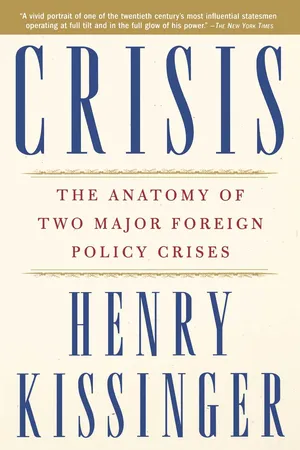
The Anatomy of Two Major Foreign Policy Crises

  1. 576 pages
  2. English
  3. ePUB (mobile friendly)
  4. Available on iOS & Android
eBook - ePub

Crisis

The Anatomy of Two Major Foreign Policy Crises

About this book

By drawing upon previously unpublished transcripts of his telephone conversations during the Yom Kippur War (1973) and the last days of the Vietnam War (1975), Henry Kissinger reveals what goes on behind the scenes at the highest levels in a diplomatic crisis. The two major foreign policy crises in this book, one successfully negotiated, one that ended tragically, were unique in that they moved so fast that much of the work on them had to be handled by telephone.The longer of the two sections deals in detail with the Yom Kippur War and is full of revelations, as well as great relevancy: In Kissinger's conversations with Golda Meir, Israeli Prime Minister; Simcha Dinitz, Israeli ambassador to the U.S.; Mohamed el-Zayyat, the Egyptian Foreign Minister; Anatoly Dobrynin, the Soviet Ambassador to the U.S.; Kurt Waldheim, the Secretary General of the U.N.; and a host of others, as well as with President Nixon, many of the main elements of the current problems in the Middle East can be seen.The section on the end of the Vietnam War is a tragic drama, as Kissinger tries to help his president and a divided nation through the final moments of a lost war. It is full of astonishing material, such as Kissinger's trying to secure the evacuation of a Marine company which, at the very last minute, is discovered to still be in Saigon as the city is about to fall, and his exchanges with Ambassador Martin in Saigon, who is reluctant to leave his embassy.This is a book that presents perhaps the best record of the inner workings of diplomacy at the superheated pace and tension of real crisis.
Frequently asked questions

Yes, you can cancel anytime from the Subscription tab in your account settings on the Perlego website. Your subscription will stay active until the end of your current billing period. Learn how to cancel your subscription.
No, books cannot be downloaded as external files, such as PDFs, for use outside of Perlego. However, you can download books within the Perlego app for offline reading on mobile or tablet. Learn more here.
Perlego offers two plans: Essential and Complete
  • Essential is ideal for learners and professionals who enjoy exploring a wide range of subjects. Access the Essential Library with 800,000+ trusted titles and best-sellers across business, personal growth, and the humanities. Includes unlimited reading time and Standard Read Aloud voice.
  • Complete: Perfect for advanced learners and researchers needing full, unrestricted access. Unlock 1.4M+ books across hundreds of subjects, including academic and specialized titles. The Complete Plan also includes advanced features like Premium Read Aloud and Research Assistant.
Both plans are available with monthly, semester, or annual billing cycles.
We are an online textbook subscription service, where you can get access to an entire online library for less than the price of a single book per month. With over 1 million books across 1000+ topics, we’ve got you covered! Learn more here.
Look out for the read-aloud symbol on your next book to see if you can listen to it. The read-aloud tool reads text aloud for you, highlighting the text as it is being read. You can pause it, speed it up and slow it down. Learn more here.
Yes! You can use the Perlego app on both iOS or Android devices to read anytime, anywhere — even offline. Perfect for commutes or when you’re on the go.
Please note we cannot support devices running on iOS 13 and Android 7 or earlier. Learn more about using the app.
Yes, you can access Crisis by Henry Kissinger in PDF and/or ePUB format, as well as other popular books in History & North American History. We have over one million books available in our catalogue for you to explore.

Information

The Middle East War of 1973
The Middle East crisis that erupted into war in 1973 had many components: the Arab-Israeli conflict; the ideological struggle between Arab moderates and radicals; and the rivalry of the superpowers, the United States and the Soviet Union. These ingredients had separate origins that had grown intertwined; a solution to one could not be accomplished without grappling with the others.
Creation of the state of Israel with American (and, at the time, Soviet) support in 1948 had inflamed Arab nationalism and led to a war at the end of which borders were based on the armistice lines. Established as a nation by force of arms, Israel lived thereafter unrecognized, ostracized, and bitterly resented by its neighbors. In 1956, Israel moved into the Sinai Peninsula as an adjunct to the Anglo-French Suez operation. Forced back by the United Nations to the 1947 border, Israel achieved a demilitarized Sinai and freedom of navigation to its Red Sea port at Eilat. In June 1967, Israel erupted across the armistice lines after Egypt, under President Gamal Abdel Nasser, spurred on by Soviet disinformation, declared a blockade of Eilat and ominously moved its army into the demilitarized Sinai toward Israel. The war ended in six days with Israel in possession of the Sinai Peninsula from Egypt, the West Bank of the Jordan River, and the Golan Heights from Syria, compounding Arab frustration with humiliation.
Israel, never having lived within accepted frontiers, saw no essential difference between locating its boundaries in one unaccepted place or another; condemned to Arab belligerency, it sought the widest possible security belt and held on to its conquests. The Arab nations, in the aftermath of that defeat, resumed a defiant posture under the leadership of Egyptian President Nasser. At an Arab summit in Khartoum they adopted the principle of ā€œNo peace, no negotiation, no recognition of Israel.ā€ A war of attrition started, as part of which the Soviet Union established an air defense system of surface-to-air missiles along the Suez Canal. In 1970, there was an upheaval by the Palestine Liberation Organization in Jordan. Syria invaded Jordan in support of the PLO, United States forces were placed on alert, and the crisis ended with the PLO’s expulsion from Jordan.
Afterward, the Arab countries were torn between their ideological and religious objection to the existence of the Israeli state and the practical reality that they could not alter the status quo except through some form of diplomacy. Moderate Arab governments like Jordan and (under Nasser, ambivalently) Egypt felt their way toward a formula that accepted Israel on its prewar (1967) borders (that is, the armistice lines of 1947). But, pending a settlement of the status of the Arab Palestinians, they would grant no more than an end to the state of belligerency—another form of armistice—rather than the full peace that Israel demanded.
And the Palestinian issue was deadlocked further by the attitude of the Palestinian nationalists who refused to accept Israel’s legitimacy on any terms. Syria refused to negotiate for any conditions; it objected to Israel’s existence, not its borders. Iraq strenuously added its weight to that of the radicals, as did Libya and Algeria. The PLO, whose claim to represent all Palestinians was not yet recognized by the Arab states, called for the creation of a secular state in Palestine—that is to say, the disappearance of Israel. And Israel came more and more to identify its security with its presence on the West Bank. This impasse blocked Middle East diplomacy for all the years between the wars of 1967 and 1973.
The symbol of the deadlock was United Nations Security Council Resolution 242 of November 22, 1967. It spoke of a ā€œjust and lasting peaceā€ within ā€œsecure and recognized boundariesā€ but did not define any of the adjectives. Rejected by some Arab states, interpreted by those that accepted it as well as by Israel to suit their preconceptions, it became more an expression of a stalemate than a means of its resolution. Those Arab leaders willing to negotiate at all construed it to require total Israeli withdrawal to the pre–June 1967 frontiers. Israel professed that none of its prewar borders was secure; it insisted on retaining some of the occupied territory of each of its neighbors. To make doubly sure that its interests were safeguarded, Israel put forward a demand as seemingly reasonable as it was unfulfillable: that the Arab states negotiate directly with it. In other words, Israel asked for recognition as a precondition of negotiation.
The Arab states, not to be outdone, demanded acceptance of their territorial demands before they would consider diplomacy. No Arab leader, however moderate, could accede to Israel’s demands and survive in the climate of humiliation, radicalism, and Soviet influence of the period. No Israeli Prime Minister could stay in office if he relinquished the claim to some of the occupied territories as an entrance price to negotiations. Israel chased the illusion that it could both acquire substantial territory and achieve peace. Its Arab adversaries pursued the opposite illusion—that they could regain territory without offering peace.
Egypt became the key to Middle East diplomacy. Tactical necessity reinforced what Egypt had earned by its size, tradition, cultural influence, and sacrifice in a series of Arab-Israeli wars. Egypt was the most populous Arab country, the cultural hub of the area. Its teachers were the backbone of the educational system of the Arab world; its universities attracted students from all over the region. It had the longest continuing history of any nation, with the exception of China. And it had borne the brunt of the Arab-Israeli conflict. As both monarchy and republic, it had engaged itself in a struggle that went beyond narrow Egyptian national interests. It had sacrificed its young men to the cause of Arab unity and of Palestinian self-determination. In the process, it had lost the Sinai Peninsula and repeatedly risked its national cohesion. Egypt had earned the right to make peace.
But so long as Nasser was President, he paralyzed Egypt by ambivalence. On the one hand, he indicated a general willingness to participate in the peace process—albeit in the name of an unfulfillable program. He demanded Israel’s withdrawal to the 1967 borders in return for Egyptian nonbelligerency; peace would depend on an Israeli settlement with the Palestinians, then demanding the destruction of the Jewish state. Nor would Nasser negotiate directly with Israel. Rather, America was asked to bring about the Israeli withdrawal, in return for which Nasser would confer on us the boon of restored diplomatic relations. In the meantime Cairo radio remained as the center of anti-American—indeed, anti-Western—propaganda throughout the Middle East. In short, Nasser wanted to lead the Arab world from an anti-American position, to present whatever concessions he obtained as having been extorted by Arab militancy, backed by Soviet arms and Soviet diplomatic support. The United States had no interest in vindicating such a course.
In the resulting stalemate, the role of the Soviet Union oscillated between the malign and the confused. Its supply of arms encouraged Arab intransigence. But this achieved no more than to increase the dangers of the deadlock; it could not remove it. Moscow never managed to choose among its dilemmas. So long as it one-sidedly supported all the positions of its Arab clients, it could not advance either the negotiating process or its own role. For we had no motive to support the program of the Arab radicals who were castigating us; in the unlikely event that we would change our view, we did not need the Soviet Union as an intermediary. In other words, Moscow could contribute effectively to a solution only by dissociating itself to some extent from Arab demands and thus jeopardizing some of its friendships in the Arab world. But if it did not do so, it risked backing objectives it could not bring about and thus earning disdain as being impotent. Moscow could stoke the embers of crisis, but once they exploded into conflagration, it could use them for its own ends only by courting a great-power confrontation, something from which the Soviet Union had until then carefully shied away.
Like the other parties, the Soviet Union temporized. It acted as the Arabs’ lawyer but could not advance their cause; it bought time through the supply of weapons, but this only escalated the level of possible violence without changing the underlying realities.
There was no American interest in imposing a settlement on Israel under radical pressure, for that would reinforce the conviction that America was best dealt with by extortion. Within the Arab world, we needed to strengthen the moderates as against the radicals, the governments associated with the West as against the clients ...

Table of contents

  1. Cover
  2. Dedication
  3. Introduction
  4. The Middle East War of 1973
  5. The Last Month of Indochina
  6. Acknowledgments
  7. About Henry Kissinger
  8. Index
  9. Copyright