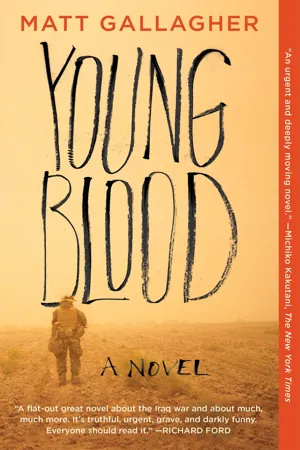
Youngblood
eBook - ePub

Youngblood

A Novel

  1. 352 pages
  2. English
  3. ePUB (mobile friendly)
  4. Available on iOS & Android
eBook - ePub

Youngblood

A Novel

About this book

"An urgent and deeply moving novel" (Michiko Kakutani, The New York Times ) about a young American soldier struggling to find meaning during the final, dark days of the War in Iraq. The US military is preparing to withdraw from Iraq, and newly minted lieutenant Jack Porter struggles to accept how it's happening—through alliances with warlords who have Arab and American blood on their hands. Day after day, Jack tries to assert his leadership in the sweltering, dreary atmosphere of Ashuriyah. But his world is disrupted by the arrival of veteran Sergeant Daniel Chambers, whose aggressive style threatens to undermine the fragile peace that the troops have worked hard to establish.As Iraq plunges back into chaos and bloodshed and Chambers's influence over the men grows stronger, Jack becomes obsessed with a strange, tragic tale of reckless love between a lost American soldier and Rana, a local sheikh's daughter. In search of the truth and buoyed by the knowledge that what he finds may implicate Sergeant Chambers, Jack seeks answers from the enigmatic Rana, and soon their fates become intertwined. Determined to secure a better future for Rana and a legitimate and lasting peace for her country, Jack will defy American command, putting his own future in grave peril.For fans of Phil Klay's Redeployment or Ben Fountain's Billy Lynn's Long Halftime Walk, Youngblood provides startling new dimension to both the moral complexity of war and its psychological toll.
Frequently asked questions

Yes, you can cancel anytime from the Subscription tab in your account settings on the Perlego website. Your subscription will stay active until the end of your current billing period. Learn how to cancel your subscription.
No, books cannot be downloaded as external files, such as PDFs, for use outside of Perlego. However, you can download books within the Perlego app for offline reading on mobile or tablet. Learn more here.
Perlego offers two plans: Essential and Complete
  • Essential is ideal for learners and professionals who enjoy exploring a wide range of subjects. Access the Essential Library with 800,000+ trusted titles and best-sellers across business, personal growth, and the humanities. Includes unlimited reading time and Standard Read Aloud voice.
  • Complete: Perfect for advanced learners and researchers needing full, unrestricted access. Unlock 1.4M+ books across hundreds of subjects, including academic and specialized titles. The Complete Plan also includes advanced features like Premium Read Aloud and Research Assistant.
Both plans are available with monthly, semester, or annual billing cycles.
We are an online textbook subscription service, where you can get access to an entire online library for less than the price of a single book per month. With over 1 million books across 1000+ topics, we’ve got you covered! Learn more here.
Look out for the read-aloud symbol on your next book to see if you can listen to it. The read-aloud tool reads text aloud for you, highlighting the text as it is being read. You can pause it, speed it up and slow it down. Learn more here.
Yes! You can use the Perlego app on both iOS or Android devices to read anytime, anywhere — even offline. Perfect for commutes or when you’re on the go.
Please note we cannot support devices running on iOS 13 and Android 7 or earlier. Learn more about using the app.
Yes, you can access Youngblood by Matt Gallagher in PDF and/or ePUB format, as well as other popular books in Literature & Literature General. We have over one million books available in our catalogue for you to explore.

Information

BOOK III

34


None of the locals could remember a Ramadan like it, not even the elders. The summer heat was supposed to blow away in the wind, they said, not wash away in rain. If they thought it meant anything, though, they kept it to themselves.
I fasted through the holy month, alone among the occupiers. I didn’t quite feel cleansed by it, but it gave me something to talk about with Rana. She was a source now. Our source. We came on the days she said to, when her husband was away in Baghdad managing his concrete business. Her information wasn’t great, but it wasn’t bad, either. She knew of some cache spots along the canal.
She didn’t speak much of the ghost who haunted her, though during our third meeting she let me read one of his love letters. When I handed it back, I searched her face for signs of sadness or reminiscence. I found neither. Instead, she was studying me behind her arrow nose, probing, considering. I swallowed away a blush. She folded up the letter, placing it in a hidden pocket of the gray cotton dress she always seemed to wear.
Snoop came to the hut with me at first, but eventually he stayed with the men in the vehicles outside. ā€œTo play cards,ā€ he said. We were short-timers now. For the soldiers, home wasn’t just a thing we’d left anymore. It was a thing that awaited.
Out there, the war endured. A land of bullets and fatwas, out there assured only death. I understood that now. The desert had always meant death for strange infidels far from home, from Alexander the Great to Elijah Rios. There were no dust storms in the sheika’s hut, though, no scorpions or holy wars. It smelled of lush wildflowers, not hot trash. With her, I felt no headaches. We listened to the playful shouts of her boys, not the shrieks of mortar shells. The war existed beyond the hamlet. In the hut—in the hut was something else.
She spoke of the past with small, soft hands flitting toward the sky. I spoke of the present with anxious proclamations. I told her to smile more. She told me to find her reasons to.
One dreary afternoon, she asked how we’d come to find Shaba’s remains. I didn’t want to say, but she insisted.
I talked about the wake, about Haitham’s call, about the fatwa that relegated Ibrahim to Camp Independence, about all the tribal leaders who knew the bones were there but had pled ignorance. ā€œDon’t worry,ā€ I said. ā€œWe’ll get them. We’ll get them all.ā€
She stayed silent for many seconds.
ā€œWhat?ā€ I asked.
ā€œAshuriyah is hell,ā€ she said, her face setting like flint. ā€œHow do you defeat the devil in his own home?ā€

35


The summer before I joined ROTC was California bright and filled with crystal skies. Will came home for a few weeks and kept talking about the time he’d called in an airstrike on the Taliban. Marissa and I decided to give it another try, at least until we went back to our respective campuses in the fall, spending our mornings at the lake and our evenings in friends’ basements.
Her sister Julie was to be married in August. Will, Mom, and I received invitations. Our dad didn’t live in our subdivision anymore, so he didn’t get one. There were rules in Granite Bay.
Julie and Will had never really gotten along, even though they’d gone to school together. Marissa and I liked to joke that the reason for the mutual distaste was their red-blooded lust for each other. ā€œOur kids could be double cousins!ā€ we said. Neither sibling ever laughed with us, but we didn’t care. We had each other.
Despite their history of antipathy, neither Will nor Julie considered themselves unreasonable, something that proved helpful when the groom, Richie Gomez, asked my brother to be a replacement groomsman—something about a Venezuelan cousin having visa issues. Richie and Will had played high school baseball together, so it made some sense, though I harbored cynical thoughts about the groom’s need to prove to the bride’s family that he wasn’t a Chavez-loving socialist, which meant trotting out Will’s dress uniform and shiny medals.
ā€œYou’re a fool,ā€ my mom said when I brought that up.
ā€œYou’re an idiot,ā€ Marissa said when I brought that up.
The week of the wedding, I stumbled into our kitchen, seeking out the pantry. Will was pacing the linoleum tile floor.
ā€œScumbag,ā€ he said. ā€œCreep. Coward.ā€
I asked who he was ranting about.
ā€œTomas Butkus,ā€ he said. ā€œHe’s coming to the wedding.ā€
It was well-known in Millennial Granite Bay that Julie and Tomas had hooked up on a camping trip, months after she began dating Richie Gomez. Well-known to everyone but Richie. Gossip peddling being gossip peddling, and gossip peddlers being gossip peddlers, the story had swirled around Richie without reaching his ears.
ā€œThat was, like, a couple years ago,ā€ I said. ā€œAnd Julie and Tomas are friends. That’s who weddings are for.ā€
ā€œNo, Jack. You’re wrong.ā€ My potato chip munching rose with his voice, and I took a seat behind the counter. ā€œWeddings are for people who will love and support your marriage. Not just a collection of friends.ā€
ā€œThen why are you going?ā€
ā€œThat’s not the point. The point—this Lithuanian prick has no honor. He should have respect for her and for Richie, and stay the fuck away.ā€
ā€œHmm.ā€ He was speaking so fast that I had a hard time keeping up. I was hungry. And stoned.
He went on to wax eloquent about HONOR. And INTEGRITY. And that lesser-known army value of NOT BEING BALTIC EUROTRASH. It all sounded quite significant and convincing, even to my pond-water mind, but one question lingered. When he finally stopped, it came off my tongue in a deluge of potato chip crumbs.
ā€œWill. Like, why do you care so much?ā€
He looked at me, wild-eyed. ā€œI don’t. I’m just saying.ā€
After the weed wore off, I figured out why he cared. The night after he’d graduated West Point, he had proposed to the daughter of a Connecticut senator he met at a Boston bar. She said yes. Some months later my family received a terse, slightly fanatical e-mail saying the engagement was off, the wedding was off, it was all off, that Will had sworn to himself that he’d never compromise and this was proof. He was going to be a man of principle, even if it meant sacrificing his own temporary happiness, because what was happiness in the long run but a silly, stupid emotion that was just a particular pattern of synaptic connections?
We never talked about the e-mail or mentioned it to Will. There wasn’t much to say, other than we were there for him when he needed us.
The wedding ceremony went well. Will was sharp and polished in his dress blues, and though the old, rich white relatives picked at him like vultures, he didn’t seem to mind. My mom patted my arm and told me perhaps I’d had a point earlier.
ā€œThose are the type of men who will keep your brother at war,ā€ she said, her voice both proud and furious. ā€œNot a grunt among them.ā€
ā€œHow do you know that word?ā€ I asked.
ā€œArmy moms know lots of words,ā€ she said. Then, after a pause, she smiled. ā€œNavy daughters do, too.ā€
The minister pronounced them man and wife. Bells clanged and spirits flowed. The world had never seen such joy, we all thought, and we all meant it. The stars were out, the night was calm, and the lakeside breeze blew with peace and joy and all sorts of particular patterns of synaptic connections.
Near the end of the reception, I slow-danced with Marissa. She wasn’t a girl who got done up often, which made her loveliness all the more palpable. In her uniform of a floral, ruffled bridesmaid dress, half drunk on wine, she clung to me, describing our future house, naming our future babies, planning a life together as idyllic as it was ordinary. I beamed, belly full of beer, knowing that sloppy, irresponsible sex awaited. Shouts and screeching chairs suddenly came from behind us, near the bar. We turned that way, same as everyone else. Will was standing over a dazed Tomas, fist clenched.
ā€œWho am I? Who the fuck am I?ā€ Will said. In that moment, his words almost sounded natural. ā€œI’m an infantry officer. I’m a man with purpose. I’m a man who knows what’s right, what’s wrong, and what you are.ā€
Tomas had trouble finding his feet, but his friends surrounded my brother and started crowing, chests out, drunken mania gliding through their eyes. I told Marissa that I’d be right back. Then I grabbed a metal chair, pushed into the circle, and told them if they wanted a fair fight, the Brothers Porter could certainly oblige.
Mom polished off her glass of Irish cream and told us to get in the car—she was driving us home just as soon as she thanked Julie and Marissa’s parents for the evening.
We didn’t say anything to one another on the drive home. As I stared out the car window at the streetlights and cul-de-sacs, I decided I wasn’t going to be a man of nothing. I wasn’t going to be a man of the idyll and ordinary. I was going to be the type of man who punched out Baltic Eurotrash at weddings for principle’s sake.
I was going to be a soldier. I was going to be an officer. I was going to be a leader of men.
Then I smiled at Will and patted him on the back. He needed that.

36


We waited out the afternoon fall storm, the insistent pat-pat-pat of water meeting packed slabs of earth. I stood at a window watching my men teach Rana’s boys poker. They’d gathered in a Stryker to keep dry, but had lowered the ramp to let in air.
ā€œYou brought this,ā€ she said from across the hut. ā€œWe haven’t had so much rain for years.ā€
She was teasing. At least I thought she was. I smiled shyly.
Her home was neat and tidy, everything from winter blankets to tableware organized into wood baskets stacked like bricks in corners. I’d thought the baskets a sign of a transient lifestyle, but Rana explained she fashioned herself a ā€œminimalist,ā€ preferring an open space.
ā€œHow’d you learn that word?ā€ I asked.
ā€œThere is a show—The Real Housewives of Cairo. My cousin in Karrada has a television. We watched it for hours when we visited last year. It was very . . .ā€ She knocked on her forehead as she searched for the English word. ā€œEducational.ā€
I ran a hand through my sweaty hair. I’d been growing it out some, pushing the regulation length. My helmet and rifle lay near the front door. A pair of Persian carpets covered much of the main room with red diamonds and purple snowflakes. I returned to my plastic chair on the carpets, facing her. Every Iraqi man I’d met with had insisted on sitting on the ground for tradition. Rana said they just enjoyed messing with foreigners. She rose, gliding like a specter to the window, her dress concealing her feet and long black hair falling behind her.
ā€œIt’s kind of your soldiers to play with Ahmed and Karim,ā€ she said. Her English was no longer clipped by breaks between syllables, improving with every conversation. ā€œThey get lonely.ā€
The other homes in the hamlet were abandoned and had been since the sectarian wars of 2006. Rana’s husband, an older cousin so infatuated with her that he hadn’t minded marrying the disgraced ex-lover of an American, maintained the other buildings in case any displaced al-Badris returned to the area. His name was Malek. I hadn’t met him, nor did I wish to.
Rana moved to the kitchen counter, a thin piece of granite on the other side of the room. My eyes followed, and my nostrils filled with her perfume, a curiously muggy scent that reminded me of swamp blossoms.
ā€œStill no chai?ā€ she asked. ā€œOr food? Most Arabs don’t follow the rules of Ramadan, you know. Just the crazy ones.ā€
My stomach growled from days of inattention, but I shook my head. Another meal of cold leftovers awaited after sundown.
She brewed her tea differently from Saif, with more familiarity and less care. She scoffed when I’d said not to use distilled water, and had been more interested in the cost of his electric kettle than dismissive of it. She began boiling water and looked up, catching my eyes before they could dart away.
ā€œTell me again,ā€ she said. ā€œAbout finding him.ā€
ā€œNothing more to tell.ā€ I’d grown weary of the topic. ā€œHaitham told us where to dig. We dug. We found the skeleton and sent it home.ā€
ā€œTo Texas,ā€ she corrected.
ā€œTo Texas.ā€
ā€œBut how do you know it was him?ā€ I marveled at the control in her voice, as if we were still discussing the weather. ā€œBecause of tests in a lab?ā€
ā€œYeah,ā€ I said. Then I tapped at a bottom tooth. ā€œAnd this was missing.ā€
A whimper escaped her throat, and she bent against the countertop like a broken vane. I stood, ready to do something, anything, but clueless as to what. Then the kettle whistled. I blinked and Rana was upright, pouring water into a pot. She let the green mint leaves soak and resumed her seat. At her gesturing, I did the same.
Had I imagined her moment of anguish? I wasn’t sure.
ā€œI remember the day he did that,ā€ she said. It took me a moment to realize she was talking about Shaba’s tooth. ā€œSome of our guards were playing tetherball and asked Elijah to join. He was so bad, but tried so hard. There was a lot of blood. It took many towels to clean his face.ā€
ā€œYou must miss him a lot,ā€ I said.
She shook her head. ā€œIt was a long time ago.ā€
Rana went to swirl the teapot. When she returned, she asked about California. I told her I hadn’t appreciated it growing up, but missed it now: the sand, the ocean. Impressing her m...

Table of contents

  1. Cover
  2. Dedication
  3. Epigraph
  4. Prologue
  5. Book I
  6. Book II
  7. Book III
  8. Epilogue
  9. Acknowledgments
  10. ā€˜Empire City’ Teaser
  11. About Matt Gallagher
  12. Copyright