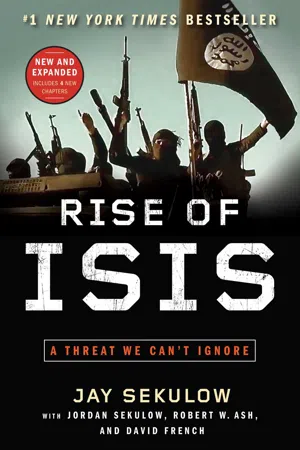
Rise of ISIS
eBook - ePub

Rise of ISIS

A Threat We Can't Ignore

  1. 144 pages
  2. English
  3. ePUB (mobile friendly)
  4. Available on iOS & Android
eBook - ePub

Rise of ISIS

A Threat We Can't Ignore

About this book

THE DEFINITIVE BOOK ON ISIS
Jay Sekulow, one of America's most influential attorneys, closely examines the rise of the terrorist groups ISIS and Hamas, explains their objectives and capabilities and how, if left undefeated, their existence could unleash a genocide of historic proportions. Recently, the world has been shaken by gruesome photos and videos that have introduced us to the now infamous terrorist group known as ISIS. The world's wealthiest and most powerful jihadists, ISIS originated within Al Qaeda with the goal of creating an Islamic state across Iraq and Syria and unrelenting jihad on Christians. Separate from ISIS, the terrorist group Hamas has waged an equally brutal war against Israel. Both groups, if left undefeated, have the potential to unleash a catastrophic genocide. Rise of ISIS gives a better understanding of the modern face of terror, andprovides an overview of the laws of war and war crimes. These laws differentiate between the guilty and innocent, and explain why the US military and the Israeli Defense Forces are often limited in their defensive measures.The authors' firsthand experience, including multiple appearances before the Office of the Prosecutor, International Criminal Court at The Hague, along with direct contact battling jihadists during operation Iraqi Freedom lends insight into this important geopolitical issue.A must-have for anyone who wants to better understand the conflict that exists in the middle east, this well-researched and fully annotated volume is invaluable in revealing how this new brand of terrorism poses a very real threat to Americans and the world at large. It also serves as a guide to what we as individuals—and as a nation—can do to stop this escalating violence, prevent jihad, and protect Israel and America from this imminent threat.
Frequently asked questions

Yes, you can cancel anytime from the Subscription tab in your account settings on the Perlego website. Your subscription will stay active until the end of your current billing period. Learn how to cancel your subscription.
No, books cannot be downloaded as external files, such as PDFs, for use outside of Perlego. However, you can download books within the Perlego app for offline reading on mobile or tablet. Learn more here.
Perlego offers two plans: Essential and Complete
  • Essential is ideal for learners and professionals who enjoy exploring a wide range of subjects. Access the Essential Library with 800,000+ trusted titles and best-sellers across business, personal growth, and the humanities. Includes unlimited reading time and Standard Read Aloud voice.
  • Complete: Perfect for advanced learners and researchers needing full, unrestricted access. Unlock 1.4M+ books across hundreds of subjects, including academic and specialized titles. The Complete Plan also includes advanced features like Premium Read Aloud and Research Assistant.
Both plans are available with monthly, semester, or annual billing cycles.
We are an online textbook subscription service, where you can get access to an entire online library for less than the price of a single book per month. With over 1 million books across 1000+ topics, we’ve got you covered! Learn more here.
Look out for the read-aloud symbol on your next book to see if you can listen to it. The read-aloud tool reads text aloud for you, highlighting the text as it is being read. You can pause it, speed it up and slow it down. Learn more here.
Yes! You can use the Perlego app on both iOS or Android devices to read anytime, anywhere — even offline. Perfect for commutes or when you’re on the go.
Please note we cannot support devices running on iOS 13 and Android 7 or earlier. Learn more about using the app.
Yes, you can access Rise of ISIS by Jay Sekulow,Jordan Sekulow,Robert W Ash,David French in PDF and/or ePUB format, as well as other popular books in Politics & International Relations & Global Politics. We have over one million books available in our catalogue for you to explore.

CHAPTER ONE

THE HORROR OF JIHAD

It was the video no one wanted to see, that few people could bear to watch.
A young American, James Foley, was on his knees next to a masked, black-clad jihadist. The jihadist was holding a knife. Foley began reciting a prepared text—delivered under the ultimate duress—condemning America. When he finished, he visibly braced himself.
We all knew what was coming.
The Foley beheading video was too graphic for YouTube. Twitter banned users who tweeted its horrific images. And while few Americans actually watched the horrifying act, everyone knew what happened.
It was ISIS, a new and horrifying jihadist force that had been unleashed in the Middle East. And now they had slaughtered an American.
Except ISIS wasn’t new. These horrible images weren’t unusual.
Some of us had seen them before.
¡ ¡ ¡ ¡ ¡
The DVD was lying in the dust.
Still weary from a midnight air assault where they’d attacked enemy-held objectives for hours throughout the evening and early morning, the troopers of the Second (“Sabre”) Squadron, Third Armored Cavalry Regiment almost missed the evidence as they searched an abandoned village south of Balad Ruz, Diyala Province, Iraq.
The village may have been abandoned, but people had recently been there. Clothes were scattered on floors, cars and trucks were still parked outside homes, and there was blood, lots of blood. And it seemed fresh.
It was a chilling sight. Soldiers stepped gingerly over children’s sandals and little girls’ dresses. They walked past bullet holes in walls, and they picked up cell phones left lying on tables in one- and two-room houses.
Our soldiers looked for anything that would provide a clue to the fate of the villagers, but the more experienced knew they were looking for one item in particular—a DVD.
In many ways, the DVD was a jihadist’s calling card, his method of bragging about his deeds in the years before smartphones and instant YouTube uploads. Terrorists would compile “greatest hits” compilations, showing IED strikes on Americans, mass executions of Iraqis, and the detonation of suicide bombs. DVDs were so common that our soldiers were trained to expect an imminent attack if a civilian was spotted filming them with a video camera.
And there it was, in a courtyard, in plain view. The troopers picked it up and kept it safe until it could be airlifted out, along with fourteen terrorist detainees, to Forward Operating Base Caldwell, a small American base just miles from the Iranian border.
As soon as the DVD arrived, intelligence officers rushed it to their office, put it on computers set aside for reviewing terrorist material (which could always contain viruses or other malware), and started watching.
What they saw was nothing short of horrifying.
As with all jihadist videos, the camera work was shaky, and the sounds were chaotic and loud. While the cameraman yelled “Allahu Akhbar!” (God is great) into the microphone, a group of about thirty Iraqi men, women, and children were led at gunpoint into a field, a field our soldiers recognized as being near the abandoned village.
One by one, the Iraqis were separated from the group and placed in the middle of a small group of jihadists. The first one was a woman, not more than forty years old. As the camera zoomed in, she had a vacant, hopeless look in her eyes—a look of utter despair.
The shouts of “Allahu Akhbar!” intensified until they all blended into one long, loud cheer, like the frenzy after a goal is scored at a soccer match. Then—as the shouting reached its peak and the camera zoomed close—the terrorists beheaded the woman.
They didn’t do it with a clean chop of a sword like one sees on television or in movies, but instead by sawing furiously through her neck with knives. It wasn’t over immediately. As she choked on her own blood, the jihadists kept sawing, and sawing, and sawing.
Finally, they pulled her head off, waved it to the camera, shouted in victory, and motioned for the next terrified victim to come forward.
How do we know this event occurred—one the mainstream media never knew about or reported? Because one of the authors of this book, a member of the American Center for Law and Justice (ACLJ) Law of War team who was deployed to Iraq at the time, saw the video with his own eyes. He walked through the streets of that village himself, stepping over bloody clothes. And he remembers. In fact, he can never forget.
What was the name of that terrorist organization?
Al-Qaeda in Iraq, or AQI.
And after al-Qaeda rejected AQI because of tactics such as this, tactics so depraved and brutal that they even repulsed al-Qaeda leader Osama bin Laden, what did AQI become?
The Islamic State of Iraq and Syria.
It became ISIS.
¡ ¡ ¡ ¡ ¡
The sirens were some of the loudest noises I’d ever heard. They blasted apart the stillness of the day, assaulted my eardrums, and made me involuntarily duck.
I was in Israel in 2008, just outside of the Hamas-held Gaza Strip. As chief counsel of the American Center for Law and Justice, I was there (along with my son and coauthor of this book, Jordan) to meet with Israeli officials to discuss a response to utterly frivolous claims that Israel’s acts of self-defense against Hamas constituted “war crimes.”
To help us make our case, I wanted to see Gaza with my own eyes, to see what life was like in southern Israel under rocket fire.
I got more than I bargained for.
When the warning siren went off, I knew I was safe. I was in a command bunker, meeting with key Israeli leaders. But my immediate thought wasn’t for my own safety; it was the same thought any father would have in the same circumstance.
“Where’s Jordan?”
“Where’s my son?”
He hadn’t come down to the command bunker. Instead, he was outside, waiting, while I finished my meeting. From the moment the siren sounded until the moment the rocket hit, he had fourteen seconds to get to safety.
Those were the longest fourteen seconds of my life.
The rocket arced high into the air over Gaza. The Hamas rockets were less powerful back then, but the Iron Dome system that protects Israeli civilians today did not exist.
In other words, that rocket wasn’t going to be shot down. It was going to land, somewhere close to us. Somewhere close to Jordan.
It hit seventy-five yards from my son. By the grace of God, the angle of the impact combined with the shape of the charge drove the blast away from Jordan. He was unharmed.
But for a few terrifying seconds, I lived the reality of Israeli fathers and mothers—someone was trying to kill my child.
Not just trying, but exerting maximum possible effort.

Hamas has sworn not just to destroy Israel, the world’s only Jewish nation, but to kill Jews, to slaughter them. Its intentions mirror those of Hitler, even if its forces are not yet capable of the same kind of destruction.

That is life in southern Israel in the shadow of Hamas, a terrorist organization that digs tunnels with openings near homes and schools. The tunnels are designed to allow squads of terrorists to run out, kill, or capture sleeping families, and dash back to Gaza before even the most rapid-reacting and elite soldiers of the Israel Defense Forces can respond.
Hamas kidnaps and murders children, sends suicide bombers to restaurants, and summarily executes anyone it believes has ties to Israel.
Hamas hides its rockets and bombs in schools and mosques, builds tunnels under United Nations facilities, and often surrounds its fighters with children and other civilians, using them as human shields. It hopes that Israel will either refrain from firing on known terrorists or that, if Israel does fire, enough children will die for the world to express outrage against Israel. In other words, this organization launches rockets hoping to kill children, and when Israel responds, it does all it can to make sure that only Palestinian children die.
Either way, the goal is to kill the most innocent and vulnerable.
Hamas has sworn not just to destroy Israel, the world’s only Jewish nation, but to kill Jews, to slaughter them. Its intentions mirror those of Hitler, even if its forces are not yet capable of the same kind of destruction.
It seeks arms from Iran (as Iran is busy building a nuclear bomb), it backs jihadists in Syria, and it is—bizarrely enough—cast as a heroic freedom fighter by millions of Europeans and even a distressing number of Americans.
¡ ¡ ¡ ¡ ¡
The goal of this book is simple: to understand the horrific jihadist threat to Christians and Jews in the Middle East, a threat that will undoubtedly come to the United States if it is left unchecked abroad. Through ISIS and Hamas, Christians and Jews face a wave of persecution and violence that is, quite simply, genocidal in scope and intent. But the situation—while grave—is not hopeless. Unlike in dark times before, America actually has strong allies on the ground, willing to take the fight to the jihadists. Even Israel isn’t as alone as it has been, with Egypt proving to be even more helpful at times than the Obama administration. In other words, the means exist to stop genocide—if only we have the will to use them.
Let’s begin with ISIS. As of the writing of this book, the terrorists of ISIS—once known as al-Qaeda in Iraq—control territory as large as an entire nation-state, with much of northern Syria and northern Iraq under its control. It is threatening Baghdad and the Kurdish capital city of Erbil, and it recently controlled (and still threatens) a poorly constructed dam near Mosul (one of Iraq’s largest cities). If that dam is blown, it would drown an entire region in a wall of water, killing hundreds of thousands.
ISIS is brutal beyond imagination to anyone—Christian, Jew, Yazidi, and even Shiite Muslim—who is not aligned with its jihadist form of Sunni Islam. In Syria, ISIS has slaughtered Shiites, Christians, and Alawites (an obscure Islamic sect). In Iraq, it has done the same, giving Christians in conquered territories a chilling ultimatum: “Convert, leave your homes, or die.”
Tens of thousands of Christians have fled. ISIS fighters have marked their homes and businesses in much the same way that Nazis marked the Jews of Germany and occupied lands, using an Arabic symbol that has come to mean “Nazarene”—a pejorative Middle Eastern term for Christians. They have sold Christian women as sex slaves, and there are numerous reports that they’ve beheaded children. None of this is a surprise. All of this is completely consistent with their behavior in Iraq when America previously fought them.
By late 2008, jihadists in Iraq were largely defeated, their leaders killed or captured, along with tens of thousands of their terrorist foot soldiers. Many had fled into Syria, and Iraq became a more stable and more humane place to live than it was when America invaded in 2003.
But now, only six years later, ISIS is stronger than any jihadist group in world history. Americans have long—and rightly—feared al-Qaeda. After all, it carried out the most devastating attack ever on American soil. But if we have feared and fought al-Qaeda, consider the following facts about ISIS:
• ISIS is more brutal than al-Qaeda, so brutal that al-Qaeda tried to persuade ISIS to change its tactics.1
• ISIS is the “world’s richest terrorist group.”2
• ISIS controls more firepower and territory than any jihadist organization in history.3
• ISIS has reportedly seized “40kg of radioactive uranium in Iraq,” raising fears that it could construct a “dirty bomb” that could spread deadly radiation in the atmosphere, rendering entire areas uninhabitable and killing or sickening everyone within the radius of its radiation cloud.4
And as if that weren’t enough, ISIS’s leader, Abu Bakr al-Baghdadi, reportedly told his American captors as he was released (we briefly detained him during the Iraq War), “I’ll see you guys in New York.”5 And now an ISIS spokesman has pledged to raise the black flag of jihad over the White House.6
ISIS is not the only radical terrorist group in the Middle East. While al-Qaeda still has a presence, Hezbollah threatens Israel in the north, and myriad other terrorist groups fight in Syria, Yemen, Lebanon, and elsewhere. But the one terrorist organization that is making a concerted, daily effort to kill as many Jews as possible is Hamas, the rulers of the Gaza Strip.
Why focus on ISIS and Hamas? Aren’t they separate organizations fighting separate enemies? After all, Hamas—a designated terrorist organization under U.S. law—focuses its efforts on Israel while ISIS is fighting virtually everyone except Israel. It has launched attacks (moving from west to east) in Lebanon, Syria, and Iraq, and its fighters are now turning up in Iran.
But it is a mistake to think of these groups as entirely separate. Indeed, they are motivated by the same hate, the same faith, and employ many of the same tactics. But they share something else in common, something strategically significant: they do not want to just spread terror; they want to establish terror-run nation-states, permanent bases from which to wage unrelenting jihad.7
In fact, the organizations are so similar in goals and tactics that one has only to look to the Christians of Iraq to see what would happen to t...

Table of contents

  1. Cover
  2. Disclaimer
  3. Foreword
  4. Chapter One: The Horror of Jihad
  5. Chapter Two: The Rise of Isis and the New Caliphate
  6. Chapter Three: ISIS: The World’s Most Ruthless and Powerful Jihadist Army
  7. Chapter Four: Hamas: Architects of Eternal Jihad
  8. Chapter Five: Hamas: Israel’s Most Relentless Enemy
  9. Chapter Six: Hamas Creates a Unity Government with Fatah, Then Launches War
  10. Chapter Seven: Waging Lawfare: The U.N. Tries to Transform Our Soldiers into War Criminals
  11. Chapter Eight: The 2014 Gaza War: Who Are the Real War Criminals?
  12. Chapter Nine: Hamas Systematically and Intentionally Violated the Law of War
  13. Chapter Ten: The Stakes Could Not Be Higher
  14. Chapter Eleven: Oppose, Don’t Appease: The Way Forward Against Jihad
  15. Chapter Twelve: New Update: ISIS Is Expanding
  16. Chapter Thirteen: ISIS Is Vulnerable
  17. Chapter Fourteen: Turkey: The Powerful Wild Card
  18. Epilogue: The Cost of Stalemate
  19. Acknowledgments
  20. Link to a Song by the Jay Sekulow Band
  21. Notes
  22. Copyright