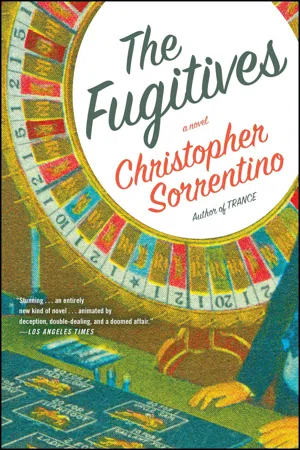
The Fugitives
eBook - ePub

The Fugitives

  1. 336 pages
  2. English
  3. ePUB (mobile friendly)
  4. Available on iOS & Android
eBook - ePub

About this book

"A mischievously funny, keenly incisive, and mind-bending outlaw tale" ( Booklist, starred review) about love and obsession, loyalty and betrayal, race and identity, and compulsion and free will. Writer Sandy Mulligan is in trouble. To escape his turbulent private life and the scandal that's maimed his public reputation, he's retreated from Brooklyn to a quiet Michigan town to finish his long-overdue novel. There, he becomes fascinated by John Salteau, a native Ojibway storyteller who regularly appears at the local library.But Salteau is not what he appears to be—a fact suspected by Kat Danhoff, an ambitious Chicago reporter who arrives to investigate a theft from a local Indian-run casino. Salteau's possible role in the crime could be the key to the biggest story of her stalled career. Bored, emotionally careless, and sexually reckless, Kat's sudden appearance in town immediately attracts a restive Sandy. All three are fugitives of one kind or another. And in their growing involvement, each becomes a pawn in the others' games—all of them just one mistake from losing everything.Moving, funny, tense, and mysterious, The Fugitives is at once a love story, a ghost story, and a crime thriller. It is also a cautionary tale of twenty-first century American life—a meditation on the meaning of identity, on the role storytelling plays in our understanding of ourselves and each other, and on the difficulty of making genuine connections in a world that's connected in almost every way. Exuberantly satirical, darkly enigmatic, and completely unforgettable, The Fugitives is "an entirely new kind of novel with exceptional interior monologues animated by deception, double-dealing, and a doomed affair that lends an air of existential dread to the story" ( Los Angeles Times ).
Frequently asked questions

Yes, you can cancel anytime from the Subscription tab in your account settings on the Perlego website. Your subscription will stay active until the end of your current billing period. Learn how to cancel your subscription.
No, books cannot be downloaded as external files, such as PDFs, for use outside of Perlego. However, you can download books within the Perlego app for offline reading on mobile or tablet. Learn more here.
Perlego offers two plans: Essential and Complete
  • Essential is ideal for learners and professionals who enjoy exploring a wide range of subjects. Access the Essential Library with 800,000+ trusted titles and best-sellers across business, personal growth, and the humanities. Includes unlimited reading time and Standard Read Aloud voice.
  • Complete: Perfect for advanced learners and researchers needing full, unrestricted access. Unlock 1.4M+ books across hundreds of subjects, including academic and specialized titles. The Complete Plan also includes advanced features like Premium Read Aloud and Research Assistant.
Both plans are available with monthly, semester, or annual billing cycles.
We are an online textbook subscription service, where you can get access to an entire online library for less than the price of a single book per month. With over 1 million books across 1000+ topics, we’ve got you covered! Learn more here.
Look out for the read-aloud symbol on your next book to see if you can listen to it. The read-aloud tool reads text aloud for you, highlighting the text as it is being read. You can pause it, speed it up and slow it down. Learn more here.
Yes! You can use the Perlego app on both iOS or Android devices to read anytime, anywhere — even offline. Perfect for commutes or when you’re on the go.
Please note we cannot support devices running on iOS 13 and Android 7 or earlier. Learn more about using the app.
Yes, you can access The Fugitives by Christopher Sorrentino in PDF and/or ePUB format, as well as other popular books in Literature & Literature General. We have over one million books available in our catalogue for you to explore.

Information

PART 1

Images

CODE SHIFTING

Images
Images

1

STORY time is at eleven, the preschoolers and their mothers, mostly the mothers; the occasional father looking faintly uncomfortable with his kid, as if he’d been asked to monitor an unfamiliar piece of equipment; sometimes babysitters, unhurried grandpas, older siblings icy with shame. Tuesday and Thursday mornings they arrive and cluster around the bronze bear, its paws, snout, and ears worn smooth and dull, to listen. Before John Salteau began, a few months ago, to tell stories twice each week at the library (ā€œTricksters and Sleeping Bears: Native Tales from Northwestern Michigan with John Salteauā€), they had a woman whose pedantic cheer fooled none of the kids: sung and shouted drills involving colors, numbers, the names of household objects. She drove up once a week from Frankfort with a steel-string guitar and a cinnamon-colored puppet named Ginger and played to a half-empty room every time. Now she’s gone. Salteau invariably fills the place.
I began to sit in the library some mornings because I like the stripped tone; the clean isolation of the footfalls and the scraping of chairs against the floor, the stillness in which other people’s most perfectly ingrained habits are encased and displayed. This one wets his index finger. This one moves her lips. Nose pickers and foot tappers. Plus it’s a nice place to come to rest in the middle of my morning circuit, when the work is done or (more likely, these days) stalled and I leave home to walk the arboreal streets (my house is between Oak and Maple; nearby are Cedar, Pine, Locust, Elmwood) or wander onto the nearby grounds of the former lunatic asylum, now a curiously mournful park.
If I arrive at the library before eleven, I’ll wait. There’s no other feeling like that of the restraint in a quiet room filled with people. Conditional unity, breached under the duress of petty bodily betrayals, farts and sneezes. The heads come up, mildly curious, then fall once more to the printed lines. One time, a middle-aged man, in a suit and tie, sat energetically turning the pages of the Record-Eagle, as if he were scanning it for a particular item: he was gently urged from the premises by a library employee who bent close to whisper to him, laying a quieting finger on the pages of newsprint. The man left, striding through a watchful silence, his newspaper abandoned on the table.
I haven’t listened to an adult tell stories to an audience of children since I was a child myself, but I’m not surprised to find that I’m calmed and reassured by it, the voice an ember glowing and changing in the midst of a muted stillness that might itself ignite at any moment. The boundaries inherent in performance are there, but there’s also an ambiguity, an offhand sense of collaboration. That regular glimpse of the inventive tension latent in those quiet, crowded spaces, when the voice begins speaking, and especially when it pauses and the room falls into its willed hush once again, is one part of what holds me in my seat in the children’s library (rather, ā€œYouth Services Departmentā€) twice a week. The other part remains a mystery to me.
Images
DYLAN FECKER TOLD me on the phone, ā€œA kids’ library? What it sounds like to me is that you miss going out. He misses going out.ā€ I’m a writer, and Dylan is my agent. To him, a panicked social life is the sole bellwether of mental health. In confusion he finds relief. Only his phone knows what he’s scheduled to do next. Without it, he might starve, freeze, wander mistakenly onto public transportation.
ā€œI go out all the time,ā€ I said. ā€œThe whole place is mostly out. Here, outside is the default. Indoors is shelter.ā€
ā€œWhen I say ā€˜going out,’ you know what I mean. And you miss it. Why can’t you just say that? Why can’t he just say what he means for once? Quicker and less confusingly? These are the big questions people want answers to. People are always waiting for him to say what he means, and then he says it, and Monte and I have to clarify.ā€ Monte is my editor.
ā€œWhat do you tell them?ā€
ā€œThat it’s all about getting to the center of the human heart. But you can thank me later. Are you writing? He’s not writing.ā€
ā€œI would be.ā€
ā€œHe’s being smart. Don’t be smart. I’ve tried calling you when you’re really working: you can’t wait to get rid of me. Lately you’re lingering. Lately you want to talk.ā€
ā€œOh, is that what you’re getting?ā€
ā€œDon’t be smart, I said. You’re not writing. I admit I made a big mistake letting you move out there all by yourself. I said, he’s a big boy. Was I wrong.ā€
ā€œYou weren’t wrong. I took my temperature this morning. Totally normal. Sent myself off to school, kicking and screaming.ā€
ā€œHa ha ha. Listen. You went out there, you said you wanted quiet. I say OK, he needs to turn it down for a while. I understand. I saw how the last couple of years were going for you, for you and Rae. And that terrible business with Susannah. Ordinarily, I wouldn’t rush you. But Monte is eager to see pages. They’re tracking you. Where is he with it, is the general tenor of things.ā€
Dylan had allowed his sense of romance to persuade him that there was something valuable, even narratively inevitable, in my leaving New York to come to northern Michigan and finish a book. It seemed right to him, right and just, that a gifted person should flee from the distractions and temptations of a big city, flee from the difficulties of a complicated personal life, to make art in self-imposed exile, working from the provinces. If some artists court outrage, others court solitude: it was a chunk of wisdom as simple as a popcorn date at the multiplex. He expected searingly brilliant, expiatory pages to flow one way, direct from my computer to his office on Mercer Street. That was the agreement, as far as he was concerned. That, he claimed, was what had kept him from going to the airport and wrestling me off the plane personally. It wouldn’t have helped at all to explain to him that I didn’t feel purposeful, I felt dangerously adrift; that escape wasn’t a strategic writerly ploy but simply and only escape. For Dylan there was no such thing as flight. He stayed, he survived, he thrived. He’d had some successes; I was one of them; I was letting him down. This much was clear. The fierce pages weren’t erupting from my printer, weren’t springing to life on his 24-inch active matrix display as unencrypted digital attachments. Exile and cunning he would accept, silence was another story.
ā€œJust get out of the house once in a while. Better yet, come back to Brooklyn and then get in a cab or whatever it is you people have there and come to Manhattan to talk to me in person. I just don’t get what you’re doing.ā€
ā€œIt’s all about getting to the center of the human heart.ā€
ā€œPlease. They don’t have what you need to be human out there.ā€
ā€œThey have enough,ā€ I said. ā€œIt feels close.ā€
ā€œHow close?ā€
Images

2

I RENT a bungalow here in Cherry City that’s much too big for me alone, though it’s a modest house. If my children lived here with me, we’d fill it, but they don’t and I doubt they’ll ever visit. But I hadn’t been thinking about my children, about accommodating my children, when I was looking for a place. It had been a long time since I’d lived in a house, and I had an idea that I’d enjoy the garden, which I watched die in the waning days of summer, after I’d pulled the last of the landlord’s ripe tomatoes from the staked vines in the backyard; that I’d like sitting on the front porch in the evenings, which I did until the weather began to cool. Moving in was like adapting to any other change in one’s material condition. Things I liked, things I didn’t. I didn’t like the feeling of being exposed, and locked the doors and pulled the curtains in the evening. I didn’t like the sounds the house made at night, settling into whatever new shape another day’s use had beaten it into. I did, though, like having a driveway to park in, a kitchen door to tote groceries through. I did like having a washer-dryer. These ordinary things were a quiet rebuke to the proud lunacy of the assumed inconvenience that marked life in Brooklyn. The sound of tumbling laundry, zippers pinging against the steel drum of the dryer, coming to me as I sat not in a molded plastic chair in a drafty laundromat, vigilantly guarding my socks and shorts, but in my own living room, could fool me into believing that this was the solution; that it addressed all my problems in their entirety.
Images
I ARRIVED HERE after I walked out of my wife’s apartment, the home of my wife and children, with no more than I could easily carry. It was the second time I’d done it. This time it was a mutual decision: You leave now, Rae said, and I did. What about it, about any of it, could possibly have come as a surprise to either of us? While remaining supremely mindful of the consequences, we’d failed spectacularly. There weren’t any protests or reconsiderations.
Prior to that, during our period of reconciliation, after the disaster of Susannah, Rae and I had been traveling once a week to the Upper West Side to see a counselor, a Dr. Heinz. Because it was the sensible thing, the requisite approach, the one reference to our catastrophe that actually could acceptably be made in public. Unfortunately, Dr. Heinz’s reassuringly Viennese-sounding name was only a front for a tall, athletic-looking fiftyish guy in Birkenstocks, chinos, and open-necked Oxford shirts who spoke in the gently twanging tones of the upper midwest.
Heinz’s office, which never failed to distract me, was as bland and unassuming as the man himself. He had a large sofa patients were to sit on, and although there was also a green armchair and matching ottoman (which together were much too big for the room), he always faced us in a swivel chair, sitting hunched forward to listen, his elbows resting on his thighs. His posture made me feel as if we’d interrupted him. If Dr. Heinz had rotated his chair 180 degrees, he would have been facing a small desk with a computer on it. A small bookcase held a selection of professional journals. His framed diplomas and certificates hung unobtrusively, in a vertical line, along one margin of the wall in which the windows were set. On the other walls were somewhat gloomy abstract watercolors—paintings that, with their vestiges of figuration, their seeming resistance to the depiction of gesture in their dark brushwork, struck me, for some reason, as ā€œEuropean-looking.ā€ The parquet floor wore a large, rectangular melon-colored chunk of deep-pile carpet. It was the Segal lock on the door, though, that preoccupied me the most. Was it supposed to keep the contents of the room secure? Or him?
Dr. Heinz’s prescription involved rigid accounting, argument and rebuttal restricted to narrowly drawn subjects and constrained by inflexible time limitations. He directed us to extend this metered form of interchange beyond his office, urging us to trump spontaneity by actually scheduling these arguments, no less frequently than three times a week, to take place at appointed, mutually convenient times.
I felt—well, what I said to Rae one afternoon as we walked from his office to the subway was ā€œIt would be more constructive if he told us to fuck every other day.ā€ She smiled at me sadly, and took my hand in hers. ā€œYou should tell Dr. Heinz that,ā€ she said, in perfect seriousness.
I nodded: of course we would need his permission. Susannah was supposed to have been my break for the open space beyond the everyday; now I felt—reflexively, and without Heinz ever having suggested such a thing—that I required approval for the smallest and most personal decisions. In the white light of disclosure, I believed that I didn’t care what other people thought. But it had turned out they thought so many things about my affair, about my marriage, about me; and in the end I had cared, and after Susannah and I disintegrated I returned to a marriage that had become public property.
Despite my doubts about Heinz’s strategy—his demands that we become conditioned to behaving in a way remote from our instincts; that we pretend to be angry when we weren’t, and pretend not to be angry when we were; that we behave with restraint when we wanted to scream, and that we confront each other when all was tranquil—it actually wasn’t a stupid plan. I don’t consider myself a man who yields automatically to convention, but I stop at the crosswalk when the light is red. If there’s any greater exhibit of the malleability of human nature than the sight of someone standing, absently waiting for the light to change at a deserted intersection, I don’t know what it is. Yet that someone never is run over. Heinz made a kind of sense.
Unfortunately, for all the sense made by his plan to teach us to talk reasonably to each other, the only person I thought about making it work with was Susannah, with whom I’d been disastrously unable to discuss anything of significance and with whom I could now discuss nothing at all. I kept it to myself: Heinz had taken each of us aside during our first session to ask if either of us had any secrets from the other and I knew instantly that I would have to exempt thought-crimes from disclosure. My rehabilitation depended on the complete repudiation of Susannah. I knew, anyway, that Heinz didn’t want any complexifying confidences to deal with. ā€œI don’t do breakup counseling,ā€ he’d advised from the outset, like a lawyer who takes on only the cases that he can win. Rae had chosen him carefully. Everyone was pulling for us; now even our doctor was insisting that we had no choice but to be cured. And so I claimed to have left Susannah behind, reciting to myself, and to anyone who’d listen, all the good reasons why I couldn’t possibly love her. It’s a familiar ruse, a good idea, never entirely convincing. But it tortured me to erase e-mails and photos from my hard drive. I never got around to deleting her number from my cell phone. Plus the sheer physical difficulty of making people’s traces vanish as completely as they themselves have. Here’s this blue T-shirt that Susannah gave me. A stupid keychain that I’d bought in a stall on the Ponte Vecchio with her. A car rental receipt falling from between the pages of a Graham Greene novel. Make, Pontiac. Model, Grand Prix. Odometer out, 13,556 miles. Destination, some motel in Santa Barbara where I fucked Susannah day and night, getting her smell into my pores, her taste into my mouth. The book was The Power and the Glory. I actually finished it on that trip, though I have no idea when I made the time. I fucked her like I wanted to climb inside her. I fucked her like I wanted to smash through the atomic structures dividing us into two separate beings. I fucked her like tomorrow they were coming to flay me, eviscerate me, castrate me, and nail my genitals to a board in the town square. The power and the glory indeed. What was this response? Biochemistry? Obsession? I played along with Dr. Heinz when he suggested, with smug self-assurance, that strong bonds grew from mutual respect, mutual communication, mutual goals, mutual commitment to compromise. There he was, delivering the mission statement of the Working Families Party, and all I could think about was Susannah’s pussy: her pussy cradled in lace; her pussy framed inside the rectangle formed by garter belt, stocking tops, and garter belt fasteners; her pussy gaping and wet; her pussy when my face was pushed into it. I thought about the way her pussy felt when it was tightly gripping my cock and the way her pussy felt when I reached over the hump of her perfect ass to stick my fingers in it while she went down on me. I knew I couldn’t speak rationally about any of it. One reason for bodily taboos is simply to restrain people from trying to express themselves on subjects such as these. It would have been possible to form a cult of one around Susannah’s pussy, with all of a fringe theology’s gorgeous blind-alley symmetries. There will never be a utopia on earth as long as each of...

Table of contents

  1. Cover
  2. Dedication
  3. Epigraph
  4. Salteau
  5. Part 1: Code Shifting
  6. Part 2: The Eternal Silence of Infinite Spaces
  7. Part 3: Attachment Theory
  8. Part 4: Smartberries
  9. Orbital Resonance
  10. Part 6: Without Shadows
  11. Acknowledgments
  12. About the Author
  13. Copyright