The One True Barbecue
eBook - ePub

The One True Barbecue

Fire, Smoke, and the Pitmasters Who Cook the Whole Hog

  1. 288 pages
  2. English
  3. ePUB (mobile friendly)
  4. Available on iOS & Android
eBook - ePub

The One True Barbecue

Fire, Smoke, and the Pitmasters Who Cook the Whole Hog

About this book

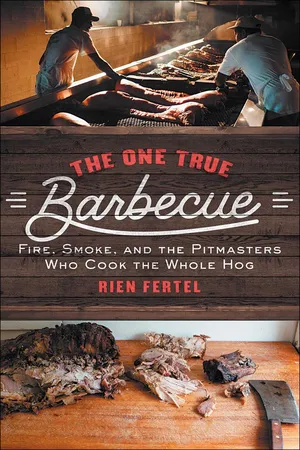
"For anyone interested in the origins, history, methods and spectacle of whole-hog barbecue, this book is essential reading...Fertel leaves readers hungry not only for barbecue but also for the barbecue country he so engagingly maps" ( The Wall Street Journal ). In the spirit of the oral historians who tracked down and told the stories of America's original bluesmen, this is a journey into the southern heartland to discover the last of the great roadside whole hog pitmasters who hold onto the heritage and the secrets of America's traditional barbecue.In The One True Barbecue, Rien Fertel chronicles the uniquely southern art of whole hog barbecue—America's original barbecue—through the professional pitmasters who make a living firing, smoking, flipping, and cooking 200-plus pound pigs.More than one hundred years have passed since a small group of families in the Carolinas and Tennessee started roasting a whole pig over a smoky, fiery pit. Descendants of these original pitmasters are still cooking, passing down the recipes and traditions across generations to those willing to take on the grueling, dangerous task. This isn't your typical backyard pig roast, and it's definitely not for the faint of heart. This is barbecue at its most primitive and tasty.Fertel finds the gatekeepers of real southern barbecue-including those we tend the fire at legendary spots like Bum's, Wilber's, Sweatman's, Grady's, the Skylight Inn, and three different places named Scott's-to tell their stories and pay homage to the diversity and beauty of this culinary tradition. These pitmasters are now influencing a new breed of chefs and barbecue enthusiasts from Nashville to Brooklyn.To quote Serious Eats: The One True Barbecue is " One damn good book about American barbecue."
Frequently asked questions

Yes, you can cancel anytime from the Subscription tab in your account settings on the Perlego website. Your subscription will stay active until the end of your current billing period. Learn how to cancel your subscription.
At the moment all of our mobile-responsive ePub books are available to download via the app. Most of our PDFs are also available to download and we're working on making the final remaining ones downloadable now. Learn more here.
Perlego offers two plans: Essential and Complete
  • Essential is ideal for learners and professionals who enjoy exploring a wide range of subjects. Access the Essential Library with 800,000+ trusted titles and best-sellers across business, personal growth, and the humanities. Includes unlimited reading time and Standard Read Aloud voice.
  • Complete: Perfect for advanced learners and researchers needing full, unrestricted access. Unlock 1.4M+ books across hundreds of subjects, including academic and specialized titles. The Complete Plan also includes advanced features like Premium Read Aloud and Research Assistant.
Both plans are available with monthly, semester, or annual billing cycles.
We are an online textbook subscription service, where you can get access to an entire online library for less than the price of a single book per month. With over 1 million books across 1000+ topics, we’ve got you covered! Learn more here.
Look out for the read-aloud symbol on your next book to see if you can listen to it. The read-aloud tool reads text aloud for you, highlighting the text as it is being read. You can pause it, speed it up and slow it down. Learn more here.
Yes! You can use the Perlego app on both iOS or Android devices to read anytime, anywhere — even offline. Perfect for commutes or when you’re on the go.
Please note we cannot support devices running on iOS 13 and Android 7 or earlier. Learn more about using the app.
Yes, you can access The One True Barbecue by Rien Fertel in PDF and/or ePUB format, as well as other popular books in Geschichte & Nordamerikanische Geschichte. We have over one million books available in our catalogue for you to explore.

Information

Images

CHAPTER 1


Hungry

I make my stand upon pig.
—CHARLES LAMB
Though I was born and raised in the South, I grew up entirely barbecueless. My birthplace of Lafayette, Louisiana, the hub city of Cajun culture, occasionally harbored a franchise chain out of Texas or Tennessee, but none endured for very long or, for that matter, served up any meat that any self-respecting Texan or Tennessean would deem to be quality barbecue. Louisianans, especially those in Cajun country, are a people raised on the hog but not barbecue. A few links of boudin, a pork, rice, and spice-filled sausage, best eaten still warm while sitting on the hood of your car or truck, is my favorite snack. We consume plenty of cured pork products, like tasso, andouille, and smoked sausage. Although it’s a disappearing custom, Cajun families still gather for a harvest-season pig slaughter and curing called a boucherie that, accompanied by music, dancing, and too much alcohol, extends over a weekend. Elsewhere in Cajun country, men roast suckling pigs, called cochon de lait, or ā€œpig in milkā€ in French, a rite of spring in a handful of small towns.
Growing up in the suburbs, I hazily remember seeing a barbecue pit in the backyard of my family home, not that it saw much use. Neither of my two dads, my birth father nor my stepfather, fired up the Weber for a Sunday rack of ribs, much less to char-grill a hamburger. Not that my two brothers and I were raised on a meat-free diet. Because my mother managed a steakhouse, we were a beef family, spoiled with the riches of steak. I worked as a busboy at her restaurant throughout my teenage years, and, on a whim, I can still conjure up the scent of seared steaks sizzling in pools of molten butter, as if the essence of beef had seeped into my skin.
Throughout my college years, while living in New Orleans, on several occasions en route to concerts or to visit friends, I detoured through hellish Atlanta traffic for Styrofoam takeout trays of charred and fatty bones from Fat Matt’s Rib Shack. Later, and further afield, I road-tripped to the Hill Country surrounding Austin with the sole intent of tasting a half dozen or so sausages and beef briskets, each more fat capped and smoke ringed than the next, to round out a gluttonous vacation that was very nearly pleasurable enough to make me consider moving to Texas. Eventually, I moved up to New York for a graduate degree and dined at Blue Smoke, a posh Murray Hill–area restaurant that covered the breadth of the nation’s barbecue cultures, complete with a complementary wine list.
For me, barbecue, in all its forms, existed as a vague notion. Real barbecue truly remained a mystery, lingering, like smoke, at an intangible distance. But in the summer of 2008 I traveled throughout Memphis recording oral histories—capturing the narrative histories and the personal stories behind the food—as a freelancer for the Southern Foodways Alliance, a University of Mississippi–based organization devoted to, as their mission states, ā€œdocumenting, studying, and celebrating the diverse food cultures of the changing American South.ā€
I saw this documentary project as an opportunity to connect with my southern roots.

So there, in Memphis, I consumed as much barbecue as I could find: twice, three times, and, at least once, five times in a single day. I gnawed on the famous dry-rubbed ribs at Charlie Vergos’ Rendezvous, the downtown grande dame of barbecue restaurants. I snacked on barbecue nachos alongside college students at the crowd-pleasing Central BBQ. I guiltily gulped down a terrible chopped barbecue sandwich at an indoor shooting range, where Second Amendment advocates took practice shots at paper targets printed with the face of Hillary Clinton. I ate all the only-in-Memphis specialties: barbecue rib tips, barbecue bologna sandwiches, barbecue Cornish game hens, and barbecue spaghetti.
By the time I left Memphis I liked barbecue—certainly didn’t love it—and had eaten enough of the stuff to think that I understood it. To riff on T. S. Eliot’s ā€œThe Love Song of J. Alfred Prufrock,ā€ I had known smoked sausages, briskets, porks; I could measure out my life with plastic sporks. The art of barbecued meats seemed simple enough, I thought: meat meet heat.
But it was on a trip beyond the city to Siler’s Old Time BBQ in Henderson, Chester County, Tennessee, that I realized that, concerning barbecue, I didn’t know a damn thing.
I arrived at the barbecue house just in time to catch the yellow, rust-worn Chevy pickup back into a gravel-lined gap between the kitchen and the pit house. A single pale-pink trotter stuck out of the truck’s bed, pointing accusatorially at the driver and the concealed-carry weapon permit sticker on the back window. Ronnie Hampton dipped out of the cab and ambled toward me. He wore a camouflage baseball cap sunk low over half-open eyes and crooked nose, his tongue steadily rolled a toothpick, and he seemed to exist in a perpetual state of drowsy awareness that only old dogs can channel. He ignored my presence, my wide-eyed ogling of his truck’s cargo, and unlatched the tailgate to reveal three hogs stacked and shrink-wrapped in glossy black contractor-sized garbage bags. They looked so much like body bags—three Mafia-dispatched corpses ready for disposal in New Jersey’s Pine Barrens—that I had to remind myself that this was just barbecue.
This is just barbecue.
Except it was not the sort of barbecue I recognized to be barbecue: a rack of ribs smoking on the Weber grill; licking sugary sauce from sticky fingers; baseball, backyards, and the Fourth of July.
This was an animal. Still bleeding, though just barely.
I leaned in closer. Amidst a pile of spent Gatorade and beer bottles, a spare tire, and a length of weed-whacker twine, each body bag—imperfectly wrapped, or perhaps too small to hold the carcass—spilled out its contents of flesh and fat and blood. The hogs had been split along the spine, their internal organs and heads removed. The flabby neck meat, remaining attached to the right-side shoulder, hung flapping like a massive, fatty tongue against the truck’s bed. Raw meat met rust. Sanguinary fluids merged with a decade’s buildup of grease, tar, and mud.
There’s a reason geneticists and other biotechnologists believe that surgeons will soon be harvesting organs from genetically modified pigs for human transplantation: inside and out we are very much the same. These poor pigs looked remarkably human.
Alive and breathing just a couple of hours ago, the hogs still radiated heat, adding unwanted degrees to an already steamy July morning. The flies had arrived before I did, buzzing back and forth between the skin—patchily jaundiced and cantaloupe mottled—and the exposed flesh. Feasting.
Chris Siler came bursting out of the kitchen’s back doors with a knife in hand. The new owner of Siler’s Old Time BBQ, here in Henderson, Chester County, Tennessee, was as lumbering as Hampton was whip thin. Under a black chef’s apron he wore a red T-shirt and a pair of bright blue Wrangler overalls with oversized pockets.
Dragging the first hog to the tailgate’s lip, Siler tore open the plastic wrapping. With the pig on its back, he used his left hand to pry open the cavity. Wiping the sweat from his face, he then gently ran the blade, sinking no deeper than an inch, along where the animal’s backbone—now split in two—once united and divided the animal. As he reached the hog’s midsection, streams of blood began issuing from some unseen wellspring, pooling in one side of the curved rib cage. This pig had been alive earlier this morning. Sweat dripped from the tip of Siler’s nose and forehead, commingling with the blood.
He grabbed a trotter, and concentrating on his knife work—biting his tongue between teeth and lips—he rotated the blade around the midpoint of the hog’s four feet, marking superficial circular incisions into the skin. Ronnie Hampton reentered the scene, his black-gloved right hand holding a reciprocating saw. He had Siler’s five-year-old son in tow.
This was the exact moment young Gabriel came to see. As his father held down the hog’s bottom half, Hampton began grinding away at the front-left trotter. The saw spat out bone, blood, and sinew. Gabriel skipped around the truck, screaming, laughing, delighting in the joy of another pig getting made ready for the pit. He stopped to tell me—taking the lollipop from his mouth—that he could not wait until he was big and strong enough to lift a hog.
The saw and the meat, combined with the promise of smoke and fire, did more than excite a version of southern exoticism within me; these rituals unlocked a deeply held memory. I was instantly and quite uncomfortably put in mind of my mother, who, in one of my earliest recollections, I can see slashing through a short loin with an electric band saw. Her thriving steakhouse—this was before the days of prepackaged, Cryovaced steaks—cut the following day’s quota of New York strips, filets, and rib eyes. When any given employee became a no-show, my mom took up his position, even if that meant being the butcher. It was brutal, violent work, not maternal in the least. The next fifteen minutes went by in the blur and whine of the saw blade. By the time Gabriel had stopped reveling in the rendering of pig flesh, twelve disembodied trotters stood macabrely piled in the truck’s bed. I was sickened. I was thrilled. I was hungry.
I walked inside to order a barbecue sandwich.
Images
The dining room of Siler’s was a jumble of southern stereotypes, minus the rusted tin sign advertisements, worn farm equipment, and other vintage bric-a-brac that define the Cracker Barrel aesthetic. There were stacks of Wonder bread buns piled high along the painted cinder-block walls, a plastic plant in each corner, and squeeze bottles full of barbecue sauce on every table. On the walls, inspirational Christian curios mingled with pig iconography and family photographs. The Ten Commandments hung over the cash register. Most of the clientele had long passed the minimum AARP age, but that would be appropriate as Siler’s Old Time BBQ was Henderson, Tennessee’s last authentic barbecue joint and one of the last surviving wood-cooked whole-hog pit houses in the entire South.
I paid for my barbecue sandwich and took a seat at the table, brushing a sesame seed from the red-gingham-clothed table.
My sandwich appeared as a grease-slicked, wax-papered parcel speared with a toothpick. I unwrapped the barbecue bundle to find a rather sad-looking plain white hamburger bun leaking what appeared to be ketchup. Disappointed by what aesthetically amounted to fast food rubbish, I rotated the wax paper clockwise to get a look at the sandwich’s backside. There, teasingly poking through the two halves of bread, was a single, sly tendril of meat. Tossing the top bun aside, I uncovered a baseball-sized mound of mixed white and dark pork: thick, ropey strands of alabaster flesh curling serpentine around chunks of smoke-stained shoulder, some pieces of which still contained black-charred bits of skin. It was all smothered in a heavily pepper flecked coleslaw containing little else but chopped cabbage and ketchup.
Using my hands, I started forking the meat into my mouth. Each bite seemed to reveal a different part of the pig. I could discern, with tongue and teeth, the textural differences between the soft, unctuous belly meat and the firm, almost jerky-dry shoulder. The slaw added softly alternating rushes of sweet and heat to each smoke-tinged taste.
In Memphis I had eaten barbecue more times than I’d like to count, but this was the first time I truly tasted barbecue. Every bite transported me to a South I partially recognized but had never really known: a porky place, a swine-swilled space, a region where barbecue was ā€œever so much more than just the meat,ā€ as the southern historian and journalist John Egerton once penned. I was tasting history, culture, ritual, and race. I was eating the South and all its exceptionalities, commonalities, and horrors—a whole litany of the good, the bad, and the ugly. Everything I loathed and everything I loved about the region I called home.
This was not just barbecue, this was place cooked with wood and fire.
As I took another bite, while rolling this possible connection over in my mind, Chris Siler joined me at the table. ā€œI’ve been doing barbecue for a few years now,ā€ he announced by way of introduction, but also a testament to his expertise. He warned me that he talked too much, which he proceeded to do, not that I minded.
He grew up in the type of southern town where you know your history and won’t ever forget your last name—Silerton, the smallest incorporated town in Hardeman County, little more than a farm hamlet of a hundred or so residents, where, as he described, ā€œthey’re all kin to me one way or another.ā€ It was in those lean years following the Civil War that two sets of four brothers, eight Siler men and their accompanying Siler families, set out from Siler City, North Carolina, to resettle in the timber forests east of Memphis. They followed a previous generation of Carolinians who had trekked to west-central Tennessee following Andrew Jackson’s Native American removal policy. There, Silers begat more Silers. Eventually the Gulf, Mobile and Northern Railroad showed up, hungry for hardwood lumber. But it didn’t take long for the timber trade to dry up, the woodlands laid bare. The Silers traded forestry for hog and cattle farming.
Chris Siler was not born on a farm, he made sure to emphasize, but ā€œin between farms.ā€ His father long ago left the family trade to open an auto body shop in the nearby town of Bolivar, but still felt it important to expose the young Siler to the farm life, or, as he termed it, to ā€œlease outā€ his son. He’d pasture the cattle: separating calf from cow, keeping the land evenly grazed. For two weeks each winter he’d have to clean out the dairy barnā€”ā€œthe really nasty downsideā€ of it all.
The dividends from working on his uncle’s hog farm far outweighed those of the dairy. In the fall they would slaughter a hog. The hind legs would be sugar-cured and hung in the family’s old-fashioned smokehouse—honey hams for next year’s holiday season. The hand-crank grinder took care of the rest. ā€œThey would line me and my cousins up and every one of them would take a turn until their arm gave out.ā€ Two to three days were spent grinding the shoulders, loin, and belly; spicing the meat with red pepper; stuffing casings and forming homemade sausage links.
The whole time during our interview he exuded a buzz of boundless, youthful energy, politely excusing himself from the table to greet customers, fix sandwiches, herd his two young children away from my tape recorder, and warmly direct his employees. He appeared able to do all of these duties and more within just a minute’s time. This energy was matched with a serene religiosity. He hinted at a trouble-filled past—drugs, alcohol—and a born-again redemption. Now thirty-three years old, with a family and a business, he felt imbued with a purpose to serve barbecue and thank the Lord every day for the opportunity.
After I finished my sandwich, he jumped up to grab me a taste of what he called ā€œa happy accident,ā€ his latest experiment in sauce making. He returned holding a square tray laden with a pair of massive, fatty, meaty pork ribs. ā€œI had a goal when we opened up that I was going to change the ribs. I wanted something that would make our ribs stand out where it would be something that people would want more. Instead of just going back to using our regular sauce, I just decided one day I was going to get back here in the back and take a mixing bucket and see what happened.ā€ He started throwing ingredients in his plastic bucket: spices, vinegar, those elements found in a traditional barbecue sauce. Because sauces in West Tennessee are sugary, he needed some nectar. He wanted something different but familiar, a punch of sweetness that embodied this place and himself. Instead of reaching for the jug of corn syrup from Piggly Wiggly—the staple cheap sweetener for barbecue sauces across the nation—he sent an employee to C&R Grocery, the little country store and gas station across the street, to fetch a gallon of locally produced sorghum molasses. ā€œWhen I got done I had something that I really liked, and I cooked a rack of ribs and gave it away as samples and, you know, we had people standing at the counter sucking on the bone.ā€ Rib sales had nearly doubled since he changed the sauce recipe.
Golden lacquered, with meat separating from bone, the ribs looked so sticky, I got the feeling that if I looked at them too hard, my eyes would cement shut. They emanated a multidimensional perfume of rich sugars and that earthy medicinal funk common to sweet sorghum. This was not the syrup some southerners drizzle on their morning griddlecakes, according to Siler, but an industrial-strength molasses, colored ā€œnearly black. Very, very, very dark. Too dark and too thick to sell by itself. At room temperature it’s almost solid.ā€
This guy, these ribs are gonna be famous, I thought to myself. This approach—taking a locally sourced historical ingredient and pairing it with a conventional recipe—went beyond ordinary barbecue. This was some cheffy, Culinary Institute of America–trained, forward-type thinking, without any hint at trend surfing.
ā€œIt’s very expensive to make because of the sorghum,ā€ Siler said. ā€œThey make a year’s supply in the month of September. Now I’m out, and I’ve done run the country store across the road out, so I’m trying to get ahold of them to see if they had any leftovers still put up.ā€
Just in case, I swiped my finger across the surface of the paper tray until I had licked the plate clean.

Siler led me back outside. On the path to the smokehouse, he nodded toward his pitmaster, the man he referred to as his ā€œfull-time cook,ā€ and sighed, ā€œI wish I could find a way to pay him more.ā€ Ronnie Hampton sat in quiet repose on an upturned tree stump, staring at a boisterous fire, smoking a cigarette.
Tw...

Table of contents

  1. Cover
  2. Dedication
  3. Map
  4. Introduction: A Dying Breed
  5. Chapter 1: Hungry
  6. Chapter 2: The Ballad of Ricky Parker
  7. Chapter 3: The Once and Future King of Barbecue
  8. Chapter 4: The Prometheus of Pigs
  9. Chapter 5: A Pitmaster’s History of Barbecue
  10. Chapter 6: My Own Private Barbecue
  11. Chapter 7: Ricky Parker Builds a Legacy
  12. Chapter 8: South Carolina: The Battleground State
  13. Chapter 9: Will Success Spoil Rodney Scott?
  14. Chapter 10: Brooklyn and Beyond
  15. Chapter 11: Come July, 100 Whole Hogs
  16. Epilogue: My One True Barbecue
  17. Photographs
  18. Acknowledgments
  19. Selected Sources
  20. About Rien Fertel
  21. Copyright