Iron Dawn
eBook - ePub

Iron Dawn

The Monitor, the Merrimack, and the Civil War Sea Battle that Changed History

  1. 416 pages
  2. English
  3. ePUB (mobile friendly)
  4. Available on iOS & Android
eBook - ePub

Iron Dawn

The Monitor, the Merrimack, and the Civil War Sea Battle that Changed History

About this book

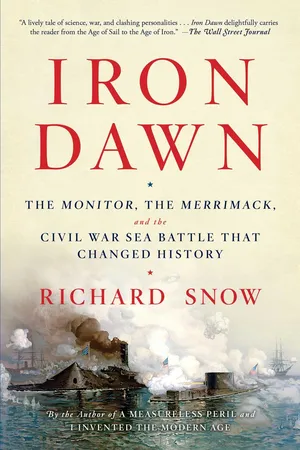
"An utterly absorbing account of one of history's most momentous battles" ( Forbes ) that not only changed the Civil War but the future of all sea power—from acclaimed popular historian Richard Snow, who "writes with verve and a keen eye" ( The New York Times Book Review ). No single sea battle has had more far-reaching consequences than the one fought in Hampton Roads, Virginia, in 1862. The Confederacy, with no fleet of its own, took a radical step to combat the Union blockade, building an iron fort containing ten heavy guns on the hull of a captured Union frigate named the Merrimack. The North got word of the project, and, in panicky desperation, commissioned an eccentric inventor named John Ericsson to build the Monitor, an entirely revolutionary iron warship. Rushed through to completion in just one hundred days, it mounted only two guns, but they were housed in a shot-proof revolving turret. The ship hurried south from Brooklyn, only to arrive to find the Merrimack had already sunk half the Union fleet—and would be back to finish the job. When she returned, the Monitor was there. She fought the Merrimack to a standstill, and, many believe, saved the Union cause. As soon as word of the fight spread, Great Britain—the foremost sea power of the day—ceased work on all wooden ships. A thousand-year-old tradition ended and the naval future opened. Richly illustrated with photos, maps, and engravings, Iron Dawn "renders all previous accounts of the encounter between the Monitor and the Merrimack as obsolete as wooden war ships" ( The Dallas Morning News ). Richard Snow brings to vivid life the tensions of the time in this "lively tale of science, war, and clashing personalities" ( The Wall Street Journal ).
Frequently asked questions

Yes, you can cancel anytime from the Subscription tab in your account settings on the Perlego website. Your subscription will stay active until the end of your current billing period. Learn how to cancel your subscription.
At the moment all of our mobile-responsive ePub books are available to download via the app. Most of our PDFs are also available to download and we're working on making the final remaining ones downloadable now. Learn more here.
Perlego offers two plans: Essential and Complete
  • Essential is ideal for learners and professionals who enjoy exploring a wide range of subjects. Access the Essential Library with 800,000+ trusted titles and best-sellers across business, personal growth, and the humanities. Includes unlimited reading time and Standard Read Aloud voice.
  • Complete: Perfect for advanced learners and researchers needing full, unrestricted access. Unlock 1.4M+ books across hundreds of subjects, including academic and specialized titles. The Complete Plan also includes advanced features like Premium Read Aloud and Research Assistant.
Both plans are available with monthly, semester, or annual billing cycles.
We are an online textbook subscription service, where you can get access to an entire online library for less than the price of a single book per month. With over 1 million books across 1000+ topics, we’ve got you covered! Learn more here.
Look out for the read-aloud symbol on your next book to see if you can listen to it. The read-aloud tool reads text aloud for you, highlighting the text as it is being read. You can pause it, speed it up and slow it down. Learn more here.
Yes! You can use the Perlego app on both iOS or Android devices to read anytime, anywhere — even offline. Perfect for commutes or when you’re on the go.
Please note we cannot support devices running on iOS 13 and Android 7 or earlier. Learn more about using the app.
Yes, you can access Iron Dawn by Richard Snow in PDF and/or ePUB format, as well as other popular books in History & American Civil War History. We have over one million books available in our catalogue for you to explore.

Information

CHAPTER 1

Terrible Havoc: March 1862

Images
One of a galaxy of patriotic tokens and medals struck in honor of the Union ironclad.
Her creator had come up with the name—Monitor—and he meant it to have the broadest implications. Not only was his ship to cast her stern gaze on all Southern deviltry, but “there are other leaders who will also be startled and admonished by the booming of the guns from the impregnable iron turret.” These leaders, he said, dwelt in Downing Street, London.
But neither the rebellious South nor the Lords of the Admiralty would have felt much admonished had they seen the USS Monitor on her maiden voyage.
It wasn’t a long trip, just from Brooklyn down to the Chesapeake Bay, but during the journey she had nearly sunk twice in twenty-four hours. She had no business being out on the open sea in early March when the Atlantic is full of brutal caprice; she should still have been making cautious trial river voyages near the yard in Greenpoint where she’d been built. Workmen had been hammering away at her iron skin right up to the time she raised anchor and steamed down through the Narrows of New York Harbor and out into the ocean.
The first few days of her life were encouraging. She hadn’t sunk like an anvil, as many had predicted, and after some adjustments she went in the direction the helmsman wanted. The few inches of freeboard stayed above water, and the deck remained dry once she got to sea. Soon enough, though, a gale was kicking her around, and nothing about her was dry, inside or out, and most of her crew, with no sails to set or ropes to haul, could only brace themselves against sweating metal bulkheads in a drizzling darkness falteringly lit by oil lamps and engine fires. They could all feel the sea, but none of them could see it because they were sealed in below the waterline—in a submarine, really, although the word did not yet exist to describe a kind of boat. They were sailors, they knew the ocean and its ways, but this duty was new to them. They’d never sailed in a ship like this one. Nobody had.
The captain got seasick—no shame in that; Lord Nelson always had at the start of his voyages—and then many of the men did too. They were helped topside to lie, sketchily shielded from the spray by canvas sheets, on the only part of their ship that was above water now: the turret (although this was so new a development that many of them called it the “tower”). Below inside it were the guns—only two of them, and all but untried. They were good cannon, big seven-ton Dahlgrens, but their inventor, Major John Dahlgren, wished they’d never left port. There hadn’t been time to test them properly, and it seemed likely there wouldn’t be until they were fired in battle.
The prospect of that battle was what had brought the Monitor and its men, half-trained and ill prepared, out into the March Atlantic. Some four hundred miles to the south, in Norfolk, Virginia, the Rebels were building—had built—a vessel sheathed in iron. Unlike the Monitor, its upperworks rested on a wooden hull; it wasn’t all iron. But what showed above the waterline was, and the vessels guarding the immense natural harbor of Hampton Roads, and thus Chesapeake Bay, the finest ships in the Union fleet, were all made of wood.
If the Rebel ship could blast its way past them, she might very well steam up the Potomac and bombard Washington, or into New York Harbor and knock apart the financial resources of the Union. This was a machine that could end the war. Or so they thought in Washington and New York, and who was to say they were wrong?
So the Monitor, hurried from the laying of her keel to her launching, hurried now, while the seas grew taller and the wretched men shivering on the top of the turret watched the frill of sparks on her stacks and prayed nothing would douse the fires that kept sending them up into the Atlantic night.
The fires stayed lit, barely, but at one point the ventilators failed and the ship filled with poisonous gases, and the insensible men pulled from the fumes out onto the turret were at first thought to have died.
But by luck and improvisation and feats of considerable bravery, they made it at last to better weather and the sight of Capes Henry and Charles, the doorposts of Chesapeake Bay. Late on the afternoon of March 8 the sailors began to hear gunfire, distant and steady, and William Keeler, the Monitor’s paymaster, saw “little black spots . . . suddenly springing into the air, remaining stationary for a moment or two & then gradually expanding into a large white cloud—these were shells & tended to increase the excitement.”
When the Monitor was close enough to take a pilot aboard, he said the Southern ironclad had come out that very morning and made “terrible havock among the shipping.” It most certainly had. As darkness settled, the sky to the west remained bright with the burning wrecks of Northern warships. The Monitor was steaming toward the worst disaster the US Navy had ever suffered, one that would not be surpassed until a December Sunday eighty years in the future. “Oh, how we longed to be there,” wrote Keeler, “but our iron hull crept slowly on & the monotonous clank, clank of the engine betokened no increase of its speed.” Everyone above decks stared at the distant fire playing on the undersides of smoke clouds and wondered if, after the months of frantic work on their ship, and the nightmare little voyage they’d just taken aboard her, they had arrived a few hours too late.
WE TEND TO SEE THE Civil War largely as a contest waged on land. Say “Civil War” and your listeners may think of Pickett’s Charge on the third day of Gettysburg, or the shredded cornfields at Antietam, or the mortal roads that led to Appomattox. It is unlikely they will envision the agglomeration of extemporized hardware that Lincoln called “Uncle Sam’s web-feet” even though, as the President said, “at all the watery margins they have been present. Not only on the deep sea, the broad bay, the rapid river, but also up the muddy bayou, and wherever the ground was a little damp, they have been, and made their tracks.”
In the war’s last year, a Union captain named Charles Steedman said of Rear Admiral David Glasgow Farragut, “That little man”—Farragut was just under middle height—“has done more to put down the rebellion than any general except Grant and Sherman.” Steedman’s thinking he had to make the remark suggests that even then people needed reminding that the naval war was as crucial to Union victory as the land operations. Yet the Civil War navies have always been in relative eclipse.
The reason is clear: the numbers of those who served on land and on sea are violently disproportionate. The Navy absorbed only 5 percent of the Union’s manpower. It was a fighting outfit, but its losses for the entire war were outstripped by any number of single days of combat ashore.
Stonewall Jackson, William Tecumseh Sherman, Grant, Lee, we all know, and, yes, probably Farragut (yet who can name his flagship?); and on the Confederate side, what naval figure comes to mind?
One place where the Civil War Navy does get equal billing with the Army is on the south side of the triumphal arch in Grand Army Plaza in Brooklyn. There, two bronze groups from the turn of the last century by the sculptor Frederick MacMonnies are named in honor of The Spirit of the Army and The Spirit of the Navy. They’re pretty terrific, and well worth a visit (Manhattan itself is oddly stingy with Civil War monuments). On the left as you face the monument is the Army, officers and men forever charging up Flatbush Avenue beneath the frozen tumult of a winged horse; on the right, the Navy. These sailors seem closer to our time, perhaps because they are less formally uniformed, and perhaps because at the front of the plinth is a black man. He’s kneeling, but not, as in so many allegorical statements of the era, in gratitude for having had the shackles knocked from his wrists. Instead he’s holding a big Navy Colt revolver, clearly ready, even eager, to use it. He looks tough as hell.
The naval group seems the more interesting, the more modern, of the two.
And if a sense of modernity is there, it is absolutely fitting. The Civil War was full of grim modernity, from twentieth-century firepower to an industrial state supporting a vast citizen army. But nowhere is that modernity more striking than in what is often considered the most traditional and hidebound of services.
If it is difficult to summon from memory the conflict’s naval leaders, almost everyone can name its two most significant warships. Of course the alliteration helps, but there’s more to it than that. Many naval battles—Trafalgar, Midway—have bent the course of history in hours or even minutes. But none has fomented in a short day’s work a whole new kind of warfare, has in one noisy morning made an ancient tradition obsolete.
Although some aspects of the meeting of these two ships carry a tang of the miraculous, their battle wasn’t in itself a miracle. The fight, or something like it, had been bound to happen, given the trajectory that military technology was taking when it occurred. Still, how likely is it that this first encounter of a brand-new kind of machinery, and an equally new idea, would also have immediate results? It is a little as if a week after the Wright brothers first flew at Kitty Hawk, they had taken their airplane out to sea and won a signal victory for their nation.
Whose victory it truly was is still argued today. What has long been beyond dispute is the courage of the two crews—one six times the size of the other—who took to sea to fight in untried vessels that were at least as dangerous to themselves as to their enemies. Their foray into the unknown has left us with the only two Civil War vessels we can automatically name: the Monitor and the Merrimack.

CHAPTER 2

Augury

Images
The Charleston floating battery seen from the side, with its hospital behind.
With the possible exception of President James Buchanan in the waning days of his administration, Major Robert Anderson held, in the early spring of 1861, the least enviable job in the newly disunited states.
Anderson, who had a distinguished record of service against Chief Black Hawk and in the Mexican War, was in charge of the US garrison in Charleston, South Carolina, and thus responsible for the military installations that guarded the harbor there. Under normal circumstances he would have been perfectly comfortable in this post: born in Kentucky in 1805, he saw himself as a Southerner, had owned slaves, and felt at home in the prosperous world their labor made possible.
The circumstances, however, were far from normal. Abraham Lincoln had been elected president half a year earlier, and six weeks later South Carolina had seceded from the Union, viewing itself, before other states joined it, as an independent nation.
Anderson and his command became the object of increasing suspicion and hostility. The major found little guidance in the paltering semi-orders that sporadically came in from Washington: Give up Nothing! and at the same time Do Nothing to annoy the South Carolinians! As a martial mood settled on the tiny new republic, he realized that this growing social isolation could easily become an honest-to-God siege.
If that happened, it would be over quickly. Among the works Anderson was responsible for was Fort Moultrie on Sullivan’s Island, a finger of land that hooks out into Charleston Harbor. He had his men busy strengthening it, but if the danger came from the quarter he now expected, his defenses would be worthless. The fort had been designed to withstand an attack from the sea by some foreign power, not from behind by its owners.
The question of ownership was urgent. Representatives of the infant government were up in Washington punctiliously offering to buy South Carolina’s defenses, saying they hoped this real estate transfer would ensure them a peaceful departure from the Union.
Anderson wanted peace with all his heart; and if there was to be a war, he most keenly wished not to start it. A devout man, he prayed daily that the crisis could be resolved without bloodshed. But he knew Charleston’s military properties were not for sale. He couldn’t defend Fort Moultrie, or any of the shore batteries. Out in the middle of the harbor, though, stood Fort Sumter on its man-made island. Under construction for thirty years, it still wasn’t finished. Nevertheless, the fort was formidable, with brick walls forty feet high and up to twelve feet thick. Once there, Anderson could make a stand if he had to.
Such was the atmosphere in the city that the major made his move as if under enemy guns: by stealth and at night, on December 26. That he was wise to do so is confirmed by the rage that greeted his occupation of Sumter, encapsulated in the Charleston Courier’s account of the maneuver, which began, “Maj. Robert Anderson, U.S.A., has achieved the unenviable distinction of opening civil war between American citizens by an act of gross breach of faith.”
If not quite war yet, it felt enough like one to the garrison in Fort Sumter: monotonous days, drab rations—little was coming over from the shore—and a constant mutter of speculation about whether supplies and reinforcements were on the way.
In the meantime, South Carolinians had occupied all the vacated federal positions and were surrounding Sumter with a necklace of batteries on the harbor islands.
Early in the charged New Year of 1861, they began a project that greatly interested Anderson. In Marsh’s Shipyard on the Charleston waterfront, well in view of the fort, carpenters were hammering together a peculiar structure. They worked under the direction of Lieutenant James Randolph Hamilton—the descendant of a South Carolina governor—who had resigned his commission in the US Navy to take command of the ambitiously named Navy of South Carolina. With no fleet at his disposal, Hamilton set about building a movable waterborne gun platform. Looking something like a cross between a barn and a covered bridge, the floating battery was a hundred feet long by about twenty-five feet wide, built of heavy pinewood logs hewn a foot square. Its broad face was pierced by four openings easily recognizable as gunports. Around them grew a shell of boiler plating that, once laid down, got crosshatched with vertical strips of railroad iron. Eventually a pair of 32-pounders and two 42-pounders—cannon that threw balls of those weights—would be trundled aboard. These were big guns, and Hamilton counterbalanced their weight with a six-foot-deep wall of sandbags along the back of his battery. Beneath the sandbags lay the magazines that held the vessel’s gunpowder; the shot it would propel was under the deck just behind the cannon. If this maritime creature were not odd enough, it was joined by a floating hospital containing several beds and two operating tables, riding on a separate raft that would tag along behind the battery sheltered by its iron façade.
Some members of Company D of the South Carolina Artillery Battalion, who would be working the battery’s guns, were sufficiently skeptical about its armor to name it “the slaughter pen.” Others thought it would capsize before the iron sheathing could be tested.
Their doubts were echoed happily by one of Anderson’s engineering officers. Captain John G. Foster wrote a report saying, “I do not think this floating battery will prove very formidable” as “it can be destroyed by our fire before it has time to do much damage.”
His commander wasn’t so sure. Major Anderson had been an artillery instructor at West Point, and his gunner’s eye didn’t like what it saw taking shape on the Charleston shore. He was worried enough to write Washington: “I should like to be instructed on a question which may present itself in reference to the floating battery, viz: What course would it be proper to take if, without a declaration of war . . . I should see them approaching my fort with that battery? They may attempt placing it within good d...

Table of contents

  1. Cover
  2. Dedication
  3. Epigraph
  4. Chapter 1: Terrible Havoc: March 1862
  5. Chapter 2: Augury
  6. Chapter 3: Disgrace
  7. Chapter 4: The First Necessity
  8. Chapter 5: Old Father Neptune
  9. Chapter 6: The Once and Future "Merrimack"
  10. Chapter 7: Guns
  11. Chapter 8: The Power of Alliteration
  12. Chapter 9: The Entrepreneur
  13. Chapter 10: The Inventor
  14. Chapter 11: The Peacemaker
  15. Chapter 12: Perfect Protection
  16. Chapter 13: Something in It
  17. Chapter 14: No Battle, No Money
  18. Chapter 15: The Tardy Patriot
  19. Chapter 16: Trial Run
  20. Chapter 17: The Prisoner Takes Command
  21. Chapter 18: Paymaster Keeler Comes East
  22. Chapter 19: Like a Duck
  23. Chapter 20: A Visit to Lincoln
  24. Chapter 21: March 8: Iron Against Wood
  25. Chapter 22: Frightful News
  26. Chapter 23: The Short, Bad Voyage
  27. Chapter 24: March 9: Iron Against Iron
  28. Chapter 25: Victors
  29. Chapter 26: Echoes
  30. Chapter 27: Hawthorne Visits the Future
  31. Chapter 28: Tattnall’s Turn
  32. Chapter 29: Lincoln in the Field
  33. Chapter 30: Not the Way to Richmond
  34. Chapter 31: Doldrums
  35. Chapter 32: Hatteras
  36. Chapter 33: Landfall
  37. Photographs
  38. A Note on Sources, and Acknowledgments
  39. About the Author
  40. Bibliography
  41. Index
  42. Copyright