Where Power Lies
eBook - ePub

Where Power Lies

Prime Ministers v the Media

  1. 336 pages
  2. English
  3. ePUB (mobile friendly)
  4. Available on iOS & Android
eBook - ePub

Where Power Lies

Prime Ministers v the Media

About this book

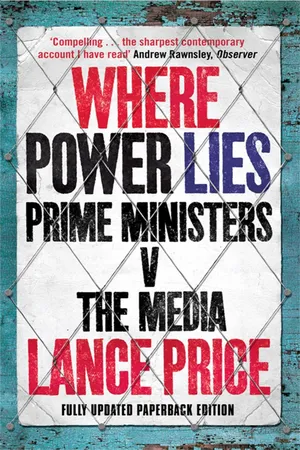
Britain has one of the oldest and most developed democracies on earth. It is admired and copied the world over. Yet at home British politics is frequently viewed with a mixture of derision and contempt. Why? Our democratic system may be mature but the politicians we elect and the media we rely on to tell us what they are up to often behave like difficult teenagers, calling each other names, arguing for the sake of argument and pointing the finger of blame rather than accepting responsibility. Little wonder that the public switches off, tired of all the racket and fed up with the lot of them. How did we get into this sorry state, or was it ever thus? With first-hand experience of the worlds of both journalism and politics, Lance Price looks back over almost a century of battles between the media and our political leaders to find out who is to blame. He exposes liars in Downing Street and scoundrels in Fleet Street, bullies and megalomaniacs in both. There are many wiser heads, too, who see the madness and try to find a better way of doing things. Yet are all in pursuit of the same objective? Power. They want power over each other and power over the rest of us. It is a battle without end and too often the truth is the first casualty. Where Power Liesis the story of how powerful men and women have tried for generations to twist the facts to their own ends. It puts the struggle for supremacy between journalists and politicians into perspective. And it offers a glimmer of hope for a future in which both sides grow up, learn to respect each other and trust the rest of us with that most precious of all commodities, the truth.
Frequently asked questions

Yes, you can cancel anytime from the Subscription tab in your account settings on the Perlego website. Your subscription will stay active until the end of your current billing period. Learn how to cancel your subscription.
No, books cannot be downloaded as external files, such as PDFs, for use outside of Perlego. However, you can download books within the Perlego app for offline reading on mobile or tablet. Learn more here.
Perlego offers two plans: Essential and Complete
  • Essential is ideal for learners and professionals who enjoy exploring a wide range of subjects. Access the Essential Library with 800,000+ trusted titles and best-sellers across business, personal growth, and the humanities. Includes unlimited reading time and Standard Read Aloud voice.
  • Complete: Perfect for advanced learners and researchers needing full, unrestricted access. Unlock 1.4M+ books across hundreds of subjects, including academic and specialized titles. The Complete Plan also includes advanced features like Premium Read Aloud and Research Assistant.
Both plans are available with monthly, semester, or annual billing cycles.
We are an online textbook subscription service, where you can get access to an entire online library for less than the price of a single book per month. With over 1 million books across 1000+ topics, we’ve got you covered! Learn more here.
Look out for the read-aloud symbol on your next book to see if you can listen to it. The read-aloud tool reads text aloud for you, highlighting the text as it is being read. You can pause it, speed it up and slow it down. Learn more here.
Yes! You can use the Perlego app on both iOS or Android devices to read anytime, anywhere — even offline. Perfect for commutes or when you’re on the go.
Please note we cannot support devices running on iOS 13 and Android 7 or earlier. Learn more about using the app.
Yes, you can access Where Power Lies by Lance Price in PDF and/or ePUB format, as well as other popular books in History & World History. We have over one million books available in our catalogue for you to explore.

Information

Year
2014
Print ISBN
9781847392855
eBook ISBN
9781471136573
Topic
History
Index
History

PART ONE

PRIME MINISTERS V. THE MEDIA:

THE CONTEST TURNS PROFESSIONAL

1

WAR AND PEACE: LLOYD GEORGE (1916–22)

Politicians are like monkeys. The higher they climb the more revolting are the parts they expose.
Gwilym Lloyd-George
When David Lloyd George supplanted Herbert Asquith in December 1916, Downing Street opened its doors for the first time to the modern age of the media-conscious prime minister. Previous holders of the post had without doubt cultivated an image and revelled in the attention of the press. The dandy Benjamin Disraeli, the war hero Lord Wellington, the precocious and aloof William Pitt the Younger were all in their own ways larger-than-life politicians. What made Lloyd George different was that, while the others drew strength from how they were perceived, he depended on his image for his very survival. It was his making and ultimately it was his undoing. Historically his misfortune is to be forever associated with that image, and in particular the less edifying aspects of it, rather than for his many achievements. Prime ministers can never escape responsibility for how they are remembered and Lloyd George is certainly no exception. He made no objection when people expected great things of him and had no cause for complaint when they felt let down. His oratory was mesmerising but he, like so many others with an instinctive gift for communication, found that what he did mattered more than what he said. Many of the defining characteristics of what we now call ‘spin’ first emerged during his time in high office and, as ever, there was a price to pay.
Lloyd George had a clear strategy for dealing with the press: ‘What you can’t square, you squash. What you can’t squash, you square.’1 He had little choice. Having deposed the Liberal leader, Herbert Asquith, he became a prime minister without a party. Without any of the usual ties of loyalty to sustain him in office, he kept the part as long as he looked the part. He was the first also to learn the hard way that journalists love nothing better than to build you up in order to knock you down. As Bernard Ingham, Margaret Thatcher’s press secretary, put it eighty years after Lloyd George’s fall from grace, ‘common sense (and hard experience) teaches that the media worm always eventually turns on a government and consumes even the hand that feeds it’.2
It all started so well. At the outset of his premiership Lloyd George was nothing short of a national celebrity. His face was everywhere, in the papers, on posters, in films and in endless cartoons. There was a star quality about him that captivated some and deeply unsettled others. With his great fluency, his easy manner, the twinkle in his eye and his unstuffy, direct way of speaking he reached out to and inspired people who didn’t normally pay much attention to politicians. In many ways he was the Tony Blair of his day.
In some respects the similarities between the two men are uncanny. Once in power Lloyd George tore up the rulebook. He was a man in a hurry, interested only in what would get things done. He was soon accused of running a presidential style of government, of circumventing the traditional civil service and relying heavily on his personal advisers. He wanted to break the mould of the old party system where he had never felt comfortable and took a positive pleasure in just being different. All of which was manna to Fleet Street. Here was a prime minister who gave them what they wanted, good copy. He made news with almost everything he said and everything he did. The newspapers lapped it up and he courted them as none of his predecessors had ever done.
Like other prime ministers who enjoyed, for a while at least, powerful support in the press, Lloyd George was a strong and determined war leader. The reason normally loyal Conservative newspapers, as well as others sympathetic to his own Liberal party, backed him was the belief that he would do better than Asquith at waging all-out war. It was not what he went into politics to do. As chancellor, his determination to push through a Budget to fund radical social reforms, including the first old-age pensions and sickness benefits, helped break the blocking powers of the House of Lords. He brought the same resolution to the conduct of the war, believing in victory at almost any cost. In the face of bloody reverses and unimaginable horrors on the battlefields of France and Belgium he never lost the will to fight to the end.
Like Blair, when he finally resigned in 1922 Lloyd George was seen to be tarnished goods. He was a huge figure on the international stage, preoccupied with the politics of the big powers but devoting much time and energy to trying to find a peaceful settlement in Ireland, the Middle East and, yes, even what is now Iraq. But at home his government had lost its authority and was haemorrhaging credibility. Personally he was mired in scandal over the granting of honours, from peerages to humble knighthoods, in return for cash. The press lords had done very nicely out of his honours lists without even having to dip into their pockets but that didn’t restrain them from self-righteous indignation. When the newspapers turned on him he had few friends left to sympathise with his plight. His enemies, some of whom had been happy to serve under him when the going was good, shook their heads sagely and said he had supped with the devil and was now paying the price. If the newspaper proprietors with whom he had both flirted and sparred proved to be fair-weather friends, then more fool him.
We shouldn’t get too carried away by the parallels. At least Tony Blair won a general election fair and square to get the top job. The media may have fallen for his charms, but it was the voters who gave him his mandate. Whereas, to his dying day Asquith believed Lloyd George had ousted him in a coup driven by the newspapers. The claims of some arrogant press barons helped convince him he was right. But the media didn’t make Lloyd George prime minister any more than they would, eighty years later, put Blair into Downing Street. What they did for both was to give them crucial support while they established themselves in office. To Blair, who had little love for the party he led, and to Lloyd George, who was disowned by the Liberals the moment he entered Number 10, the support of the press provided important breathing space. It was raw politics that brought each of them down. Lloyd George fell because the Conservative party that had supported him as an expedient no longer had any use for him. He may have disappointed the traditionalists in his own party but at least he was a great believer in the traditions of parliament. So much so that he remained an MP for twenty-three years after resigning as prime minister. Tony Blair quit the Commons the very same day.
The press tired of both men, as they always do of such individuals, but in the decades that separated their two governments the nature of the media changed out of all recognition. Fortunately for Lloyd George he governed in a more respectful age, one when private vices rarely made it on to the front pages. He wouldn’t have survived five minutes with the popular press of today. He was the first man of truly humble origins, and, incidentally, the first and only Welshman, to make it to the top of what Disraeli first dubbed ‘the greasy pole’. He was always conscious that he lacked the private means that sustained so many of his colleagues and shamelessly lined his own pockets once he got there, leaving office far wealthier than when he entered it. Shame was not a word that appeared to feature in his private lexicon. In the drawing rooms of polite society, where he never fitted in, he was known as ‘the goat’. His personal life reflected his general disregard for the rules of convention. He lived openly with his mistress, his secretary Frances Stevenson, and saw little reason to curb his enthusiasm for sexual philandering other than to keep his wife, who stayed at home in Wales for much of the time, from erupting. Yet none of it appeared in the press.
Later in life he hosted a private dinner at a London hotel. The guests included Sir Oswald Mosley, the British fascist leader. Mosley remarked, ‘this will hit the roof if it gets out’. Lloyd George was unruffled as ever, replying, ‘My dear boy, if everything I have done in this hotel during the last forty years had got out, you have no idea how many times I would have had to retire from politics.’3 The relationship between the press and politics then and now is as different as a top hat to a hoodie.
Today’s newspapers may be partisan, prurient and prejudiced, but in the first quarter of the twentieth century many were either the playthings of proprietors or the prostitutes of parties. From the point of view of the political classes, they were not so much domesticated animals as part of the family. Many of the great titles – some we would still recognise, others that have long since disappeared – were joined at the hip to either the Conservative or Liberal establishments. In some cases this reflected the views of the millionaire press barons who controlled them. Others didn’t just lap up the propaganda of the side they supported out of loyalty, they were as good as owned by them, subsidiary holdings of the party organisations. Before long this shabby business would be on the wane. Newspapers would become more expensive to own and the parties’ pockets weren’t deep enough to keep up. With a wider readership came advertising revenues that bought political independence. Relations between Downing Street and Fleet Street were soon to get a great deal more fractious, but when Lloyd George was catapulted into Downing Street in December 1916, press support was still a commodity that could be bought and sold.
Newspapers were rarely profitable and so were easy pickings for wealthy men. The Liberal chief whip and the Tory party chairman saw it as part of their jobs to find well-heeled supporters to act as front men, investing in titles that would otherwise go under or, worse still, fall into the hands of the other side. So the Liberals effectively owned the Westminster Gazette, a very influential evening paper despite having few readers outside London, the Daily News, less overtly political but more widely read, and the best-selling Daily Chronicle. The Tories had the snobbish Morning Post, the Pall Mall Gazette, the Daily Telegraph and the Observer as well as dozens of regional titles including the Yorkshire Post. Conservative-party money was also sunk into the Daily Express through a Canadian-born Tory MP by the name of Max Aitken.
Aitken was an extraordinary character, now remembered as one of the great press barons of the twentieth century but then more interested in playing kingmaker than proprietor. He may have been a Conservative but it was Lloyd George who turned him into him Lord Beaverbrook in 1917. On Christmas Day the new prime minister sat down to lunch with Sir George Riddell, chairman of the News of the World. ‘I see that Max Aitken has got his peerage,’ remarked the newspaperman. Lloyd George laughed heartily. ‘Yes, my first peer! He had a great deal to do with the formation of the government.’4 Lloyd George enjoyed the company of men like Beaverbrook and Riddell. Their trade fascinated him. A few years later Beaverbrook penned some reflections on Lloyd George and his dealings with the press. ‘Mr Lloyd George,’ he observed, ‘falls into the class neither of the sensitive nor of the indifferent. He is himself too much a part of the movements of popular opinion to be unduly resentful of its blame or to be scornful of its praise. He frankly accepts press criticism as one of the most important presentations of the national mind . . . He likes a good press like a shopkeeper likes a good customer.’ And in words that could be used to describe many of those who became prime minister after him, Lloyd George was judged to be ‘over-subtle in studying the press . . . He reads too much into what is often merely the result of haste, accident or coincidence. He searches for a motive in every paragraph.’5
Beaverbrook will feature heavily in the story of the battles between Downing Street and Fleet Street over the next thirty years but at first it was by no means clear in which of the two streets he would make his name. He got involved in newspapers only because he was very rich and his Tory masters wanted his money to help them buy influence. He wrote a cheque for £25,000 to the editor of the Express on the steps of the Monte Carlo casino in 1911 at the request of Andrew Bonar Law, a fellow Canadian and leader of the Conservative party. The same year the Tories offered him a knighthood. He was told it was ‘for the purpose of rewarding me for services to come’,6 an unusual interpretation of the honours system to say the least. They wanted to keep him sweet so that they could use his money again for the same purpose. But he was a slippery character and in 1916 he took a controlling interest in the Express on his own behalf not the party’s. The date was significant, which is why he kept what he’d done secret. It coincided with the coup that put Lloyd George into power. Had it been made public, Asquith and his supporters would have had yet more evidence for their theory of a press conspiracy.
Not all newspapers relied on party money. The Manchester Guardian, then owned and edited by the magisterial C. P. Scott (who first declared that ‘comment is free but facts are sacred’), was Liberal out of conviction and its support all the more valuable for not being bought. On the other side the Daily Mail and The Times backed the Tories without being paid to do so. They were owned by the other great press baron of the time, Alfred Harmsworth, 1st Viscount Northcliffe, the father of modern popular journalism.
In his last few years Lord Northcliffe’s grasp on reality would slip away from him. Before his death in 1922 he was to be found driving about in his blue Rolls-Royce, firing off shots from his revolver at imaginary enemies, ranting about assassination attempts with poisoned ice cream and calling his editors at all times of the night to demand that they sack most of their staff. In 1916 he was merely power crazy. He didn’t much like politicians and he was very happy to be thought both cleverer and more powerful than they were. Northcliffe once tried on Napoleon’s hat and wasn’t joking when he said he’d make a better emperor. Merely deposing prime ministers was clearly well within his assessment of his own strength and ability. The morning after Lloyd George’s victory Northcliffe rang his younger brother Cecil, then MP for Luton. Had he seen that day’s Morning Post? The paper’s headline was in the form of a question. ‘Who Killed Cock Robin?’ it asked, referring to Asquith’s demise. ‘You did!’ replied Cecil, telling his brother exactly what he wanted to hear.
Yet in his more considered moments, even Northcliffe was forced to admit that Asquith’s days were numbered with or without the influence of the press. There was intrigue, certainly, but the main players were politicians not newspapermen. The papers didn’t make Lloyd George prime minister but the events of 1916 proved a major turning point nonetheless and they are worth looking at in detail. For the first time the media played a significant, though not decisive, role in deciding who should occupy Number 10. The struggle for supremacy between Fleet Street and Downing Street was suddenly much more evenly balanced. From then on, like two arm wrestlers who refuse to give up, first one then the other might appear to have the upper hand but neither would ever walk away the undisputed winner.
Lloyd George’s accession was no ordinary transfer of power. It was a coup against the serving prime minister in the middle of a war. The myth that newspapers can make or break prime ministers was born with Asquith’s own conviction that an overmighty press had been responsible for his demise. He did what all powerful men do when they come a cropper: he looked for somebody else to blame. Lloyd George had certainly cultivated the press although he claimed never to have wanted the job but only to change the way the war was being run. In April 1916 he had invited C. P. Scott to his house outside London and had shown the great man a letter. It was his resignation from Asquith’s government. Scott was duly impressed and urged him to go to the back benches where he could be more effective in opposing the current strategy. The letter was never sent, but by the time the crisis came to a head eight months later Scott and others who had been taken into Lloyd George’s confidence had no doubt that his opposition to Asquith was principled and not opportunistic. Despite all the newspaper criticism of his war strategy, or lack of it, Asquith continued to get enough personal support in the Liberal-owned press to mislead him about the strength of his position. He was a politician from a different age, hopelessly ill equipped for the task in hand. Eventually he had to go because his policy was wrong, not because the papers said it was.
Asquith had always been dismissive of journalists, saying even of those who supported him ‘the Liberal press is written by boobies for boobies’.7 He was aloof and had nothing of the common touch. Above all, he was a gent when his rival was clearly anything but. Asquith’s bland but easy style had worked well in peacetime. Now that the country was waging a war of unprecedented brutality he looked out of place. He enjoyed country ...

Table of contents

  1. Cover
  2. Author biography
  3. Also by Lance Price
  4. Title page
  5. Copyright page
  6. Contents
  7. Dedication page
  8. Epigraph page
  9. Acknowledgements and notes
  10. Introduction: The Power and the Glory
  11. PART ONE: PRIME MINISTERS V. THE MEDIA: THE CONTEST TURNS PROFESSIONAL
  12. 1. War and Peace: Lloyd George (1916–22)
  13. 2. ’Tis Pity She’s a Whore: Bonar Law, Baldwin, MacDonald (1922–31)
  14. 3. A Farewell to Arms: MacDonald Again, Baldwin Again, Chamberlain ‘never again’ (1931–40)
  15. 4. Put Out More Flags: Churchill (1940–45)
  16. 5. Of Mice and Men: Attlee, Churchill Again (1945–55)
  17. 6. Great Expectations: Eden, Macmillan, Douglas-Home (1955–64)
  18. 7. Brave New World: Wilson (1964–70)
  19. 8. Three Men and a Boat: Heath, Wilson Again, Callaghan (1970–79)
  20. PART TWO: PRIME MINISTERS V. THE MEDIA: TWENTY-FOUR-HOUR NEWS AND THE MEDIA DEMOCRACY
  21. 9. She: Thatcher (1979–90)
  22. 10. Decline and Fall: Major (1990–97)
  23. 11. A Man for All Seasons: Blair (1997–2007)
  24. 12. Sunset Song: Brown (2007–10)
  25. Conclusion: Atonement
  26. Notes
  27. Bibliography
  28. Index
  29. List of Illustrations