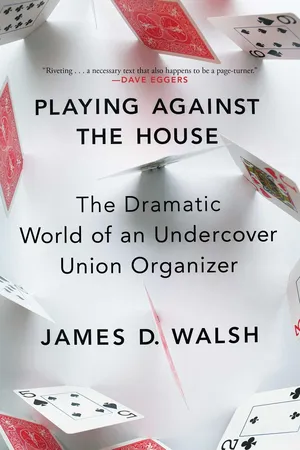
Playing Against the House
eBook - ePub

Playing Against the House

The Dramatic World of an Undercover Union Organizer

  1. 288 pages
  2. English
  3. ePUB (mobile friendly)
  4. Available on iOS & Android
eBook - ePub

Playing Against the House

The Dramatic World of an Undercover Union Organizer

About this book

In the tradition of Barbara Ehrenreich’s classic Nickel and Dimed, a talented young journalist goes undercover as a casino labor-union organizer in this rare inside look at the ongoing struggle of hourly-wage service workers to survive in America.

“Salting” is a simple concept—get hired at a non-union company, do the job you were hired to do, and, with the help of organizers on the outside, unionize your coworkers from the inside. James Walsh spent two years as a “salt” in two casinos in South Florida, working as a buffet server and a bartender. Neither his employers nor the union knew of Walsh’s intentions to write about his experience. Now he reveals hard-won and little-known truths about how unions fight to organize service workers, the vigorous corporate opposition against them, and how workers get caught in the middle.

As a salt, Walsh witnessed the cultish nature of labor organization and was constantly grilled by his union organizer as to whether he had enough grit and determination to win converts to the cause while remaining undercover. At work, Walsh witnessed the oddities of casino life and management’s stunning mistreatment of service industry employees, most of whom were hanging on to economic survival by their fingernails. His meticulous reporting reveals supervisors berating workers for the smallest infractions, even as employees submit to relentless scrutiny, ever-changing work schedules, and the callous behavior of casino customers.

A clear-eyed and balanced account, Playing Against the House explores the trials of day-to-day life for the working poor and the face of twenty-first-century union organizing and union busting in unprecedented detail.
Frequently asked questions

Yes, you can cancel anytime from the Subscription tab in your account settings on the Perlego website. Your subscription will stay active until the end of your current billing period. Learn how to cancel your subscription.
No, books cannot be downloaded as external files, such as PDFs, for use outside of Perlego. However, you can download books within the Perlego app for offline reading on mobile or tablet. Learn more here.
Perlego offers two plans: Essential and Complete
  • Essential is ideal for learners and professionals who enjoy exploring a wide range of subjects. Access the Essential Library with 800,000+ trusted titles and best-sellers across business, personal growth, and the humanities. Includes unlimited reading time and Standard Read Aloud voice.
  • Complete: Perfect for advanced learners and researchers needing full, unrestricted access. Unlock 1.4M+ books across hundreds of subjects, including academic and specialized titles. The Complete Plan also includes advanced features like Premium Read Aloud and Research Assistant.
Both plans are available with monthly, semester, or annual billing cycles.
We are an online textbook subscription service, where you can get access to an entire online library for less than the price of a single book per month. With over 1 million books across 1000+ topics, we’ve got you covered! Learn more here.
Look out for the read-aloud symbol on your next book to see if you can listen to it. The read-aloud tool reads text aloud for you, highlighting the text as it is being read. You can pause it, speed it up and slow it down. Learn more here.
Yes! You can use the Perlego app on both iOS or Android devices to read anytime, anywhere — even offline. Perfect for commutes or when you’re on the go.
Please note we cannot support devices running on iOS 13 and Android 7 or earlier. Learn more about using the app.
Yes, you can access Playing Against the House by James D. Walsh in PDF and/or ePUB format, as well as other popular books in Economics & Workplace Culture. We have over one million books available in our catalogue for you to explore.

Information

Publisher
Scribner
Year
2016
Print ISBN
9781982115555
eBook ISBN
9781476778372

Part 1

GETTING IN

Images
Just west of Little Havana I saw the neon sign’s giant letters burning red like a bull’s-eye: Magic City Casino. I’d just consumed four times the recommended serving size of Miami’s most popular legal upper, Cuban coffee, and my heart was bouncing like a racquetball in my rib cage. Sarah turned into the vast empty parking lot and pulled up alongside a row of taxis whose drivers were trying their luck between fares.
ā€œIt’s going to be really hard to get a job at Neverland,ā€ she said. Unite Here Local 355, South Florida’s hospitality union, was targeting three casinos for unionization. Magic City (code name: Neverland) was one of them. ā€œI’m pretty sure they only hire people who speak Spanish. But it’s worth a shot. So, I want you to go in and look around.ā€
ā€œJust walk around?ā€ I asked.
ā€œYeah, and then, there’s a bar on the left side when you walk in, I want you to go sit there and get the bartender’s name. Start a relationship. Who knows? Maybe she will get you hired.ā€
In fact, it was Sarah’s job to get me hired. Sarah worked for Unite Here. She traveled the country recruiting and training ā€œsalts,ā€ union activists who got jobs in non-union workplaces, intent on organizing them from the inside. I was in Miami to salt.
The thought of waltzing into Magic City and striking up a conversation with a bartender was daunting. I protested. What if the bartender is a woman? And what if she’s hot? What if she doesn’t want to talk to me? Sarah didn’t budge. It was a push, union-speak for something more than a request and slightly less than a directive. Sarah, like other organizers, presumed any excuse to get out of a push to be a manifestation of fear. Of course, in this case, she was right. Back then, few tasks could have been more challenging than starting a conversation with a female bartender.
All three of the targets were relatively new. Miami-Dade voters had only recently approved slot machines at pari-mutuels (dog tracks, horse tracks, and jai alai frontons). Only three weeks earlier, Flagler Dog Track—first opened in 1931—had celebrated a grand reopening as Magic City Casino. Despite being largely empty of customers, the casino floor was loud and bright. Lights pulsed. Buttons blinked. The room was shaking with euphoric tintinnabulation. Ding, ding, bling, bluuuueooorrrp. Ding, ding, bling. I walked through the cornfield of machines with names like Kitty Glitter, Desert Spirit, Wolf Run, and Cleopatra. The people sitting in front of them, all older than forty, were transfixed. Slot machines were once thought to be a superfluous part of the gambling industry. They lined the walls of casinos, simple games for women to pass time with while their husbands played blackjack, poker, and roulette. But casino operators learned that the earning potential of slot machines greatly outmatched that of any other game. By the end of the twentieth century slot machines were the most prominent part of every casino in the country, producing twice as much revenue as blackjack, poker, roulette, and all other live games combined.
I found the bar. Behind it, to my horror, was a gorgeous bartender. Tall and slender, her black hair braided like a whip, she was wearing a red corset and fishnet stockings. As I took a seat at the otherwise empty bar, I was struck by the dolorous realization that I had never spoken to a woman wearing a corset and fishnets.
ā€œWhat can I get you?ā€ she asked with a thick Latin accent.
ā€œA coffee?ā€
ā€œAmerican or Cuban?ā€
ā€œCuban, please.ā€ Was it safe to consume two Cuban coffees in under an hour? I sipped what she placed in front of me, though it looked nothing like the colada Sarah had ordered for me on Calle Ocho twenty minutes earlier.
ā€œHow long have you been working here?ā€ I asked with the surety of a newborn giraffe’s first steps.
ā€œNot long,ā€ she said coldly.
ā€œI just moved here and I’m wondering who I should talk to if I want to get a job?ā€
Realizing that I wasn’t hitting on her, she loosened up. ā€œMy manager isn’t here right now. But I don’t think they’re hiring. They just fired, like, eight people in the buffet, and two bar backs.ā€ Sarah had warned me that newly opened casinos often overstaffed for grand openings.
ā€œWhen is your manager usually around?ā€
ā€œHe comes by the bar around eleven. If you come back another time I’ll introduce you.ā€
I paid and asked for her name.
ā€œMaria,ā€ she said with a smile. I retreated to Sarah’s rental car, caffeine and adrenaline coursing through my body.
Inside the car, Sarah wrote down Maria’s name. Sarah was constantly collecting intel on hotels and casinos. She had a list—food and beverage managers, security guards, directors of human resources—that might come in handy one day. Sarah had been responsible for getting plenty of salts hired. She believed my hiring to be a matter of societal certainty—I was a white male with straight teeth and a nonregional accent. I had been in Miami for less than a day and I was already eager to get inside. Once there, I could start making trouble.
Images
A few months before I met Sarah, I knew nothing about unions, casinos, or Miami. I had just graduated from journalism school and landed an interview to be a research assistant to a popular historian. The interview went well. Toward the end of our conversation the historian casually asked me to pitch him a story. I’d known a few friends in college who salted. I told him about salting because it was the first—and only—good story that came to mind.
ā€œUsually when I ask people your age to pitch me a story, they give me something that’s total shit. But that’s good. That might say something about your generation and what’s going on in the country. You should do it.ā€ When I had asked my friends if I could write the story, they’d said no, salting was top secret. Off limits. ā€œNo, you should do it,ā€ the historian said. ā€œYou should salt. Then write about it.ā€
Images
Growing up, I knew nothing of unions. My only point of reference was the premature end of a pitiful Red Sox season in 1994. The baseball players’ strike was a far cry from the battles fought between laborers and ruthless industrialists in Colorado’s coal mines, Chicago’s train yards, and Lowell’s factories. As I became aware of unions’ bloody history, I began to understand the importance of organized labor to the country’s identity.
In 1935 Franklin Delano Roosevelt signed the National Labor Relations Act into law as part of a second wave of New Deal reforms that protected middle-class and poor Americans who had taken the brunt of the Great Depression. Over an eighteen-month period, from 1936 to 1937, more than three million workers unionized. By the middle of the twentieth century, almost one in three Americans belonged to a union.
In 2010, nationwide, labor unions represented 12 percent of the workforce and only 7 percent of private-sector workers. Studies proved the link between the plummeting rate of union membership and the disconcerting rise of income inequality. Unionized workers made about $200 more every week with greater access to benefits than their non-union counterparts. With the economy in shambles, why weren’t low-wage workers joining in droves as they had after the Great Depression? Salting was the best way to find out. I was about to discover that some campaigns, no matter how well conceived, face anti-union strategies so insurmountable it’s hard to fathom how any union organizing is accomplished.
Images
In the summer of 2009, I told a salt I knew that I wanted in. He gave me Tom’s number. Given the clandestine nature of the work it was best not to meet near the union hall, Tom said over the phone. A few days later, he sat coolly on the crossbar of his bike waiting for me near a coffee shop on Hanover Street in Boston’s North End. He wore a newsboy cap atop a thicket of blond hair. Cheap sunglasses hung from the neck of his green collared shirt, the sleeves of which were rolled up, exposing the word ā€œunityā€ tattooed on the inside of his left forearm.
Tom and I stepped into an authentic Italian coffee shop. As soon as we sat down, he started telling me about himself. Until recently, Tom had been working as a cook at a swanky corporate hotel in Boston. He had taken a leave of absence to work for Local 26, Unite Here’s Boston chapter, as a full-time union organizer. He told me with pride that he had been one of the first salts in the city, and in the few years since the program began operations in Boston, the city’s hotels had gone from 30 to 60 percent unionized. (Other salts would later say those numbers were optimistic.) Then Tom got more personal. His father was a stiff Republican and a National Guardsman who always worked two jobs. His mother was a waitress. They never had much money.
ā€œSpaghetti with butter every night, man,ā€ he said, spinning his cup of cappuccino. ā€œI wouldn’t wish it on my worst enemies.ā€
Just as I was thinking about how I had not asked any questions to prompt these personal details—what Tom was divulging normally took beers or years for most people to share—I realized this was not just coffee. Tom was baiting a story swap. I was now in a vetting process.
ā€œSo tell me about a time in your life when you had to fight for something,ā€ he said.
I would soon learn this verbal strategy. Sure, union organizers want to know if you have grit. But their conversations follow a kind of Socratic method; they want you to ask yourself if you have grit. There was a yawning silence while I wracked my memory for a story. I had also eaten spaghetti with butter every night, but only because everything else grossed me out. Did I have grit? Hardly. I told him about some college activism, how I’d fought apathy and all that, and made some nebulous reference to obstinate parents, which everyone can relate to. Tom didn’t know my true intention was to write about my experience as a salt, which made me uncomfortable. I liked Tom. He wasn’t what I had expected, a college punk who looked in the mirror and saw Che looking back. I needed to display a commitment. Organizers don’t like half commitments because they don’t have time to train salts who bail early.
ā€œThis is what I want to do,ā€ I said, looking him straight in his bright blue eyes. ā€œI want to salt.ā€
ā€œWe actually say ā€˜intern.’ No problem, it’s just, ā€˜salt’ is such a loaded name.ā€ I’d learn that ā€œsaltā€ could mean a lot of different things to different people. For example, some unions used salts to provoke employers into breaking the law, a tactic, as far as I knew, antithetical to Unite Here’s salting philosophy. ā€œAnyway, you know the work’s fucking hard, right?ā€
I both relished and feared the chance to work as a waiter or a bellman. I had never worked a service job, or any real job for that matter, in my life. ā€œYeah, I’m ready.ā€
ā€œOkay. There’s a need in Miami, Phoenix, and Seattle.ā€
ā€œMiami?ā€ I asked, unsure if I had heard him correctly.
ā€œThey’re putting together a team down there. You’ll be great, the hospitality industry loves us white guys. I can see you in a white linen suit. Miami Jim, they’ll call you.ā€
After Tom, I met with Becky, another member of Boston’s salt team. Becky asked me the same questions Tom had as we walked around Cambridge. Like Tom, Becky approved of me, which meant I had been double-cleared. Sarah called a few days later. Sarah was one of two Unite Here staff members who worked full-time to build salt teams around the country. She came to Boston to meet me.
Sarah was my age, twenty-four, gaunt and tough like a stickball bat. She had thick black wavy hair and a hoop through her nose. She wore jeans with squiggly lines stitched up and down the legs. We ate burritos and walked around a reservoir. Our conversation had the same rhythm as my conversations with Tom and Becky—I’ll share my story if you share yours.
Sarah was from rural Massachusetts, the kind of small college town populated by farmers, plumbers, and professors. Cows and hybrids. Growing up in a working-class townie family, Sarah was resentful of the white, comfortable, liberal lifestyle that permeated the town, even becoming disillusioned with members of her own family. She hung out with wandering street kids, hitchhiked the East Coast, and eventually dropped out of a small liberal arts college in Maryland and began salting. She never looked back. She salted for three years at a DoubleTree outside Washington, D.C. Salting gave her more than school ever had, she said. Finding the mettle to lead her coworkers and confront her bosses made Sarah, once shy and yielding, feel as if she had control of her life. After she organized the union at the DoubleTree, she joined Unite Here’s staff to help build the salt program nationally.
When she finished her story, Sarah asked me questions similar to Tom’s. Sarah offered me the same quiet attention that Tom had. They both used open-ended follow-ups—Why? How did that make you feel?—and nodded along to make sure I knew they were listening. I wasn’t sure if they had ever met but it was as if they had attended the same church of conversation.
When I had convinced her that I would be a good underground organizer, she gave me what I wanted. ā€œHow do you feel about Miami?ā€
ā€œGood?ā€
ā€œI fucking love it. Everything you’ve heard about it is true. But there’s more.ā€ Her eyes were wide, as if she were revealing a secret.
ā€œWhere would I work?ā€
ā€œWe don’t know yet, but we’re targeting casinos more than hotels now.ā€
In late October, I stuffed everything I owned into my Ford Focus and headed down I-95, the air a little bit warmer each time I stopped for gas.
Images
After Magic City, Sarah took me to Calder Casino and Race Course. We drove north along one of Miami-Dade’s long avenues, past strip malls, schools, parks, and airports. In South Florida, places aren’t hidden by hills or tucked into valleys. Mystery is man-made, veiled by walls and protected by gatekeepers with clipboards. An hour later we were on the northern edge of Miami-Dade, entering another vast parking lot. The newly built casino, with its teal and yellow siding, rose out of the pavement like the Emerald City.
The grandstand, on the track’s southern straightaway, was a massive structure enclosed in glass. Off to the side of the grandstand was the shell of the casino, a one-story building with the same dimensions as a Walmart. The casino hadn’t opened yet so Sarah instructed me to walk around the grandstand.
ā€œThe guy who’s going to be doing the hiring’s name is Stanley Donovan; I think he’s in charge of the food and beverage department or something. Let’s not talk to him yet but you should go look around. Ask a worker about Stanley Donovan.ā€ This time I knew enough not to protest.
Unlike Magic City’s casino floor, Calder’s grandstand was quiet, ou...

Table of contents

  1. Cover
  2. Dedication
  3. Epigraph
  4. List of Key People
  5. Author’s Note
  6. Part 1: Getting In
  7. Part 2: The Horse Track Campaign
  8. Part 3: The Dog Track Campaign
  9. Part 4: The Trial
  10. Part 5: The Wait
  11. Acknowledgments
  12. About the Author
  13. Index
  14. Copyright