eBook - ePub
Olivia
About this book
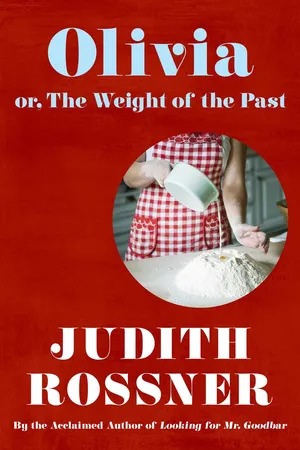
From the New York Times bestselling author of Looking for Mr. Goodbar comes the story of one family's unfinished business and overcoming the weight of the past. Caroline Ferrante is a gifted chef who has just been tapped for her own cooking show. But her turbid past returns to haunt her when her estranged teenage daughter, Oliviaāraised to hate her by a Caroline's vindictive ex-husbandāreturns home. Overcoming Olivia's anger while navigating a new career and burgeoning love life proves to be her greatest challenge.
Frequently asked questions
Yes, you can cancel anytime from the Subscription tab in your account settings on the Perlego website. Your subscription will stay active until the end of your current billing period. Learn how to cancel your subscription.
At the moment all of our mobile-responsive ePub books are available to download via the app. Most of our PDFs are also available to download and we're working on making the final remaining ones downloadable now. Learn more here.
Perlego offers two plans: Essential and Complete
- Essential is ideal for learners and professionals who enjoy exploring a wide range of subjects. Access the Essential Library with 800,000+ trusted titles and best-sellers across business, personal growth, and the humanities. Includes unlimited reading time and Standard Read Aloud voice.
- Complete: Perfect for advanced learners and researchers needing full, unrestricted access. Unlock 1.4M+ books across hundreds of subjects, including academic and specialized titles. The Complete Plan also includes advanced features like Premium Read Aloud and Research Assistant.
We are an online textbook subscription service, where you can get access to an entire online library for less than the price of a single book per month. With over 1 million books across 1000+ topics, weāve got you covered! Learn more here.
Look out for the read-aloud symbol on your next book to see if you can listen to it. The read-aloud tool reads text aloud for you, highlighting the text as it is being read. You can pause it, speed it up and slow it down. Learn more here.
Yes! You can use the Perlego app on both iOS or Android devices to read anytime, anywhere ā even offline. Perfect for commutes or when youāre on the go.
Please note we cannot support devices running on iOS 13 and Android 7 or earlier. Learn more about using the app.
Yes, you can access Olivia by Judith Rossner in PDF and/or ePUB format, as well as other popular books in Literatura & Literatura general. We have over one million books available in our catalogue for you to explore.
Information
Topic
LiteraturaSubtopic
Literatura generalIt was my intention that this memoir be a lighthearted kitchen romance, My Life in Food. I would describe how, the daughter of two professors, I was drawn to cooking as a small child, eventually became a professional chef, and after working for years in Italy, returned to the States to become known as the talky-impulsive host of the TV show āPot Luck.ā I meant to glide lightly over my marriage to Angelo Ferrante and life with our daughter, Olivia. If I was supremely comfortable with mishaps before an audience and occasionally courted disaster to liven up my show, Iām far less easy with the mistakes and misunderstandings of real life and had no desire to recount them to strangers.
I was first diverted by the question of names. My maiden name was Sindler. Iād changed it automatically when I married Angelo in 1974, and thereād never been any question of going back to Sindler when we divorced. If Ferrante suggested someone I was not, neither was I a Sindler anymore. A new name would solve the problem in theory even while denying my past. Nor did I like the awkward hyphenated labels many women were choosing. My maiden name, was, after all, not just mine but my fatherās. Using it seemed to negate my life since leaving home. I finally decided to be Ferrante for publishing purposes because that was who could get a contract. In fact, my professional name would be a useful reminder of what the book was to be about. Settled.
Well, not so settled. For as soon as I began writing, I was swamped by memories that werenāt the ones Iād intended to evoke. Stories about Angelo. Good and bad times with LivvyāOlivia, as Iām instructed to call her. And finally I realized Iād made the same mistake I had when she was young, in assuming I had two lives, in and out of the kitchen, and that she would take this for granted as I did. I was an adoring mother from the time Livvy was born, but I was patient and attentive only when I wasnāt cooking meals for twenty to sixty people at a time. Now her memories of me are of a kitchen monster, a whirling dervish who never turned from the stove except to scream at her. Nothing I say can make her believe the pleasure I took in her, what wonderful times we had, while her memories of Angelo are of a father who adored her until he remarried and life changed, to an unimaginable degree, for the worse.
Itās so much easier to deal with food than with people. The difference between people and food is that if you take identical pieces of food and treat them identically, they will turn out the same way. Eggs whipped for a long time will be frothier, meat will grow tender if you pound on it, sour cream thatās separated by heat can be restored in the blender. Results are predictable, damage can be disguised or repaired.
It took me a long time, with Livvy, even to understand that some attempt at repair was in order. At first I thought she was simply a teenager gone haywire. I could pinpoint the moments when adolescent irritability erupted into volcanic rage; they never appeared to be about anything really terrible. One of the worst occurred after the first television show I did, in 1989, when I was called in as a last-minute replacement on the cooking segment of āJohnny Wishbone.ā

āHi, everybody. Iām Caroline Ferrante and the camera is visiting my summer cooking class in Westport. Weāve just finished making a buridda, the Ligurian fish stew that you can see in these pots on the stove. I was thinking about a change of pace for āJohnny Wishbone,ā and fresh vegetables seemed like an obvious choice at this time of year. Donāt get scared. This isnāt going to be one of those, uh, Everything-You-Ever-Were-Scared-to-Ask-About-Sterilizing routines. But Iād like to encourage you to, say, prepare some fresh tomato sauce and freeze what you donāt use in a couple of washed-out yogurt containers. Everyoneās learned about pesto geneovese in the last few years, itās all over the place. But it doesnāt seem to occur to people that plenty of other herbs can be frozen when theyāre fresh and dry. Or pounded or ground up with oil into pestos, pastes, and frozen in those little pill bottles you never had any use for, then added to sauces, soups, all kinds of dishes that need to be livened up a little. Including vegetables. I mean, vegetables arenāt sexy the way meat is, but meat without any vegetables is . . . is sort of like sex without a mattress. The good stuff is there, but it isnāt quite as easy to enjoy. By the way, those little bottles are good for tiny amounts of leftover sauce and gravy, too.
āAnyway, today weāre going to do a salsa verde. A green sauce. Itās usually easy to get the main ingredient, good Italian parsley, the kind that doesnāt curl up so hard you canāt taste it. Some people use arugula and basil as well. If I have time, Iāll do different versions of green sauce, and encourage you to do the same. See which one you like best. Think about which food youād like to put it on.
āUse your imagination. I donāt mean try cinnamon if the recipe says capers or anchovies. But if it calls for basil, and youāve got a lot of mint in your backyard, try the mint. Look at whatever else is around thatās green. Taste it. Try to imagine how the combinationāll taste. If you think it might be good, throw it in. The worst that can happen is itāll be awful, in which case youāll play with it to make it better. Or throw it out.ā
As I spoke, Iād been chopping garlic, then parsley and basil. Now I started to put them in the Cuisinart, then realized that the bowl was clean, but the blade wasnāt in it. I saw the Waring Blender nearby on the counter, pulled it over, took off the cap. I put in the garlic, parsley, and arugula, then measured in the mustard, lemon juice, and olive oil.
āI yield to none in my love of the Cuisinart, but the fact is youāre really supposed to do all this with a mortar and pestle, so I donāt think you should worry if you have to use a blender. In fact . . .ā I pressed one of the buttons, smiled at the camera. I was about to say that it barely mattered which button you pressed, but I stopped speaking because the contents of the blender, the cover of which I had neglected to put back on, were spraying my hair, my neck, and the near side of my face, as well as everything else in the vicinity.
I looked down to find the button to turn off the machine and the green gunk flew into my eyes.
āOh, my God!ā I moaned, trying to find the buttons. āThis is like braille!ā
I found them and pressed one. The machine stopped. I groped for a dish towel, which one of the women in my class came forward to hand me. They were all giggling. The cameraman turned to catch them, returned to show me cleaning myself off.
āI just rememberedādid you ever hear about the Jew who gave a blind man his first piece of matzo?ā I pretended to be the blind man, running his fingers over the big, crinkly matzo cracker that is foreign to him. āAnd he feels it, and feels it, and after a while, he asks, āWho wrote this shājunk?ā ā
As the class laughed harder, the cameraman signaled that I had four minutes to fill.
āActually, this reminds me, when my daughter was little, maybe two years old, we lived in Rome, and I was the chef in a restaurant there. . . . The Italians do not believe, as the French and Americans do, that women shouldnāt cook in an establishment where money changes hands. . . . Anyway, one day Livvy wanted something to eat and she looked down into a bowl of salsa verde and asked what the grasso verde was. They may sound similar, but one is green sauce and the other is green grease.
āLetās see. Where was I? Okay. We can clean up the mess later. I guess the first thing to do is . . . No, even before that, weāre going to cover the blender. Then weāll turn it on for a few seconds and see what weāve got left.ā I took off the cover, stuck in my finger, withdrew it, and tasted it. āHmmm. What Iāve got is a pleasant blend of some herbs and garlic, to which Iām going to add some oil and a little lemon juice, and Iāll end up with a pleasant little salsa thatās a little better or worse than the one I usually do. Or maybe itāll make a nice salad dressing. Flexibility is the important thing. . . .ā
Two minutes.
āIām reminded . . . Telling the story about Livvy reminded me of another one. Some years ago, my brother, Gus, came to visit us in Rome during Easter vacation. Gus is a physicist, the kind of person who wants to know everything about a place before he goes there, and heād read a lot, not just on the museums and the Vatican, but about food. Heād read that abbacchio, baby lamb, was a Roman Eastertime specialty. He was delighted because he hated fish and heād been afraid heād have to eat pasta all week. He was dismayed to discover that the restaurant owners hadnāt read the same book as he had, and almost every good place in Rome was closed for Easter week. Of the open, more modest ones, nobody was serving abbacchio, which is not only very expensive, but difficult to hold in its rare and juicy state for any length of time.
āThe Italian word for lamb is agnello, and abbacchio is a word Livvy had probably never heard. Anyway, we were all sitting around in the restaurant, our restaurant, before dinner hour, and Gus was complaining about not being able to find abbacchio, and I was saying Iād make it for him, and Livvy asked what it was, and Gus explained in his detailed, physicistās fashion, and Livvy sat there staring at him. Something horrible had clicked. I think until that moment, sheād never connected meat to the pictures of animals sheād seen in her books. She ran to me for protection as though Gus might take it into his head to carve her up next! And nothing I said could change her feeling about him.
āIt was a while before my daughter would look at any kind of meat. On the other hand, Iām happy to tell you that by the end of that week, Gus was eating two kinds of fish.ā

The first three phone calls were from Sheldon, my agent, now producer. 1. I was wonderful. 2. I was to get back to my parentsā house immediately so he could reach me. 3. If anyone wanted to talk to me about a show, I should just give them his number. Not try to talk to them. And I should please, for Godās sake, put on some makeup and comb my hair before anyone saw me on the street. You never knew who . . . (Iād had ten minutes to prepare for the show and hadnāt been able to worry about my appearance. I am an ordinarily attractive female with light-brown hair and dark-brown eyes who, when I was younger, got looked at on the street no matter what I was wearing. Now I was more likely to have my existence noted by strangers if I dressed up a little.)
I made my way back to my parentsā. I hadnāt thought to call and tell them to turn on the set. It was just as well; Iām not sure they knew yet that it worked during daytime hours. Unfortunately, the same was not true of everyone else in Westport.
āYou think Iām Mickey Mouse or something?ā were Oliviaās first, furious words as she stormed into the house, having been told by a friendās mother that Iād talked about her on TV. Thank God the friendās mother hadnāt repeated the anecdote. āYou think Iām some kind of character you made up?ā
It crossed my mind that a case could be made for my having, indeed, made her up, but I wasnāt about to sacrifice all hopes of peace for a one-liner.
āI can understand if you donāt want me to make a habit of talking about you in public. But I was asked to fill in for someone on a cooking show. Last minute. I needed to fill the timeāā
āThatās what you think Iām here for? When you need to fill time?ā
āNo,ā I said, ābut the stories were about when you were little and it didnāt ocāā
āI donāt want you to talk about me!ā she shouted. āEver!ā
āI guess I thought I was talking about me, too.ā
āWhatās that supposed to mean?ā she demanded.
āIt means that whether you like it or not, we have a great deal to do with each other.ā
āNothing but money! All we have to do with each other is money!ā
āOh,ā I said wearily. āWell, if you can believe that, I guess thereās nothing to discuss.ā
āExcept using me on your show.ā
I smiled slightly. āWell, I hope Iāll have a show to not use you on. If I do, all I ever really expect to talk about is food and cooking. On the other hand, itās not giving away any secrets to say I have a daughter. Hundreds of people between here and Italy know Iām your mother.ā
āMy birth mother!ā she shouted back.
āBirth mother?ā I hadnāt heard the phrase before, though I gather itās widely used. āWell, of course Iām your birth mother. Your birth mother and your nursing mother and your diaper-changing mother and your hugging and kissingāā
āI donāt remember you ever hugged me or anything else! I donāt believe any of it!ā
āOh. But you do believe I gave birth to you?ā
āNo.ā It was so fast as to take my breath away. āI donāt really believe it, except my father said it was true.ā
āI see. Your father acknowledged that I was your mother.ā
āHe acknowledgedāāthe words were slowly and loftily spokenāāthat your womb held me for nine months while I grew into a baby that could be born.ā
āI see. Thatās all a mother, a birth mother, is. A womb. A holder.ā
āThatās right. Some mothers.ā Not a momentās hesitation or ambivalence.
āWell, then . . .ā It was coming slowly. I was amazed by the way my tears were staying in my brain and out of my eyes. āPerhaps my reward for carrying you for nine months is that I can say I have a daughter.ā
From that time on, I didnāt refer to Livvy in my classes, or, later, on the show. But I cannot eliminate her so thoroughly from my writing memories. Blood is stickier than desire, less subject to the ownerās whim, or to the wear and tear of time. Unacknowledged bonds are no less powerful and may even, like mushrooms, grow better in the dark. There are times when I think that if Livvy hadnāt gone so far in her rebellion the trip back would have been less painful.
Whatever else is true, whatever I think is on my mind as I sit down to write, she is with me as the words begin to flow.

When I was younger I was puzzled to hear women talk about cooking as though it were higher mathematicsāsome arcane field one dare not enter without the brilliance to divine the meaning of 1 C flour or 1 Tbsp. salt. Assurances to friends that some dish Iād served was straight out of a cookbook they could read as easily as I were met with admiring disbelief or uneasy laughterāas though Iād promised that if theyād just glance at a physics text, they would understand instantly why E equaled MC2.
Aside from its physical pleasures, cooking always held for me the allure of the forbidden. My parents, having passed on to me their strong interest in eating well, resisted the notion that any subject so remote from the academy was appropriate as a lifeās work. They both taught at Columbia University, my father, European history with emphasis on the Second World War and its aftermath, my mother, art, her strong interest being in the nineteenth- and twentieth-century Italians. Gus teaches physics at the California Institute of Technology. My older sister, Beatrice, is a psychologistāborderline academic but still acceptable to my parents.
I was born in June 1954, my birth cleverly arranged by someone or other to coincide with my parentsā summer vacation. If its timing had been arranged, the fact of my con...
Table of contents
- Cover
- Dedication
- Epigraph
- Chapter One
- Chapter Two
- Chapter Three
- Chapter Four
- Chapter Five
- Copyright
