Every Second Counts
eBook - ePub

Every Second Counts

The Extraordinary Race to Transplant the First Human Heart

  1. 368 pages
  2. English
  3. ePUB (mobile friendly)
  4. Available on iOS & Android
eBook - ePub

Every Second Counts

The Extraordinary Race to Transplant the First Human Heart

About this book

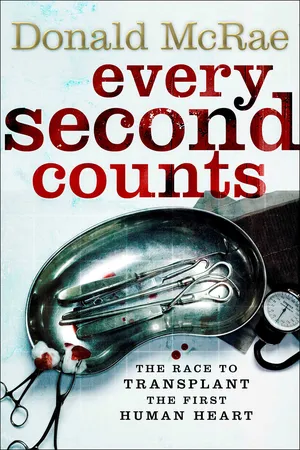
The dramatic race to transplant the first human heart spanned two years, three continents and five cities against a backdrop of searing tension, scientific brilliance, ethical controversy, racial strife and emotional turmoil. It culminated in a terrifying moment in the early hours of 3 December 1967 when, in a cramped operating theatre in a Cape Town hospital, Professor Chris Barnard stared into an empty cavity from which he had just removed a heart. He knew that he had only minutes left to make history and save the life of a 55-year-old man by filling the gaping hole in his chest with a heart which had just been beating inside a 25-year-old woman.

Every Second Countsis the story of this gripping race to conquer the greatest of medical challenges. It also reveals the truth about the man at the centre of it all, whose turbulent life story was just as gripping. The kind of true story that would be dismissed as far-fetched if presented as fiction, it combines an utterly compelling portrait of cutting-edge science with raw human drama, and shows how the course of medicine itself was changed for ever.
Frequently asked questions

Yes, you can cancel anytime from the Subscription tab in your account settings on the Perlego website. Your subscription will stay active until the end of your current billing period. Learn how to cancel your subscription.
No, books cannot be downloaded as external files, such as PDFs, for use outside of Perlego. However, you can download books within the Perlego app for offline reading on mobile or tablet. Learn more here.
Perlego offers two plans: Essential and Complete
  • Essential is ideal for learners and professionals who enjoy exploring a wide range of subjects. Access the Essential Library with 800,000+ trusted titles and best-sellers across business, personal growth, and the humanities. Includes unlimited reading time and Standard Read Aloud voice.
  • Complete: Perfect for advanced learners and researchers needing full, unrestricted access. Unlock 1.4M+ books across hundreds of subjects, including academic and specialized titles. The Complete Plan also includes advanced features like Premium Read Aloud and Research Assistant.
Both plans are available with monthly, semester, or annual billing cycles.
We are an online textbook subscription service, where you can get access to an entire online library for less than the price of a single book per month. With over 1 million books across 1000+ topics, we’ve got you covered! Learn more here.
Look out for the read-aloud symbol on your next book to see if you can listen to it. The read-aloud tool reads text aloud for you, highlighting the text as it is being read. You can pause it, speed it up and slow it down. Learn more here.
Yes! You can use the Perlego app on both iOS or Android devices to read anytime, anywhere — even offline. Perfect for commutes or when you’re on the go.
Please note we cannot support devices running on iOS 13 and Android 7 or earlier. Learn more about using the app.
Yes, you can access Every Second Counts by Donald McRae in PDF and/or ePUB format, as well as other popular books in History & World History. We have over one million books available in our catalogue for you to explore.

Information

Year
2013
Print ISBN
9781471135347
eBook ISBN
9781471134739
Topic
History
Index
History

One ON THE BRINK

Cape Town, South Africa, November 21, 1967

Chris Barnard’s old suit was black and frayed. It matched his mood as he rifled furiously through his pockets in search of a cigarette. He knew it was hopeless. He hadn’t bought a pack in weeks. The surgeon usually stole a smoke at work from a sultry nurse he liked, or from one of the boys who sliced open his dogs in the dark and stinking Animal House. Alone in his wife’s little red Toyota, Barnard was stuck at a set of broken-down lights on Main Road. The Tuesday-evening traffic was as thick as the frustration that overwhelmed him.
It had been a long and terrible day. His arthritic hands were raw and swollen as they gripped the steering wheel. Barnard’s knuckles had turned red, as if in raging protest at the endless waiting. It seemed as if he did nothing but wait—whether for the light to change or for a human heart he might transplant into the chest of his dying patient. It sometimes felt as if he had even less time to make history than poor Louis Washkansky, a bloated and breathless wreck of a man, had days to live. The race closed in on them, tormenting Barnard with the thought that they might both be beaten before the month was out.
Black and colored workers ghosted past, heading for the crammed buses and trains that would rattle and clatter away from the city to the barren townships of Langa and Gugulutu, Athlone and Mannenberg. Cape Town was still “white by night.” Only domestic servants were exempt from the racial curfew. They were allowed to stay in rooms at the bottom of suburban gardens so that they could clear tables and wash dishes before they rose early the next morning to polish shoes and prepare breakfast for their white masters and madams.
Barnard did not rail against apartheid. He just said that whenever he pulled on his surgical mask and the lights shone down on the table, it was the same old story. The color of skin, once he started cutting, was of no consequence. On the inside he always faced a field of red.
If he had been cruising along in a swanky American convertible, drifting through Sea Point and then past the golden beaches of Clifton and Camps Bay before climbing smoothly up Chapman’s Peak, where the blue mountains and the glittering ocean stretched out majestically in front of him, perhaps he might have been able to dream of worldwide fame and medical immortality. Instead, on grimy old Main Road, he was just another middle-aged white commuter jammed to a standstill in a small and tinny car—a popular 1962 model called the Toyopet Crown.
The gaunt surgeon had to fold his six-foot-two-inch frame into the cramped front seat. His short black hair, slicked down with a morning dash of Brylcreem, sometimes left an oily stain on the low interior of the upholstered roof of the car. He was a good-looking man, even if his ears stuck out too much like jug handles for the comfort of his own vanity, but Barnard sometimes wondered if driving his wife’s car made him look like a bank clerk. Who would guess, either by looking at his clothes or car, that he was the country’s premier cardiac surgeon—a man accustomed to flipping open hearts? No one else trapped on Main Road that evening would have glanced over at him and imagined that he barely flinched when he encountered something as terrible as the tangled cluster of cardiac abnormalities known as a tetralogy of Fallot—the congenital heart defect that would have otherwise killed those hundreds of blue and tiny babies he had saved on the operating table.
Louwtjie, his wife, enjoyed the anonymity of driving the unremarkable little Toyota. Yet Christiaan Barnard had never been interested in obscurity. Two weeks earlier he had turned forty-five—the same age as the unquestioned frontrunner in this race. Norman Shumway, based at Stanford University, in California, was already celebrated as a great American surgeon and a master of transplant research. Now, more than ever, Barnard craved recognition for his own brilliance. He knew this might be his last chance.
Washkansky’s health had continued to deteriorate as speculation surrounding the world’s first heart transplant intensified. Although Barnard had tried to keep his plans for the operation secret, that morning the Cape Times, quoting “a hospital source,” revealed that surgeons were “on standby to perform a human heart transplant.” The brief report suggested that the surgical team would “probably be led by Professor Chris Barnard.”
It had been another day of grinding emptiness in which they seemed as far from finding a donor for Washkansky as they had ever been. Flicking on the car radio just after six, Barnard realized hazily that he had switched on the national evening news. The first few words slipped from the car’s speakers in a senseless blur—but the final phase jumped out as if intent on wounding him: “…a heart transplant at Stanford Medical Center.”
The words hit him with shocking force. His hand reached out instinctively to crank up the volume, but the robotic newscaster had already moved on to another story, something about the high morale of the South African Defense Force. Barnard stared in anguish at the radio, as if he might force a miraculous replay of the report he had just missed. It was, of course, useless. And Barnard was suddenly sure of it. It was over. He had lost the race.
Shumway had done it. Jesus! Shumway won.
He had not even needed to hear Shumway’s name. Stanford meant Shumway—the same coolly acerbic and grinning surgeon Barnard remembered from ten years earlier. In 1957 and the first six months of 1958 they had worked together under Owen Wangensteen and Walt Lillehei at the University of Minnesota. Barnard knew that Shumway had little regard for him. He didn’t care, because he, sure as hell, had never cared much for Shumway.
Barnard’s quest to become the first surgeon to transplant a human heart was driven in part by his desire for a measure of revenge. He wanted to prove that he was more than just some dumb Afrikaner from a despised country. He thought he was just as smart as Shumway. He was just as dedicated and just as inspired. He didn’t know then how much the rest of the world might care about the winner of the race. His ambition was far more narrow in its focus. He thought of all those who had mocked or sneered at him in the past. Barnard pictured the surprise, perhaps the awe, in their faces when one day they might hear that he had made history.
His dream now lay in ruins. If Shumway had made the SABC (South African Broadcasting Corporation) news, that surely meant he had successfully transplanted a human heart. Barnard yearned for a twine of hope to which he might cling—but the sound of hooting and shouting made him look up instead. A cop in a brown uniform and white gloves gestured impatiently at him. Standing tall and grand on a wooden box, from which he directed the passing cars like an imperious conductor, he stared witheringly down at Barnard.
“Hey!” the traffic cop yelled above the noise of snarling traffic. “Are you blerrie [bloody] stupid?”
The surgeon drove home in a daze. When he got back after a typical day Barnard usually burst through the front door of The Moorings, the house he’d bought on the water’s edge at Zeekooivlei (an Afrikaans name meaning Hippopotamus Lake), in an ordinary suburb on the edge of Cape Town. He would kick off his shoes and socks and head for the bedroom, leaving a trail of clothes for his wife to pick up while he soaked in a hot bath. Barnard would then dry himself, flop down on the bed and cover his face with a pillow while he recovered from the day.
But this evening was different. By the time he reached home he was deeply agitated—especially when Louwtjie shrugged and replied that she had not listened to the news and so could not tell him whether Shumway had already done a transplant. The weariness in her voice suggested she cared little either way. She was more interested in the unlikely dream of her husband getting home at a decent hour than in his pursuit of medical stardom.
An irate Barnard brushed past her and reached for the phone. He called Groote Schuur Hospital where he was finally put through to François Hitchcock, a young registrar who had been among those assisting him in transplanting the first kidney on the African continent in early October. Hitchcock had since been given a place on the cardiac team. He quietly explained to Barnard that he had been working and had not had time to listen to his radio. He had no idea what Shumway might have done.
“You’d better go out and find a donor now!” Barnard snapped.
He slammed down the phone and scrambled for the telephone number of the state-run SABC. He was still convinced the race was over. Barnard felt it in his bones and aching hands. His rheumatoid arthritis had been diagnosed in the bitter Minnesota winter of 1956. He knew that it was an incurable disease. While a student doctor in Cape Town, his first patient had been an old woman crippled so badly by the illness that she could no longer wash or feed herself. When he was told that he suffered from the same ailment, his future threatened to collapse around him. How could he cut and heal when his own hands were so damaged?
It took him almost twenty minutes to locate the relevant editor on the news desk who could confirm that they had run the Stanford story. Barnard gripped the phone as tightly as his hands allowed.
And then, slowly, he let a long breath slide from him. The SABC, picking up on an American wire report, had merely reported Shumway’s readiness to carry out a transplant. He had not, as yet, fulfilled his ambition. Shumway was frighteningly close. Yet, as long as they lacked a donor at Stanford, Barnard still had a chance. Relief swept through him.

Groote Schuur Hospital, Cape Town, South Africa, December 2, 1967

Eleven days later, on a sweltering Saturday afternoon, the hospital seemed desolate. Before his round of the wards, including A1, where Washkansky lay dying, not one nurse or resident seemed to share Barnard’s craving for a cigarette. They all claimed to be nonsmokers. The surgeon was incredulous.
“What kind of people are you?” Barnard yelled.
The race again seemed to be slipping away from him. His American rivals—Shumway, Lower, and Kantrowitz—had already amassed a vast bank of transplant research that mocked his own limited experience. He knew that each surgeon in that esteemed trio was now preparing separately for the first clinical trial. Shumway led a crack team at Stanford, while Lower, his former research partner, headed his own unit at the Medical College of Virginia in Richmond, where the great kidney transplant pioneer, David Hume, was desperate that they should be the first to claim the heart. At Maimonides Hospital in Brooklyn, Kantrowitz had at his command a $3 million grant and thirty-five international researchers and surgeons.
Barnard relied instead upon his younger brother, Marius, who was just making his way in cardiac surgery, and their lab’s untrained “nonwhite” staff. Chris and Marius argued bitterly and frequently—but they were bound together by love for their father, Adam, a Calvinist minister who had suffered in the harsh desertlike region of the Karoo. Adam Barnard and his family had been reviled by the local Afrikaans community in the small town of Beaufort West because he preached in a colored church. Chris and Marius’s sense of isolation and insecurity had been forged amid such hostility.
They had still not endured the same hardship as the men they worked alongside at the Animal House. Victor Pick was a colored man from the barren Cape Flats. Hamilton Naki, like the imprisoned Nelson Mandela, was a Xhosa. Apartheid dictated that they could never officially claim to be anything more than a laboratory attendant and a former gardener turned cleaner. But Victor ran the lab and opened and closed the dogs, removing and transplanting kidneys and hearts alongside Marius. And Hamilton proved himself a competent anesthetist and an even better experimental surgeon. Chris taught them well, but they had both exhibited an instinctive aptitude for the work.
By mid-November 1967, the unlikely Cape Town team had transplanted forty-eight hearts in dogs—250 less than Shumway and 210 less than Kantrowitz in New York. Unlike the Americans, who could restore their transplant-dogs to full health for a year and more, the South Africans’ longest survivor died after ten days. Yet Barnard insisted that “in over ninety percent of [our] experiments the new heart had begun to beat regularly. It was a technique built on that developed by Shumway and Lower, who had experimented on more than 300 dogs. The body of their work was formidable—especially in their studies of rejection. With their findings joined to ours, there was little sense in continuing the further sacrifice of animals.”
Barnard had, in his own words, “plagued [his chief cardiologist] Val Schrire day and night” for permission to transplant a human heart. Finally, despite also suffering from kidney and liver failure, Louis Washkansky was put forward by Schrire as a possible recipient. For once, the meticulous cardiologist set aside the empirical evidence and spoke of Washkansky as a fighter—a fifty-three-year-old former boxer who refused to give up until he was “knocked out for good.”
While Washkansky believed utterly in the transplant, his wife, Ann, worried that he regarded the Afrikaans surgeon as an improbable Godlike figure. In Yiddish he called Barnard “the man with the golden hands.” Ann Washkansky thought, rather, that Barnard looked like a young Gregory Peck. That would have been great if she had been standing in line for a Saturday-night movie. But this was a man who wanted to remove her husband’s heart from his chest. She shuddered at his audacity. Louis, however, was emphatic. “Stop worrying, kid,” he always said. “Everything’s going to be just fine.”
On that quiet Saturday, however, it suddenly seemed to Washkansky that nobody cared. He looked angry and miserable when Barnard approached his bedside. The two doctors on the transplant team who monitored his condition most closely, M. C. Botha and “Bossie” Bosman, had visited Washkansky earlier that morning. They had promised him cheerfully that that they would see him again on Monday.
Washkansky said softly that they had gone fishing—there was no need for him to add the words “while I’m dying…”
Barnard tried to reassure him, reminding Washkansky that the entire team was on constant alert. They could be ready for surgery within an hour of a donor being found.
“I’m getting the hell out of here,” Washkansky wheezed.
He was too ill to move. Washkansky started coughing and, as usual, brought up blood. His hands were trembling as he pressed a peach-colored tissue to his mouth. He spat and the tissue turned red.
Barnard knew that Washkansky’s heart had been reduced to a third of its normal pumping capacity. The second of two massive heart attacks had destroyed most of his left ventricle. After studying the initial angiogram of Washkansky’s heart, Barnard had told Schrire that surgery would be pointless. Nothing could save such a heart. And there was serious doubt, now, that the big man would survive long enough for them to even attempt a transplant.
Washkansky, stretched out like a corpse on his bed, asked Barnard if he thought they would soon find a donor.
“Maybe,” the doctor murmured. “I hope so… yes.”
“It was one of those lies you tell,” Barnard wrote later, “to keep courage and hope both for yourself and the patient. I had no way of knowing when we might get a heart for him—if ever.”
The tension was almost unbearable. By two-thirty that afternoon the man with the golden hands could stand it no longer. He decided to drive home. Another day had disappeared. Barnard could only hope for tomorrow—and pray hard that night for a heart.

Stanford Medical Center, Palo Alto, California, December 2, 1967

That same day, in the early hours of a cold California morning, death closed in on another small white room. Norman Shumway’s thirty-five-year-old patient, a potentially ideal candidate for a heart transplant, slid away slowly. He had developed terminal heart disease after a long period of radiation for Hodgkin’s disease. Shumway and his young chief resident, the cool and erudite Ed Stinson, were convinced that a transplant could save him. An extensive course of radiation had probably caused his chronic heart failure, but at the same time they believed that his diminished immune system would be too weak to reject a new heart. They just needed a donor.
Shumway stood on the brink—but he would not wish death on anyone. He could not part the blinds, slatted against the gray dawn, in the hope that he might see an ambulance screaming around the bend along Welch Road carrying a potential donor strapped to a stretcher. Shumway was not ghoulish. He was calm rather than frantic. But he was still a man who could not keep a lid on his ambition forever. Shumway needed a heart to save his patient, and to fulfill the destiny he had been inching toward for nine long years. He needed a heart that was still beating and just waiting to be taken. Shumway, having left nothing to chance for so long, needed a slice of random luck to break the heavy spell of waiting.
He might have found a donor more readily if he was still up on the fifth floor of the old Stanford-Lane Hospital in San Francisco, where he and Lower, his close friend, had first transplanted dog hearts in 1958. There were many more downtown trauma victims there than on the sleeker streets of Palo Alto. Shumway knew nothing of Barnard’s plans, but as the days grew shorter, he felt a growing urgency.
He tried to amuse his team with shards of black humor. It did not even take the distant howl of an ambulance to prompt another wisecrack. Onc...

Table of contents

  1. Cover
  2. Dedication
  3. Epigraph
  4. Prologue: Into the Void…
  5. Chapter One: On the Brink
  6. Chapter Two: Out of the Cold
  7. Chapter Three: Colored Hearts
  8. Chapter Four: Sparky’s Gang
  9. Chapter Five: Heads and Hearts
  10. Chapter Six: Changing Tack
  11. Chapter Seven: Mississippi Gambling
  12. Chapter Eight: The Prince
  13. Chapter Nine: The Steal
  14. Chapter Ten: The Wait
  15. Chapter Eleven: Fame and Heartbreak
  16. Chapter Twelve: The Man with the Golden Hands
  17. Chapter Thirteen: Death and America
  18. Chapter Fourteen: The Trial
  19. Epilogue: Acceptance
  20. Notes and Sources
  21. Acknowledgments
  22. About the Author
  23. Index
  24. Copyright